Create, analyze, optimize your ETF portfolio. Start now →



Are Biotechnology ETFs In the Midst of a Comeback?
Biotech stocks are under pressure in 2025, but these ETFs may offer turnaround potential.


Keep up with what matters in ETFs
Get timely ETF insights, market trends, and top ideas straight to your inbox.
Your newsletter subscriptions with us are subject to ETF Central's Privacy Policy and Terms and Conditions.
The healthcare sector has had a rough run in 2025, and part of the pain has come from the insurance giants. UnitedHealth, Cigna, and Elevance have all struggled this year with rising medical costs, unpredictable claims, and a tougher regulatory environment. These issues have bled into investor sentiment and helped drag the sector down.
Biotech stocks are also feeling the pressure. Big names like Vertex Pharmaceuticals and Regeneron have slipped after underwhelming earnings and cautious guidance. Another example came on August 19 when Viking Therapeutics, a company developing an oral GLP-1 drug, saw its share price plunge 43%. The drug showed effectiveness for weight loss, but high rates of nausea, vomiting, and early dropouts during Phase 2 trials spooked the market.
At the same time, the S&P 500 is trading near all-time highs, with a growing chunk of its gains driven by a small group of mega-cap tech stocks. Investors looking to diversify or find underpriced segments may want to revisit biotech. To get a clearer picture, we’ll look at how two popular biotech ETFs—iShares Biotechnology ETF
Like what you're reading?
Stay in the loop — get the latest ETF insights: trends, analysis, and expert picks.
Biotech ETFs: simple moving averages
The following chart compares IBB and XBI using their respective price levels, 50-day simple moving averages (SMA), and 200-day SMAs. These moving averages are common technical indicators used to assess the direction of a trend. The 50-day SMA reflects the medium-term trend, while the 200-day SMA captures the longer-term picture.
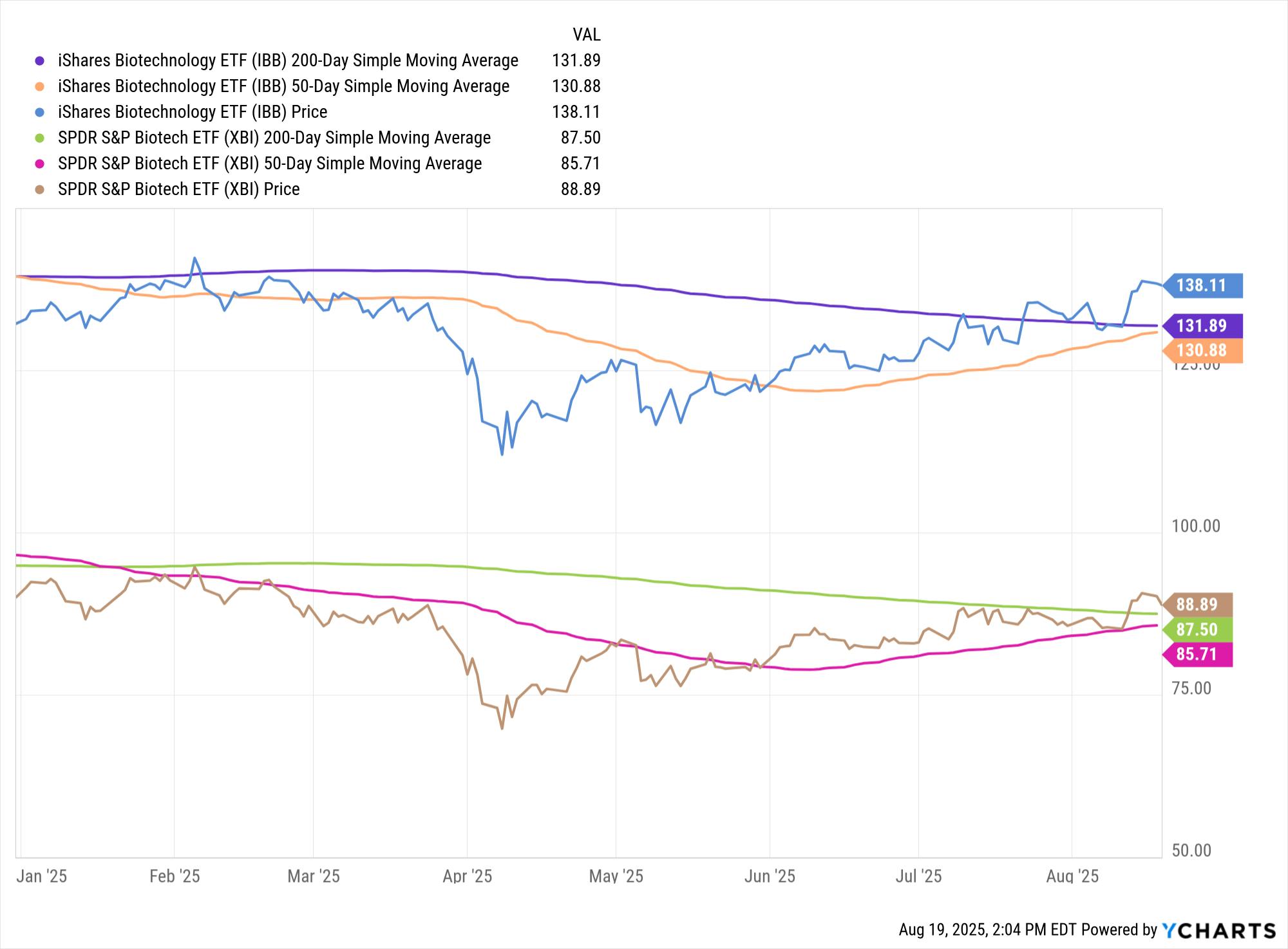
For IBB, the story looks relatively strong. As of August 19, it’s trading at $138.11, well above both its 50-day SMA ($130.88) and 200-day SMA ($131.89). More importantly, the 50-day recently crossed above the 200-day, a technical pattern known as a golden cross, which is typically viewed as a bullish signal. That tells us the medium-term trend has caught up with and overtaken the long-term trend, and often confirms a shift into an uptrend.
XBI, on the other hand, is showing some recovery but hasn’t confirmed the same trend reversal. It’s currently trading at $88.89, just slightly above both its 50-day ($85.71) and 200-day ($87.50) SMAs. Unlike IBB, the 50-day is still below the 200-day, so no golden cross yet. The narrowing gap between the two does suggest momentum is improving, but the trend remains unconfirmed.
For me, this technical setup suggests that larger-cap, commercialized biotech names, which dominate IBB due to its market-cap weighting, are leading the rebound. Smaller and mid-cap clinical-stage biotechs, which make up a greater share of XBI’s equal-weight strategy, continue to lag.
Biotech ETFs: relative strength index (RSI)
RSI is a momentum oscillator that measures the speed and magnitude of recent price changes to evaluate overbought or oversold conditions. It’s expressed as a value between 0 and 100.
Traditionally, an RSI above 70 signals that an asset might be overbought and due for a pullback, while an RSI below 30 suggests the asset may be oversold and potentially primed for a rebound.
The formula for RSI is RSI = 100 – [100 / (1 + RS)], where RS is the average gain during up periods divided by the average loss during down periods, typically measured over a 14-day window.
Looking at this next chart, both IBB and XBI show RSI values currently above 64, which implies moderately strong bullish momentum. Neither has crossed above 70 yet, so technically, neither ETF is in overbought territory. But they’re close.
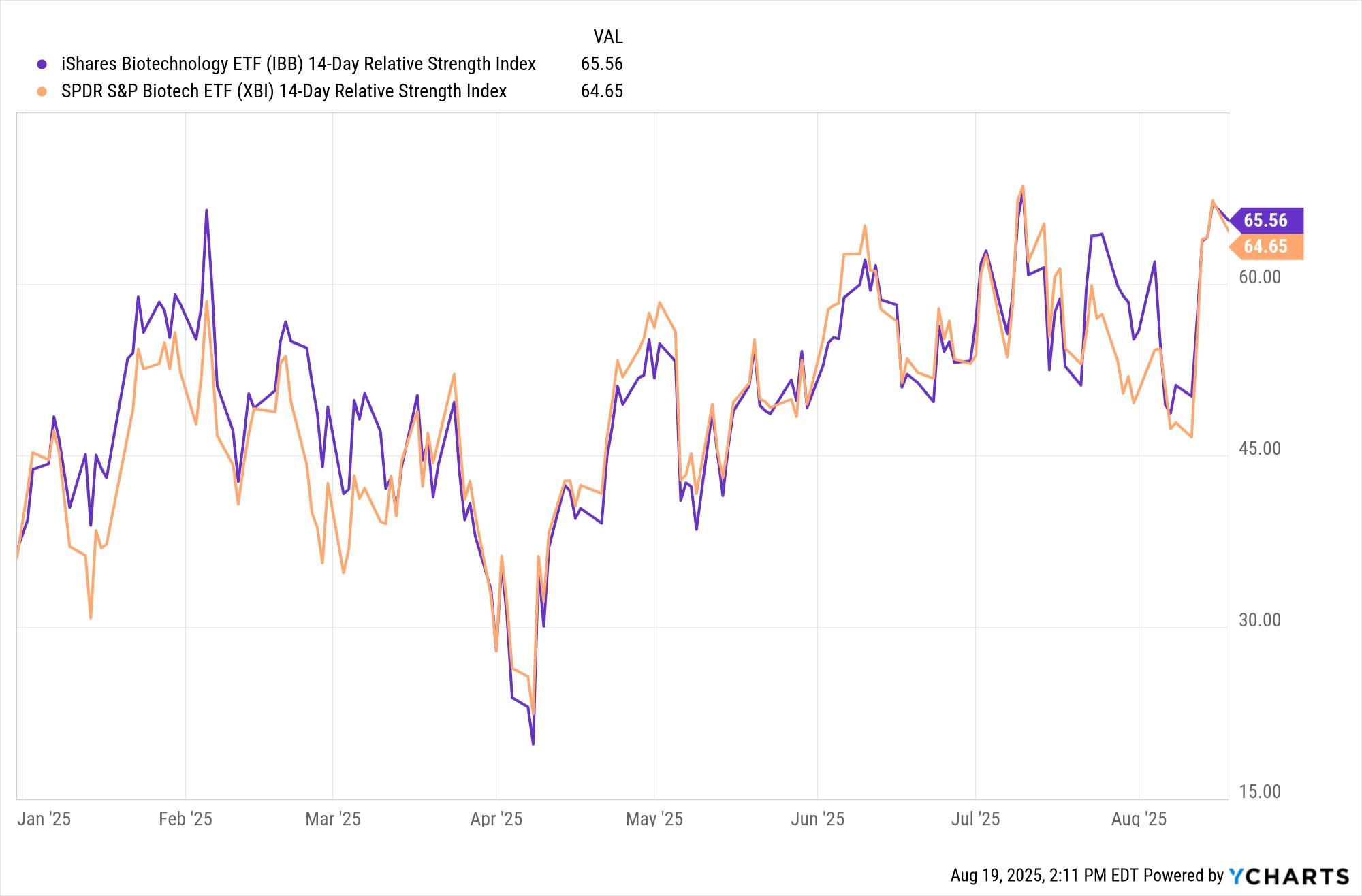
Throughout 2025, both ETFs showed periods of weak momentum (March and April stand out), with RSI levels dipping close to or below 30. Since then, the RSI trend for both has been steadily climbing, and recent price moves have pushed RSI near the higher end of the neutral range.
Given how close both ETFs are to the overbought threshold, much of the easy money may already be in. This doesn’t necessarily mean a pullback is imminent, but it does mean any fresh entries at this point may face short-term resistance.
Please note that this article reflects the author’s personal views and does not represent the opinions of the publication or its affiliates. It is for informational purposes only and does not constitute investment advice. It is essential to seek guidance from a registered financial professional before making any investment decisions.
Topics
See all
Segments
See all
Mentioned ETFs
Latest ETF News
See all ETF newsCould Water ETFs Be the Next AI Bottleneck Trade?

What is a Boomer Candy ETF?

ETF Comparison: NEOS Nasdaq-100 High Income ETF (QQQI) Versus Goldman Sachs Nasdaq-100 Premium Income ETF (GPIQ)





 Advantages of ETFs over Mutual Funds1/6
Lower Costs
In this guide, we'll explore the advantages of ETFs over mutual funds, giving you valuable insights into why ETFs have gained significant popularity among investors like yourself.
Leveraged ETFs: Unlocking the Potential for Amplified Returns1/6
Understanding Leveraged ETFs
Explore leveraged ETFs: potential for amplified returns & risks. 5 ETFs to consider across equities, commodities & fixed income.
What is a Leveraged ETF?1/6
Introducing Leveraged and Inverse ETFs
In this guide, we'll dive into the world of leveraged ETFs, exploring their definition, mechanics, potential risks, and rewards.
Recent educational content

ETF Trends
ETF Industry KPIs September 8, 2026
This week’s KPI data overview highlights key metrics and trends shaping the ETF landscape.

ETF Trends
ETF Industry KPIs August 31, 2026
This week’s KPI data overview highlights key metrics and trends shaping the ETF landscape.
ETF Trends
ETF Industry KPIs August 24, 2026
This week’s KPI data overview highlights key metrics and trends shaping the ETF landscape.
What’sTheFund
What's the Fund | Ocean Park Diversified Income ETF (DUKZ)
James St Aubin, Chief Investment Officer at Ocean Park Asset Management, discuss the DUKZ ETF, exposing investors to the whole spectrum of asset classes in the fixed income markets, through their rules-based process.

Browse all educational columns



Expert-Built ETF Portfolios, All in One Place
Don’t start from scratch. Discover ready-made ETF portfolios built by professionals to match different goals, timelines, and market views. Use them as inspiration or as a starting point for your own allocation.