From idea to ETF portfolio in minutes. Build yours now →



Agricultural Commodity Futures ETFs vs Agricultural Equities ETFs
Both options can provide investors with exposure to the agriculture sector but with distinct trade-offs.


Keep up with what matters in ETFs
Get timely ETF insights, market trends, and top ideas straight to your inbox.
Your newsletter subscriptions with us are subject to ETF Central's Privacy Policy and Terms and Conditions.
Investing in the agriculture sector can be a strategic choice for those looking to diversify their portfolio and potentially hedge against inflation. Why?
Well, one of the key components of the Consumer Price Index (CPI) basket is food, a fundamental commodity that directly reflects the health and trends of the agricultural industry.
By going deeper into the food supply chain, we encounter the base agricultural commodities such as wheat, soybeans, dairy, and corn, as well as the companies that specialize in their production and distribution. These elements form the backbone of the agricultural sector, influencing both market dynamics and consumer prices.
For investors considering an emphasis on this industry within their portfolio, it's crucial to understand that while this can offer a degree of inflation protection, the level of effectiveness heavily depends on how the investment is executed.
In this context, the choice between investing in agricultural commodity futures ETFs versus agricultural equities ETFs is particularly significant. Both options provide exposure to the agriculture sector but in fundamentally different ways, each with its unique trade-offs and implications for inflation protection.
Like what you're reading?
Stay in the loop — get the latest ETF insights: trends, analysis, and expert picks.
Investing in Agricultural Commodities
Agricultural commodities encompass a range of essential goods used in daily life, including staples like corn, sugar, soybeans, and wheat. These commodities are fundamental to global food supply chains and, as such, are significant components of the commodities market.
For most investors, direct physical ownership of these commodities is impractical due to storage, decay, and other logistical issues. Therefore, exposure to agricultural commodities in investment portfolios is typically achieved through futures contracts.
Futures contracts are agreements to buy or sell a specific quantity of a commodity at a predetermined price on a specified future date. These derivatives enable investors to gain exposure to commodities without the need to physically hold them.
However, it's important to note that futures prices do not always align perfectly with the current, or spot, prices of commodities. This discrepancy arises due to various factors, including storage costs, time value, market expectations, and contango/backwardation.
Agricultural commodity futures, especially front-month futures (those closest to their delivery date), are particularly sensitive to inflation. This sensitivity is partly due to speculation by traders who anticipate how various factors, including inflation, supply and demand dynamics, weather conditions, and geopolitical events, will impact commodity prices.
During inflationary periods, commodities are often seen as a hedge, as their prices tend to rise with increasing inflation, driven by higher costs of production and transportation. Consequently, this speculative activity can lead to more pronounced price movements in commodity futures, making them a potentially effective but volatile inflation hedge.
Investing in Agricultural Equities
For investors seeking a more long-term, buy-and-hold approach to the broader agricultural sector, purchasing stocks of companies involved in the production, refinement, and sale of agricultural commodities is a viable option.
Publicly traded agricultural companies, such as Archer Daniels Midland and Nutrien, provide an opportunity to invest in the industry without the direct exposure to commodity price fluctuations that futures contracts entail.
However, while agricultural equities have some correlation to inflation, the relationship is not as direct as with commodity futures. This approach places investors one step removed from the direct impact of commodity price movements.
Unlike commodity futures, where the investment thesis often hinges on the anticipation of rising commodity prices, investing in agricultural equities involves a bet on the companies' ability to remain profitable and grow.
The stock prices of agricultural companies are influenced not only by the underlying commodity prices but also by broader market risks common to equities. These risks include fluctuations in the stock market, changes in investor sentiment, and varying economic conditions.
Additionally, the financial performance of these companies – their earnings, revenue growth, operational efficiency, and management decisions – plays a crucial role in determining their stock prices.
Which is Better for Inflation Hedging?
Comparing the performance of the VanEck Agribusiness ETF (MOO) to the Teucrium Agricultural Fund (TAGS) provides a clear picture of this dynamic at play historically.
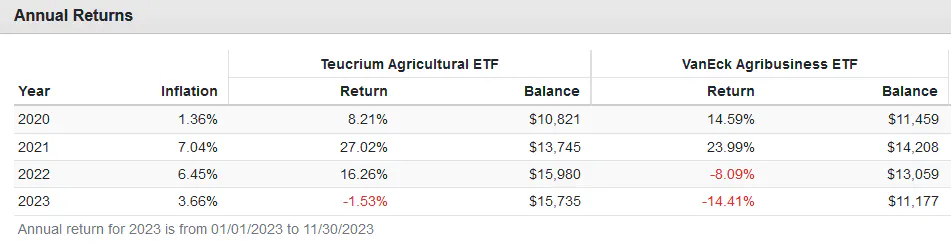
During the high inflation environment of 2021 and 2022, TAGS recorded consecutive years of double-digit returns. Its portfolio of corn, wheat, soybeans, and sugar futures recorded a low correlation with equities and bonds alike, giving them great short-term diversification potential.
In contrast, MOO did not experience the same upside in 2022, as its companies faced headwinds from higher interest rates and bearish investor sentiment. Its holdings faced the same market risk as most equities did during the 2022 downturn, and subsequently underperformed.
Please note this article is for information purposes only and does not in any way constitute investment advice. It is essential that you seek advice from a registered financial professional prior to making any investment decision.


Latest ETF News
See all ETF newsWhy IUSB Is Overtaking AGG as the Default Bond ETF for Investors


Beyond TLT: Treasury ETFs For the Long Duration Trade

MoneyShow Chart of the Day 9/30/26: Are Hyperscalers the New "Sovereigns?"





 Advantages of ETFs over Mutual Funds1/6
Lower Costs
In this guide, we'll explore the advantages of ETFs over mutual funds, giving you valuable insights into why ETFs have gained significant popularity among investors like yourself.
Leveraged ETFs: Unlocking the Potential for Amplified Returns1/6
Understanding Leveraged ETFs
Explore leveraged ETFs: potential for amplified returns & risks. 5 ETFs to consider across equities, commodities & fixed income.
What is a Leveraged ETF?1/6
Introducing Leveraged and Inverse ETFs
In this guide, we'll dive into the world of leveraged ETFs, exploring their definition, mechanics, potential risks, and rewards.
Recent educational content

First Look ETF
First Look ETF: Income, International, and Cash Flow ETFs
In this season 6 episode of First Look ETF, Stephanie Stanton @etfguide examines the latest ETF marketplace trends with NYSE and guests.


ETF Trends
ETF Industry KPIs October 5, 2026
This week’s KPI data overview highlights key metrics and trends shaping the ETF landscape.

ETF Trends
ETF Industry KPIs September 28, 2026
This week’s KPI data overview highlights key metrics and trends shaping the ETF landscape.
ETF Trends
ETF Industry KPIs September 22, 2026
This week’s KPI data overview highlights key metrics and trends shaping the ETF landscape.