Open Now: The Global ETF Survey Take the Survey →



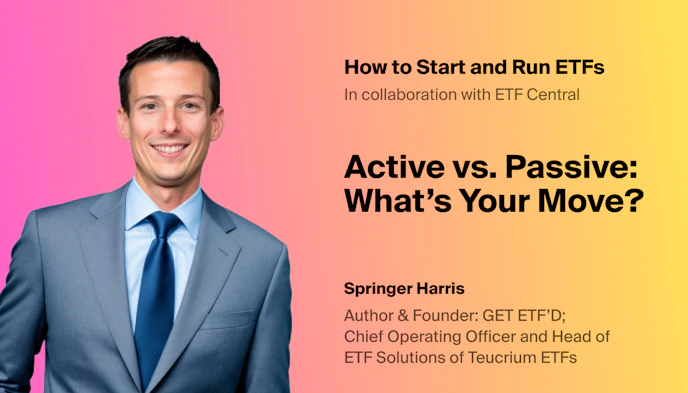
Active vs. Passive: What's Your Move?
In the latest installment of "How to Start and Run ETFs," Springer Harris delves into the intricate world of ETF structures, focusing on the pivotal decision between active and passive management styles for your ETF

Keep up with what matters in ETFs
Get timely ETF insights, market trends, and top ideas straight to your inbox.
Your newsletter subscriptions with us are subject to ETF Central's Privacy Policy and Terms and Conditions.
ETF Structuring Essentials
Identifying your niche is just the beginning of launching an ETF. The real challenge lies in structuring your ETF to ensure it meets legal frameworks and operational guidelines while aligning with your strategic vision. As an ETF consultant, I’ve observed many entrepreneurs with brilliant ideas struggle to adapt them to the ETF model's constraints. Despite its flexibility, the ETF structure isn't one-size-fits-all. Choosing between passive or active management is one of the first steps in that process.
Like what you're reading?
Stay in the loop — get the latest ETF insights: trends, analysis, and expert picks.
The Passive ETF Model
Passive ETFs are managed to track as closely as possible the performance of a specific index by replicating its composition and weightings. This approach ensures that the ETF's performance aligns closely with the index it emulates. However, the distinction between passive and active management isn't always clear-cut. Some index funds, although designed to replicate an index, might track a fairly dynamic portfolio, which changes daily. This blurs the traditional lines between passive and active management.
Advantages of Passive ETFs:
- Lower Costs: Passive ETFs typically have lower expense ratios than active ETFs.
- Predictable Structure: Since they follow an index, investors can anticipate performance based on the index.
Drawbacks of Passive ETFs:
- Dependence on Index Providers: Managing a passive ETF often involves paying fees to index providers. These costs can add up over time and impact overall fund expenses.
- Lack of Control Over Index Providers: ETF issuers rely on index providers to calculate and maintain the index. If these providers change their strategies or stop calculating the index, it can jeopardize the ETF’s performance and continuity.
The Active ETF Model
In contrast, active ETFs are managed by professionals who actively select investments with the goal of outperforming a performance benchmark index. These funds may use various strategies such as growth, value, or sector-specific approaches based on in-depth market analysis and economic indicators.
Some active ETFs have limited decision-making management decisions, sometimes restricted to a few variables as detailed in their registration statements. This again shows how the lines between active and passive are blurring.
Advantages of Active ETFs:
Potential for Higher Returns: Active management aims to outperform the benchmark.
Flexibility: Active managers can adapt to changing market conditions, potentially mitigating risks and seizing opportunities.
Proprietary Strategies: Active managers can keep their strategies confidential, maintaining a competitive edge.
Drawbacks of Active Management:
Higher Fees: Active ETFs typically have higher expense ratios.
Performance Risk: Success depends heavily on manager skill, with no guarantee of outperforming the index.
Self-Indexing: A Hybrid Approach
An emerging strategy in ETF structuring is self-indexing. This involves creating an index based on your strategy to generate historical performance data. This can enhance your ETF's marketability at launch. In some cases, this index might attract other issuers interested in acquiring the intellectual property and managing the ETF operations.
Self-indexing blurs the lines even more between active and passive management, combining elements of both. It offers the perceived transparency and stability of passive management with the flexibility and potential for higher returns associated with active management.
Marketing and Structuring of ETFs
When structuring your ETF, the choice between active and passive management styles extends beyond operational and compliance factors—it significantly influences your marketing strategy. Positioning your ETF as actively or passively managed affects how you appeal to potential investors and how your product is perceived in the market.
Active ETFs typically attract investors looking for potential outperformance and willing to pay higher fees for superior returns. However, active ETFs often need a track record over several years to attract substantial interest. For managers transitioning from traditional mutual funds to ETFs, there might be opportunities to port over performance history, although this is limited.
Passive ETFs usually have lower fees, appealing to cost-conscious investors. Some investment platforms may have restrictions that favor either passive or active ETFs, influencing your decision on how to structure and market your ETF.
Your ETF: Aligning Strategy with Market Goals
When designing your ETF, the decision between active and passive management styles is critical to defining your product's structure and potential for success. This choice should not only align with your strategic and financial goals but also with how you intend to position your ETF in the market. Consider how you want your ETF to be perceived by the investing public—whether it's the dynamism of active management or the stability of passive investments. This decision will guide your structuring, pricing, and promotional strategies, ensuring your ETF meets both regulatory and operational standards.
By carefully weighing these factors, you can create an ETF that appeals to the specific needs of your target market and stands out in a competitive landscape. Whether investors prefer the approach of active management or the cost-effectiveness and consistency of passive management, your ETF can offer distinct value, capturing your target audience's interest and maximizing its success potential.
As someone who has managed both passive and active ETFs, I've witnessed the evolution of the market from one that was predominantly passive to one that now appreciates the nuanced benefits of active management, reflecting a broader range of investor expectations and market conditions.
About the Author
Springer Harris, author of "GET ETF'D: An Insider's Guide to Starting and Running an ETF," focuses on simplifying the complexities of launching and managing ETFs to empower entrepreneurs. He discusses the detailed processes and challenges of successfully introducing ETFs to the market in his writings. As Chief Operating Officer and Head of ETF Solutions at Teucrium ETFs, Springer has helped a broad spectrum of clients, from individuals to large asset managers, launch their ETFs efficiently. Connect with Springer on LinkedIn for more insights or help starting your ETF.
Please note this article is for information purposes only and does not in any way constitute investment advice. It is essential that you seek advice from a registered financial professional prior to making any investment decision.

Latest ETF News
See all ETF news


Should You Avoid a Small ETF?




Why ETF Spreads Often Mislead Investors


 Advantages of ETFs over Mutual Funds1/6
Lower Costs
In this guide, we'll explore the advantages of ETFs over mutual funds, giving you valuable insights into why ETFs have gained significant popularity among investors like yourself.
Leveraged ETFs: Unlocking the Potential for Amplified Returns1/6
Understanding Leveraged ETFs
Explore leveraged ETFs: potential for amplified returns & risks. 5 ETFs to consider across equities, commodities & fixed income.
What is a Leveraged ETF?1/6
Introducing Leveraged and Inverse ETFs
In this guide, we'll dive into the world of leveraged ETFs, exploring their definition, mechanics, potential risks, and rewards.
Recent educational content

ETF Trends
ETF Industry KPIs June 22, 2026
The ETF Industry saw 40 New Launches and 23 closures last week.

Asset TV
The ETF Show - New Autism-Impact ETF Launched
Defiance ETFs has launched the first ETF, $ASD, focused on the autism ecosystem, investing in companies that provide services, products, and research related to autism and neurodivergence.

ETF Trends
ETF Industry KPIs June 1, 2026
The ETF Industry saw 22 New Launches, 1 Ticker Change and 1 closure last week.
ETF Trends
ETF Industry KPIs May 20, 2026
The ETF Industry saw 44 New Launches, 3 Mutual Fund Conversions and 9 closures last week.
Browse all educational columns



Expert-Built ETF Portfolios, All in One Place
Don’t start from scratch. Discover ready-made ETF portfolios built by professionals to match different goals, timelines, and market views. Use them as inspiration or as a starting point for your own allocation.