Open Now: The Global ETF Survey Take the Survey →



WisdomTree Floating Rate Treasury Fund (USFR) Celebrates 10-Year Anniversary on NYSE ARCA
This highly popular floating-rate Treasury fund now commands over $17 billion in AUM, making it the most popular U.S.-listed ETF in this niche.


Keep up with what matters in ETFs
Get timely ETF insights, market trends, and top ideas straight to your inbox.
Your newsletter subscriptions with us are subject to ETF Central's Privacy Policy and Terms and Conditions.
This year marked another significant milestone in the ETF industry as the WisdomTree Floating Rate Treasury Fund (
Now boasting over $17 billion in assets under management (AUM), USFR has distinguished itself as the preeminent floating-rate Treasury bond ETF in the U.S. market.
Among the 17 options available for investors seeking exposure to this specific niche, USFR stands out not just for its size but also for its popularity, with its AUM nearly tripling that of its closest competitor, the iShares Treasury Floating Rate ETF (
As USFR marks a decade of operation, it continues to attract investors with its unique offering in the floating-rate space, showcasing its sustained appeal and importance within investment portfolios.
Here's an overview of USFR, including what makes it a standout in the floating-rate Treasury sector and how it can be utilized effectively within an investment strategy.
The ETF Industry Is Evolving Fast
From AI infrastructure to active strategies, the ETF landscape is shifting. Share your perspective in the 7th Annual Global ETF Survey and get exclusive early access to the final report.
High credit quality, low interest rate risk
Unlike most bond ETFs, USFR specializes in holding a unique kind of Treasury security known as floating-rate notes, or FRNs.
These securities are designed to adjust their interest rates in line with short-term rates, specifically priced at a spread over 3-month Treasury Bills. Their rate fluctuates based on the outcomes of the weekly 3-month Treasury Bill auctions, making them responsive to changes in the broader interest rate environment.
The significance of USFR's structure became particularly evident following the bond bear market of 2022 when interest rates surged.
With short-term rates now exceeding 5%, USFR is positioned advantageously because its holdings in FRNs mean its payouts increase as short-term rates rise. This contrasts sharply with fixed-rate bond ETFs, which typically suffer losses when rates climb.
For example, in 2022, while traditional bond ETFs like the iShares U.S. Aggregate Bond ETF (
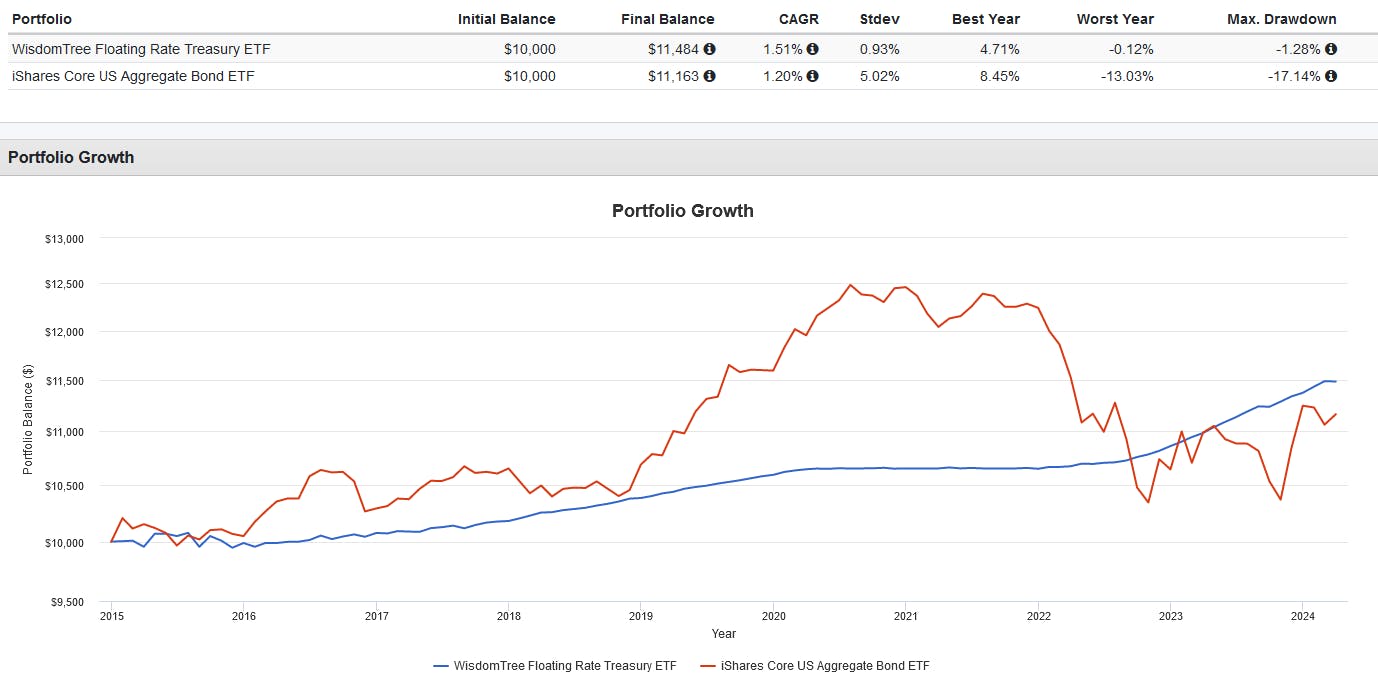
As of April 2, USFR is offering a yield to maturity of 5.49% with an exceptionally low duration of 0.02 years. This essentially means that investors in USFR can enjoy relatively high yields while being exposed to minimal interest rate risk, a balance that is hard to achieve in today's market.
Additionally, USFR provides monthly distributions, allowing investors to receive consistent income at a low expense ratio of 0.15%. For DIY retail investors and advisors alike, this setup offers a more accessible and economical alternative to individually rolling over FRNs.
How USFR fits into a portfolio
I envision multiple ways that USFR can be incorporated into an investment portfolio.
Firstly, USFR can serve as a highly liquid and secure alternative to traditional cash management tools like money market funds, T-bill ETFs, and brokerage cash sweeps.
The securities within USFR are issued by the federal government, ensuring very high credit ratings and minimal risk of default.
Additionally, the ETF aligns closely with prevailing interest rates, adjusting as they change, which makes it an attractive option for investors looking to manage their cash while still earning a competitive yield.
Its high liquidity is evidenced by a very narrow 0.02% 30-day median bid-ask spread, making it easy for investors to enter and exit positions without significant cost.
The second application for USFR is as a substitute for traditional aggregate bond ETFs within the fixed-income portion of a risk-averse investor's portfolio.
Unlike many bond ETFs that include corporate bonds or bonds with intermediate to long durations, USFR focuses exclusively on floating-rate Treasuries.
This approach significantly reduces the ETF's exposure to both credit risk and interest rate fluctuations, making it a solid choice for investors seeking stability in their fixed-income investments.
Finally, USFR stands out as an effective, affordable, and accessible hedge against a scenario where interest rates remain higher for an extended period.
Despite initial expectations at the start of 2024 for four rate cuts later in the year, revised forecasts now anticipate only two cuts due to a cautious Federal Reserve, a hot economy, and an uptick in inflation.
In such an environment, an ETF like USFR provides an inexpensive and convenient means to protect a portfolio against unexpected shifts in monetary policy and their potential impact on the markets.
This article was prepared as part of WisdomTree's general paid sponsorship of ETF Central. This specific content within and any opinions expressed therein belong solely to ETF Central and do not reflect the opinion or analysis of WisdomTree, its employees, or its affiliates. Content published on ETF Central is provided for educational purposes only and should not be considered investment or tax advice. For investment or tax advice, please consult a financial professional.
WisdomTree is an independent company, unaffiliated with ETF Central. WisdomTree has not been involved with the preparation of the content supplied by ETF Central. It does not guarantee, or assume any responsibility for its content.
Latest ETF News
See all ETF newsAvoid S&P 500 Concentration Risk with These Two ETFs

How Investors can Maximize Tax Efficiency with Income ETFs

Trump Accounts: Here's Which ETFs You Can Invest In

The Two Best Types of Fixed-Income ETFs For Managing Cash




 Advantages of ETFs over Mutual Funds1/6
Lower Costs
In this guide, we'll explore the advantages of ETFs over mutual funds, giving you valuable insights into why ETFs have gained significant popularity among investors like yourself.
Leveraged ETFs: Unlocking the Potential for Amplified Returns1/6
Understanding Leveraged ETFs
Explore leveraged ETFs: potential for amplified returns & risks. 5 ETFs to consider across equities, commodities & fixed income.
What is a Leveraged ETF?1/6
Introducing Leveraged and Inverse ETFs
In this guide, we'll dive into the world of leveraged ETFs, exploring their definition, mechanics, potential risks, and rewards.
Recent educational content

ETF Trends
ETF Industry KPIs July 20, 2026
This week’s KPI data overview highlights key metrics and trends shaping the ETF landscape.

ETF Trends
ETF Industry KPIs July 13, 2026
This week’s KPI data overview highlights key metrics and trends shaping the ETF landscape.

First Look ETF
First Look ETF: Cash Deployment, Bond, and Hedged ETFs
In this season 6 episode of First Look ETF, Stephanie Stanton examines the latest ETF marketplace trends with NYSE and guests.

ETF Trends
ETF Industry KPIs July 6, 2026
This week’s KPI data overview highlights key metrics and trends shaping the ETF landscape.
Browse all educational columns



The ETF Industry Is Evolving Fast
From AI infrastructure to active strategies, the ETF landscape is shifting. Share your perspective in the 7th Annual Global ETF Survey and get exclusive early access to the final report.