Global ETF Survey Is Live! 600+ ETF Professionals Weigh In. See Results →



Winners & Losers Of 4Q’25 REIT Earnings Season
In our Earnings Season Recap, we analyze and highlight the incremental positive and negative takeaways for each property sector, noting the best and worst performers during this earnings season.


Keep up with what matters in ETFs
Get timely ETF insights, market trends, and top ideas straight to your inbox.
Your newsletter subscriptions with us are subject to ETF Central's Privacy Policy and Terms and Conditions.
Summary
- REIT earnings results were quite a bit better than consensus expectations- especially in the back-half of earnings season- and avoided the type of high-profile flops that overshadowed recent earnings seasons.
Global ETF Survey 2026 is Live!
With 1,790 new products launched by July 2026, choosing is harder than ever. Our Global ETF Survey 2026, built on 620 professional investors and allocators, shows how active, fixed income, options-based and thematic ETFs are reshaping fund selection.
- Nearly two-thirds of the sector (62%) beat their full-year FFO outlook - above the Q4 historical average of 50-55% - with better underlying property-level trends, aided by disinflationary expense trends.
- Before the Iran-related disruptions, REITs were enjoying a very favorable "goldilocks" macro backdrop, lifting the REIT sector to 6-percentage points of outperformance vs. S&P 500 during this earnings season.
- Upside standouts this earnings season include Senior Housing, Data Center, and Retail REITs. Specialty and agriculture-focused REIT sectors shined in the back-half of earnings season. Two REITs accepted takeover offers.
- There were few major bombshells, but Apartment, Office, and Commercial Mortgage REITs have been the notable laggards. Multifamily rents softened in late 2025, particularly in the Sunbelt. Office REIT results showed progress at the property-level, but lingering headwinds on bottom-line FFO from balance sheet repair.
Winners & Losers of REIT Earnings Season
In our Earnings Season Recap, we analyze and highlight the incremental positive and negative takeaways for each property sector, noting the best and worst performers during this earnings season.
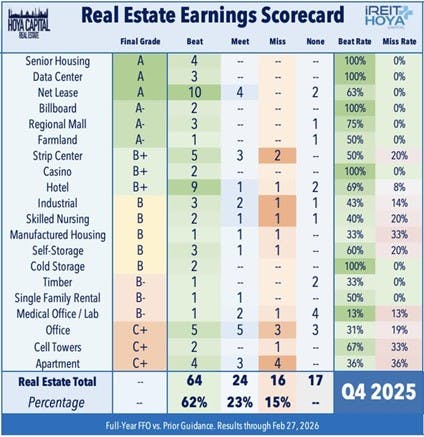
Over 200 U.S. REITs and homebuilders have reported fourth-quarter earnings results over the past six weeks, providing critical information on the state of the commercial and residential real estate industry. Overall, REIT earnings results were quite a bit better than consensus expectations - especially in the back-half of earnings season - and avoided the type of high-profile flops that overshadowed recent earnings seasons, with some impressive individual results across a balanced mix of sectors and market cap sizes. Of the 104 equity REITs that provided full-year guidance for Funds from Operations ("FFO"), 64 (62%) reported full-year 2025 FFO that topped the midpoint of their most recent guidance, 24 (23%) matched their guidance, while 16 (15%) missed their guidance - well above the historical average "beat rate" for the fourth quarter of 50-55%. Property-level metrics have posted more favorable trends, with roughly 70% of REITs beating their full-year Net Operating Income ("NOI") outlook - upside driven primarily by lower expenses - consistent with the "disinflation" theme observed in the back-half of 2025.
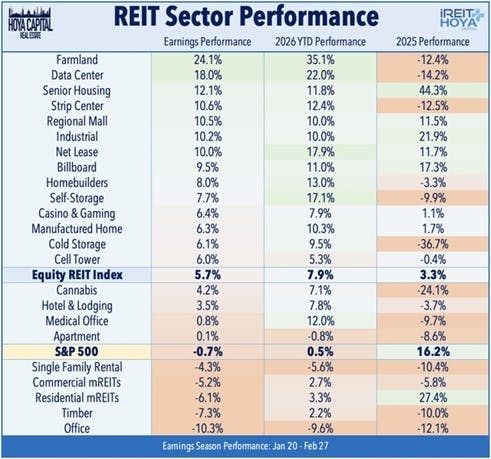
Before the Iran conflict sent energy prices to multi-year highs and lifted Treasury yields off of multi-year lows, REITs were enjoying a very favorable "goldilocks" macro data trends - cooling inflation alongside "good enough" labor market data - which helped the sector deliver notable earnings season outperformance over the S&P 500. Since the start of earnings season in mid-January, the Equity REIT Index (VNQ) is higher by 5.7%, outperforming the -0.7% decline from the S&P 500 during this time. Despite this recent outperformance, REITs still maintain a historically-wide 60-percentage-point underperformance gap versus the S&P since early 2022. Solid trends across most of the real estate sector come alongside a slightly weaker-than-expected set of earnings results across the broader U.S. equity market, particularly among the mega-cap tech giants that had shouldered the market gains in recent years. FactSet reports that 73% of S&P 500 constituents have topped consensus Earnings Per Share ("EPS") estimates - slightly below the 5-year average of 78% and the 10-year average of 76%.
Notable upside standouts this earnings season include Data Center, Senior Housing, Farmland, and Retail REITs. Senior Housing REITs - the perennial performance leader in recent years- reported another stellar quarter, with an equally impressive 2026 outlook for 15% NOI growth in their critical Senior Housing Operating Portfolio ("SHOP") segment. Data Center REITs continued to prove they could hang with the tech “big boys” amid the AI boom, maintaining near-zero vacancy and impressive pricing power. Results from Retail REIT across the strip center, regional mall, and single-tenant formats were a pleasant upside surprise, as limited new supply has kept occupancy rates near record-highs, and rent spreads in double-digits despite a slight demand moderation. Net Lease REITs, meanwhile, have accelerated their pace of acquisition activity as cap rates have ticked higher, resulting in increasingly attractive investment spreads. Specialty and agriculture-focused REIT sectors shined in the back-half of earnings season: Farmland and Cannabis REITs showed signs of operator stabilization after a post-pandemic slump in crop prices. Billboard REITs showed no signs of cooling in demand for Out-of-Home advertising, while Cold Storage REITs halted their cold streak of quarterly "misses" with a decent quarter. Hotel REITs also posted surprisingly solid results despite a soft stretch of travel demand in late 2025. Manufactured Housing REITs were the long residential sector to earn a spot among the "winners", with impressive performance in their core MH segment.
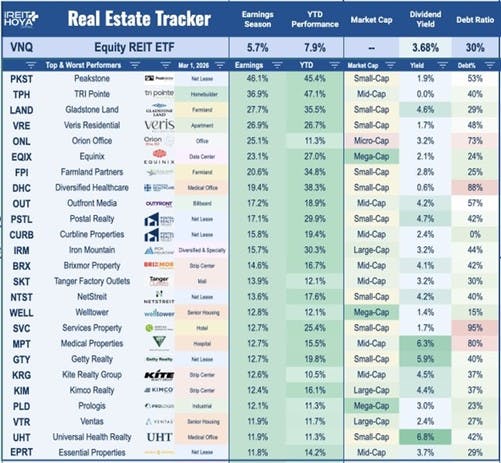
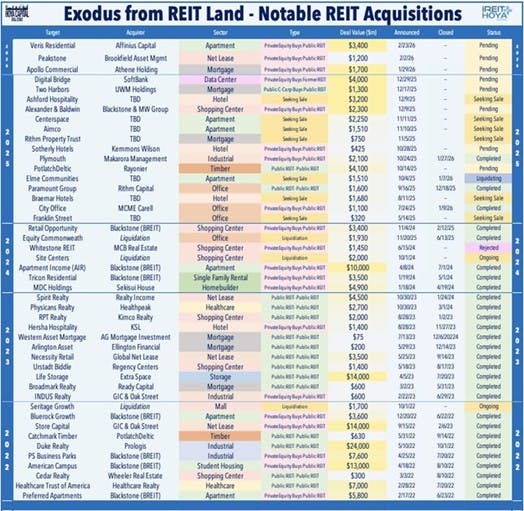
This season’s leaderboard is topped by REITs that agreed to deals to be taken private, reinforcing the “REIT Exodus” trend that has persisted over the past several quarters. Small-cap net lease REIT Peakstone (PKST) has surged near 50% after it agreed to be acquired by Brookfield Asset Management in an all-cash deal at $21/share - a 34% premium to its last closing price. PKST owns 70 industrial properties across 18 states, with a focus on the Industrial Outdoor Storage ("IOS") segment - a niche category consisting of outdoor yards used to store large equipment and materials. Homebuilder Tri Pointe (TPH) has jumped nearly 40% after it agreed to be acquired by Japan's Sumitomo Forestry for in an all-cash $4.5B deal at $47/share - a 29% premium to its prior closing price. Veris Residential (VRE) – a small-cap NYC-metro focused apartment REIT that owns roughly 6,500 units across 17 properties – has rallied nearly 30% after reaching a deal to be taken private by an investor consortium led by Affinius Capital in an all-cash transaction valued at $19.00 per share. Since 2022, a total of 42 REITs have been acquired, liquidated, or formally put up for sale, as deep and persistent public-market NAV discounts relative to private valuations continue to incentivize boards and management teams to pursue strategic alternatives aimed at narrowing this valuation gap and maximizing shareholder value.
While there weren't any major bombshells, we have seen a handful of disappointing results and softer-than-expected trends across a handful of sectors. Results from Office REITs showed that while property-level trends have inflected positively—evidenced by improved leasing volumes, modest occupancy gains, and stabilizing in-place rents—bottom-line profitability remains constrained by elevated leverage, higher interest expense, and balance sheets still healing from years of value erosion. Results from Residential REITs - both apartment, single-family rental - were also modestly disappointing, with results showing the early-year reacceleration in rent growth completely reversed in the back half of the year, even in the tight Northeast and Midwest markets. Results from Commercial Mortgage REIT were a setback after several encouraging quarters, as pockets of distress lingered in office, multifamily, and lab space loans, stretching dividend coverage and prompting a pair of cuts. For Residential Mortgage REITs, however, the underlying earnings were quite encouraging, highlighted by an unexpected 20% dividend increase from a name that's already paying a double-digit dividend yield. Results from Cell Tower REITs were relatively soft, as expected, given the DISH default and ongoing carrier consolidation. Industrial REITs showed that fundamentals remain steady outside of the still-struggling West Coast, but the upward inflection in fundamentals isn't expected until late 2026 amid lingering oversupply. Results from Medical Office REITs were a step in the right direction, with upside surprises from the core MOB segment offset by lab space weakness.
Winners of REIT Earnings Season
Winner #1: Senior Housing: (Final Grade: A)
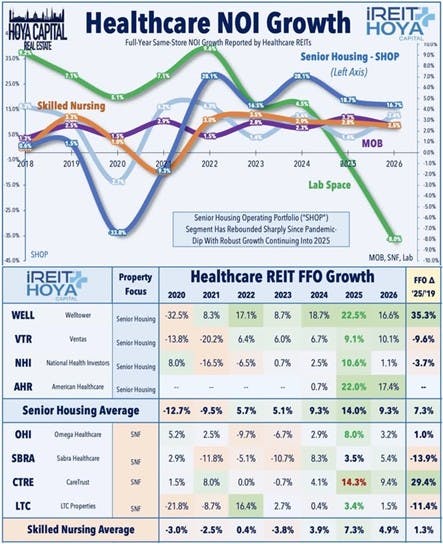
Positives: Stellar senior housing outlook for 2026 for 15%+ NOI growth after 15-20% growth in 2025; External growth activity broadening beyond WELL; Skilled nursing tenant rent coverage improves to decade-highs.
Negatives: Low-single-digit NOI growth in non-SHOP segments; Slight FFO miss from CTRE on equity raise (but still impressive double-digit growth); Mixed results from NHI & LTC amid continued push into SHOP segment.
Big Winners: American Healthcare (AHR), Welltower (WELL)
Big Losers: None
Winner #2: Data Center: (Final Grade: A)
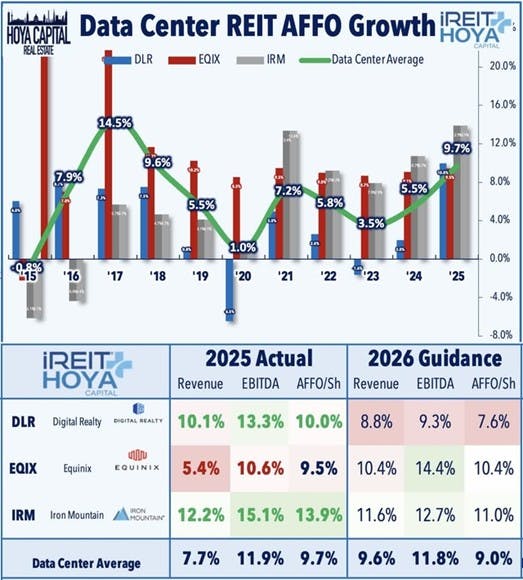
Positives: Impressive 2026 FFO outlook for double-digit growth; resilient pricing power despite booming investment in capacity; EQIX 10% dividend hike; DLR has its "mojo" back after half-decade of zero growth.
Negatives: Choppy hyperscale leasing volume (primarily on capacity constraints), FX headwinds on recent dollar strength; Fermi has tumbled since its IPO after anchor tenant backed-out of Project Matador.
Big Winners: Equinix (EQIX), Iron Mountain (IRM)
Big Losers: Fermi (FRMI)
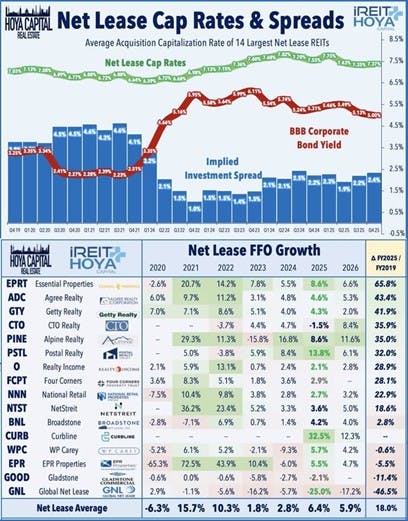
Winner #3: Net Lease: (Final Grade: A)
Positives: Sector-leading 10 FFO beats with no misses; Rebound in acquisitions as investment spreads become more accretive, No major new credit issues; Strength from value-oriented retail, automotive, experiential.
Reacceleration in acquisition activity as investment spreads become more accretive (highest since pre-pandemic), Steady free-standing retail fundamentals, Particularly impressive small & mid-cap reports.
Negatives: Typical mix of tenant-specific issues in softer segments (pharmacy, restaurants, theater); Emerging competition from renewed private equity interest (Starwood, Blackstone) in net lease space.
Big Winners: Peakstone (PKST), Curbline (CURB), Postal Realty (PSTL)
Big Losers: Generation Income (GIPR)
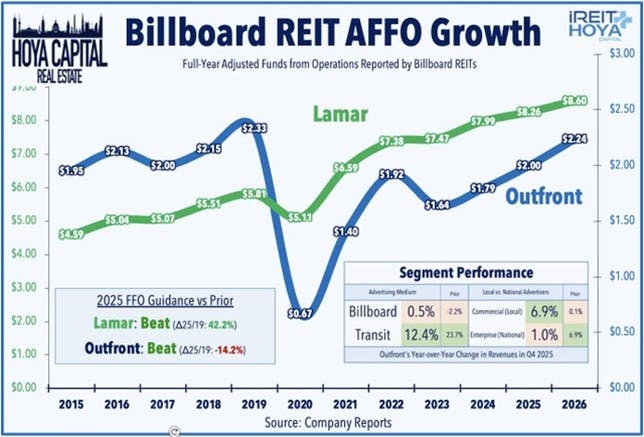
Winner #4: Billboard: (Final Grade: A-)
Positives: Rebound in ad spending among national advertisers, Big outperformance in transit segment (led by New York MTA), Continued benefit from digital billboard conversions, Stronger segments: tech, travel, legal.
Negatives: Softness local and regional spending, Tough comps from political spending last year, Weaker segments: restaurants, real estate, nonprofit.
Big Winners: Outfront (OUT), Lamar (LAMR)
Big Losers: None
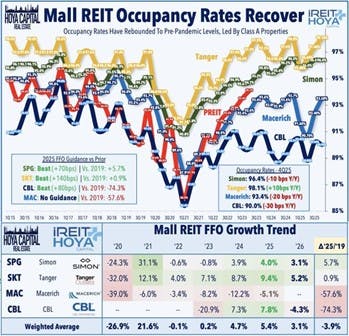
Winner #5: Regional Mall: (Final Grade: A-)
Positives: Upper-end consumer remains strong and still spending; Tanger's record-high leasing volumes & occupancy rate; Simon's 5% domestic NOI growth with same 2026 outlook; MAC beginning to get its act together.
Negatives: Announced retail closures in recent months have been more mall-heavy relative to recent trends; CBL's 2026 FFO forecast suggests its not out of the woods yet; Lower-end consumer cited as segment of softness.
Big Winners: Tanger (SKT), Simon (SPG)
Big Losers: None
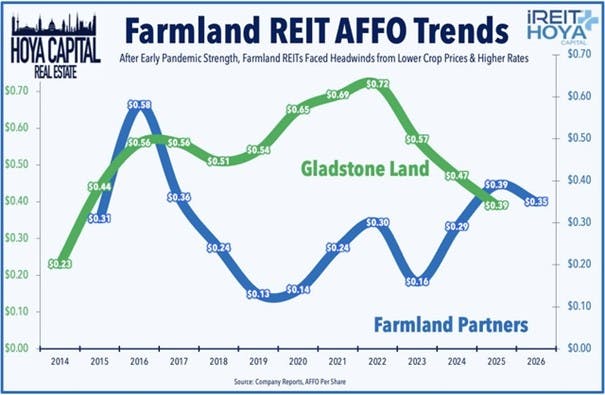
Winner #6: Farmland: (Final Grade: A-)
Positives: Strong harvest & fewer drought conditions help farmers after several tough seasons; Impressive rebound from FPI since 2023; FPI's 10% dividend hike; LAND stabilizing via re-leasing and direct farming operations.
Negatives: Grains prices still near four-year lows & hovering around pre-pandemic levels; Lingering farmland vacancies; Tariff & trade uncertainty.
Big Winners: Gladstone Land (LAND), Farmland Partners (FPI)
Big Losers: None
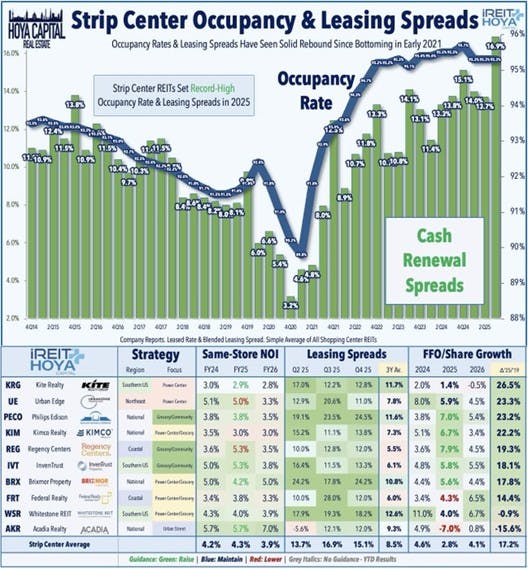
Winner #7: Strip Centers: (Final Grade: A-)
Positives: Double-digit leasing spreads for 15th-straight quarter; Occupancy rates still near record-highs; small-shop occupancy improving; Handful of dividend hikes including UE (+11%) and IVT (+5%).
Negatives: Still relatively quiet on the acquisitions front (leaning heavily into redevelopment); Noisy report from AKR on one-time factors; some short-term occupancy headwinds from recent bankruptcies (Rite Aid).
Big Winners: Brixmor (BRX), Kite Realty (KRG),
Big Losers: Site Centers (SITC)
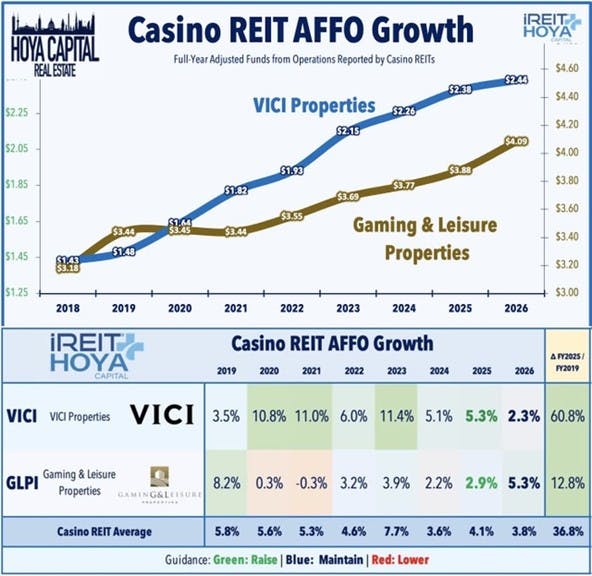
Winner #8: Casino: (Final Grade: B+)
Positives: Steady FFO beats driven by mid-sized M&A deals (VICI buys Golden Entertainment portfolio, GLPI buys Live Virginia & Sunland Park), GLPI notes tribal opportunity, VICI sees push into university sports.
Negatives: Lingering concerns over Las Vegas weakness (visitor traffic down 5-8% y/y), Vegas weakness primarily due to steep dip in inbound international tourism (Canada especially), Minor delays in GLPI's Chicago development
Big Winner: Gaming & Leisure Properties (GLPI)
Big Loser: None
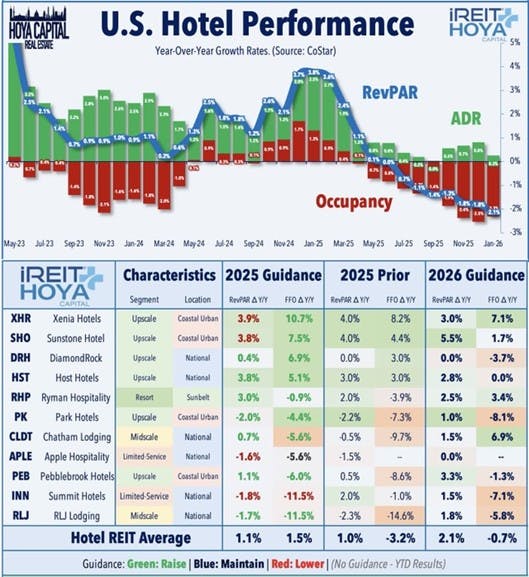
Winner #9: Hotel (Final Grade: B+)
Positives: Upside surprises: 9 of 10 hotel REITs reported 2025 FFO growth above prior guidance (+1.5% average vs. -3.2% expected); Group demand remained the standout, particularly in upscale urban / resort portfolios.
Negatives: Tone for 2026 turned more cautious: five REITs guide to negative FFO growth; Lingering margin and cost pressures; Economy segment remains soft; International travel remains weak & Middle East conflict won't help.
Big Winners: Chatham Lodging (CLDT), Diamondrock (DRH)
Big Losers: Braemar Hotels (BHR), Ashford Hospitality (AHT)
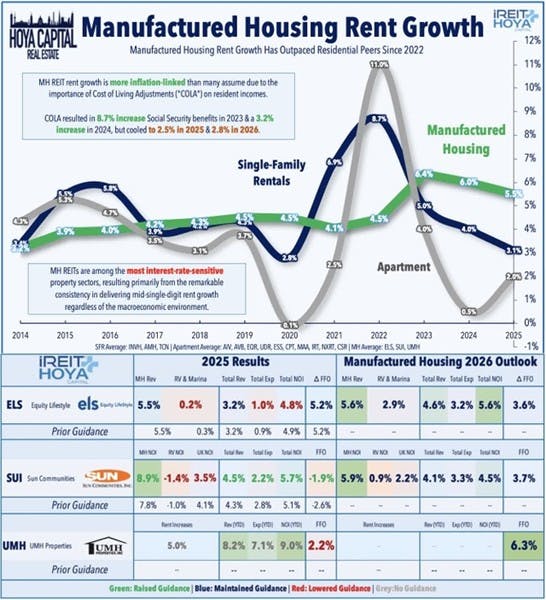
Winner #10: Manufactured Housing: (Final Grade: B+)
Positives: Core manufactured housing portfolio continues to outperform; Solid mid-single digit rent increases expected in 2026; Sun getting its "mojo" back as U.K. portfolio stabilizes; Dividend hikes from SUI (8%) and ELS (5%).
Negatives: Miss from UMH on equity issuance; RV segment remains weak - especially from Canadians; Still quiet on the domestic M&A front; Softness in lower-end consumer will weigh on ability to push rents.
Big Winner: Sun Communities (SUI)
Big Loser: UMH Properties (UMH)
REIT Earnings Season Losers
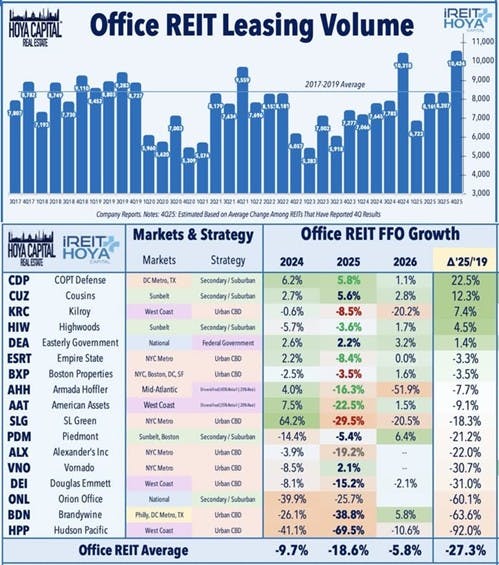
Loser #1: Office: (Final Grade: C)
Negatives: Balance sheet repairs pushing the upward FFO inflection in 2027 despite improved property-level trends; No bottoming yet in California market; Mamdani's property tax proposal hit NYC-focused names (SLG, BXP ESRT).
Positives: Best quarter of leasing volume since mid-2010s; Occupancy rates finally bottoming; Continued Sunbelt outperformance (CUZ, HIW); Solid government/defense leasing activity as DOGE concerns fade.
Big Winners: COPT Defense (CDP), Easterly Government (DEA)
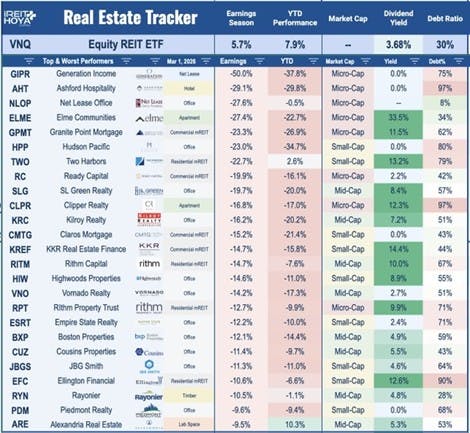
Big Losers: Kilroy (KRC), SL Green (SLG), Hudson Pacific (HPP)
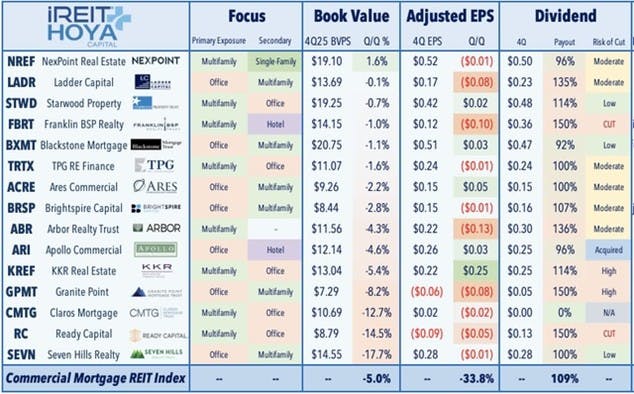
Loser #2: Commercial Mortgage REITs (Final Grade: C)
Negatives: Worst BVPS decline since 2021; Loan downgrades in multifamily, lab space, and office; Stretched dividend coverage prompts FBRT dividend cut & KREF to "review policy;" No bottom yet for struggling CMTG or GPMT.
Positives: ABR shows signs of stabilization after rough 2025, ARI's acquisition by Athene signals some M&A appetite & confirms deep NAV discounts vs. private markets, Solid quarter from the sector's "big boys" (STWD & BXMT).
Big Winners: Arbor Realty (ABR), Apollo Commercial (ARI)
Big Losers: Granite Point (GPMT), Claros Mortgage (CMTG)
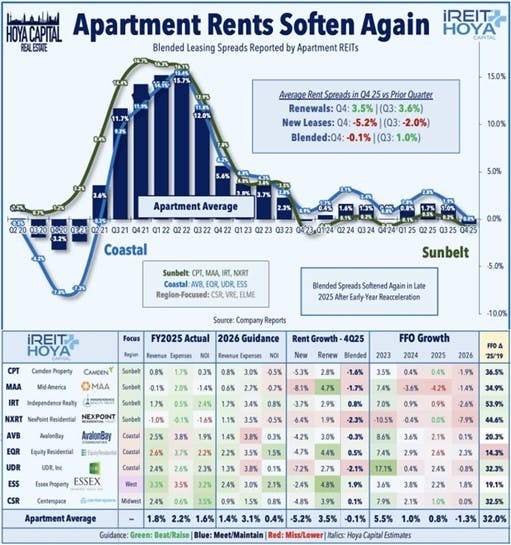
Loser #3: Apartment: (Final Grade: C+)
Negatives: New lease rent trends (-5.2%) worsen after rebound in early 2026, Softness spreads from Sunbelt to Mid-Atlantic and West Coast, Early signs of immigration impact on demand (especially at lower-tier).
Positives: Renewal rent growth (+3.5%) still holding up, Favorable expense control trends (moderate property tax and insurance increases), Veris Residential gets bought-out (and others - CSR, ELME - still in play).
Big Winners: Veris Residential (VRE)
Big Losers: Elme Communities (ELME), Clipper Realty (CLPR)
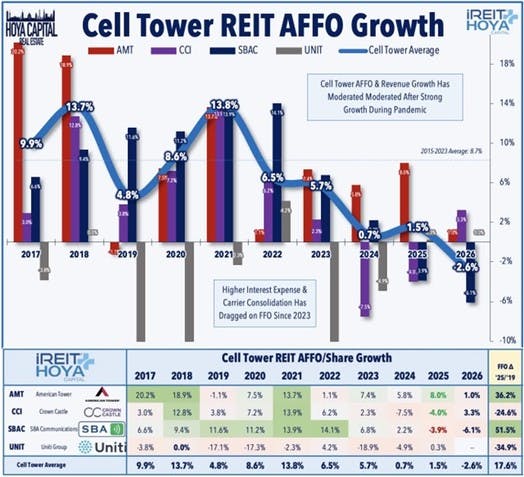
Loser #4: Cell Tower: (Final Grade: C+)
Negatives: Material hit from DISH/Echostar default with pending legal fight; 3rd-straight year of low-to-negative FFO growth expected in 2026; No near-term catalysts to drive upward inflection amid ongoing carrier consolidation.
Positives: SBAC's 13% dividend hike; Guidance beats on cost savings with more efficiencies planned; AMT's data center outperformance; Chatter on 6G networks helps lift sentiment; Valuations hovering around historic lows.
Big Winners: SBA Communications (SBAC), American Tower (AMT)
Big Losers: None
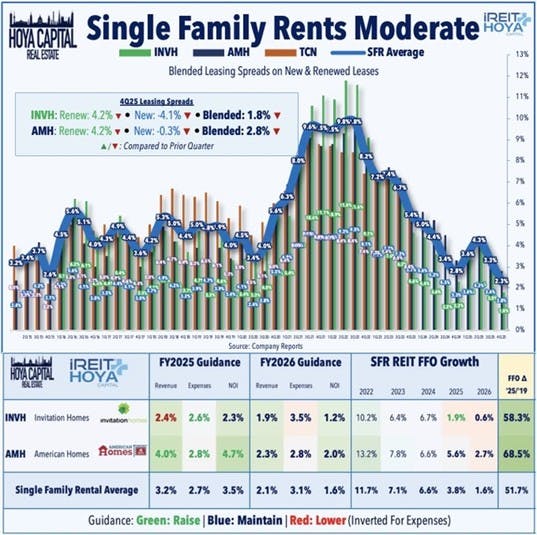
Loser #5: Single Family Rental: (Final Grade: B-)
Negatives: Policy risk remains key overhang as White House advances institutional homebuying ban; Deceleration in new lease rates across all regions; Sunbelt rental trends remain especially weak.
Positives: Favorable expense controls (modest insurance and property tax increases); Continued push into Built-to-Rent internal development to offset acquisitions risk; Renewals remain buoyant; AMH dividend hike (10%).
Big Winners: None
Big Losers: American Homes (AMH)
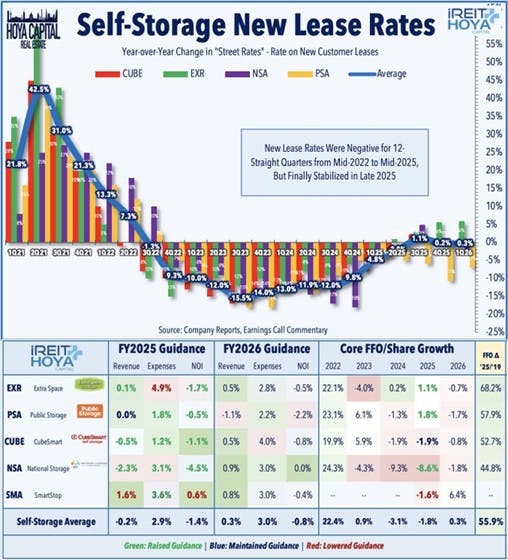
Loser #6: Self-Storage REITs: (Final Grade: B)
Negatives: Occupancy rates remain under pressure, Home moving rates (which drives storage demand) still historically low, Still dealing with pockets of oversupply (especially in Sunbelt) after COVID-era development boom.
Positives: New lease rates ("Street Rates") finally stabilized after 12 quarters of declines, Favorable expense controls (modest advertising, labor, and property taxes), Signs of recovery from NSA after rough 2022-2024.
Big Winners: Public Storage (PSA), CubeSmart (CUBE)
Big Losers: SmartStop (SMA), Global Self Storage (SELF)
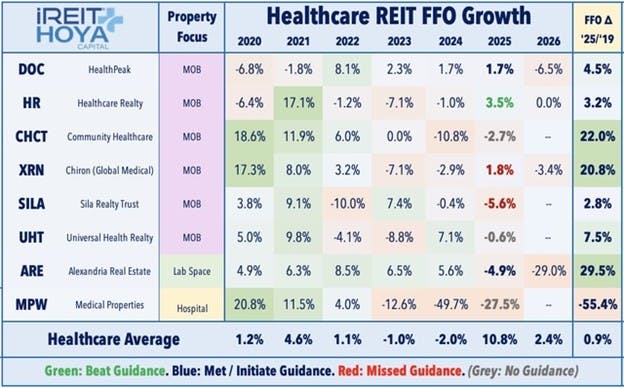
Loser #7: Medical Office / Lab Space:(Final Grade: B)
Negatives: Lab space fundamentals remain very soft with positive inflection not expected until 2027 at the earliest; Disappointing 2026 FFO outlook given the healthy MOB property-level trends; Misses from XRN and SILA.
Positives: Solid Medical Office Building ("MOB") leasing volume & rent spreads; MOB guidance sees 2-3% Same-Store NOI growth; Signs of stabilization at MPT after brutal stretch from 2022-2025.
Big Winners: Universal Health (UHT), Medical Properties (MPT)
Big Losers: Alexandria (ARE), Chiron / Global Medical (XRN)
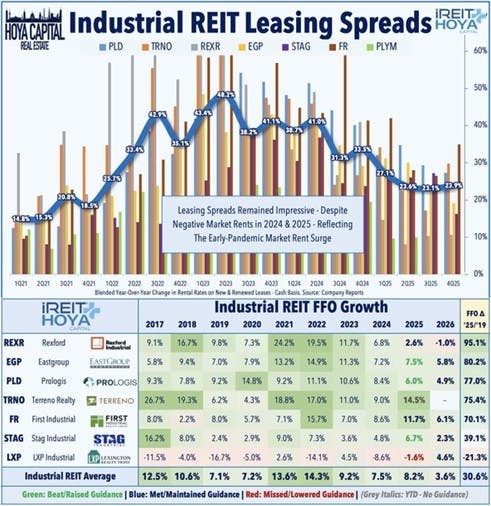
Loser #8: Industrial: (Final Grade: B)
Negatives: Market rent growth still negative (-4% Y/Y) with inflection not expected until 2H26, Setback in sluggish Southern California market; Smaller tenants still delaying major lease decisions, PLYM's sale at a discount to prior offer.
Positives: Reacceleration in leasing volume and rent spreads in "middle-America" markets following tariff-related pause; Tenant recognition of the need for supply chain diversification.
Market rent growth still negative (-4% in 2025 following -7% in 2024) with inflection not expected until 2H26,
Big Winners: Prologis (PLD), First Industrial (FR)
Big Losers: LXP Industrial (LXP), Rexford (REXR)
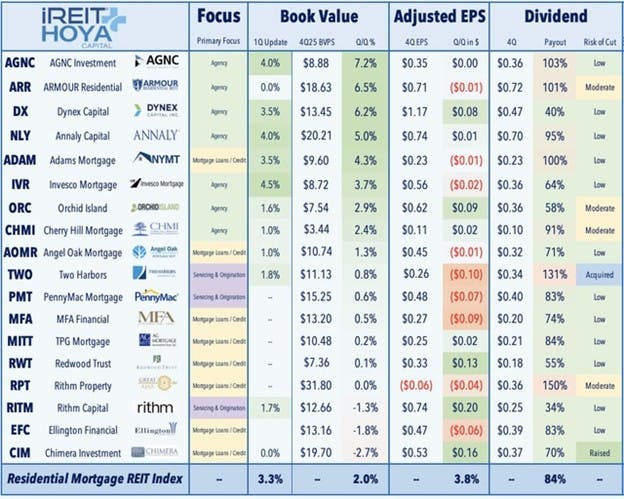
Loser #9: Residential Mortgage REITs (Final Grade: B)
Positives: Much-improved dividend coverage after two-straight quarters of increased Book Values (+2.0%) & EPS (+3.8%) increases; Agency mREITs report +5% average BVPS increased and +2-4% QTD; CIM's dividend hike.
Negatives: Relative weakness from long-outperforming MSR segment, Highly competitive refinancing environment for services-heavy mREITs (PMT, RITM); TWO back at pre-acquisition value on UWMC share price slump.
Big Winners: Chimera (CIM), Redwood (RWT), MFA Financial (MFA)
Big Losers: Two Harbors (TWO), Rithm Capital (RITM)
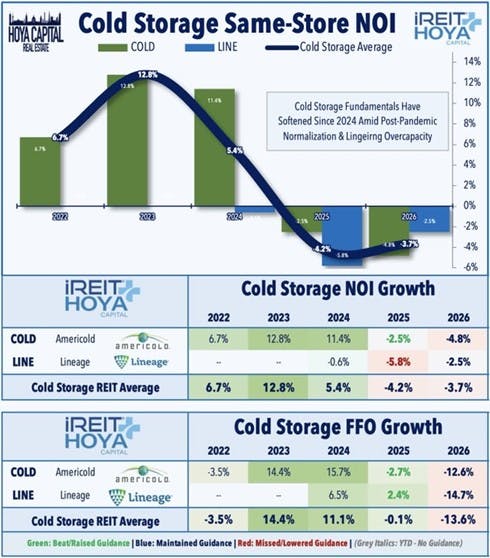
Loser #10: Cold Storage (Final Grade: B)
Negatives: Both REITs see double-digit FFO dip in 2026 (as expected); Not out of the woods yet in pressure on both pricing and economic occupancy as customers continue to manage inventory tightly.
Positives: Stabilization in occupancy rates; Strong harvest season helping; Finally a "beat" after several downbeat quarters; New leasing volume has been a bright spot, offset by reductions in the base business and churn.
Big Winner: Lineage (LINE)
Big Loser: None
Earnings Recap: Strong Results, But Still Overlooked
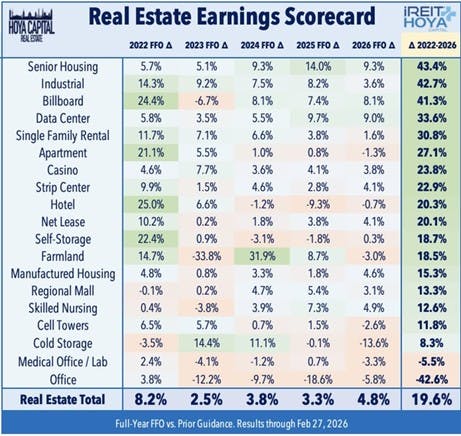
Overall, REIT earnings results were quite a bit better than consensus expectations - especially in the back-half of earnings season - and avoided the type of high-profile flops that overshadowed recent earnings seasons, with some impressive individual results across a balanced mix of sectors and market cap sizes. Upside standouts this earnings season include Senior Housing, Data Center, and Retail REITs. Speciality and agriculture-focused REIT sectors shined in the back-half of earnings season. There were few major bombshells this earnings season, but Apartment, Office, and Commercial Mortgage REITs have been the notable laggards. Multifamily rents softened in late 2025, particularly in the Sunbelt. Office REIT results showed progress at the property-level, but lingering headwinds on bottom-line FFO from balance sheet repair. Two REITs accepted takeover offers - surging more than 30% as a result - indicating that the public market discount is as wide as ever, and the "REIT Exodus" trend will persist until public REITs can close this valuation gap. And while these REITs should be commended for pursuing the path that maximizes shareholder value, investors are seeing the investible universe shrink and more assets pulled out of the public markets - an unfortunate byproduct of REITs being "too cheap" for too long.
About the Author
David Auerbach boasts over two decades of experience in the securities industry, specializing as an institutional trader with a focus on Real Estate Investment Trusts (REITs), Equity and Preferred stocks, MLPs, ETFs, and Closed End Funds.
Based in Dallas, TX throughout his entire career, David currently serves as the Chief Investment Officer for Hoya Capital, managing the Hoya Housing 100 ETF (Ticker: HOMZ) and The High Yield Dividend ETF (Ticker: RIET). Previously, David held the position of Managing Director at Armada ETF Advisors, the sub-advisor for the Residential REIT ETF (Ticker: HAUS) and The Private Real Estate Strategy via Liquid REITs ETF (Ticker: PRVT).
Additionally, he acts as a consultant with IRRealized, LLC, focusing on corporate access in the REIT industry. David's industry journey includes roles at World Equity Group, Esposito Securities, and Green Street Advisors where he got his start in the REIT industry.
At Esposito Securities, he played a crucial role in building the REIT/Real Estate platform and worked extensively with institutional investors, Equity REITs, and ETF issuers.
Throughout his career, David has been quoted by reputable publications such as Bloomberg, WSJ, Financial Times, REIT.com, and GlobeSt.com. He has also made notable appearances as a featured guest on networks like Yahoo Finance, TD Ameritrade, and Bloomberg.
David holds a BBA in Finance from the University of Texas at Austin (May 1999) and an MBA in Finance from Southern Methodist University (May 2005). He maintains FINRA Series 7, 24, 55, and 63 registrations.
In his leisure time, David is an avid traveler, often found crisscrossing the country in pursuit of attending as many Phish concerts as possible.
Disclaimer
Please note this article is for information purposes only and does not in any way constitute investment advice. It is essential that you seek advice from a registered financial professional prior to making any investment decision.

Latest ETF News
See all ETF newsWhat To Watch This REIT Earnings Season - Q3 2026


Your ETF Is a Tool. Investors Will Decide How to Use It.


How Much ETF Infrastructure Do You Really Need?





 Advantages of ETFs over Mutual Funds1/6
Lower Costs
In this guide, we'll explore the advantages of ETFs over mutual funds, giving you valuable insights into why ETFs have gained significant popularity among investors like yourself.
Leveraged ETFs: Unlocking the Potential for Amplified Returns1/6
Understanding Leveraged ETFs
Explore leveraged ETFs: potential for amplified returns & risks. 5 ETFs to consider across equities, commodities & fixed income.
What is a Leveraged ETF?1/6
Introducing Leveraged and Inverse ETFs
In this guide, we'll dive into the world of leveraged ETFs, exploring their definition, mechanics, potential risks, and rewards.
Recent educational content

First Look ETF
First Look ETF: Income, International, and Cash Flow ETFs
In this season 6 episode of First Look ETF, Stephanie Stanton @etfguide examines the latest ETF marketplace trends with NYSE and guests.


ETF Trends
ETF Industry KPIs October 5, 2026
This week’s KPI data overview highlights key metrics and trends shaping the ETF landscape.

ETF Trends
ETF Industry KPIs September 28, 2026
This week’s KPI data overview highlights key metrics and trends shaping the ETF landscape.
ETF Trends
ETF Industry KPIs September 22, 2026
This week’s KPI data overview highlights key metrics and trends shaping the ETF landscape.