ETF model portfolios designed for real investor needs. Discover →



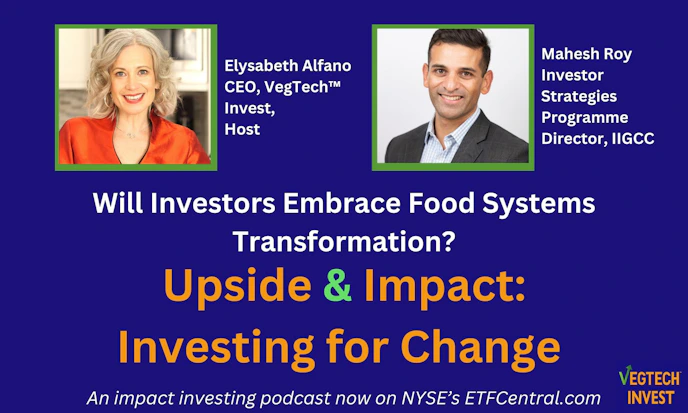
Will Investors Embrace Food Systems Transformation? With Mahesh Roy of IIGCC
Discover the IIGCC's perspective on investing in food systems transformation to combat climate change and seize the sector's potential growth.

Keep up with what matters in ETFs
Get timely ETF insights, market trends, and top ideas straight to your inbox.
Your newsletter subscriptions with us are subject to ETF Central's Privacy Policy and Terms and Conditions.
Will investors embrace food systems transformation? Mahesh Roy, Investor Strategies Program Director of the Institutional Investors Group on Climate Change, sits down with Elysabeth Alfano of VegTech™ Invest to discuss the IIGCC perspective on investing in food systems transformation to combat climate change and partake in the potential growth of the sector.
Specifically, they discussed
- What is the IIGCC and what does it accomplish?
- Why do you believe that the global food systems shift is going to happen quickly?
- Why is the food sector the only sector that can be net zero by 2030?
- Why has IIGCC expanded to invest in Food Tech as well as Climate Tech?
- What is your most critical tip for institutional and impact investors?
Get data on 14,000+ ETFs
Access Trackinsight's reliable and comprehensive data with 500M+ points on 14,000+ ETFs.
Transcript
Elysabeth: Hey everyone, welcome to the VegTech Invest Upside & Impact podcast. I’m your host, Elysabeth Alfano, the CEO of VegTech Invest, Advisor to the Plant-based Innovation and Climate ETF, EATV. On Upside & Impact I chat with the leaders and movers who are shaping and growing impact investing for meaningful change. We “pull up as we go up” as the expression goes so this podcast is all about making meaningful and productive impact while also managing one’s portfolio for upside. Of course, always managing for upside.
If you’d like more information about VegTech Invest you can visit us at VegTechInvest.com and subscribe to our newsletter. You can also find us on LinkedIn and on Twitter @VegTechInvest. We record live every first and third Wednesday of the month on our LinkedIn page at 1:30pm eastern standard time. So, check us out live and be sure to bring your questions.
Now if you’re listening as part of a podcast, of course subscribe to this podcast right now so that you never miss an episode. And if you’re listening on iTunes, be sure to leave a 5-star review. It really does help.
So now let’s get down to today’s show and thanks for being with me on today’s episode of VegTech Invest’s Upside & Impact. And as always, a reminder, this podcast is for informational purposes only and is not meant to recommend any specific company or investment. Now, onto the show.
Hi everyone, I’m Elysabeth Alfano, CEO of VegTech Invest. Welcome to another episode of Upside & Impact: Investing for Change. Thank you to the New York Stock Exchange, which distributes this podcast on ETFCentral.com, their podcast platform. Of course, you can always get this podcast on iTunes and Spotify. It’s best to subscribe to never miss an episode, and of course, you can always leave a five-star review. Those do help. You can find us on the VegTech Invest LinkedIn page. We are live on every episode right there.
I’ll tell you, here we are almost about to round the corner into April, and I still have memories from December of 2023. Now, if you remember, when I spoke at COP27 I couldn’t get anyone to talk to me about food systems transformation. I spoke four times at COP28 and not only was there a day dedicated to food systems transformation, but food systems transformation discussions particularly around financing food systems transformations, were permeated throughout the twelve days of the summit.
I attended so many fascinating panels, and one of them had my guest today. I’ve quoted him many times, so I do not want to steal his thunder. I will let the words come right from his mouth. I want to bring on today’s guest, Mahesh Roy, who is the Investor Strategies Program Director at the Institutional Investor Group on Climate Change. Mahesh joins me from London, I believe. Is this correct?
Mahesh Roy: That’s right. It’s great to be here.
Elysabeth: Thank you for your time today. I’ve been trying to track you down since December because the words that you spoke at COP28 and after your panel you and I had a chance to chat, and those words really stayed with me. I think they’re pivotal for helping investors wrap their minds around what will most likely be a very fast transition in food systems. But before we get into all that and of course the investment thesis therein, let’s backtrack and help everyone who might not know what IIGCC is, the Institutional Investor Group on Climate Change. Please tell us what that is.
Mahesh Roy: Thanks, Elysabeth. IIGCC is a membership organization. It was started by investors around twenty years ago. Currently we have around 450 members who manage around 65 trillion US dollars in assets. These range from local pension funds to some of the world’s largest asset managers.
We focus on three main areas. Policy, where much of our work started in being the investor voice on climate change with policymakers and regulators. Then we have a corporate program. We are one of the investor networks leading Climate Action 100+ which is the largest investor platform for engaging with some of the highest-submitting listed companies globally.
More recently and probably more relevant to this conversation, we’re one of the founding partners of Nature Action 100+. It’s a similar platform for investors to engage with companies on addressing nature and biodiversity loss.
Finally, we have our investor strategies program, which is the one that I have the privilege of leading. We work with investors on integrating climate change into their strategies. So we’re maybe best known for founding the Net Zero Asset Managers Initiative and the Paris Aligned Asset Owners Initiative. We produced the net zero investment framework which is the most widely used framework for targets and transition plans by investors who have committed to net zero.
It’s probably worth taking this opportunity to say that my comments today are my views and not necessarily those of IIGCC or its members and of course our members act individually in accordance with their own obligations to their clients' beneficiaries and regulations within the jurisdictions in which they operate.
Elysabeth: Wonderful, thank you for that. I have so much to talk to you about today, but I do want to take a chance to backtrack already on what you’ve said. I just want to make sure that people can access some of these platforms. Would you be kind enough here so that we have it documented, and of course for everyone listening on audio podcast you can refer to the transcript on ETFCentral.com, the New York Stock Exchange’s podcast platform. This transcript will be written out in full, but I want people to have those websites. Can you read off the website link so that people, have it?
Mahesh Roy: Yes, so that would be Climate Action which is climateaction100.org. Then there is NA 100 which is natureaction100.org. Net Zero Asset Managers which is netzeroassetmanagers.org. You will be able to find resources for the net zero investment framework if you go to iigcc.org and search for NZIF.
Elysabeth: Wonderful, thank you for that. So, some of the comments that stayed with me since COP28 in December of 2023 was when you were on a panel with FAIRR and the former ambassador to the United Nations Food and Agriculture Organization, the FAO, and you were saying that you thought food systems transformation was going to take place quickly and that investors would be diving into this opportunity. Why do you think that is?
Mahesh Roy: Well, I think I wouldn’t go 100% to say that it will happen very quickly. I think what’s promising is that it can happen very quickly, and they can transition very quickly. So, investors who have sort of signaled their commitment to aligning with the Paris Agreement and aligning their investment strategies with the Paris Agreement are obviously looking at different sectors and different areas of focus on which they can help the transition.
If you look at the IPCC, the Intergovernmental Panel on Climate Change reports, the most recent one being AR6, you look at the different scenarios in the different sectors. Agriculture, forestry, and other land use, which food systems sort of fits under, is a sector that can transition very quickly compared to say transport, which won’t make it by 2050, energy systems, which we hope will make it by 2050, and real estate, which will be well past 2050.
There is the ability for food systems to transform in a way that is net zero by 2030. Due to the increased focus on nature- I mentioned Nature Action 100 that we launched recently now has over 200 signatories in just a year engaging with 100 listed companies that sort of have the highest impact on nature. It shows that there’s a real will to understand how to move this transition as quickly as it can. But in saying that, you know, the practicalities mean that there are other things that need to be considered.
You just must look at the farmers’ protests on the European continent recently which show that it isn’t a given, but I think if there is the will from policymakers and the will from investors to sort of lean into this transition, then it can happen very quickly. My own opinion is that those things are starting to come together, and it will happen a lot quicker than people think.
Elysabeth: And perhaps we’ll say quicker on a relative scale, so quicker than the other industries, which people naturally think of energy and transportation first usually as the things to address climate change. And the little engine that could come from behind is going to be a food systems transformation, perhaps that grows at a relatively fast scale to impact climate change.
Synonymous with this, another thing that you said which stayed with me is that this sector is the only sector that can get to net zero by 2030. Now I would say that those two comments are intertwined, that it will move quickly and that this sector can get to net zero by 2030. They’re related and it’s that low hanging fruit, if you will, of impacting climate change, which will drive investment into the sector, which will therefore force it to grow quickly. I don’t want to speak for you, please. Do I have it right that this is the sector that can reach net zero by 2030 and the only one?
Mahesh Roy: Yeah, well I think once again to caveat, that’s not my analysis. I’m parroting the good work by the scientists in the Intergovernmental Panel on Climate Change that produced the six-assessment report. But yes, if you look at that report and I think it’s at the top of section four on page sixty in the longer report if you want to go and google “IPCC Six AR” you’ll see a diagram which shows the different main sectors and it shows that agriculture, forestry, and other land use is the only sector that can transition by 2030.
It can get halfway by 2025 and it’s well on its way to 2025. This is obviously because of land use and its effects on nature. It’s not only a source of emissions, but it is a carbon sink when you’re addressing land use change, including halting deforestation and looking at the sectors that are responsible for that and what needs to be done there. It’s not like you’re relying on any new technology or untested technology or the rollout of technology, it’s simply a change in practices, and generally those changes in practices can lead to better financial outcomes and more efficiency as well.
So, all of those things coming together mean that because there is a focus on climate and impact and this being a sector that can change quickly, that sort of those two things coalescing together mean that there will be increased attention in this area and there already is. As I’ve sort of outlined, the interest that we’ve had in addressing nature and biodiversity loss in financial portfolios mean that there’s very likely to be a shift towards food systems transformation in the coming future.
Elysabeth: It’s very exciting. Although I would say just anecdotally that certainly prior to let’s say the first half of 2023 coming out of COP27, very few people could follow my logic that food systems transformation was going to take place relatively quickly and be an important investment opportunity because of its ability to create wealth. When you have huge systems change that’s when you have real wealth creation, but you would have this huge systems transformation which would then increase wealth due to its impact on climate change.
Very few people could follow that conversation. Now, I don’t have to do so much explaining. People are starting to put that together in their own mind. Somewhere they’ve heard there’s a connection between food systems and biodiversity loss, deforestation, climate change, and they’re wanting to know more. So, I feel that steps are being made. That said, I still feel that we are woefully behind.
You seem to be- again not putting words in your mouth, but you’re saying things like,
“We’ve already made some progress” and sometimes I wonder about that. Maybe if you could illuminate us a little bit on some of the progress that’s been made because I’m surprised to hear that we could meet 2025 goals in agriculture.
Mahesh Roy: It’s worth probably caveating that these assessment reports even though it was only released a few years ago are backward-looking so I think it’s using 2015 as a base year. I think that the progress that’s been made is probably a little bit more distributed and isn’t happening sort of systemically. However, a focus particularly in tropical areas where there’s a greatest impact on reducing carbon emissions and increasing carbon sinks, a focus particularly by investors on looking at supply chains of companies they invest in or directly in other companies if they invest in them, in halting deforestation before 2025.
Another initiative that doesn’t have a website just yet, but we’ve been working closely with the climate champions team on is FSDA, Finance Sector Deforestation Action, where several leading global investors are engaging with companies that have the greatest impact on deforestation, particularly in tropical areas. So, I think the more of that progress that happens- and if you start to, I don’t have the numbers off the top of my head, but we’ve all heard of the football fields and the Amazon being destroyed at a great pace at certain times. The quicker you halt those, the greater impact you have on an exponential level because not only do you stop the emissions being released, but you increase the carbon sequestration.
Furthermore, investing in more cutting-edge food tech style companies or companies that have solutions like in the Netherlands where they are obviously a very small footprint on the global scale, but the second largest agricultural exporter, as those sort of learning starts to spread throughout because they are more efficient because they can produce more food with less. Then you see those learnings come to more broad-based companies in the ecosystem and you start to see those network effects starting to sort of increase the ability for those food systems to transform and to stop the conversion of natural ecosystems and also things like regenerative agriculture and carbon sequestration within agriculture and then other efforts around ecosystem restoration, deforestation and reforestation starting to make that progress and realistically the duplication of or the learning from those case studies and those being broadly systemically adopted, particularly when investors are engaging with the companies they invest in in these types of efficiencies and these types of measures, means that it can sort of spread quite rapidly and have that overall impact.
Elysabeth: I’m going to act like a little mouse here and follow up on some crumbs because I just want people to be able to maintain some key points of what you’ve said, correct me if I have anything wrong here. So, this is one of the sectors that can have the most impact because it isn’t necessary to have a large capex spend. A lot of halting deforestation, for example, not only halts the biodiversity loss, but in keeping those forests, you can capture. So, you’re stopping the damage and you’re creating a sink, stop and sink.
So, you’re maintaining the sink that also captures. So, you need less for dramatic change and therefore you can have impact quickly and you can have change quickly and this is what would allow us to impact these numbers. So, let’s talk about some of these numbers. According to the United Nations Environment Programme, agriculture is 30% of greenhouse gas emissions. So, you’re just not going to impact climate change if you don’t look at that 30% number. Animal agriculture specifically, is 18% of that. So, 60% of the 30%. Therefore 18% of greenhouse gas emissions come from that sector.
It’s a lot of deforestation primarily happening in the tropics to make room to graze cattle and grow feed. So that number, if you can address that 18% of greenhouse gas emissions coming from the agricultural sector specific to animal agriculture, you’ve made a huge impact without spending that much money. So, you say football field, we say soccer field. I just want to circle back and give the stat on this, it comes from the World Resources Institute, their report on the status of climate action for 2023. Indeed, in 2022 we lost 15 soccer fields worth of deforestation, in one year alone, every minute. 15 soccer fields of deforestation were lost every minute in 2022.
That’s the rate of deforestation, which leads me to say thank you for your shareholder engagement around biodiversity loss, deforestation, etc. I’m excited to hear that it sounds like you have support for this from your members, and investors kind of understand the impact here. Is that correct?
Mahesh Roy: Yeah, I think so, and thank you for elucidating my comments with some very strong facts and I believe they are all correct. Beyond the sort of progressive and sort of leading investors that are working on things like FSDA and Nature Action 100, we’ve also just recently updated our guidance. I mentioned at the start the net zero investment framework, which is the most widely used framework by investors that have committed to net zero. We’ve recently upgraded the NACE code which is sort of an industry classification code, the one for agriculture, forestry, and fisheries to a high impact sector.
What that means effectively is that investors using this framework to assess the alignment of their assets against the Paris Agreement goals will need to hold companies in those sectors to the same standards of oil and gas companies and other high impact sectors as well. So, what that guidance sort of does is help those investors then figure out where they need to engage in their portfolios and then maybe make other asset allocation decisions as well. So, when it comes to mainstreaming this, it’s now sort of broadly recognized that the impact that can be had by engaging with companies, halting deforestation, and stopping nature loss can have a huge effect that is a key part of their strategy in getting to net zero, not just looking at power and energy systems transformation, which is important.
I think the other side to that as well is the opportunity that you mentioned, the opportunity to scale this and where there was a lot of bangs for buck in investing you mention the relatively low capex even though changing the way an organization operates, whether that’s tracking supply chains or different methods of agriculture, still is less capex intensive than changing energy systems. I think in that same report that I mentioned before from the IPCC, if you look at what’s required in an investment to help the transition, the ceiling is quite low. It’s only $500 billion annually, which is still quite a lot of money, but it’s not in the sort of trillions annually that you hear thrown around for the energy transition.
The gap there though is larger because there’s less being invested in it. So there needs to be somewhere between a 10 to 31 times increase in investment required for the transition of the food system. But the bang for buck is even bigger because once you get that $500 billion, then you can see the system transform and transition and have huge climate impact and obviously in that as we sort of discussed there are huge efficiency gains.
Generally I’m not saying in all cases but where there’s efficiency gains it’s more profitable and those companies will perform better so there’s a lot of win-wins across there and as investors start to engage with these companies, start to understand in their portfolios where the alignment is in those sectors, so agriculture, forestry and fishery or agriculture, forestry and other land use, as the IPCC puts it, then you’ll hopefully start to see that change starting to cascade through from a sort of compliance and alignment style into more of actual opportunity here because these countries can transition. It’s not going to cost as much to transition them and we’re going to get a whole lot of impact in transitioning them as well.
Elysabeth: Okay, so much to follow up on there as well. I just want to make sure everyone’s processing all the information. If I can distill it slightly down to just some things, I want people to remember. This swift change and this strong climate impact hinges on investing. One might say investing to the tune that we invest in a new energy economy is going to need to invest in a new food systems economy.
I quote Geeta Sethi here who’s the World Bank Food Systems Expert who says that while 30% of greenhouse gas emissions come from this sector, 60% of that from animal agriculture, this sector only gets 2.5-4% of the world’s climate tech investment. So, we’re going to need to scale that 2.5-4% up to the 30% of the damage that is creates. She was mentioning between $300 billion and $500 billion a year for the next ten to fifteen years.
Now, while that might seem like a lot of money, and I’m just underscoring exactly what you said, which is $500 billion, while that might seem like a lot of money, it’s not the same kind of capex spend that one might need to shift the entire electrical grid, let’s say, around the globe. So relatively speaking, the low hanging fruit, lesser financial investment is needed, but it is needed. That is the hint. We’re going to have to invest to see these numbers really take fruition. The silver lining here is, as I see it, Mahesh, you let me know if you see it differently. There is a huge investment opportunity to get in now on food systems transformation.
You talked about these novel technologies that are using less land and less water. I have these stats off the top of my head, so I’ll use them. A plant-based burger compared to an analog burger: You’re looking at 97% less land use, 97% less water use, 90% fewer greenhouse gas emissions emitted, and 37% less energy used. Kind of a fun topic for another day is that venn diagram of overlapping of energy in transportation and fossil fuels and food. I think that’s interesting, but you’re looking at major efficiencies and where there is efficiency, that means better bottom lines.
Forget morality and even forget the environmental argument here. You’re looking at huge efficiencies that’s better for industry that really trickles down to being better for consumers, in addition to the climate change impact. That usually translates to being better for investors, but I also see it as if investment is going from 2.5% or 4% to about 30%, that’s also a great opportunity for investors. That means there’s a jump in interest and where there is demand things usually go up. That means it’s a very healthy place to be for investors.
Be it in that ag tech sector, or at VegTech Invest we invest all along the supply chain. We really see the supply chain as building out the infrastructure for this new system is where all the wealth is going to be created. That can be anywhere from the very beginning of ag tech to the ingredients used for the flavor and texture on novel foods to the synthetic biology, synbio, to the novel technologies utilized all the way at the end of the consumer-packaged goods. So, there’s lots of opportunity anywhere in the supply chain to invest.
Before we move on because there’s so much to discuss here, something else that Geeta Sethi from the World Bank said is that she really sees food tech investing as climate tech investing. Do you see the same?
Mahesh Roy: Well, I think so. There’s obviously huge crossover between both the mitigation side and the adaptation and resilience side. I think that’s where almost all food tech investing, considering its dependence on land use and water as well which has a huge impact on adaptation and resilience. So, I think across climate, if you’re looking at mitigation and adaptation and resilience, any technology that makes food and food systems more efficient can probably be couched as climate investment as well. Where it doesn’t, it will have co-benefits, particularly in the adaptation and resilience side when you think about the future of water and food scarcity that we’re looking down the barrel of, even in the lower temperature rise scenarios, which we are all sort of working towards. So, I would say that’s a pretty good way of passing it.
And a way that may confuse some people at first, but I think as you’ve so clearly laid out, the different mechanisms by which it will impact both mitigation and adaptation resilience, start to bring it into focus once again for investors to think about. Whilst this might be a broader secular shift that needs to happen for various reasons, if you marry that in with your climate goals and it makes a lot of sense to look at this transition and this change now.
Particularly for the World Bank it’s a great analogy because their initial mandate or their founding mandate is on poverty alleviation and climate is now starting to come into that lens as well. But if you’re looking at poverty alleviation and then acting on climate change, it’s a great way to ensure things like food security, water security, etc.
Elysabeth: You and I could speak for many hours. I’ll divert quickly to talk about the sustainable development goals of the United Nations. So, food systems transformation touches on human health, food insecurity, water, life on land, life underwater and climate change. At least six if not seven of the SDGs, which is wonderful.
We did talk about mitigation and adaptation, but you’ve hit on resilience. I just want to take a minute to say that we all lived through Covid, and we saw how quickly those food supply chains fell apart. Places like Singapore which is reliant on importing 90% of its food, went into panic mode, as did the Caribbean islands, as did the U.S. We all saw this as people started hoarding food and grocery stores were empty. So those resilient supply chains were back to efficiency building better business models.
You can even say, forget the environmental claims for now, just look at building a better supply chain to be more robust, and this in the end has less cost. It’s what, again, we focus on at VegTech Invest and we think that supply chain is really very interesting. I’ll just circle back for a minute and say you said we’re looking down the barrel at water shortages. I would say we are here. Colorado and Arizona are already fighting over water. I believe in the Middle East it’s a high concern.
So, it may not be in your town today, folks, but water issues are here. That’s only going to cascade. It’s two sides of the same coin. Food systems can change quickly or if we don’t invest and they don’t change, the fall off is going to happen equally as quickly. Increased climate change and increased water concerns. This can all cascade quickly. I don’t want to be doom and gloom here, but I’ll just say that that’s possible.
Before I once again quote the World Bank, I want to touch base on how much shareholder engagement you’re doing and the just the success that you’re having therein. We have shareholder engagement at VegTech Invest around building robust supply chains and so protein diversification just so that we’re not all dependent on- you know, it’s funny when you think of food it’s maybe 5, 6, 7 major companies around the world. Sometimes I wonder how they get so much protection. It’s not like we talk about an industry, and we think, “Oh gosh, it’s a huge industry. There are so many players.”
There are very few players, and they have enormous amounts of protection while putting out so much damage. A report from the FAO, the Food and Agriculture Organization of the United Nations, says that $12.7 trillion of cost is externalized to the global taxpayer, resulting in 10% of GDP from food systems in our current state. Primarily 80% of that cost is from not being healthy. Obesity, heart disease, diabetes, colorectal cancer. These large-scale lifestyle diseases keep people from being productive. 20% of that $12.7 trillion is in environmental cost cleanup. So that’s food systems.
Certainly, animal agriculture is going to be 60% of it and other sectors are going to have their chunks of that $12.7 trillion. So, I think, “Gosh, society bears such a heavy burden and yet such amazing protections.” But you feel that investors are quite ready to support shareholder engagement. So, I’m pleased to hear that.
Anecdotally I will say, because I’m in so many conversations like this, industry reaps the most rewards of protection today, but has the most to gain from tightening up their supply chains and having more efficiencies and building those better business models. It’s a bit of a carrot and a stick. So, there’s the carrot for them just like for investors to reap the benefits. There’s also the stick, I do believe, with the SEC looking at regulating scopes 1, 2 and 3. With the state of California having already passed into law that businesses that want to do business in California, the fifth largest economy in the world, must disclose scopes 1, 2 and 3. These things are paving the way.
Now I would say we’re looking down the barrel of fines and real materiality around this subject if people do not act. Okay, back to the FAO. What do you think it would take- let’s say in a hypothetical world, we go from 2.5% and 4% of investment to let’s say 18% or 30% of the investments on climate change are in food. What kind of timeline do you think it might take to get there?
Mahesh Roy: I’m not quite sure if I would say getting to 30% of climate investment being in food only because of that gap between the sort of $500 billion gap within food systems and the sort of trillions it’s required each year. Though I might be proven wrong, and I probably haven’t got the data or the expertise of the World Bank. But that said, I think if you look at portfolios now and you’d say you look at the S&P 500, it’s majority technology. Not the majority, but the largest share is technology and that might be where the growth is.
So, whether you call it food tech or just technology itself, and that technology itself being utilized for things like understanding supply chains, understanding emissions in supply chains, provenance of goods, etc., which is really quite hard when you get to sort of tier two or tier three suppliers. I think that technology and investment in that technology might be where you see efficiencies and those efficiencies mean that it might rise from whatever the 2% or 3% of portfolios that sort of consumer goods and foods now might just double.
But because of those efficiencies, the investment required is less. Therefore, you see that impact happen more readily. I think the upside for investors that do get into whatever slice, whether it’s a doubling of the current allocation or whether it is actually a ten times up to sort of 30%, those that do invest in those solutions- to your point previously, if there is increased regulation around supply chains, around emissions, disclosures, etc., then there is going to be huge demand for those sorts of technology and a huge demand for that greater transparency and understanding.
So once again, the bang for buck is probably likely to be larger because it isn’t about rolling out large pieces of hard technology and installing them in certain places. It’s about building that greater efficiency. So I think hopefully those technological breakthroughs and that tech investing in sort of information technology as opposed to necessarily capex on actual equipment will mean that the ability for investors to actually access those investments, so it’s not necessarily always going to be through private markets or sort of obscure funds or in untested technologies, it’s really going to be investing in those technologies or engaging with companies to apply those technologies to actually build that efficiency. So, whether it is an extra 3% or an extra 27% or whatever it might be, there is certainly a huge investment case for getting involved and allocating more to this transition.
Elysabeth: Again, so much to unpack here. I will say, I believe it will follow an S-curve. To accurately quote the World Bank, they did not say that it will become 30%. They said it should. So let me correct myself there. But I do believe it will follow an S-curve, so it won’t be linear. You’ll see investments start to pour in and the efficiencies are readily apparent. That will be positive reinforcement. At the same time, we have environmental negative reinforcement to move quickly.
I think that will just scale from there and really everyone's a winner, even the industry which stands to have tighter supply chains and better cost of goods sold by tightening these supply chains. Plus, their better sustainability numbers and avoiding fines. So, everyone gains here, which means once the world opens up to this kind of information, there’ll be very few headwinds. I mean once we get out of a funky election year and a bad economy. I think there’ll be very little in the way of headwinds. So, you could see this really culminating 2025, 2026, 2027 for this to be really an area where people focus.
I’d like to say if there’s any need for, let’s say a tangible understanding of the climate impact, one of the investment products that we have at VegTech Invest, we asked our third-party advisor to kind of look at the fund and say, “Well, what kind of global temperature warming impact does this basket of companies have?” It came to be that due to the efficiencies and of the stopping and creating of a sink, that it has a temperature global warming potential of 1.18 degrees centigrade. Well below the Paris Accords, which we all know now that we’re not even going to hit.
Then it looked at the S&P 500 index and that had a global temperature warming potential of 3.23, which is where the world invests. That’s probably one of the most common investment products based on that index. So, you see where we are, a global temperature warming footprint, and you see where we could be or what food systems offer. You can get more information on that if you go to VegTechInvest.com, but I think it’s interesting to have global temperature warming in mind.
One more thing to say before we end here, so much of a knowledge drop from you today. Thank you for that. I think it’s encouraging. We’re talking about all the work that the Institutional Investor Group on Climate Change, IIGCC, if you can remember that one, is doing and I’m so grateful for your shareholder engagement. I do hope everyone will go to the websites which are in the transcript, and you can sign up and engage there or become a member. But you’re not the only ones.
I mean FAIRR has some great shareholder engagement. Mighty Earth has been doing some great work. I think of ISS which those in the U.S. will know as a proxy voting organization. They also have research and ESG arm. They’ve recently come out with a biodiversity benchmark tool. So, you can start to look at your investments and use their data specifically around biodiversity and nature. So, you’re seeing more tools everywhere. This means more knowledge, more information. It’s very exciting.
I’ll also ask you maybe as a kind of exit question, you talked about novel technologies and garnering efficiencies, is there any one technology that’s caught your fancy or your fascination? Not as an investment opportunity, but just as-
Mahesh Roy: Yes, I’ll stick to just sort of climate strategies and measuring alignment as opposed to giving out sort of investment tips or technologies. But I think there’s interesting work being done and not to be that person that just speaks about AI on an investing podcast because that’s what you do, and to try and attract members of the like. A previous role of mine, I worked at CDP, and they had a partnership with BCG and looked at using AI in sort of mapping supply chains and understanding supply chains.
I think across climate, both in mitigation and adaptation and resilience, the interconnectedness, and the systemic connectedness of everything and how they relate to each other. You can look at singular assets you invest in or the company you invest in, but without their sort of supply and value chains, as you mentioned, very much highlighted by Covid and some of the hangover of Covid and how that can affect food availability but also things like inflation. When you’re trying to look two or three tiers down a supply chain it becomes very hard.
There is a lot of good work on engagement being done, as you mentioned, through work we’re doing with Nature Action 100, FAIRR, CDP, and others. So, there is a lot of information that is being gleaned, but that’s not necessarily all being pieced together. So I’m hoping that technological advances to sort of understand that mapping of interdependencies and supply chains and also that data that’s being produced through those engagements can start to sort of become more open and accessible so people can sort of understand the provenance of goods and services that they’re procuring and whether that be thinking about the climate impacts through carbon emissions or other greenhouse gas emissions of those goods and services, but also understanding the physical climate risks that are related to different companies and different resources by their interdependence on other bits of infrastructure as well.
I think that will be a critical place for hopefully investors and many members of ours to invest in and the large technology organizations who might control some of these innovations that can give us this information to sort of meet the climate challenge. I think once technology can start working for us and understanding it’s not for profits like us, producing reams of PDFs on how to engage and how to interact with companies that can actually start to automate what we do and probably put myself and others out of the job, which for the right reasons would be a great thing to do.
I think that would be a great place to sort of start thinking about where we can investigate the most impact and sort of tie together those two big secular shifts into the climate and sustainability, but other things like digitization and artificial intelligence and sort of getting where we are. I don’t know of anyone doing that particularly well, but I’d say if someone starts to, that would be a good place to start investing.
Elysabeth: I couldn’t agree more. I think AI is going to have a very rapid impact on transparency. Now we’re back to the carrot and the stick. This is a wonderful carrot for consumers. They really get to see, “Hey, where was my stuff made and how was it made?” This is an awful stick for industry because a lot of industry has been hiding for a while and I think AI is going to turn that on its head.
I am excited about a technology that is not a new technology. Again, one of the underscoring principles of food systems transformation. I’m excited about fermentation. Now the world has been fermenting beer and bread and yeast and kimchi. If you like kimchi, I do not, but you know that fermentation is nothing new. When you’re looking at fermenting clean protein like microbes- a microbe is neither an animal nor a plant. You can ferment the amount of protein of a cow which would take a year and a half and all that deforestation, all the land and water, and you do that in three to four hours.
So, we haven’t talked too much about food insecurity here, really focusing on climate change, but another mandate for many is, in fact it just got out of a meeting with a large international bank of Latin America. Food insecurity, not just for the Middle East to worry about, but also other places. You see that ability to create more protein using less resources creating less damage in a shorter amount of time. It’s a very interesting mandate. So, I’m interested in revitalizing the old techniques, if you will, of something like fermentation, which of course needs to be tweaked from where it is now. Pharmaceutical grade often, which is a different price point than commodities. So of course, it needs some investment.
I think there’s a lot of interesting things being done around precision fermentation for proteins, for example. I’m very excited, again using the word precision, about things like precision watering. Back to that ag tech technology where you really focus on just watering what you need. Israel has been focused on that for a while, but other technologies with drones, etc., making regenerative farming and crop rotation and finding the crops that need the least water that can have the most precision watering for the bettering of the soil, as well as the food that’s created.
I just think there’s a lot of interesting technologies. We watch all of these, of course. I do have one more question involving a tip, I’ll say, but not an investor tip. If you’re having a very busy day, what is your go-to snack that you recommend?
Mahesh Roy: I’m not just saying this because I’m on the VegTech podcast but falafel. Apparently when my mother was pregnant with me, she was a hippie. She was a vegan and she ate a lot of falafels and that’s my comfort food and it sort of sits somewhere between the line of healthy and delicious fried food so it’s pretty good for most situations. Whether it’s in a wrap or a bowl of falafels or whatever, it never really feels like it was the wrong decision afterwards. So yeah, my go-to is falafel. I would dare say I’m a bit of a falafel snob. So, I have a pretty good rating system of different Middle Eastern restaurants and their falafels.
Elysabeth: When I’m in London, I’m going to get your recommendations. What I love about falafel is it’s appealing to Gen Z because it goes with you. So, you don’t have to sit down for falafel. You take it where you go. You’re on the move and that’s how everyone eats nowadays. I can’t remember the last time my family sat down to dinner. Everyone’s just on the move and eating on the go. Eating standing up, eating walking around. So, falafel can do that. So very exciting and very fun about your parents, although I will say for the record, as we talk about data and stats, not all vegans are hippies. In fact, my custodian at US Bank is a vegan and she is not a hippie, just for the record.
I think what has come to my attention in this podcast is that it is almost possible to do an entire podcast with just acronyms. ISS, IIGCC, FAO, BCG. I don’t know how everyone keeps up because it’s basically a podcast episode today of just acronyms. I want to thank Mahesh Roy, Investor Strategies Program Director at IIGCC, Institutional Investor Group on Climate Change. Having shared with us such a knowledge drop today, I really do appreciate it.
We’re going to have all these links in the show notes, the transcription on the New York Stock Exchange platform ETFCentral.com, you can find them there. If you would like to become a member or if you would like to participate, I imagine your shareholder engagement is not members only, is that correct?
Mahesh Roy: Generally, shareholder engagement is generally members of the networks. So, we work with various investor networks. So usually they are members only, but quite reasonable fees for quite a lot of work we help our members with.
Elysabeth: Okay, wonderful. So, you’ve got your mandate folks, you know what to do. Of course, if you have any questions, you can always find Mahesh Roy on LinkedIn. You can find me, Elysabeth Alfano, on LinkedIn as well. I want to thank everyone for joining this podcast. Mahesh don’t go away. Everybody else on LinkedIn, YouTube, and X, I will see you all in a few weeks. Bye everybody.
Thanks for being with me everyone on today’s episode of VegTech Invest’s Upside & Impact. I hope that you’ve found this to be a knowledge drop and I’m always here to answer any questions so please feel free to reach out to me on LinkedIn. Elysabeth Alfano, you can find me there. I’m also on Twitter @ElysabethAlfano and you can find the VegTech Invest pages on both LinkedIn and Twitter.
Sign up for our newsletter at VegTechInvest.com and share this podcast with your colleagues, friends, and clients. And of course, be sure to subscribe to this podcast to never miss an episode. Remember we record live on the VegTech Invest LinkedIn page every first and third Wednesday of the month at 1:30pm eastern standard time. So come find us there to join the conversation live. Until then, thanks for leaving a 5-star review on this podcast app because it really does help.
If you’d like more information about VegTech Invest you can visit us at VegTechInvest.com and subscribe to our newsletter. Okay everyone, great show today. See you next time on VegTech Invest’s Upside & Impact.
VegTech Invest is a registered investment advisor focused on investing in sustainable food and materials. This podcast is for informational purposes only and should not be relied on as the basis for investment decisions. It does not constitute either explicitly or implicitly any provision of services or products by VegTech Invest. All statements made regarding companies and securities are strictly beliefs and points of view held by VegTech Invest or podcast guests and are not endorsements or recommendations to buy, sell, or hold any security. Clients of VegTech Invest may maintain positions in the securities discussed in this presentation. VegTech Invest believes that the information presented is accurate and was obtained from sources that VegTech Invest believes to be reliable. However, VegTech Invest does not guarantee the accuracy or completeness of any information and such information may be subject to change without notice from VegTech Invest.
Certain statements in this presentation may be statements of future expectations and other forward-looking statements that are based on VegTech Invest’s views and assumptions at the time of publication and involve risks that could cause actual results, performance or even events to differ materially from what is expressed or implied by such statements. VegTech Invest’s strategies are actively managed and not intended to replicate the performance of any cited index which may differ materially. You cannot invest directly in an index.
Segments
See all
No specific market segments were tagged
Mentioned ETFs
No specific ETFs were tagged
Further reading

Latest ETF News
See all ETF newsThis is How Calamos Turned Wall Street’s $100 Billion Secret Into an ETF




From Dot-Com to ETFs: How One Entrepreneur Helped Spark an Investment Revolution
How Blossom Social Is Revolutionizing Retail Investing and ETF Marketing

Is 2025 the Year for Financing Food Fast?

 Advantages of ETFs over Mutual Funds1/6
Lower Costs
In this guide, we'll explore the advantages of ETFs over mutual funds, giving you valuable insights into why ETFs have gained significant popularity among investors like yourself.
Leveraged ETFs: Unlocking the Potential for Amplified Returns1/6
Understanding Leveraged ETFs
Explore leveraged ETFs: potential for amplified returns & risks. 5 ETFs to consider across equities, commodities & fixed income.
What is a Leveraged ETF?1/6
Introducing Leveraged and Inverse ETFs
In this guide, we'll dive into the world of leveraged ETFs, exploring their definition, mechanics, potential risks, and rewards.
Recent educational content

ETF Trends
ETF Industry KPIs August 31, 2026
This week’s KPI data overview highlights key metrics and trends shaping the ETF landscape.

ETF Trends
ETF Industry KPIs August 24, 2026
This week’s KPI data overview highlights key metrics and trends shaping the ETF landscape.
What’sTheFund
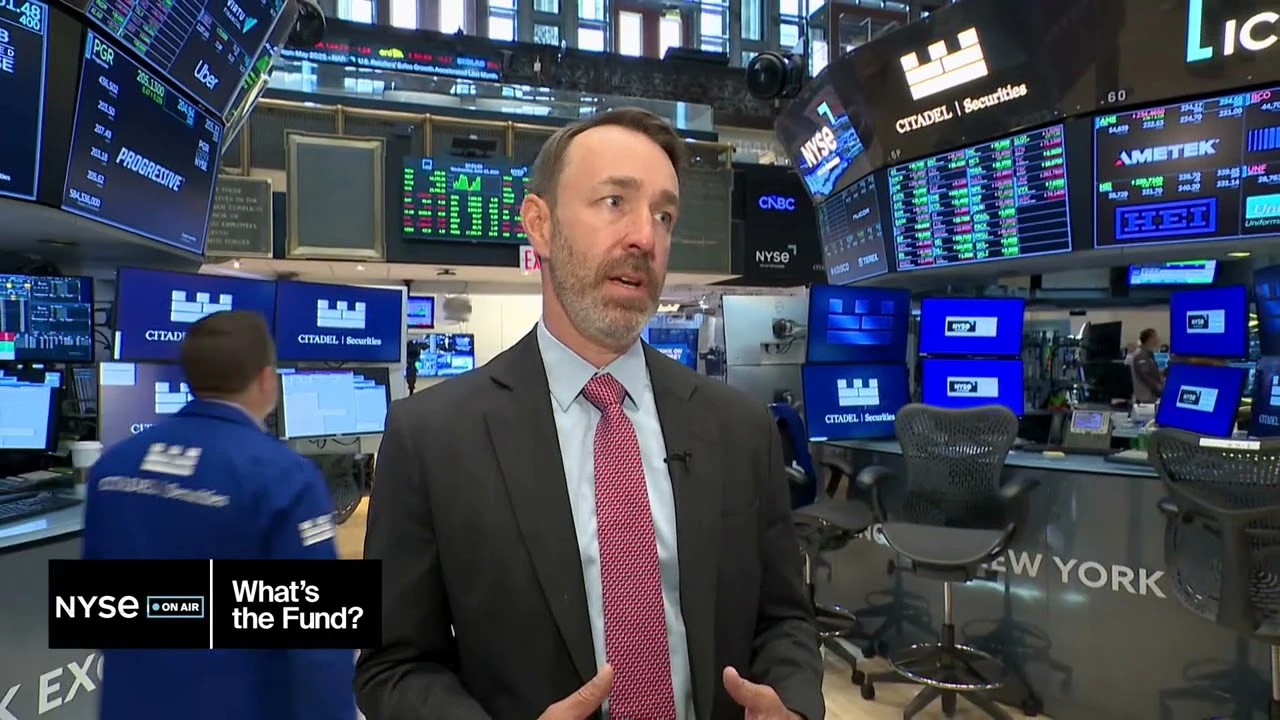
What's the Fund | Ocean Park Diversified Income ETF (DUKZ)
James St Aubin, Chief Investment Officer at Ocean Park Asset Management, discuss the DUKZ ETF, exposing investors to the whole spectrum of asset classes in the fixed income markets, through their rules-based process.

ETF Takeaway
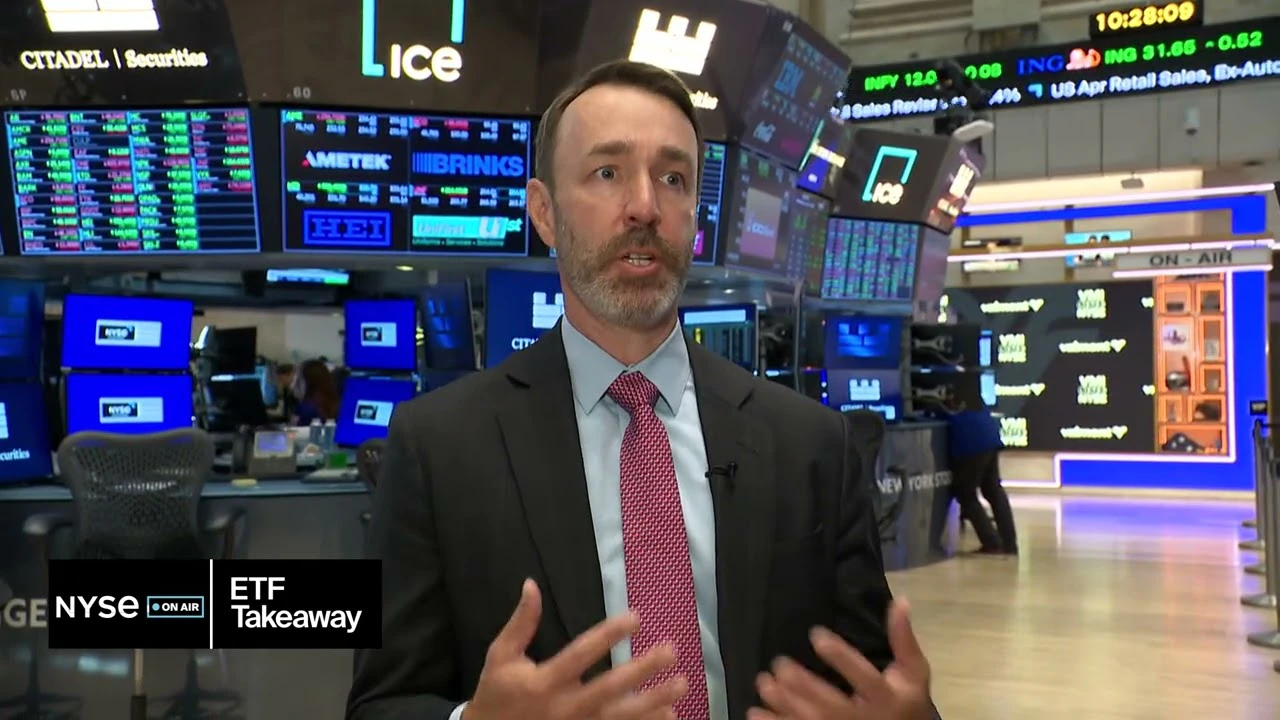
ETF Takeaway: Ocean Park Diversified Income ETF (DUKZ)
James St Aubin, Chief Investment Officer at Ocean Park Asset Management discusses the state of fixed income markets and how their DUKZ ETF, through their rules-based process, tactically allocates to 11 sectors of fixed income through underlying ETFs.
Browse all educational columns



Active Trader Report: Use of Leveraged & Inverse ETFs Way Up
Direxion partnered with Compound Insights and Vanda to explore what’s driving the evolution of active trading — and how active traders are using leveraged and inverse funds across equities, single stocks, commodities, and volatility.