Ready-made ETF portfolios built for real investor needs. Explore now →



Why Passive Investors Are Taking a Closer Look at Concentration
Investors lean on broad-market indexing, yet rank concentration behind other equity risks. Here’s a closer look at what that means for core portfolios.

Keep up with what matters in ETFs
Get timely ETF insights, market trends, and top ideas straight to your inbox.
Your newsletter subscriptions with us are subject to ETF Central's Privacy Policy and Terms and Conditions.
For years, "buy the S&P 500 and forget about it" has been one of the most widely repeated pieces of investment advice. The evidence supporting passive investing remains compelling. According to the latest S&P Indices Versus Active (SPIVA) scorecard, 90.49% of actively managed U.S. large-cap equity funds underperformed the S&P 500 over the 15 years ended June 30, 2026.¹
For investors, that makes a strong case for low-cost index investing rather than attempting to consistently identify outperforming fund managers. Still, the S&P 500’s central role in portfolios raises two questions worth exploring.
The first concerns governance. Passive investing still depends on decisions made by index providers, particularly when determining which companies qualify. Inclusion in a widely tracked benchmark can trigger billions of dollars in passive investment flows. That issue came into focus during the debate over fast-track inclusion for large initial public offerings (IPOs), particularly SpaceX.
With competing index providers relaxing their eligibility requirements to accommodate newly listed mega cap companies, S&P Dow Jones Indices consulted the market on its own rules. Following that consultation, it chose to retain the S&P 500's existing requirements, including its seasoning period, profitability criteria and minimum public float threshold.²
The second concern is concentration risk. As of October 5, 2026, the S&P 500’s ten largest constituents accounted for approximately 37.3% of the index, with Apple alone representing 7.7%. Information technology stocks made up another 37.4% of the benchmark’s weight.³ This concentration reflects the market itself: a market-cap-weighted index is designed to mirror the opportunity set as it stands.
Despite these concerns, broad-market indexing remains deeply embedded in portfolio construction. This raises an interesting question: how should investors reconcile the established advantages of passive indexing with the concentration that comes with today’s market leadership?
That's what we'll examine in this second installment of our four-part series exploring the findings of Trackinsight's 2026 Global ETF Survey, focusing on what the survey reveals about investor attitudes toward concentration risk and the portfolio construction choices available to address it.
Global ETF Survey 2026 is Live!
With 1,790 new products launched by July 2026, choosing is harder than ever. Our Global ETF Survey 2026, built on 620 professional investors and allocators, shows how active, fixed income, options-based and thematic ETFs are reshaping fund selection.
The Momentum Behind Passive Indexing
Despite growing concerns about concentration risk, the findings from Trackinsight's 2026 Global ETF Survey suggest that the fundamental appeal of passive indexing remains firmly intact.
Cost continues to be a major consideration. 45.5% of professional respondents identified cost as a primary factor when evaluating whether to replace an existing ETF. That was comfortably ahead of the incumbent ETF's performance at 31.8%, changes to strategic or tactical asset allocation at 27.3%, tracking difference at 18.2%, and tracking error at 9.1%. Respondents could select multiple answers.
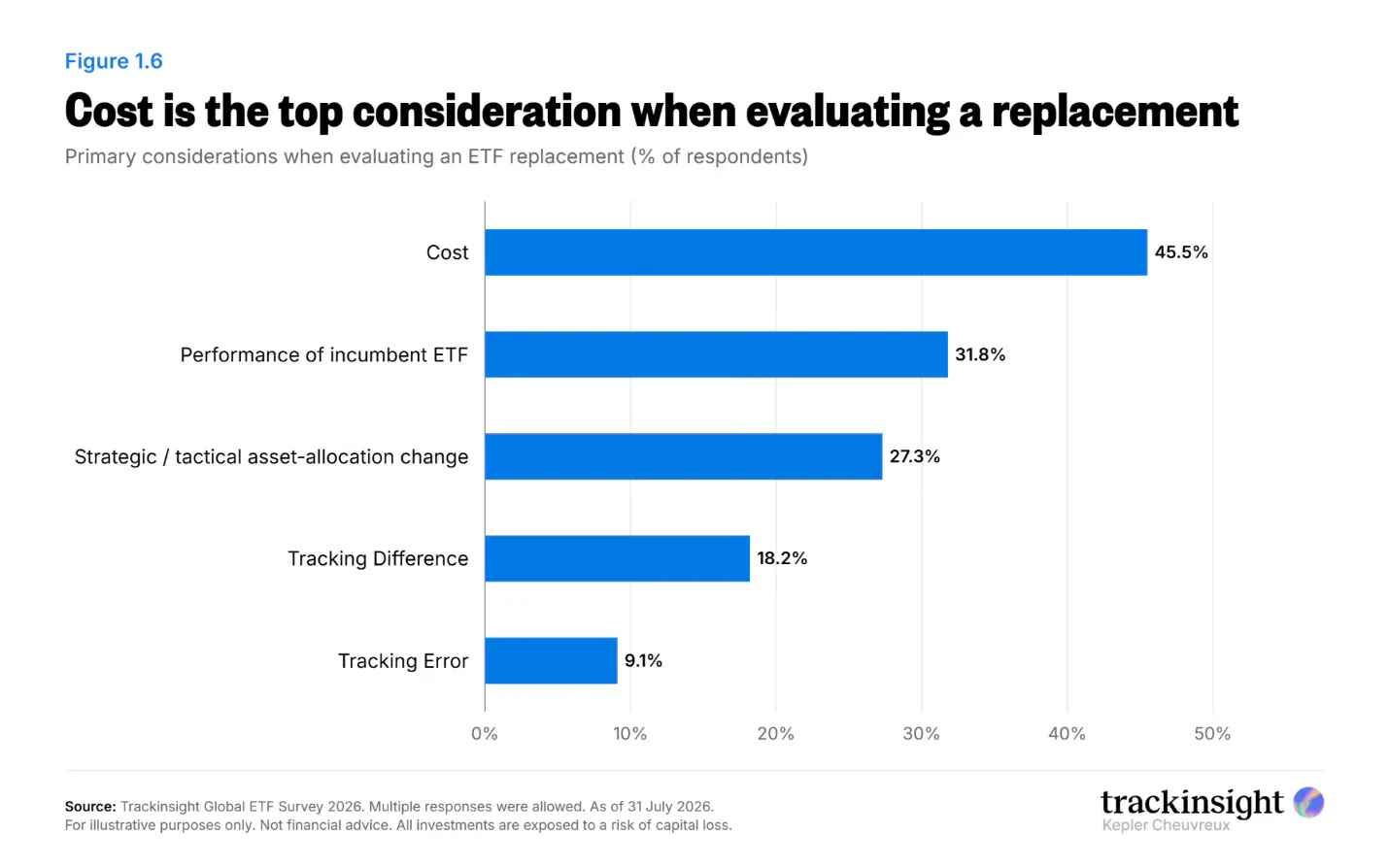
This helps explain why inexpensive, broadly diversified index ETFs remain so difficult to displace. Once an investor has established a core position in a low-cost S&P 500 fund (often with embedded capital gains), switching to another product requires a compelling justification, whether that involves lower fees, better implementation or a meaningful change in portfolio exposure.
Moreover, when asked about their primary approach to achieving equity growth, 40.4% of professional respondents selected broad-market indexes, making this the most popular choice by a considerable margin. Active stock selection came second, followed by sector and thematic strategies.
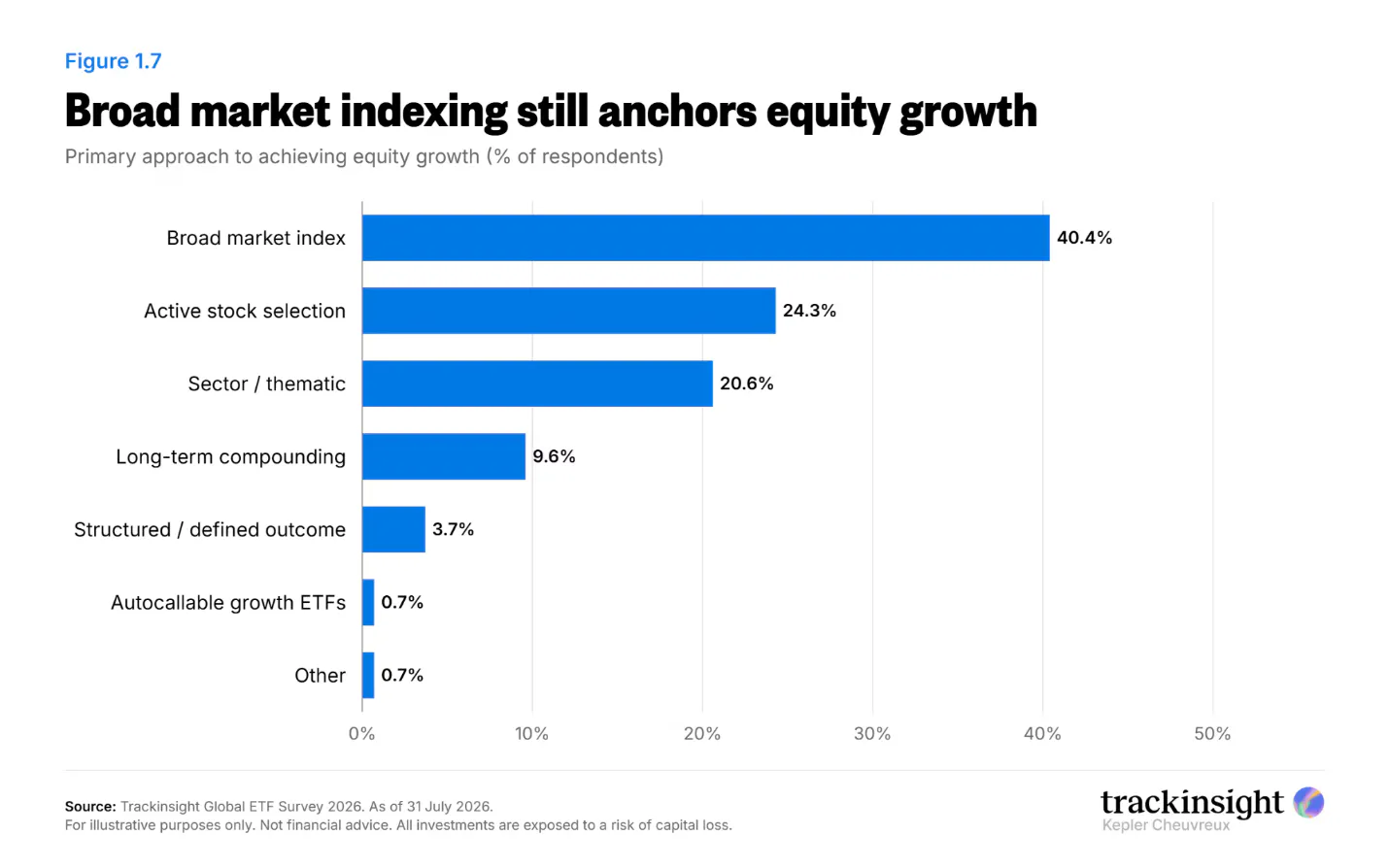
For all the attention devoted to active ETFs, thematic investing and increasingly sophisticated derivatives-based products, conventional indexing remains the preferred foundation for equity growth. However, investors also look beyond the benchmark’s name when choosing how to implement that exposure.
34.6% of respondents considered the index provider's brand somewhat important alongside other factors. Another 28.1% explicitly ranked index branding below strategy design and portfolio outcomes, while 21.3% considered issuer expertise and implementation more important.
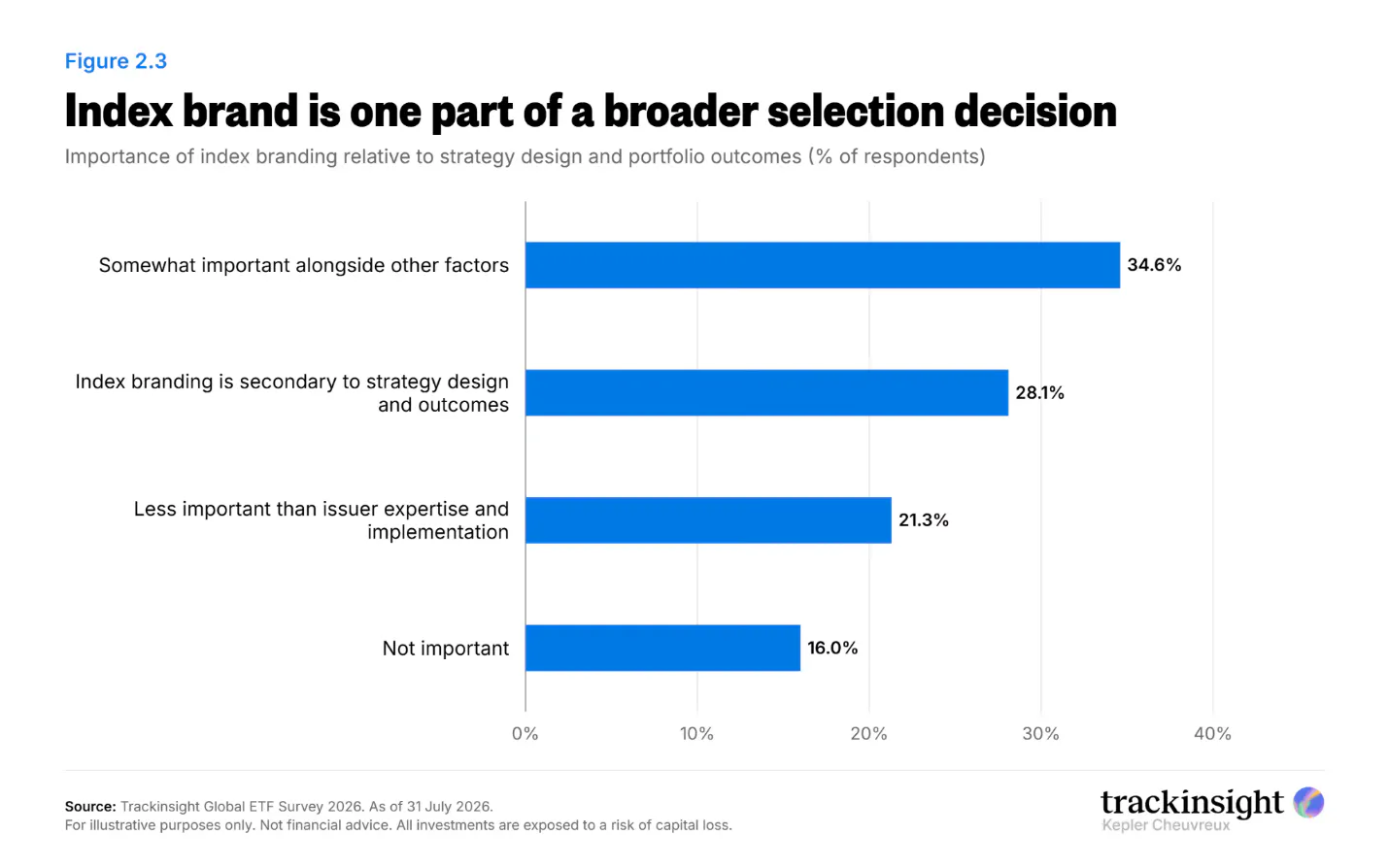
The remaining 16% said index branding was not important. Taken together, 65.4% placed index branding in a secondary position or assigned it no importance, suggesting that investors weigh benchmark reputation alongside strategy design and implementation.
I think this distinction is important. Investors clearly value the low costs, transparency and simplicity associated with passive indexing, but they are also open to different ways of building that exposure. An S&P 500 ETF may remain the default core holding, yet alternatives could still appeal to allocators seeking to address concentration risk without abandoning passive management.
The challenge for these alternatives is demonstrating that their different construction methods offer sufficient value to justify any additional costs and tracking differences. For ETF issuers, the opportunity lies in improving portfolio construction while preserving the characteristics that made broad-market indexing popular in the first place: affordability, transparency and ease of implementation.
Indexing Is a Continuum
Before examining alternatives, it's worth acknowledging why market-cap-weighted indexing has been so effective: the methodology is straightforward, inexpensive to implement and naturally efficient.
As companies appreciate in value, their index weights increase without requiring additional trading. Conversely, companies that decline in relative value gradually become smaller positions. This allows winners to run while reducing exposure to underperformers, creating an implicit momentum tilt.
Turnover is generally low, which can help minimize transaction costs and taxable capital gains. For ETF issuers, market-cap-weighted benchmarks are also relatively easy to replicate or sample, contributing to the exceptionally low expense ratios associated with many broad-market index funds.
However, moving away from market-cap weighting doesn't necessarily mean abandoning passive investing in favor of discretionary stock picking or proprietary quantitative strategies.
Indexing exists along a continuum, with considerable flexibility in how benchmarks select, weight and rebalance their constituents. Crucially, these decisions can remain transparent and rules-based, allowing investors to understand their exposures without relying on a portfolio manager's judgment.
Consider the S&P 500. Alongside the flagship market-cap-weighted benchmark, S&P Dow Jones Indices calculates variations that, in no particular order:
- Assign equal weights to all 500 constituents.⁴
- Weight companies according to their revenues rather than market capitalizations.⁵
- Screen for companies with at least 25 consecutive years of dividend increases.⁶
- Select the 80 highest-dividend-yielding constituents.⁷
- Identify the 100 least volatile stocks.⁸
- Apply a systematic covered call overlay to generate option premium income.⁹
Most of these approaches have corresponding ETFs available from established issuers. Each retains some connection to the S&P 500 universe while expressing a different view on portfolio construction.
Of course, these variations introduce their own trade-offs. Equal weighting increases exposure to smaller constituents and requires periodic rebalancing. Dividend screens can introduce sector biases, while low-volatility strategies may become concentrated in defensive industries. Covered calls can generate additional income but limit participation in strong market rallies.
The important point is that investors have more choices than simply accepting the prevailing weights of the largest companies or abandoning indexing altogether. Understand what risks a benchmark introduces, which exposures are intentional and which alternatives are available.
Market-cap weighting remains a compelling default for many investors. The opportunity for ETF issuers is to make that default an informed choice and present viable alternatives.
Sources
¹ https://www.spglobal.com/spdji/en/research-insights/spiva/
³ https://www.spglobal.com/spdji/en/indices/equity/sp-500/#data
⁴ https://www.spglobal.com/spdji/en/indices/equity/sp-500-equal-weight-index/#overview
⁵ https://www.spglobal.com/spdji/en/indices/dividends-factors/sp-500-revenue-weighted-index/#overview
⁶ https://www.spglobal.com/spdji/en/indices/dividends-factors/sp-500-dividend-aristocrats/#overview
⁷ https://www.spglobal.com/spdji/en/indices/dividends-factors/sp-500-high-dividend-index/#overview
⁸ https://www.spglobal.com/spdji/en/indices/dividends-factors/sp-500-low-volatility-index/#overview
⁹ https://www.spglobal.com/spdji/en/indices/multi-asset/sp-500-covered-call-1-otm-daily-index/
This article is part of a series drawing on findings from Trackinsight’s 2026 Global ETF Survey, sponsored by Calamos Investments and S&P Dow Jones Indices.
Please note that this article reflects the author’s personal views and does not represent the opinions of the publication or its affiliates. It is for informational purposes only and does not constitute investment advice. It is essential to seek guidance from a registered financial professional before making any investment decisions.
Latest ETF News
See all ETF news

 Advantages of ETFs over Mutual Funds1/6
Lower Costs
In this guide, we'll explore the advantages of ETFs over mutual funds, giving you valuable insights into why ETFs have gained significant popularity among investors like yourself.
Leveraged ETFs: Unlocking the Potential for Amplified Returns1/6
Understanding Leveraged ETFs
Explore leveraged ETFs: potential for amplified returns & risks. 5 ETFs to consider across equities, commodities & fixed income.
What is a Leveraged ETF?1/6
Introducing Leveraged and Inverse ETFs
In this guide, we'll dive into the world of leveraged ETFs, exploring their definition, mechanics, potential risks, and rewards.
Recent educational content
First Look ETF
First Look ETF: Conventional and Unconventional International ETFs
First Look ETF’s November episode covers record-setting ETF launches and inflows with the NYSE, William Blair’s new active international and emerging markets ETFs, and the launch of the Long Nook Uncommon Compounders ETF (LUNC).


ETF Trends
ETF Industry KPIs November 16, 2026
This week’s KPI data overview highlights key metrics and trends shaping the ETF landscape.

ETF Trends
ETF Industry KPIs November 9, 2026
This week’s KPI data overview highlights key metrics and trends shaping the ETF landscape.
ETF Trends
ETF Industry KPIs November 3, 2026
This week’s KPI data overview highlights key metrics and trends shaping the ETF landscape.