Explore professionally built ETF model portfolios. Discover now →



Why High Dividend Yield ETFs Can Be an Effective Replacement for the Value Factor
Forget the higher income potential – high yield dividend ETFs actually deliver potent value exposure.


Keep up with what matters in ETFs
Get timely ETF insights, market trends, and top ideas straight to your inbox.
Your newsletter subscriptions with us are subject to ETF Central's Privacy Policy and Terms and Conditions.
High dividend yield ETFs are often celebrated for their ability to generate steady income, which is particularly appealing to investors who appreciate seeing regular dividend payments hit their accounts.
This psychological benefit can be a strong incentive to remain invested, especially for beginners who might find the visibility of income reassuring.
However, beyond the immediate allure of these dividends, high dividend yield ETFs offer a less discussed but equally significant advantage: potent exposure to the value factor.
This is because such ETFs tend to invest in companies that are undervalued relative to their financial health and dividend payouts, making them not just tools for income but also powerful vehicles for value investing.
For instance, the WisdomTree U.S. High Dividend Fund
Like what you're reading?
Stay in the loop — get the latest ETF insights: trends, analysis, and expert picks.
How does DHS work?
Unlike typical market-cap weighted ETFs, DHS allocates its holdings based on the proportionate share of the aggregate cash dividends that each component company is projected to pay in the coming year.
This is based on the most recently declared dividends per share, which inherently steers the fund towards companies that not only pay significant dividends but are also able to sustain and potentially grow them.
To refine its selection and weighting strategy, DHS employs a "composite risk score." This score integrates assessments of value, quality, and momentum, and it's used to adjust the weightings of holdings, capped at 5% during the annual rebalance.
The quality component is measured within industry groups by examining trends in return on equity (ROE), return on assets (ROA), gross profits over assets, and cash flows over assets.
These metrics are critical as they indicate the financial health and efficiency of a company, ensuring that the high dividends are not only sustainable but are also being generated by fundamentally strong enterprises.
The inclusion of momentum—risk-adjusted total returns over historical periods of 6 and 12 months—is particularly vital in a fundamentally driven strategy. It helps ensure that the investment does not run counter to prevailing market trends, which can be a significant risk in value-driven investment strategies.
This multi-dimensional approach to selecting high-dividend-paying stocks is crucial. Relying solely on high dividend yields can lead to "value traps," where a stock's price has fallen significantly, inflating the dividend yield temporarily until a likely cut.
By integrating quality and momentum filters with dividend yield considerations, DHS provides a robust framework that mitigates these risks.
How much value exposure does DHS provide?
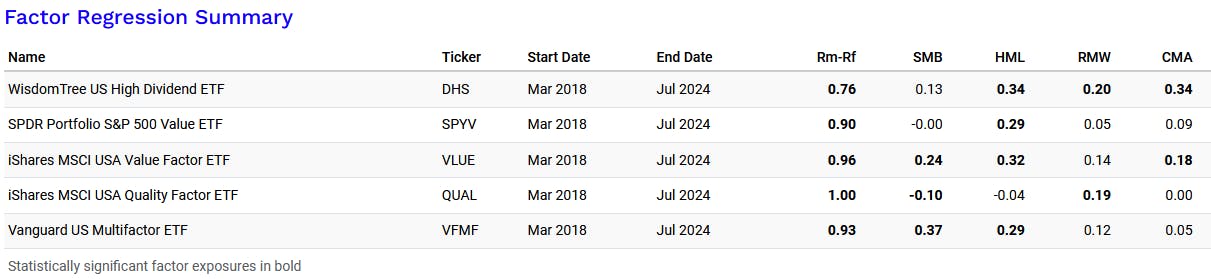
The factor regression summary presented below demonstrates the WisdomTree US High Dividend ETF
- Value Exposure (HML - High Minus Low):
- DHS shows a significant exposure to the value factor with an HML loading of 0.34. This is marginally higher than other renowned value ETFs like the SPDR Portfolio S&P 500 Value ETF SPYV-0.37%and the iShares MSCI USA Value Factor ETFVLUE+0.44%, which exhibit HML loadings of 0.29 and 0.32, respectively. Although the difference may appear modest, it indicates that DHS effectively captures the value factor, positioning it as a solid alternative or complement to these more traditional value-focused ETFs.
- Quality and Investment Factors:
- Beyond just value, DHS also incorporates a "composite risk score" that evidently contributes to palpable exposures to quality and investment factors, specifically RMW (Robust Minus Weak) and CMA (Conservative Minus Aggressive).
- RMW (0.20): This factor measures profitability, where DHS's loading of 0.20 is higher than the dedicated quality factor ETF, iShares MSCI USA Quality Factor ETF QUAL-0.25%, which has an RMW loading of 0.19. This suggests that DHS not only seeks value stocks but also those with solid profitability, enhancing its appeal to investors looking for quality in value stocks.
- CMA (0.34): Representing investment conservatism, DHS's CMA loading is significantly higher than the other ETFs listed, including the multifactor Vanguard US Multifactor ETF VFMF-0.39%, which has a CMA loading of 0.05. This highlights DHS's preference for companies that are prudent in their asset growth strategies, aligning with a lower risk profile.
This combination of exposures makes DHS not just a straightforward high-dividend yield or pure value play; it strategically targets companies exhibiting both value and quality characteristics, potentially offering a more balanced and risk-mitigated approach to value investing.
Please note this article is for information purposes only and does not in any way constitute investment advice. It is essential that you seek advice from a registered financial professional prior to making any investment decision.
Latest ETF News
See all ETF newsThese Public-Private ETFs Invest in Polymarket and Anduril

There's an ETF for That? Frontier Markets

10-Year Treasury Yield Hits 5%: Which Bond ETFs Offer the Most Direct Exposure?

ETF comparison: NEOS S&P 500 High Income ETF (SPYI) Versus Goldman Sachs S&P 500 Premium Income ETF (GPIX)




 Advantages of ETFs over Mutual Funds1/6
Lower Costs
In this guide, we'll explore the advantages of ETFs over mutual funds, giving you valuable insights into why ETFs have gained significant popularity among investors like yourself.
Leveraged ETFs: Unlocking the Potential for Amplified Returns1/6
Understanding Leveraged ETFs
Explore leveraged ETFs: potential for amplified returns & risks. 5 ETFs to consider across equities, commodities & fixed income.
What is a Leveraged ETF?1/6
Introducing Leveraged and Inverse ETFs
In this guide, we'll dive into the world of leveraged ETFs, exploring their definition, mechanics, potential risks, and rewards.
Recent educational content

ETF Trends
ETF Industry KPIs October 5, 2026
This week’s KPI data overview highlights key metrics and trends shaping the ETF landscape.

ETF Trends
ETF Industry KPIs September 28, 2026
This week’s KPI data overview highlights key metrics and trends shaping the ETF landscape.
ETF Trends
ETF Industry KPIs September 22, 2026
This week’s KPI data overview highlights key metrics and trends shaping the ETF landscape.

First Look ETF
First Look ETF: Income, Corporate Arbitrage, and Growth and Value Investing
First Look ETF September 2026: iCapital, Mast Investments and North Square unpack new ETFs targeting monthly income, merger arbitrage and complementary growth and value exposure.

Browse all educational columns



Expert-Built ETF Portfolios, All in One Place
Don’t start from scratch. Discover ready-made ETF portfolios built by professionals to match different goals, timelines, and market views. Use them as inspiration or as a starting point for your own allocation.