Create, analyze, optimize your ETF portfolio. Start now →



Why European Equity ETFs Deserve a Closer Look
Numerous structural and secular trends are propelling European equities to new highs. Here’s why U.S. investors should give them a look and reconsider their home-country bias.


Keep up with what matters in ETFs
Get timely ETF insights, market trends, and top ideas straight to your inbox.
Your newsletter subscriptions with us are subject to ETF Central's Privacy Policy and Terms and Conditions.
For over a decade, U.S. stocks have led the global markets—benefiting from American exceptionalism, a tech sector that pushed the frontier of innovation, shareholder-friendly capital markets, and relative political stability. That dominance is reflected in benchmarks like the MSCI World Index, where U.S. equities now account for just over 70% of total market capitalization as of April 29.
But the music stopped abruptly with the re-election of Donald Trump. Since taking office, the administration has alienated key trading partners and allies with sweeping tariffs, shaking investor confidence in the stability of the domestic economy, global trade, and U.S. capital markets.
Capital doesn’t wait. It’s already moving overseas, with Europe emerging as the primary beneficiary. European equities have seen a surge in both performance and investor interest. According to ETF Central, the 50 ETFs representing the “Europe Blended Cap ETFs” segment has returned 16.28% on average year to date, alongside $11.42 billion in inflows.
ETF Central “Europe Blended Cap ETFs” YTD Inflows & Performance
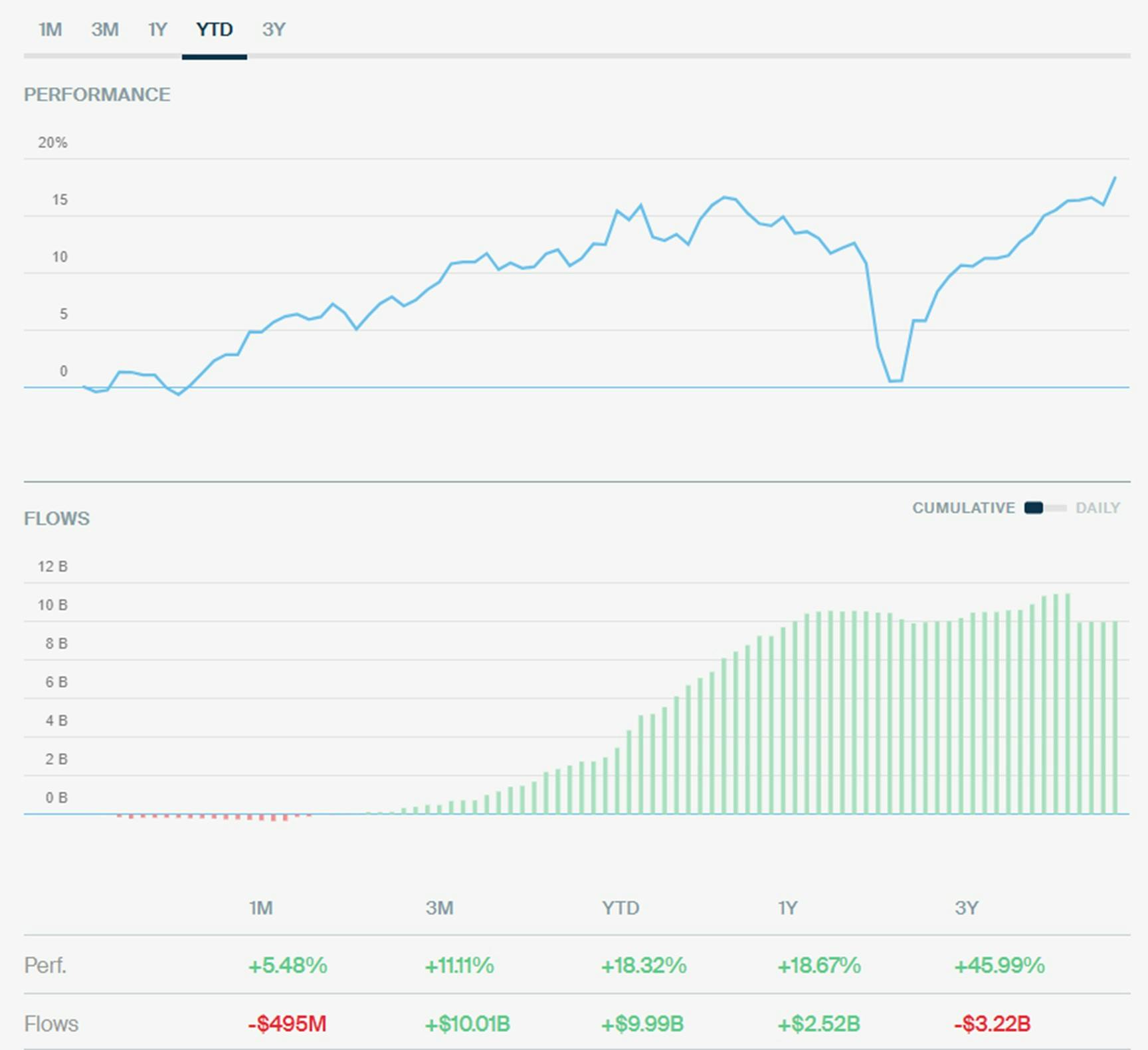
Data as of May 3, 2025.
With such strong early momentum, some investors may worry that they’ve missed the boat. I’d argue otherwise. Here’s a breakdown of the bull case for European stocks—and an ETF duo from Xtrackers that can help investors position for continued upside.
Global ETF Survey 2026 is Live!
With 1,790 new products launched by July 2026, choosing is harder than ever. Our Global ETF Survey 2026, built on 620 professional investors and allocators, shows how active, fixed income, options-based and thematic ETFs are reshaping fund selection.
What’s Behind the European Equity Surge?
According to DWS’s CIO View, the strong outperformance of European equities this year may have been sparked by the Trump administration’s policies, but it is structurally underpinned by macroeconomic changes that were already underway. Trump’s trade and foreign policy moves simply brought these shifts into sharper focus and highlighted a relatively cheap area of the global market.
Performance: European equities have underperformed the U.S. for decades. Within Europe, Germany has recently outperformed.*
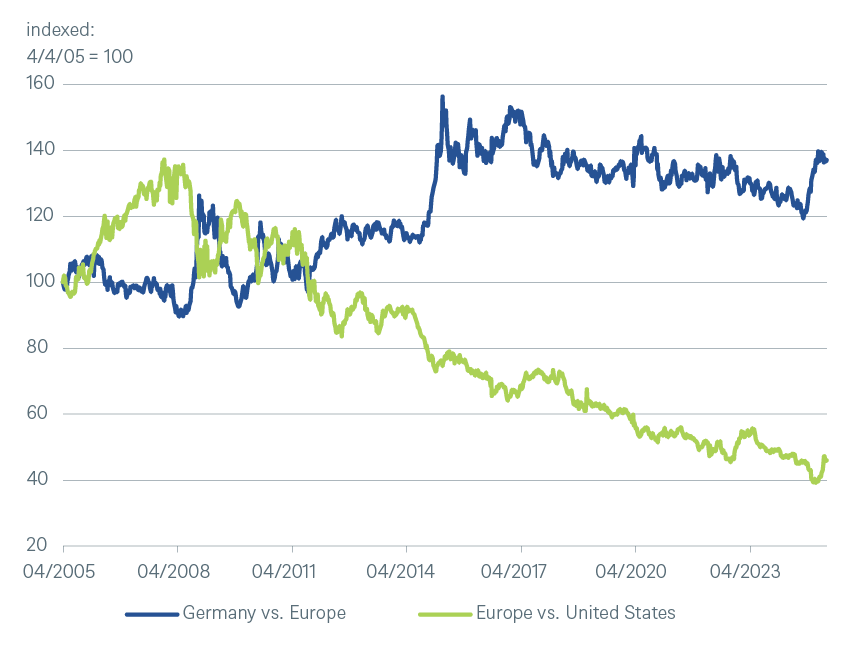
* Based on regional Datastream total return equity indices. LSEG Data and Analytics, DWS Investment GmbH as of 4/7/25
Valuation (P/E ratio): Europe is still cheap compared to the U.S., while Germany is more expensive than Europe for the first time in 15 years.*
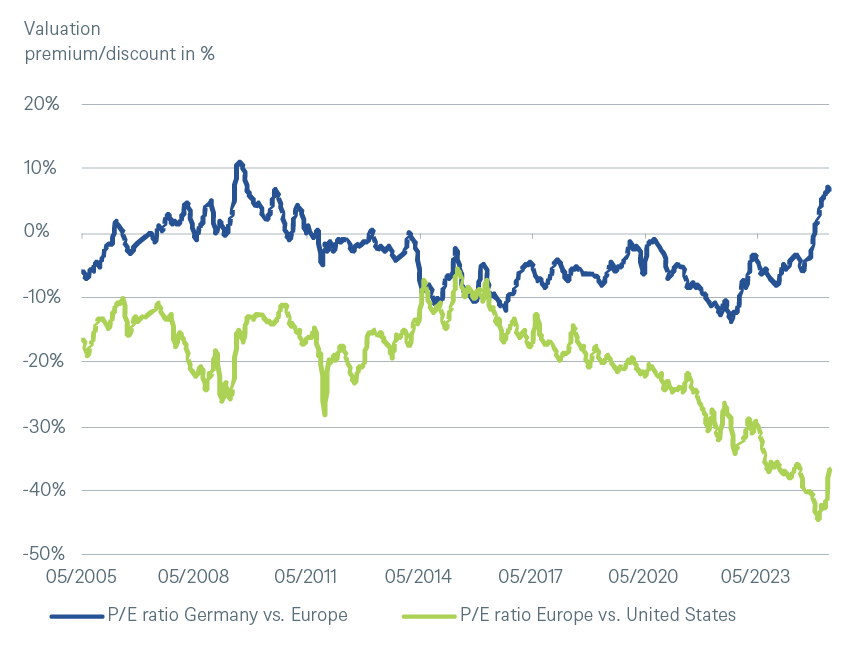
* Based on regional Datastream equity indices; Sources: LSEG Data and Analytics, DWS Investment GmbH as of 4/4/25
In particular, the administration’s hesitation to continue military aid to Ukraine under President Volodymyr Zelensky has triggered a broader mindset shift across Europe. There is now a growing consensus that Europe can no longer fully rely on the U.S. as a strategic partner.
German Chancellor Friedrich Merz cemented this trend by securing two-thirds support in the Bundestag on March 18 for a major constitutional amendment. The amendment allows the federal government to spend 300 billion euros on infrastructure and the German states another 100 billion euros.
Defense spending under NATO’s definition is set to gradually rise from 90 billion euros in 2024 to 170 billion euros by 2028, pushing it from 2% to 3.5% of GDP. Crucially, spending above 1% of GDP will be excluded when calculating the permissible new federal debt.
Additional defense and infrastructure spending could add more than 1 percentage point to GDP growth by 2027
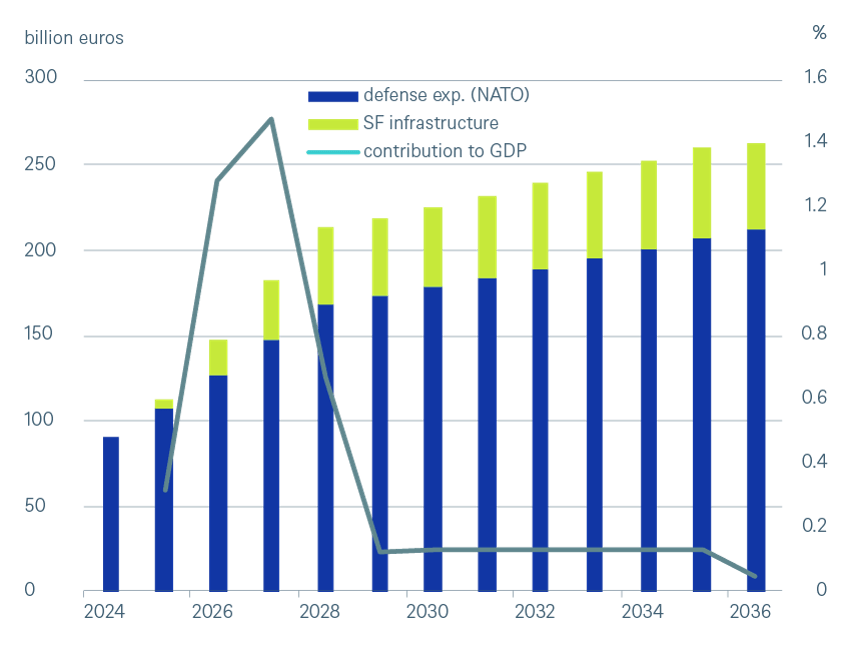
Sources: German Ministry of Defense, DWS Investment GmbH as of 4/7/25
The fiscal package hits overall underutilized capacities. But one needs to look at single sectors in Germany.
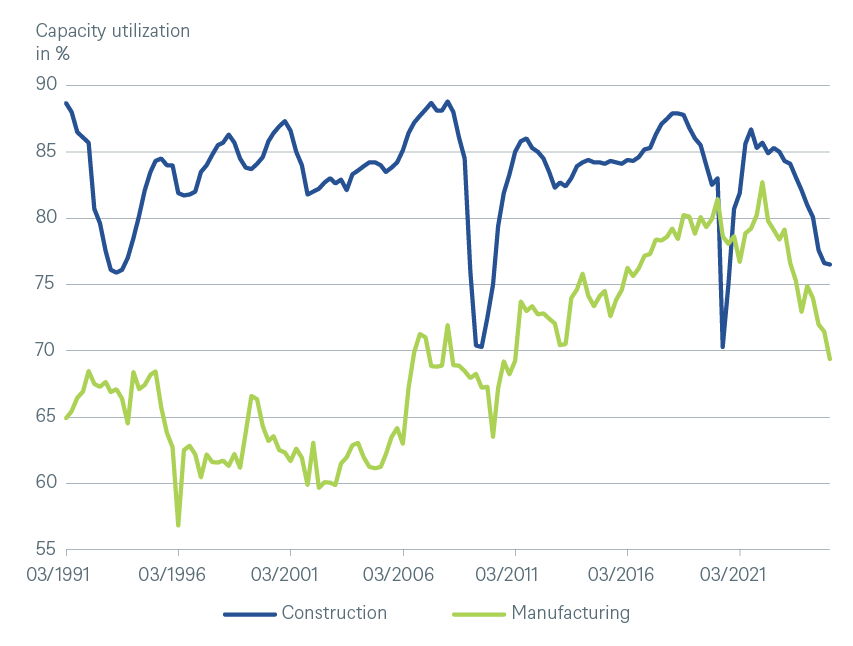
Sources: Haver Analytics, DWS Investment GmbH as of 3/31/25
DWS believes this fiscal package is bullish for Europe’s long-term growth outlook. It addresses chronic underinvestment in infrastructure and persistent labor productivity challenges, both of which have weighed on Europe’s competitiveness for years.
This is not just a German story. It is likely to reinvigorate fiscal stimulus across the broader EU, particularly through the ReArm Europe Plan and Readiness 2040 initiatives. Together, these programs represent around 800 billion euros in defense and security-related investments, including 150 billion euros earmarked for joint military procurement with an emphasis on European-made systems.
Defense companies such as Rheinmetall, Leonardo, Thales, and BAE Systems have already seen their shares surge in anticipation of this spending wave.
European rearmament has been aggressively played on the stock exchange for over two years
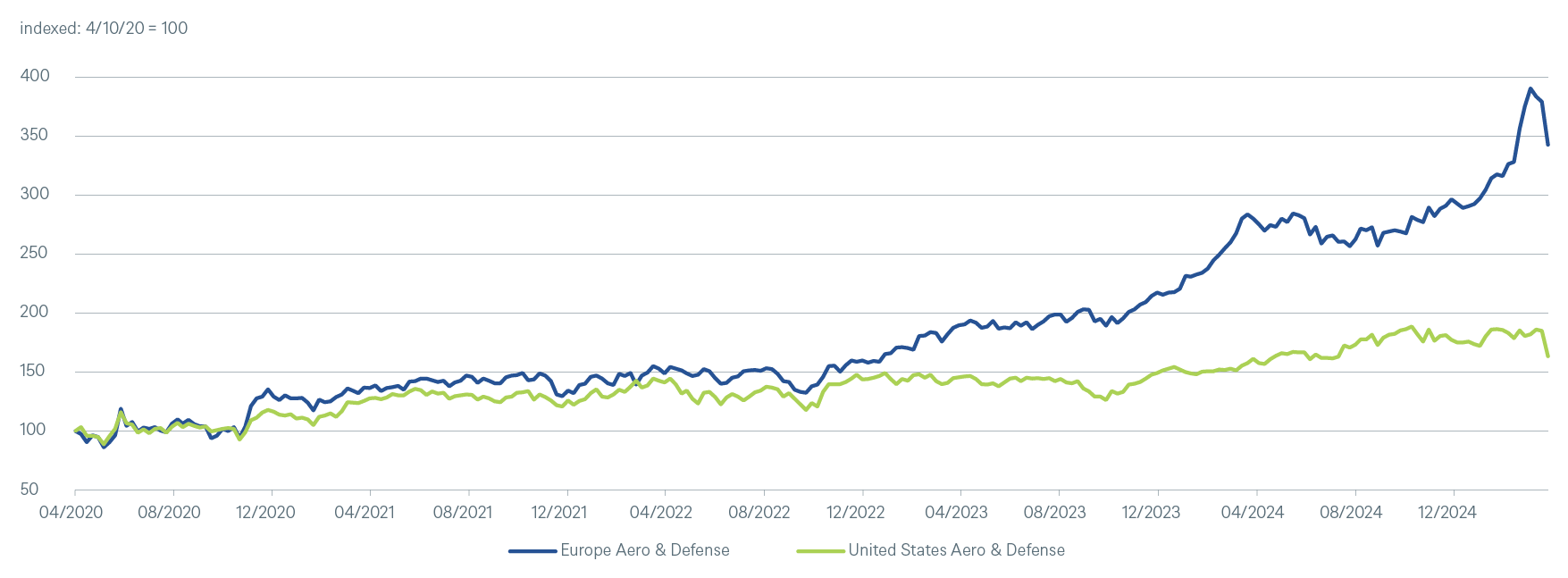
Sources: Bloomberg Finance L.P., DWS Investment GmbH as of 4/4/25
DWS’s CIO Office does not view this as a short-term reversal but a multi-year structural shift, warranting an overweight rating on European equities. With Trump still early in his four-year term and U.S. policy volatility likely to remain high, European stocks may offer investors valuable insulation and a differentiated source of growth moving forward.
Two European Equity ETFs to Watch
Xtrackers offers two standout options for U.S. investors looking to tap into European equities while mitigating currency risk: the Xtrackers MSCI Europe Hedged Equity ETF
Both ETFs carry a 0.45% expense ratio and focus on European equities, but there are important differences that new investors should be aware of.
DBEU is the broader option. It includes mid-cap and large-cap companies from the United Kingdom, Switzerland, the Nordic region, and the European Monetary Union (commonly called the eurozone), covering major economies like France, Germany, Italy, and Spain.
DBEZ, on the other hand, restricts itself to the eurozone. That means it entirely excludes exposure to the U.K. and Switzerland, which together make up about 35% of DBEU’s portfolio.
The country selection differences create noticeable sector tilts as well. Only banks and insurance are shared among the top five industry group weights of both ETFs. DBEU has greater exposure to pharmaceuticals, food, and oil and gas, while DBEZ leans more heavily into semiconductors, electrical equipment, and aerospace and defense.
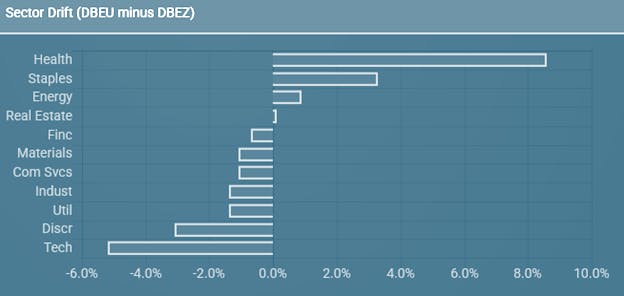
Even so, there is significant portfolio overlap. As of the latest data, DBEU and DBEZ share 212 overlapping holdings, representing 53.8% of DBEU’s 423 total holdings and 40.8% of DBEZ’s lineup.
Another important feature of both ETFs is their built-in currency hedging. This structure helps protect investors from the effects of a stronger U.S. dollar, which has faltered recently amid tariff fears but historically tends to be stronger than the euro, especially during periods of flight-to-safety flows when the dollar’s reserve currency status is most valuable.
Because of this, both ETFs have historically outperformed their unhedged counterparts—the iShares Europe ETF
DBEZ & DBEU Annualized Total Returns Versus IEV & EZU
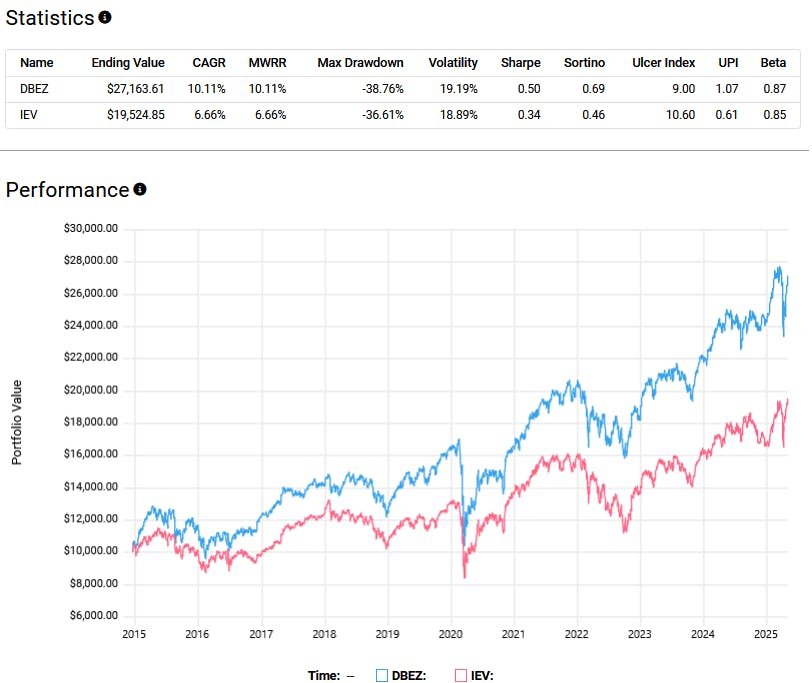
DBEZ vs IEV (Date range: 2014-12-15 - 2025-05-02)
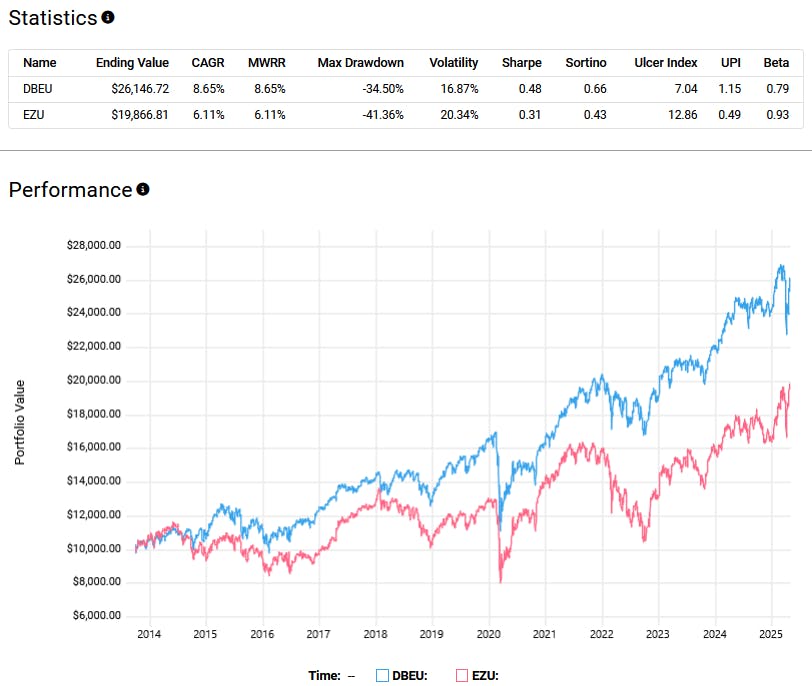
DBEU vs EZU (Date range 2013-10-01 - 2025-05-02)
Unhedged ETFs face headwinds when the dollar rises against the euro, hurting returns even if the local European markets perform well. By contrast, DBEU and DBEZ neutralize the currency impact, letting investors capture the true underlying equity performance.
The performance gap between Xtrackers’ currency-hedged ETFs (DBEU and DBEZ) and their unhedged iShares counterparts (IEV and EZU) offers a clear lesson: own European stocks, not the USD/euro currency pair.
Currency exposure is a source of uncompensated risk that can drag on returns, even when the underlying equities perform well. While the U.S. dollar has weakened year to date, you don’t want foreign exchange volatility becoming a long-term headwind to what should be a straightforward equity investment.
Please note that this article reflects the author’s personal views and does not represent the opinions of the publication or its affiliates. It is for informational purposes only and does not constitute investment advice. It is essential to seek guidance from a registered financial professional before making any investment decisions.
Segments
See all
Mentioned ETFs
Latest ETF News
See all ETF newsBeyond Big Tech: The Increasing Specialization of AI ETFs

There's an ETF for That? Humanoid Robotics and Physical AI

How Some ETF Issuers Use Their Own Funds for Cash Management

These Public-Private ETFs Invest in Polymarket and Anduril

There's an ETF for That? Frontier Markets



 Advantages of ETFs over Mutual Funds1/6
Lower Costs
In this guide, we'll explore the advantages of ETFs over mutual funds, giving you valuable insights into why ETFs have gained significant popularity among investors like yourself.
Leveraged ETFs: Unlocking the Potential for Amplified Returns1/6
Understanding Leveraged ETFs
Explore leveraged ETFs: potential for amplified returns & risks. 5 ETFs to consider across equities, commodities & fixed income.
What is a Leveraged ETF?1/6
Introducing Leveraged and Inverse ETFs
In this guide, we'll dive into the world of leveraged ETFs, exploring their definition, mechanics, potential risks, and rewards.
Recent educational content

First Look ETF
First Look ETF: Income, International, and Cash Flow ETFs
In this season 6 episode of First Look ETF, Stephanie Stanton @etfguide examines the latest ETF marketplace trends with NYSE and guests.


ETF Trends
ETF Industry KPIs October 5, 2026
This week’s KPI data overview highlights key metrics and trends shaping the ETF landscape.

ETF Trends
ETF Industry KPIs September 28, 2026
This week’s KPI data overview highlights key metrics and trends shaping the ETF landscape.
ETF Trends
ETF Industry KPIs September 22, 2026
This week’s KPI data overview highlights key metrics and trends shaping the ETF landscape.