Ready-made ETF portfolios built for real investor needs. Explore now →



Why Big Tech Is Turning to Nuclear Power — and What It Means for Cooling Infrastructure
As AI power demand surges, Big Tech is turning to nuclear energy — creating new opportunities in data center cooling and mission-critical HVAC infrastructure.

Keep up with what matters in ETFs
Get timely ETF insights, market trends, and top ideas straight to your inbox.
Your newsletter subscriptions with us are subject to ETF Central's Privacy Policy and Terms and Conditions.
The relationship between nuclear energy and data centers was, until recently, largely theoretical. Engineers and energy planners recognized the operational alignment, both environments demand uninterrupted power, extreme reliability, and continuous thermal management, but commercial ties between the two industries remained limited. That is changing rapidly, and the implications for infrastructure investors extend well beyond the utilities sector.
Global ETF Survey 2026 is Live!
With 1,790 new products launched by July 2026, choosing is harder than ever. Our Global ETF Survey 2026, built on 620 professional investors and allocators, shows how active, fixed income, options-based and thematic ETFs are reshaping fund selection.
Why Data Centers Need Firm, Continuous Power
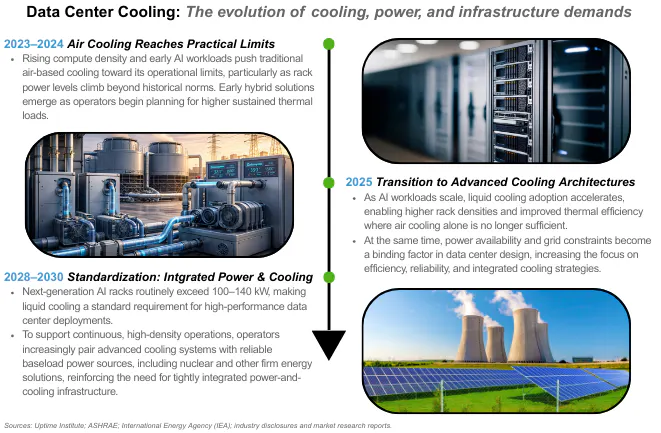
Advanced cooling systems, the infrastructure that prevents server hardware from overheating, require uninterrupted electricity. There is no tolerance for intermittency. A gap in cooling, even a brief one, can trigger hardware failures, service outages, and cascading uptime consequences. Data center operators routinely target 99.999% availability, what the industry calls "five nines", and cooling continuity is inseparable from that standard.¹
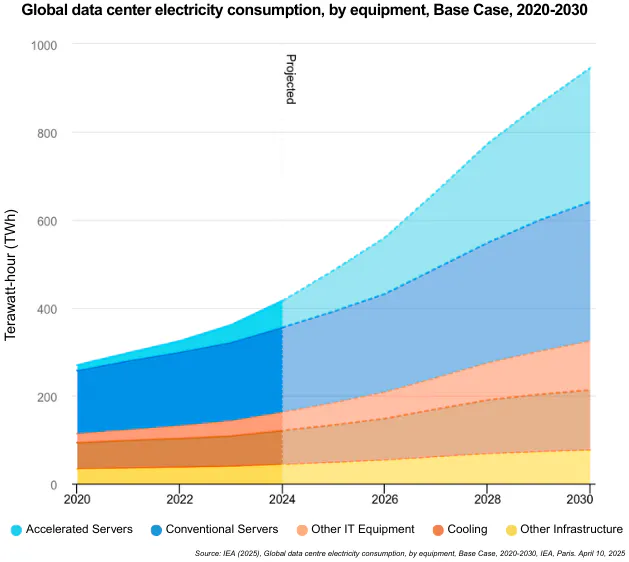
Renewable energy sources play a meaningful role in reducing carbon intensity, but their variable output creates a fundamental tension with this requirement. Solar and wind generation fluctuate with weather and time of day, making them an incomplete solution for mission-critical, round-the-clock thermal loads. As AI workloads have pushed data center power consumption to unprecedented levels, U.S. facilities used approximately 183 terawatt-hours (TWh) in 2024, more than 4% of total national electricity demand²,³, the need for a reliable baseload answer has grown more urgent. Projections indicate that figure exceeded 200 TWh by the end of 2025.⁴
Nuclear's Operational Profile Is a Near-Perfect Match
Nuclear energy offers several characteristics that align directly with the demands of high-density data center operations:
- Capacity factors consistently exceeding 95%, providing around-the-clock baseload power that supports uninterrupted cooling and compute uptime requirements.⁵
- A carbon intensity approximately 160 times lower than coal, helping hyperscalers meet sustainability and ESG targets without sacrificing reliability.⁶
- A compact physical footprint relative to output, enabling closer geographic proximity between generation assets and data center campuses, reducing transmission complexity and loss.⁷
- Operating lifespans of 60–80 years, providing long-term cost stability and allowing operators to plan power and cooling infrastructure with multi-decade certainty.⁸
- A 2025 update from the Nuclear Energy Institute added a further data point: co-located nuclear–data center projects could reduce transmission losses by 10–15%, improving overall energy efficiency and reinforcing the case for integrated power and cooling design.⁹
Hyperscalers Are Moving From Commitment to Construction
What distinguishes 2025 from prior years is that major technology companies moved beyond pledge-making into binding, long-term infrastructure commitments. The following developments reflect a structural shift in how hyperscalers are approaching power strategy:
- Microsoft entered a 20-year power purchase agreement tied to the restart of Three Mile Island Unit 1 (approximately 835 MW), with operations targeted by 2028. This represents one of the most concrete nuclear-data center linkages to date.¹⁰
- Amazon advanced plans for 12 small modular reactors (SMRs) at its Cascade facility in Washington State, targeting up to 960 MW of dedicated nuclear capacity for its data center energy supply.¹¹
- Google committed to developing approximately 1.8 GW of nuclear capacity across multiple planned U.S. reactor sites, with partnerships in place for advanced nuclear deployments expected to begin delivering power later this decade.¹⁰, ¹²
- Meta entered strategic agreements supporting the development of a 1.2 GW nuclear energy campus in Ohio, intended to provide steady baseload power for AI data center clusters, with development activity moving into 2026–27.¹¹, ¹³
- Google, Amazon, and Meta also joined an industry-wide pledge to help triple global nuclear capacity by 2050, reflecting broad alignment across hyperscalers on advancing nuclear as part of long-term power portfolios.¹¹
- Initial nuclear-supported data center projects are expected to come online between 2028 and 2030, with broader SMR deployment anticipated in the mid-2030s.¹⁴
The HVAC Dimension: Where Cooling Meets Nuclear Standards
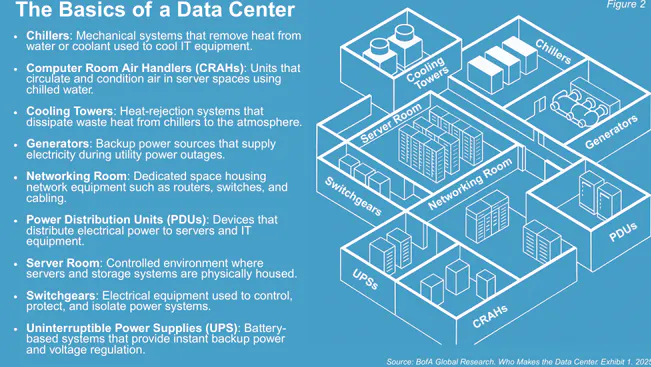
Nuclear facilities have long operated with HVAC systems engineered to the highest available standards, extensive redundancy, fail-safe design, continuous availability, and strict regulatory oversight. These systems manage heat loads across reactor buildings, control rooms, and auxiliary systems while controlling airborne contaminants and maintaining precise environmental conditions under both normal operations and contingency scenarios.
As nuclear-adjacent data center campuses advance from planning to execution, their HVAC infrastructure will be expected to meet comparable standards. The convergence of these two industries is not merely a power procurement story; it is an infrastructure design story. Cooling systems serving nuclear-powered data centers will need to satisfy both the extreme thermal demands of AI workloads and the stringent safety, redundancy, and efficiency standards already embedded in nuclear facility design.
For HVAC manufacturers with established capabilities in mission-critical environments, this represents a differentiated and durable demand signal, one that is structurally more defensible than standard commercial construction cycles.
An Infrastructure Convergence Worth Watching
The relationship between nuclear energy and data centers is progressing, with agreements in place, construction timelines outlined, and regulatory and engineering work underway. For investors, the more immediate consideration is not simply whether these sectors will intersect, but which companies may be positioned to participate as that intersection develops.
One area of potential relevance is the HVAC industry. As nuclear-powered and nuclear-adjacent data center campuses move from planning toward construction, demand for advanced, mission-critical cooling infrastructure could increase alongside them. HVAC companies that are able to meet the reliability, redundancy, and efficiency requirements of these facilities may be positioned to participate in what is expected to be a sizable and specialized procurement cycle.
The broader market backdrop provides additional context. The global data center cooling market is projected to grow from $22.13 billion in 2024 to $56.15 billion by 2030, representing a 16.4% CAGR, compared to an approximately 6.9% CAGR forecast for the overall U.S. HVAC market.¹⁵, ¹⁶ Companies with exposure to data centers, liquid cooling capabilities, and service-oriented business models may be better aligned with these trends. Some firms are already reporting growth in this area: Modine Manufacturing noted 102% year-over-year growth in data center-related sales in Q2 2025¹⁷, and Johnson Controls reported an order backlog approaching $15 billion in fiscal 2025, with data center thermal management cited as a contributing factor.¹⁸
The durability of this opportunity remains uncertain, but it is influenced by several concurrent factors, including AI-driven compute demand, evolving energy infrastructure, grid efficiency considerations, and sustainability initiatives. Together, these dynamics may support continued investment in advanced HVAC systems, though outcomes will depend on execution, policy, and broader market conditions. For investors with a long-term perspective, companies involved in thermal management for digital infrastructure may warrant consideration within a diversified approach.
The opinions expressed in this publication are those of the authors and are subject to change. They do not purport to reflect the opinions or views of ETF Central or its members. ETF central does not guarantee the accuracy, completeness, or reliability of the information provided.
Sources
1. Sustainable Development Goals Whitepaper. Kass, Susanna. Designing and Building the Next Generation of Sustainable Data Centers.
2. Pew Research Center. US Data Centers' Energy Use Amid the Artificial Intelligence Boom. October 24, 2025.
3. AEI Magazine. SolarTech. How Much Electricity Does a Data Center Use? Complete 2025 Analysis. January 1, 2026.
4. World Resources Institute. Goldsmith, Ian. Powering the US Data Center Boom: Why Forecasting Can Be So Tricky. September 17, 2025.
5. Hanwha Data Centers. 165% AI Power Surge with Renewables by 2030. July 16, 2025.
6. Pew Research Center. Leppert, Rebecca. What we know about energy use at U.S. data centers amid the AI boom. October 24, 2025.
7. North American Electric Reliability Corporation (NERC). Characteristics and Risks of Emerging Large Loads. July 2025.
8. McKinsey & Company. Long Duration Energy Storage Council. Long Duration Energy Storage for a Renewable Grid. 2021.
9. Nuclear Energy Industry (NEI). State of the Nuclear Energy Industry, Nuclear Energy Policy Forum. May 20, 2025.
10. Constellation Energy. Constellation to Launch Crane Clean Energy Center, Restoring Jobs and Carbon-Free Power to The Grid. September 20, 2024.
11. Reuters. Amazon, Google sign pledge to support tripling of nuclear energy capacity by 2050. March 14, 2025.
12. Reuters. Kearney, Lalia. Google announces Tennessee as site for advanced nuclear power plant. August 19, 2025.
13. Reuters. Meta Strikes Nuclear Power Agreements with Three Companies. January 9, 2026.
14. American Society of Civil Engineers (ASCE). Demand for data centers soars; could small modular reactors meet the need? December 17, 2025.
15. Grand View Research. Market Analysis Report. Data Center Liquid Cooling Market (2026-2033).
16. Grand View Research. U.S. HVAC Systems Market (2025 - 2033).
17. Modine. Press Release. Modine Reports Second Quarter Fiscal 2025 Results. October 29, 2025.
18. Johnson Controls. Press Release. Johnson Controls Reports Q4 and FY25 Results; Initiates FY26 Guidance. November 5, 2025.
Segments
See all
No specific market segments were tagged
Mentioned ETFs
No specific ETFs were tagged
Further reading


Latest ETF News
See all ETF newsWhat To Watch This REIT Earnings Season - Q3 2026



Your ETF Is a Tool. Investors Will Decide How to Use It.


How Much ETF Infrastructure Do You Really Need?





 Advantages of ETFs over Mutual Funds1/6
Lower Costs
In this guide, we'll explore the advantages of ETFs over mutual funds, giving you valuable insights into why ETFs have gained significant popularity among investors like yourself.
Leveraged ETFs: Unlocking the Potential for Amplified Returns1/6
Understanding Leveraged ETFs
Explore leveraged ETFs: potential for amplified returns & risks. 5 ETFs to consider across equities, commodities & fixed income.
What is a Leveraged ETF?1/6
Introducing Leveraged and Inverse ETFs
In this guide, we'll dive into the world of leveraged ETFs, exploring their definition, mechanics, potential risks, and rewards.
Recent educational content

First Look ETF
First Look ETF: Income, International, and Cash Flow ETFs
In this season 6 episode of First Look ETF, Stephanie Stanton @etfguide examines the latest ETF marketplace trends with NYSE and guests.


ETF Trends
ETF Industry KPIs October 5, 2026
This week’s KPI data overview highlights key metrics and trends shaping the ETF landscape.

ETF Trends
ETF Industry KPIs September 28, 2026
This week’s KPI data overview highlights key metrics and trends shaping the ETF landscape.
ETF Trends
ETF Industry KPIs September 22, 2026
This week’s KPI data overview highlights key metrics and trends shaping the ETF landscape.
Browse all educational columns



ETFs’ Next Act: From Access to Selection
With 1,790 new products launched by July 2026, choosing is harder than ever. Our Global ETF Survey 2026, built on 620 professional investors and allocators, shows how active, fixed income, options-based and thematic ETFs are reshaping fund selection.