Keep tabs on your favorite ETFs with a personalized weekly tracker. Create a Watchlist now →



Which ETFs Invest in Private Equities?
A handful of ETFs now include private company stakes, challenging old limits on what belongs in an ETF.


Keep up with what matters in ETFs
Get timely ETF insights, market trends, and top ideas straight to your inbox.
Your newsletter subscriptions with us are subject to ETF Central's Privacy Policy and Terms and Conditions.
The latest hot debate in the ETF industry has shifted from semi-transparent ETFs and single-stock ETFs to funds that hold private assets. State Street made headlines with the SPDR SSGA IG Public & Private Credit ETF
In the past, access to private markets was limited to interval funds, which only allowed periodic redemptions, or closed-end funds, which could trade at large premiums or discounts to NAV depending on investor sentiment. An infamous example is the Destiny Tech 100 (DXYZ), which reached a 1000% premium to NAV at the height of hype thanks to positions in SpaceX, Revolut, OpenAI, and Epic Games.
Today, ETFs are permitted to allocate up to 15% of their assets to private companies. Proponents argue this opens the door to growth opportunities once reserved for institutions, while critics worry about valuation opacity, lagging price discovery, and liquidity mismatches.
The truth will emerge over time, as trading patterns and investor flows reveal how sustainable these strategies really are. For now, here’s a look at two ETFs that make private company stakes a deliberate part of their approach.
Get data on 14,000+ ETFs
Access Trackinsight's reliable and comprehensive data with 500M+ points on 14,000+ ETFs.
Entrepreneur Private-Public Crossover ETF XOVR
XOVR is built primarily on the ER30TR Index, which emphasizes companies led by entrepreneurs. The methodology blends a bottom-up “Entrepreneur Factor®” with top-down thematic research that considers innovation cycles and sector flows.
In practice, this translates to a large-cap growth tilt, with heavy allocations to technology (about 34%) and communications (around 15%). But what makes XOVR really stand out is its 7% allocation to SpaceX, its second-largest holding.
Because SpaceX shares aren’t publicly listed, the fund gains exposure through a special purpose vehicle (SPV), specifically Astra Holdings SPV, LP. SPVs are structures that allow pooled investors to indirectly hold private company stakes without requiring direct ownership.
XOVR charges an expense ratio of 0.75%, which is fairly typical for specialized strategies and not far off what many active funds cost despite being index-based. With $356 million in assets under management, it has carved out a meaningful niche among ETFs that bridge public and private equity.
KraneShares Artificial Intelligence & Technology ETF AGIX
KraneShares launched AGIX in July 2024, and it has since grown to $74 million in assets. That’s an important milestone as crossing $50 million generally reduces the risk of closure for newer ETFs.
At first glance, AGIX looks like a standard thematic ETF. At least 80% of its assets track the Solactive Etna Artificial General Intelligence Index, which divides the AI ecosystem into three buckets: hardware, infrastructure, and applications. Companies are chosen based on an “AI Exposure Score,” which gauges how central they are to AI development and adoption.
In practice, that means holdings range from foundational model developers to firms supplying the chips, cloud capacity, and data services that make AI training and deployment possible.
One notable feature is its fifth-largest position: a 3.9% allocation to Anthropic, the AI startup best known as a rival to OpenAI. Anthropic has attracted high-profile backing from firms like Amazon and Google, making its inclusion unusual and noteworthy for a listed ETF.
The main drawback is cost. AGIX charges a 0.99% expense ratio, which is steep compared to other thematic products. I think something closer to 0.75%, in line with XOVR, could make the fund more competitive and draw stronger flows.
How liquid are these ETFs?
Liquidity is one of the main concerns with newer or more specialized ETFs. Unlike mutual funds, ETFs rely on a creation and redemption process handled by authorized participants (APs).
When demand rises, APs create new shares by delivering the underlying basket of securities, and when investors sell, APs redeem shares for that basket. In theory, this process keeps ETF prices close to their net asset value (NAV). But in stressed markets, if the underlying holdings are hard to trade or if APs step back, disconnects can emerge.
On one front, bid-ask spreads provide a good snapshot of trading costs. According to the ETF Central data, AGIX has had a 30-day median spread of 0.17% ($0.06), while XOVR’s spread was 0.09% ($0.02).
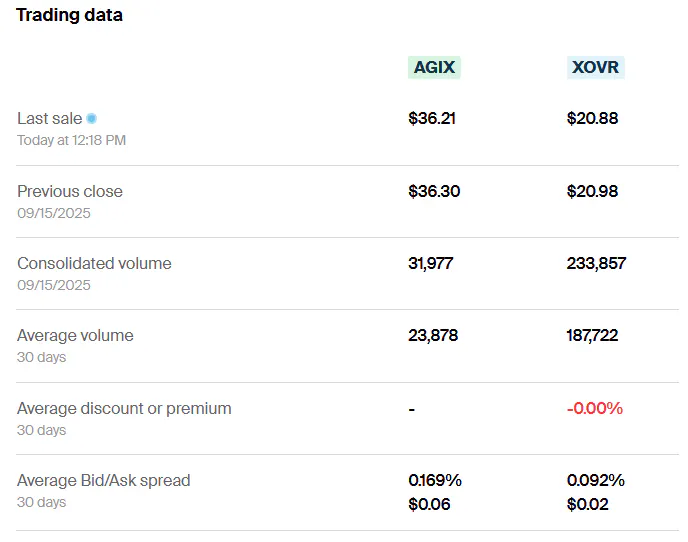
The takeaway is that spreads aren’t razor-thin like the biggest domestic equity index ETFs, but they’re also not unreasonable for funds of this size and focus. Liquidity is adequate for most investors trading in moderate sizes.
Another key metric is the premium or discount to NAV. Investors don’t transact at NAV, only at market prices, so the gap shows how well the creation/redemption mechanism is working.
Looking at the chart, XOVR has been steady, with discounts and premiums contained near ±0.5% and an average of 0.14%. AGIX has shown more noise, with frequent swings up to ±1% and the current reading around 0.39%. During the April 2025 “tariff tantrum,” AGIX even touched deeper discounts, reflecting stress in its underlying holdings.
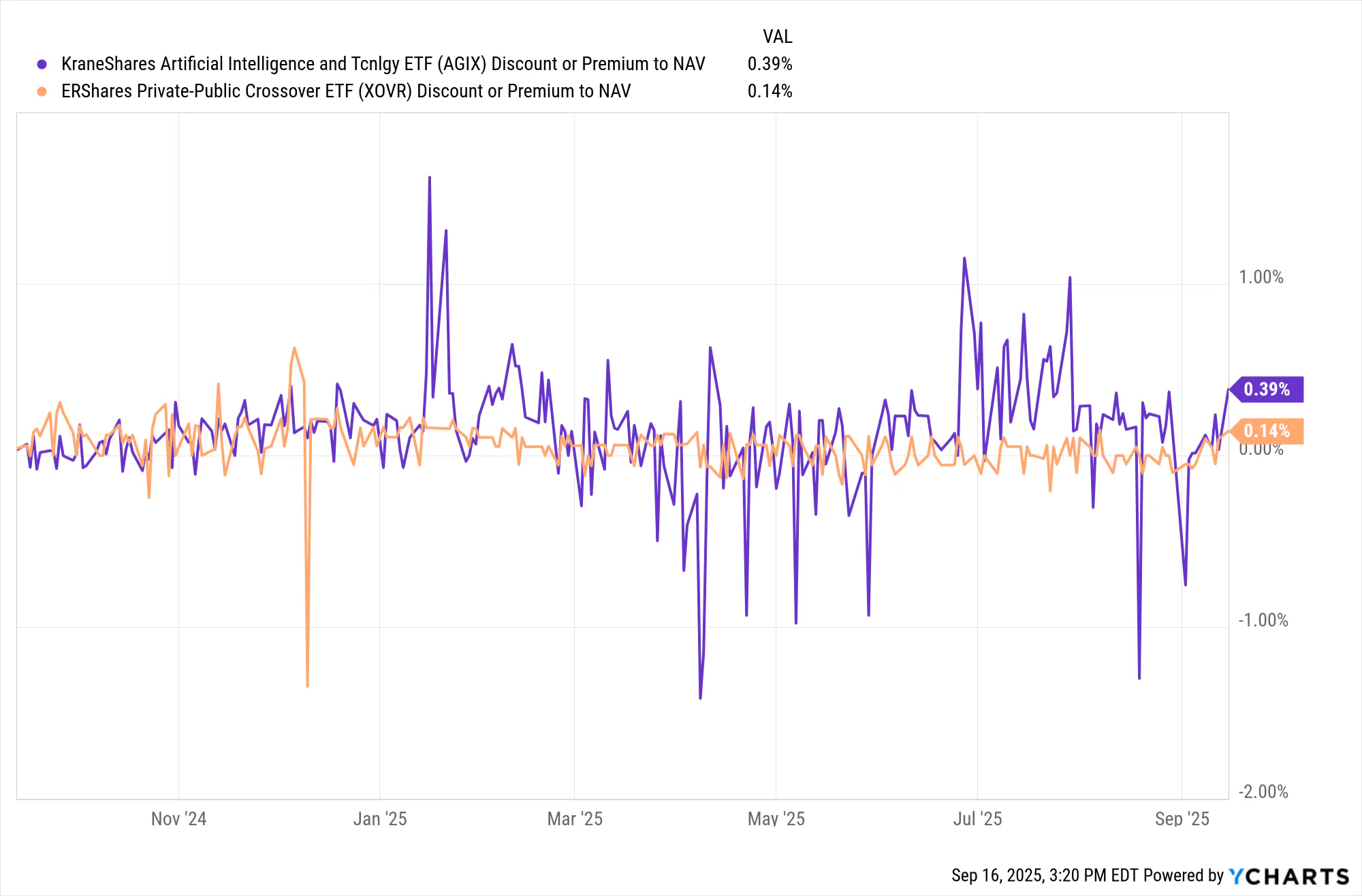
Both ETFs have so far maintained acceptable liquidity for niche products. XOVR looks tighter and more consistent, likely due to a larger asset base and steadier flows. AGIX is more volatile in its pricing, which is worth monitoring if you plan to trade in size, but nothing here suggests a structural liquidity problem.
Please note that this article reflects the author’s personal views and does not represent the opinions of the publication or its affiliates. It is for informational purposes only and does not constitute investment advice. It is essential to seek guidance from a registered financial professional before making any investment decisions.

Latest ETF News
See all ETF newsThese Public-Private ETFs Invest in Polymarket and Anduril

There's an ETF for That? Frontier Markets

10-Year Treasury Yield Hits 5%: Which Bond ETFs Offer the Most Direct Exposure?

ETF comparison: NEOS S&P 500 High Income ETF (SPYI) Versus Goldman Sachs S&P 500 Premium Income ETF (GPIX)




 Advantages of ETFs over Mutual Funds1/6
Lower Costs
In this guide, we'll explore the advantages of ETFs over mutual funds, giving you valuable insights into why ETFs have gained significant popularity among investors like yourself.
Leveraged ETFs: Unlocking the Potential for Amplified Returns1/6
Understanding Leveraged ETFs
Explore leveraged ETFs: potential for amplified returns & risks. 5 ETFs to consider across equities, commodities & fixed income.
What is a Leveraged ETF?1/6
Introducing Leveraged and Inverse ETFs
In this guide, we'll dive into the world of leveraged ETFs, exploring their definition, mechanics, potential risks, and rewards.
Recent educational content

ETF Trends
ETF Industry KPIs September 28, 2026
This week’s KPI data overview highlights key metrics and trends shaping the ETF landscape.

ETF Trends
ETF Industry KPIs September 22, 2026
This week’s KPI data overview highlights key metrics and trends shaping the ETF landscape.
First Look ETF
First Look ETF: Income, Corporate Arbitrage, and Growth and Value Investing
First Look ETF September 2026: iCapital, Mast Investments and North Square unpack new ETFs targeting monthly income, merger arbitrage and complementary growth and value exposure.

ETF Trends
ETF Industry KPIs September 14, 2026
This week’s KPI data overview highlights key metrics and trends shaping the ETF landscape.
Browse all educational columns



Build and Analyze Your ETF Portfolio Like a Pro
Create your own ETF portfolio in minutes and instantly see allocations, exposures, performance, and risk. Visualize diversification across asset classes, regions, and sectors. Stress-test ideas, compare benchmarks, and refine your strategy with professional-grade analytics.