Open Now: The Global ETF Survey Take the Survey →



What makes WisdomTree's Dividend ETFs Different?
Hint: It's a contrarian strategy called "fundamental indexing".


Keep up with what matters in ETFs
Get timely ETF insights, market trends, and top ideas straight to your inbox.
Your newsletter subscriptions with us are subject to ETF Central's Privacy Policy and Terms and Conditions.
The typical approach of most dividend ETFs can indeed seem counterintuitive. These funds often begin by identifying stocks that offer high yields or have a history of growing dividends – characteristics that suggest strong fundamentals.
However, the process often takes a contradictory turn when these stocks are then weighted based on market capitalization. I think the common practice of market-cap weighting may dilute the very essence of a dividend-focused strategy.
If the intention is to isolate stocks based on distinct fundamentals, such as higher yields or consistent dividend growth, it seems counterproductive to then give more emphasis to the largest companies, as one would in a broad market index ETF.
Similarly, an arbitrary equal weighting doesn't always align with the goal of maximizing dividend income or growth. Rather, it seems like a misguided, superficial attempt at diversification.
WisdomTree's approach stands in contrast to these methods. Known for its extensive lineup of dividend-based ETFs, WisdomTree has gained recognition by employing a strategy called "fundamental indexing." In part due to this, the firm recently hit $100 billion in AUM, a noteworthy milestone.
Let's look at how WisdomTree's contrarian approach to indexing has set them apart and what it means for investors seeking exposure to their dividend ETFs.
Get data on 14,000+ ETFs
Access Trackinsight's reliable and comprehensive data with 500M+ points on 14,000+ ETFs.
Fundamental vs market-cap weighted indexing
The widespread use of market-cap-weighted indexing in ETFs is largely due to its practical advantages. This method is cost-effective, straightforward to construct, and easy for ETF providers to license and track.
Additionally, market-cap-weighted indexes involve minimal turnover, contributing to their overall efficiency. The fundamental basis of this approach is simple: a stock’s price multiplied by its outstanding shares should reflect the market’s consensus expectations about that stock.
In contrast, fundamental indexing takes a different approach, moving beyond market capitalization as the sole criteria for stock selection and weighting.
As the name suggests, fundamental indexing focuses on a company's intrinsic financial characteristics, such as earnings, dividends, cash flow, or return on equity. These metrics are considered key indicators of a company's financial health and potential for growth.
The rationale behind fundamental indexing is based on the premise that these financial fundamentals are more indicative of a company's true value than its market capitalization.
Unlike market-cap indexing, which can sometimes overweight overvalued stocks or underweight undervalued ones based purely on market price fluctuations (the recent top-heavy nature of the Nasdaq-100 is a great example of this), fundamental indexing aims to align more closely with a company’s true underlying economic value.
It’s important to note that fundamental indexing is not the same as active management. No fund manager is making discretionary decisions about buying, selling, or rebalancing. Instead, the process remains systematic and rules-based, but the criteria for inclusion and weighting in the index are based on fundamental financial data rather than market cap alone.
In short, the belief underpinning fundamental indexing is that these financial metrics are a better predictor of a company's intrinsic value than its market capitalization.
An example with DGRW
The WisdomTree U.S. Quality Dividend Growth Fund (
- Starting Point: It begins with companies from the WisdomTree U.S. Dividend Index, specifically focusing on those with a market capitalization of $2 billion or more.
- Company Selection: Out of this group, the index picks the top 300 companies. For growth, the index looks at long-term earnings growth expectations. For quality, it examines their three-year historical average return on equity and return on assets.
- Weighting Scheme: Finally, the index weights constituents based on the dividends it's expected to pay in the upcoming year, calculated using the latest declared dividend.
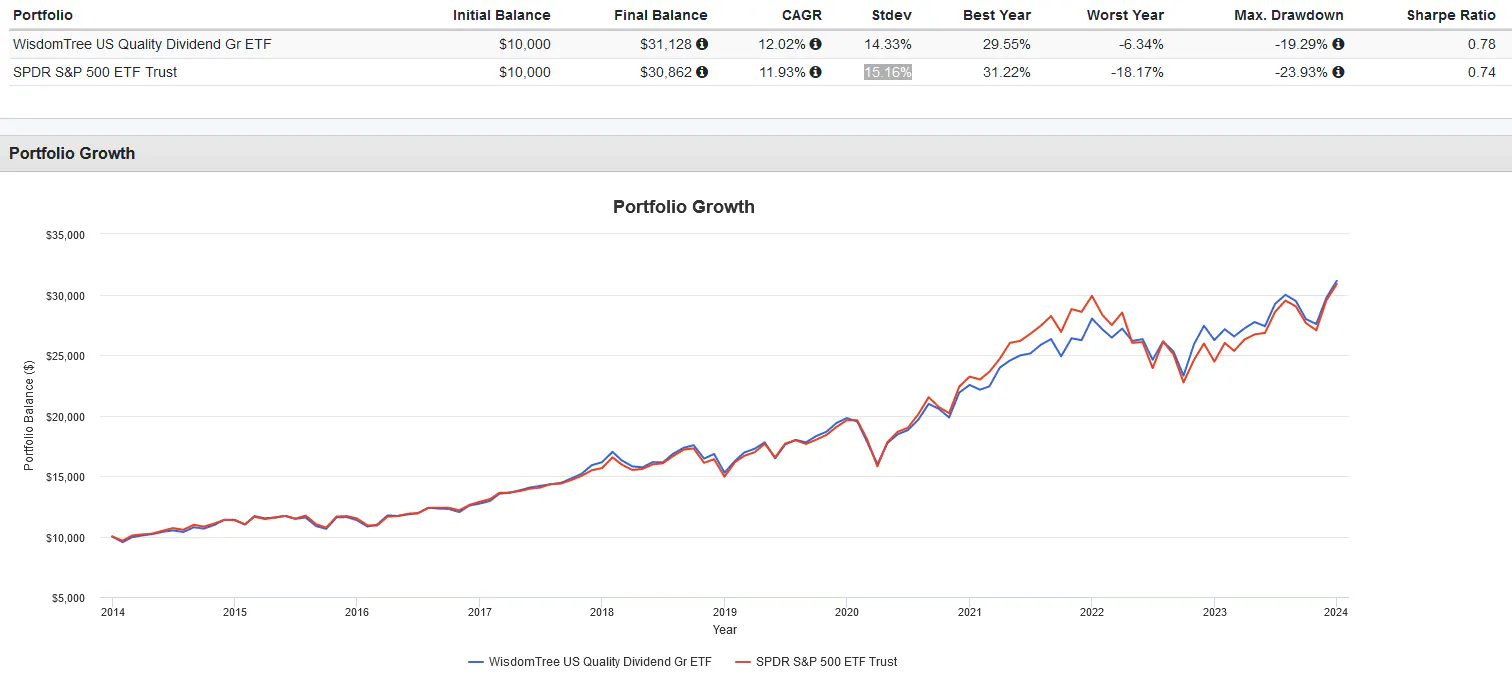
Despite a relatively higher expense ratio of 0.28%, DGRW has shown impressive performance. From 2014 to December 31, 2023, DGRW managed to outperform the SPDR S&P 500 ETF (SPY), delivering an annualized return of 12.02% compared to SPY's 11.93%.
Furthermore, DGRW exhibited a standard deviation of 14.33% versus SPY's 15.16%, indicating lower volatility. The overall risk-adjusted returns were also superior for DGRW at 0.78, compared to SPY's 0.74.
A factor regression analysis of DGRW also reveals statistically significant loadings to both the profitability (RmW) and investment (CmA) factors.

This is an important aspect for investors as it suggests that DGRW's performance can be partially attributed to its exposure to profitable companies which invest conservatively.
These loadings indicate that DGRW is not just a dividend growth play but is also effectively capturing elements of quality and growth in its selection process, validating the fundamental indexing approach used in its construction.
Please note this article is for information purposes only and does not in any way constitute investment advice. It is essential that you seek advice from a registered financial professional prior to making any investment decision.
Latest ETF News
See all ETF newsThe Two Best Types of Fixed-Income ETFs For Managing Cash

ETF Comparison: Roundhill Generative AI & Technology ETF Versus iShares A.I. Innovation and Tech Active ETF

Crypto Income ETFs: Futures, Options, or Staking?

There’s an ETF for That? Air Conditioning Stocks




 Advantages of ETFs over Mutual Funds1/6
Lower Costs
In this guide, we'll explore the advantages of ETFs over mutual funds, giving you valuable insights into why ETFs have gained significant popularity among investors like yourself.
Leveraged ETFs: Unlocking the Potential for Amplified Returns1/6
Understanding Leveraged ETFs
Explore leveraged ETFs: potential for amplified returns & risks. 5 ETFs to consider across equities, commodities & fixed income.
What is a Leveraged ETF?1/6
Introducing Leveraged and Inverse ETFs
In this guide, we'll dive into the world of leveraged ETFs, exploring their definition, mechanics, potential risks, and rewards.
Recent educational content

ETF Trends
ETF Industry KPIs July 13, 2026
This week’s KPI data overview highlights key metrics and trends shaping the ETF landscape.


First Look ETF
First Look ETF: Cash Deployment, Bond, and Hedged ETFs
In this season 6 episode of First Look ETF, Stephanie Stanton examines the latest ETF marketplace trends with NYSE and guests.

ETF Trends
ETF Industry KPIs July 6, 2026
This week’s KPI data overview highlights key metrics and trends shaping the ETF landscape.
Asset TV
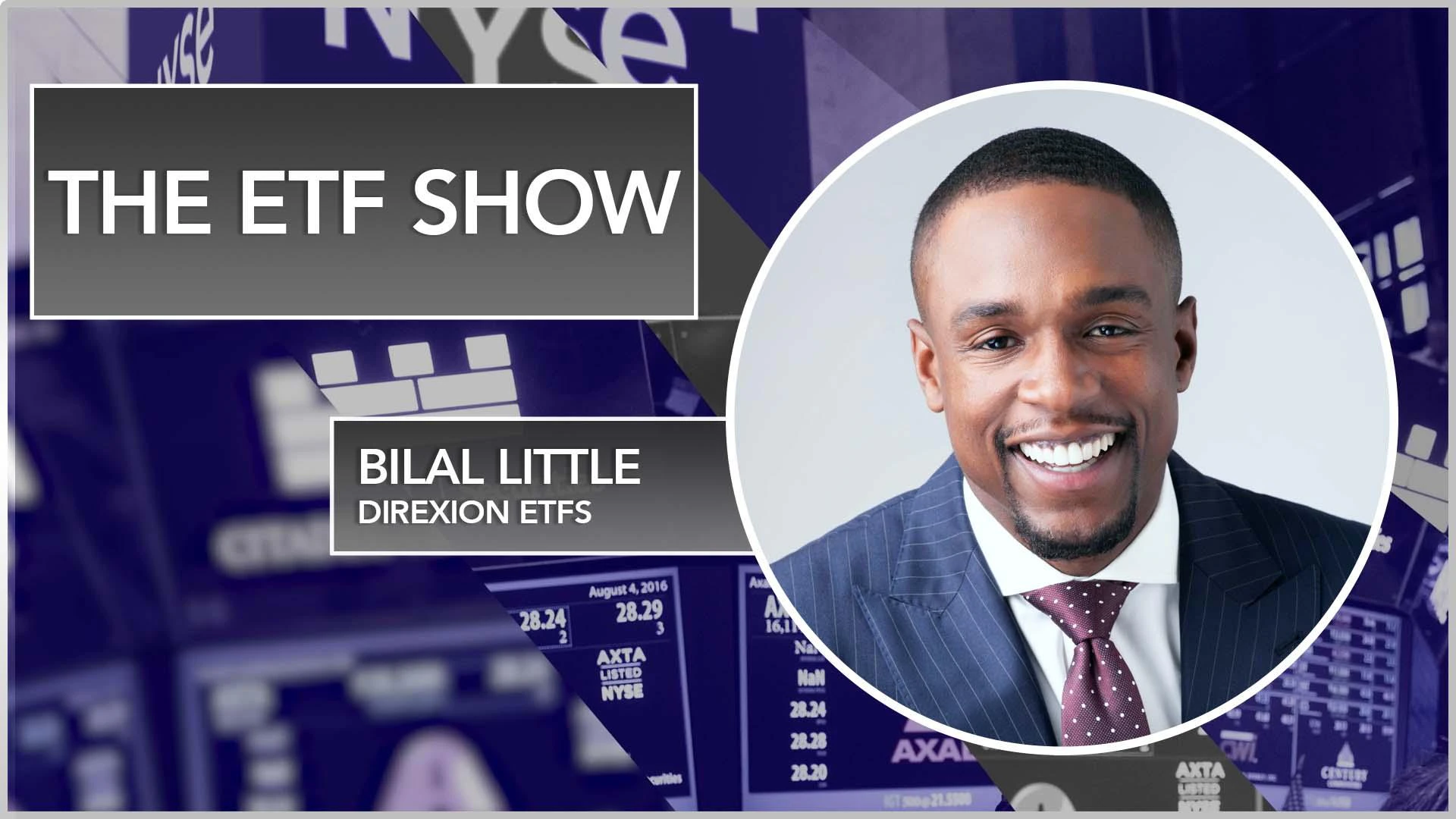
The ETF Show - The Evolution of Leveraged & Inverse ETFs
Leveraged and inverse ETFs have exploded in popularity over the past decade capturing more assets as retail traders seek to capture volatility.

Browse all educational columns



Active Trader Report: Use of Leveraged & Inverse ETFs Way Up
Direxion partnered with Compound Insights and Vanda to explore what’s driving the evolution of active trading — and how active traders are using leveraged and inverse funds across equities, single stocks, commodities, and volatility.