ETF model portfolios designed for real investor needs. Discover →



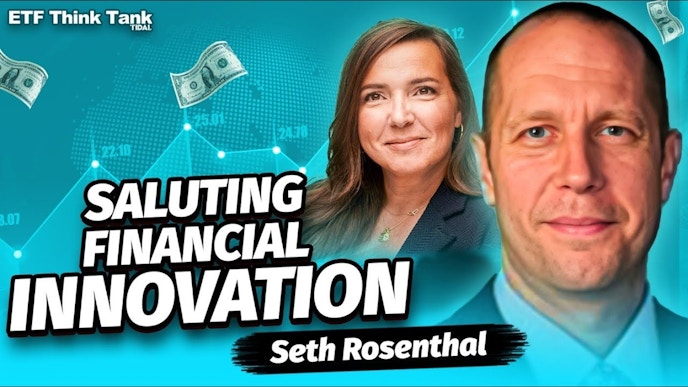
Wavemakers: Strategic Investments and Veteran Leadership: Seth Rosenthal's Guide to Management and the VETZ ETF
ETF Think Tank’s Head of Research Cinthia Murphy hosts a series about innovation, disruption and entrepreneurship in the ETF industry told first-hand by those who are leading the effort: ETF providers.

Keep up with what matters in ETFs
Get timely ETF insights, market trends, and top ideas straight to your inbox.
Your newsletter subscriptions with us are subject to ETF Central's Privacy Policy and Terms and Conditions.
The ETF industry has been in the business of disrupting and improving investor outcomes for 30 years. ETF issuers sit on the frontline of this innovation. Here they share the choices, the pivotal moments, the lessons and the battle scars that make up their journey into an industry that has democratized and revolutionized market access for investors everywhere.
Our guest this week is Seth Rosenthal, Chief Investment Officer at Academy Asset Management
Join us for a riveting conversation with Seth Rosenthal, the financial virtuoso at the helm of Academy Asset Management. Today, we unlock the untold synergy between disciplined military prowess and the high-stakes world of asset management. Seth, a beacon of investment acumen, illustrates Academy's dedication to guiding veterans as they transition from the battlefield to the boardroom. We delve into how Academy's seasoned team, which boasts the strategic acumen of retired admirals and generals, becomes instrumental in forecasting market-shifting geopolitical events. Their foresight, such as predicting the market tremors following Russia's incursion into Ukraine, proves invaluable for anyone vested in the nuances of fixed income investing. This discussion is not just about financial strategies; it's a testament to the profound impact of our veterans' skills when applied to a new mission in the civilian sector.
In the next segment, we turn to the pioneering VETZ ETF, a financial product that does more than promise returns—it stands as a pillar of support for veteran entrepreneurs. I unravel the intricate journey of bringing the ETF to life, sharing the triumphs and tribulations from securing its ticker through to its launch day on Wall Street. This isn't just an ETF; it's a commitment to social impact, with a slice of its management fees aiding veteran-focused charities. The conversation also gazes forward, speculating on the allure of mortgage-backed securities and their potential role in diversifying fixed income portfolios, especially in a volatile economic landscape. Whether you're a finance aficionado or looking to make a difference through your investments, this episode is a salute to the innovative spirit of our veterans in the financial arena.
Get data on 14,000+ ETFs
Access Trackinsight's reliable and comprehensive data with 500M+ points on 14,000+ ETFs.
Read the Full Transcript below
Cinthia Murphy (00:01):
The ETF industry has been in the business of disrupting and improving investor access for more than 30 years. ETF product providers, the issuers themselves sit on the front line of that innovation. Here, we get to hear their stories and learn what it takes to be a disruptor. This is Wavemakers. Welcome to Wavemakers, I am Cinthia Murphy, head of research for the ETF Think Tank. And today I am joined by Seth Rosenthal, chief Investment Officer of Academy Asset Management. Welcome, Seth.
Seth Rosenthal (00:39):
Thank Cinthia. Great to be here.
Cinthia Murphy (00:42):
I'm excited to talk to you today because Academy has such an interesting business and such an interesting story, and I really want to dig into that. So let's start right there. Tell us a little bit about Academy, which is a veteran-owned asset manager. How did the firm came to be? Tell us a little bit about this veteran connection. Why is that so important to you? And give us a little bit of the flavor of the firm.
Seth Rosenthal (01:10):
Great. So as you noted, Academy Asset Management is a veteran-owned asset manager, and our focus really is on authenticity and capability. So we were launched on the heels of success in the investment banking and broker dealer space from our sister company Academy Securities. And so our mission authenticity capability, and so let's unpack the authenticity piece for a bit. So mission is to mentor, hire and train veterans. We pair Wall Street veterans to coach and mentor military veterans until they build the skills to be successful on Wall Street. We target a 50% veteran staffing level. And it's really difficult when you're transitioning out of the military.
(01:58):
There's a huge challenge with veteran unemployment and underemployment every year it's estimated about 250,000 service members are transitioning out of the military, but there really are limited opportunities for veterans, especially in industries that aren't necessarily connected to the government. So you think about a veteran's resume as they're coming out of the service, they're used to the team environment, but if you look at a resume, it's more about the team and it's really difficult for them to say I, and they're always crediting the team. So we think we have a unique perspective and able to dissect that and see through some of those things as we look at a resume. And then the other thing around veterans, they have a unique skillset that translates really well into asset management.
(02:52):
On the capability side, we've got an investment team that has decades of experience in managing large pools of fixed income assets coming from well-respected institutions. And we have this geopolitical intelligence group that is made of 18 retired admirals and generals, which really have their finger on the pulse as it relates to geo-strategic risks, and their impact on capital markets. So this unique insight really helps us shape our investment thesis. And if you reflect over the past few years, quite often, market sentiment is hinging on these geopolitical outcomes and second order effects.
(03:36):
So we really think it's a really unique offering that helps shape our investment thesis and is also there for our clients as they think about how they manage risk. Just to kind of transition how we got in into asset management, our sister company, as I mentioned, Academy Securities, a few years ago partnered with JPMorgan to launch a few money market share classes and as our CEO, Chance Mims and was working with JPMorgan leadership. The thought was if you get it to $2 billion, it's a home run. Well, fast-forward to where we're at today is we got the 16 billion. And so that really led Chance and the team to say, "How do we look to do this in house and how do we be even more impactful to our mission?" And that is really us launching Academy Asset Management and us managing the efforts ourselves.
Cinthia Murphy (04:40):
I love everything about the story. First of all, total respect for the mission. I think it's so cool the connection of veterans to Wall Street. So thank you for doing that. I think it's very, very cool. On the geopolitical intelligence team, from a fixed income investor perspective, which is what Academy is an expert on, how does that geopolitical expertise, the finger on the pulse of the world's problems really inform fixed income investing on the day-to-day. Walk us a little bit about that plumbing right there.
Seth Rosenthal (05:18):
Yeah, so I'd give you a story. We talked about it shaping our investment thesis. So if you rewind the clock back to 2022 when Russia was about to invade Ukraine, I'd say first of all, the market anticipated it was just posturing. They're not going to invade. And our gig, as we call it geopolitical intelligence group, they said, "No, they're going in and they don't line up tanks on the border for nothing." And so they called that piece and then we started talking about what are the derivative effects of that. So thinking about the disruption to commodity markets as well as the impact to energy sanctions, things like that. And really let us say there's a potential for inflation to have a pretty big impact.
(06:11):
And if you think about how the market thought about that and they didn't really see this coming, but this unique impact actually allowed us to position our portfolios appropriately because the market wasn't anticipating that the carry through to inflation. And geopolitical risk has been elevated. It's more elevated now than it's been in a long time. So we think it really has a high probability to disrupt the global economy. What's unique is I can call up any of our admiral and generals, a have them must be dial and I can call them at any time and what are you thinking about this event or that event? So to me is a really unique capability that we have that we believe no one else has.
Cinthia Murphy (06:58):
Yeah, you don't hear, we generally throw around the concept of geopolitical risk when we're talking about portfolios, but we usually are talking about PE or these other metrics of evaluating opportunities. So I think it's really an interesting value prop here to really have an expert focus on that. It's super unique. I don't know anybody else who's doing that.
Seth Rosenthal (07:25):
No, we don't. It's definitely a unique, and it's great as we have these conversations with clients and we walk into meetings and they're typically an hour long and then you got to get to the next meeting and it's like these things could go on for hours. So it's a unique group and they're handpicked and we're really... It's just an awesome [inaudible 00:07:49].
Cinthia Murphy (07:50):
So Seth, you guys recently got into the ETF world, and so let's talk a little bit about that. Let's first talk a little bit about just the concept of an ETF as a product, as a structure that enables you to share your value prop with the world. With an ETF... And we'll talk about the strategy later, but with an ETF, you're kind of opening the doors to everyone out in the market to access to your specific view of the world investment philosophy and all that. How did you get that? What was that decision line to come to an ETF? Was the idea to just broaden access? Was the idea that are you focused on the veteran community and you want to broaden that exposure? I mean, talk to us about how you came to the ETF structure.
Seth Rosenthal (08:42):
Yeah, great quick question. So our predominant focus out of the gate was really fixed income separately managed accounts for large institutional investors, really leveraging my experience over the 25 plus years in running fixed income portfolios. So as we were having conversations about different SMA strategies that would fit that experience, we actually had a client and said, "I love the mission. How do I create an FMA that aligns for that mission?" So we took the homework assignment away and we came back with this veteran impact SMA strategy that was lending to veterans through residential mortgages as well as small business loans to veteran owned businesses.
(09:34):
And they loved it. And so kind of fast forwarding, we're having more conversations with other clients and prospects and one of our insurance companies said... One of the insurance companies that we're talking to said, "For us to do this in estimate format, probably not going to work, but if you ever do it in ETF, we'd love to be involved." So fast-forward to where we're at today, everything from reserving the ticker to selecting an LLM to all those elements, we're really tided of the progress and it really credits to this particular client who challenged us. And it's really resonating with a lot of folks as we talked about.
Cinthia Murphy (10:24):
Was the process to launch an ETF easier than you guys expected? Was it harder? What was that journey like?
Seth Rosenthal (10:33):
Yeah, I'd say a little bit of both. But the thing that I found interesting is while it's a competitive landscape, everyone is really willing to help out, right? So we had great support from Title, from our lead market maker, Gene Street, to the New York Stock Exchange where we're listed. I mean, all in all... And then the interesting thing is after we launched, there were actually a couple of ETF experts that love it, this is a great idea and here's some ideas to think about. So it's extremely competitive space, but people are willing to help, because I think we all want the ETF industry to grow.
Cinthia Murphy (11:24):
Yeah, it's funny because it's something that we're all in awe about this space, but this kind of collaborative competition really is the flavor that permeates everything we do. And I think that's very unique to the ETF industry. It's a good place to be, that's for sure.
Seth Rosenthal (11:40):
I agree.
Cinthia Murphy (11:41):
So let's talk a little bit about this strategy itself. Veteran loans, it's not something that you hear a lot of people talk about. So what exactly is the vets? Is the E-T-F V-E-T-Z, let's talk a little bit about what the strategy actually is. Why is military and service people landing an interesting investment space?
Seth Rosenthal (12:08):
So vets allows investors to gain exposure to agency mortgage-backed securities and asset-backed securities, but at the same time delivering impact to veterans. And the unique element here is we also provide a... We're able to support veterans but also deliver market-based returns. So you think about many impact strategies, they require some type of market concession, but this does not. And really we're impacting veterans in three different ways. So the first is we are investing in pools of residential mortgages and small business loans to veterans and active duty service members. Just to highlight around on the small businesses, according to the Small Business Association, veterans own about 2 million small businesses and employ five and a half million people.
(13:04):
So that's a huge impact the economy. And if we can help facilitate that, it's something that we think is additive. And then a couple other ways that we're impacting veterans is this grows in AUM. We talked earlier about our mission to mentor higher and trained veterans. If this strategy grows, it'll allow us to continue on that and hire more veterans to fulfill that mission. And then the third component of impact is at Academy we've committed to donate a portion of the management fee to veteran and military related charities. And we're really excited about that we've announced that we're partnering with the Bob Woodruff Foundation to help facilitate that.
Cinthia Murphy (13:52):
What has been the most challenging part about growing this ETF right out of the gates? It sounds like it's such a compelling story, so I'm assuming telling this story is not difficult or is it difficult? How are advisors interacting with the story?
Seth Rosenthal (14:11):
Yeah. I mean, I'd say the biggest thing is obviously we're not the largest ETF issuer out there. It's our first. So to me it's about getting the message out and you're not going to find vets unless you get the message out and people hear the story. So you could have all the performance in the world and everything else and have the greatest idea, but if people don't know about it, so for us is getting that message out and really try to spread the word.
Cinthia Murphy (14:45):
Seth, as we wrap up, putting on your CIO hat for a moment, and we're about to enter 2024, what's the key to your outlook at the moment? Where's the opportunity or the concern when it comes to fixed income investing? What's on your radar as we flip to the new year?
Seth Rosenthal (15:07):
Yeah. So I mean, if you think about that, I think it fits a number of different places. Obviously, diversification is really important. So as you think about reducing corollary risk in the current environment, adding MBS to your portfolio, we believe is pretty attractive. Historically, during volatile environments, mortgage backed securities and aspect securities have exhibited low correlations to the S&P 500 and even investment grade bond indices. And candidly, even just looking over the past few months with all those volatility, the MBS indices have outperformed the ag. We think you could use vets as an allocation to your broader fixed income portfolio. MBS is about 25% of the ag, but compared to that index, MBS provides a pickup and yield with similar duration. So thinking about that, and then you also could just have a discretionary allocation to MBS, right? So we see value given that spread relative to other after classes and based on history.
(16:27):
And I think a lot of the concern around mortgage backed securities and prepayment risk or extension risk, but we're in an interesting sweet spot, at least from our perspective today in that by our estimate, mortgage rates could fall over 200 basis points and still over 80% of the mortgage markets still wouldn't have the incentive of the refinance. So you're able to navigate that [inaudible 00:16:54] and just the fact that the majority of the mortgage universe is well out of the money. So we think all in all those are great. And then I guess the last thing would be is if you have MBF holdings and you want to use vets, which gives you that added impact to supporting veterans, but you still get the marketplace returns. So those are some places where we think we see value and we think we've timed the launch of vets in an appropriate way.
Cinthia Murphy (17:28):
Yeah. No, it's a really, really cool product. Seth, thank you so much for joining. Congratulations on the launch. We don't often hear the story of fixed income and impact together. I think it's a beautiful story. So welcome to the ETF world and we'll be watching the fund and what Academy brings on next. So congratulations and thanks for coming on the show.
Seth Rosenthal (17:53):
Thank you very much. Appreciate you having me.
Segments
See all
Mentioned ETFs
Further reading

Latest ETF News
See all ETF newsThis is How Calamos Turned Wall Street’s $100 Billion Secret Into an ETF


AAM’s Chandler Nichols on Making ETFs Work for Advisors and Investors


From Dot-Com to ETFs: How One Entrepreneur Helped Spark an Investment Revolution
How Blossom Social Is Revolutionizing Retail Investing and ETF Marketing

Is 2025 the Year for Financing Food Fast?


 Advantages of ETFs over Mutual Funds1/6
Lower Costs
In this guide, we'll explore the advantages of ETFs over mutual funds, giving you valuable insights into why ETFs have gained significant popularity among investors like yourself.
Leveraged ETFs: Unlocking the Potential for Amplified Returns1/6
Understanding Leveraged ETFs
Explore leveraged ETFs: potential for amplified returns & risks. 5 ETFs to consider across equities, commodities & fixed income.
What is a Leveraged ETF?1/6
Introducing Leveraged and Inverse ETFs
In this guide, we'll dive into the world of leveraged ETFs, exploring their definition, mechanics, potential risks, and rewards.
Recent educational content
Asset TV
The ETF Show - Investors Can Fight Healthcare Inflation with Newly Launched ETFs
Adam Schenck, Principal and Managing Director of Fund Services at Milliman joined The ETF Show to discuss Milliman's first ETFs designed to hedge against rising healthcare inflation.


ETF Trends
ETF Industry KPIs April 20, 2026
The ETF Industry saw 14 New Launches, 1 Ticker Change and 16 closures last week.

Asset TV
The ETF Show - Investors Run to Cash Alternatives as Markets Remain Volatile
Jason England, Portfolio Manager and Fixed Income Strategist from Simplify joined The ETF Show to discuss investor allocations to fixed income as markets continue on their rollercoaster ride.
ETF Trends
ETF Industry KPIs March 30, 2026
The ETF Industry saw 33 New Launches, 1 Ticker Change and 9 closures last week.
Browse all educational columns



Active Trader Report: Use of Leveraged & Inverse ETFs Way Up
Direxion partnered with Compound Insights and Vanda to explore what’s driving the evolution of active trading — and how active traders are using leveraged and inverse funds across equities, single stocks, commodities, and volatility.