From idea to ETF portfolio in minutes. Build yours now →



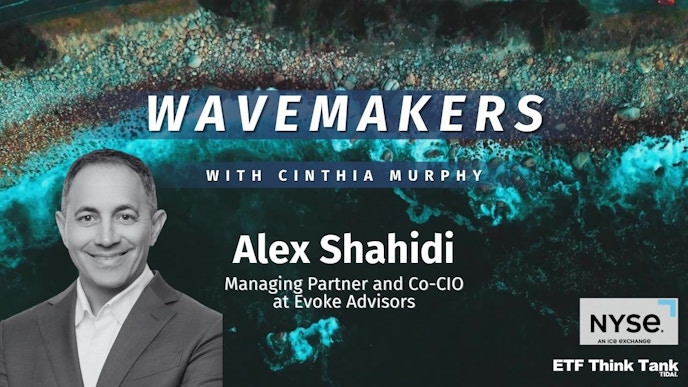
Wavemakers: Mastering Risk Parity with Alex Shahidi
ETF Think Tank’s Head of Research Cinthia Murphy hosts a series about innovation, disruption and entrepreneurship in the ETF industry told first-hand by those who are leading the effort: ETF providers.

Keep up with what matters in ETFs
Get timely ETF insights, market trends, and top ideas straight to your inbox.
Your newsletter subscriptions with us are subject to ETF Central's Privacy Policy and Terms and Conditions.
The ETF industry has been in the business of disrupting and improving investor outcomes for 30 years. ETF issuers sit on the frontline of this innovation. Here they share the choices, the pivotal moments, the lessons and the battle scars that make up their journey into an industry that has democratized and revolutionized market access for investors everywhere.
Our guest this week is Alex Shahidi, co-CEO and managing partner at Evoke Advisors.
Like what you're reading?
Stay in the loop — get the latest ETF insights: trends, analysis, and expert picks.
In this episode, Alex tells us about the power of true diversification and risk management, and how ETFs are a tool for that:
- Advisors get a lot of heat for a sales culture, which isn’t always best for the client, but sales skills are key for growth, especially given market randomness.
- The ETF wrapper is the most tax efficient way to achieve broad diversification at a low cost. It delivers ‘structural alpha’ like no other vehicle.
- ETFs remain underused as a total portfolio solution across advisory space because what’s ideal on paper may not be optimal in practice. Advisors need to optimize for real life.
Watch the episode here:
Cinthia Murphy: Hi Alex. You’ve had a really interesting journey into the industry. There you were at Merrill Lynch working with institutional clients, and then in 2014 you started a firm called ARIS, which in 2020 merged with EVOKE Advisors. Walk us through that journey. What was the opportunity you saw or the problem you were trying to solve that led you to create ARIS?
Alex Shahidi: It’s a great question. I was at Merrill Lynch for 15 years, and I'd say after the first year or so I discovered that our industry is more of a sales industry; not really an investment industry. And I'm not a salesperson at all – anybody who knows me knows that's one of the things that I'm definitely not. I think of myself more as an analyst, and I feel that my responsibility is to give the best investment advice to clients. That's what all advisors should be doing, and it doesn't help the clients if you're a good salesperson.
So, early on I realized that I wasn't the right fit for that industry. I saw myself as an RIA trapped within a brokerage firm. That's how I felt. And for 15 years, I operated under that setup. But what worked well is I was able to effectively operate like an RIA within a brokerage firm.
When I was there, I hardly used Merrill Lynch as a custodian. I didn't use their research and their products. I just happened to work there. I wasn't a typical Merrill Lynch financial advisor. For years, clients were asking me, ‘Well, why are you even at Merrill Lynch?’
And I would tell them, ‘Look, I'm an independent, objective advisor. I look at everything they offer. I look at everything else that's out there. And my job is to find what's best available to you. I'm going to give you what I think is best.’
So, it was very natural to transition from that to launching my own RIA 15 years later. I probably could have done it 5 or 10 years sooner, but I felt like that was the right time. When I left, we started becoming more creative and being more innovative, where you could actually create structures that I call structural alpha. People try to generate alpha by timing markets, but that’s hard to do. It’s a lot easier to do by creating structures – much more reliable. ETFs are one of those structures. And you can't really do that under the umbrella of Merrill Lynch or big firms like that. You need to be on your own.
I had my own firm for 6 years and then merged with my good friends Evoke Advisors, whom I'd known for 20 years. The timing was right for us to join forces, and now we're at about $23 billion in assets, about 60 people and about 650 clients or so.
Murphy: And it’s a firm that has been recognized by the industry in terms of success. Last year it landed in a “50 Advisors to Watch” list. Congratulations on that.
Shahidi: We were lucky. Forbes ranked us number one last year in the country. That was nice.
Murphy: That’s no small feat because there's a lot of advisors out there. It’s interesting this point about our industry’s sales culture and how that’s not always to the benefit of the client. Is that a key part of Evoke’s value proposition? How do you your value prop?
Shahidi: Yeah, it is. Let me just start by saying it's understandable why the industry is set up that way. I don't think it's an ill intent of the advisors or the industry. It’s just set up that way because one of the hardest things to do as a financial advisor is to get clients. You have to convince people to give you their hard earned money. That's not easy to do, and it takes good sales skills in order to survive. You could be the greatest investor in the world, but if you don't have good sales skills, it's going to be hard to convince somebody that you're a great investor. What ends up happening is there's a natural screening process where great salespeople survive.
The other thing that's unique about our industry is that you could have somebody who's a mediocre investor who looks brilliant for a long period of time, and somebody who's a great investor who may look like an idiot for a long period of time because there's a lot of randomness in market returns. It’s hard to decipher who's good and who's not good. As a result, sales skills tend to dominate. But that’s not sustainable. At some point the clients are going to learn who's a good advocate, who's a good investor, and who's not. And I want a good investor as my advisor, so the industry would naturally evolve to a point of just having good investors.
Clients deserve better advice, so we position ourselves as analysts and as advisors. We obviously have some sales skills, or we wouldn't have $23 billion in assets. But we try to attract talent, really good investment consultants. We spend a lot of time doing research. We try to talk to the smartest investors in the world. Having large assets gives you access to the brightest minds on Wall Street. And that's the culture that we're trying to develop. That’s our value proposition.
Murphy: How do you begin to discern a bad from a good from a great advisor? Is that a timeframe thing – to your point of smart investors can look bad for a long time? Is there a good way to make sure you are working with a good advisor?
Shahidi: The way I think about it is, what's the role of an investment advisor? They're there to hold your hand, walk you through the process. But in terms of building a portfolio, our responsibility is to manage risk. If you can get a comparable return as others taking a lot less risk, that's a better portfolio than one that takes more risk. And risk is a hard thing to see. You see it during bad environments, but during most environments you don't see it. It's like that old saying where everybody's a good pilot until there's a storm.
The way you can quickly tell whether your advisor is doing a good job managing risk is to take a snapshot of your portfolio. If like most portfolios you are heavily concentrated in stocks, that's not a well-diversified portfolio. As a result, you're probably taking too much risk for the return that you're seeking. If your portfolio is much more diversified - less stocks, more other things that have equity-like expected returns – that’s a more diversified portfolio.
That portfolio is probably better positioned long term than one that is heavily concentrated in stocks because that stock heavy portfolio is going to ride the ups and downs of the stock market. If you just look at history, and I'm saying go back 100 years, the stock market goes through long term bull markets, long term bear markets. If you're on that on that ride, you're going to be thrilled for about half the time and really upset half the time.
We've been in a 13- or 14-year bull market since the lows of 2009, and most people are stock heavy, so they're happy with their portfolio. But looking forward, you don't get the same returns you earned looking backwards. Oftentimes it's the opposite. Take a simple glance of your portfolio, and if you have more than, say, 40% or 50% of stocks, you're starting to become heavily concentrated. That's a lot of risk.
Murphy: You're a prolific writer, and you have two books on balanced asset allocation and risk parity. Let's walk through your thinking. In the post-pandemic market, many have realized that correlations can be a problem. What’s your concept on the 60/40 and the high correlation to risk that you can get there, as well as the view that risk parity is as an all-weather allocation?
Shahidi: The way to think about it is to forget everything you know about investing and start with the basic principles. The way you can earn an attractive return through time with the least amount of risk is to invest across individual return streams. Think of all of these as streams of returns that are individually attractive but different from one another. What I mean by different is they're fundamentally biased to do well and poorly in different environments.
If you can do that well, that's a more diversified portfolio than one that is heavily concentrated in a single asset class. If you think about a conventional 60/40 portfolio, they basically have two assets to choose from. It's high return, high risk stocks, low return, low risk bonds. That framework has a significant flaw, which is the more risk you take, the more return you're trying to achieve, the more concentrated the portfolio becomes.
There's a tradeoff between return and diversification. We all know the one free lunch in investing is diversification. If you're if you're more diversified, you get a higher return for the amount of risk you're taking. That's the math. So the question is, is there a better framework than that?
Fortunately, there is. It follows the concept of individual return streams that are attractive but different for one another. Invest in multiple assets. Here are the four that we use and can achieve equity-like returns but are different from one another: Equities; commodities or commodity producer equities, an asset class that are diverse equities because they are better inflation hedge, as well as gold, which is more of a currency and a store of wealth. The other two assets are Treasuries and TIPs, the government guaranteed bonds. No credit risk. Those two assets are normally viewed as low risk/low return. But they have a similar Sharpe ratio or return per unit of risk as equities. So, you can raise the risk of those assets and you have a similar expected return through longer duration, a little bit of leverage. If you do that over the long run, you can expect a comparable return. That's the framework for balanced asset allocation and risk parity.
Murphy: Let’s talk about your idea of structural alpha and the choice of the ETF vehicle as the way to deliver this view. How did you get to ETFs in the first place?
Shahidi: It’s interesting because to me, there's two separate steps. First, what portfolio are you trying to construct? Second, how do you structure it? The structuring part is the ETF question, but let me cover the first part. If you think about the way most people invest, they have a portfolio of stocks and bonds.
If you have a more diversified portfolio, you can be in a better place in risk and return space. The things that you can be confident will benefit you over time are high diversification, low fees, low taxes. If you try to time markets, you'll be right sometimes, wrong sometimes. On average, you're probably about even. You can’t depend on that in building a portfolio. Most portfolios have low diversification, high fees, high taxes – 60/40 portfolios are over 95% correlated to a 100% stock portfolio. That statistic surprises a lot of people, and it's because you have more allocated to the volatile asset, stocks. That can't be diversified. They generally have high fees because there's active management, the advisor fee and multiple layers of expenses. Taxes are higher than they should be because portfolios are trying to generate alpha by timing markets.
People should maximize diversification, minimize fees, minimize taxes. That’s the objective. How do you implement that in practice? How do you structure that? You can look at all the different structures available. ETFs, in my opinion, are the best because they have a unique tax minimization structure, they are generally low fee. If you can take a well-diversified portfolio, put it inside of an ETF, you check off all three boxes: high diversification, low fees, low taxes. That's what led us to this approach. We looked at everything available and ended up with an ETF. And to me that was just a very easy call.
Murphy: It’s interesting that we often say that cost is the only thing you can truly control in your investments. But with the choice of an ETF, you're kind of taking control of other key decisions.
Shahidi: The ETF structure is heavily underutilized because if you look at the vast majority of ETFs out there, there are very few ETFs that are total portfolio ETFs. It doesn't have to represent your total portfolio, but you have multiple asset classes inside of a single vehicle. You can rebalance across those, and if you do a well, you could potentially defer cap gains until you sell the ETF. That’s a huge advantage. If you're an investor and you have a total portfolio, if you could put an ETF wrapper around the entire portfolio, you could gain all these tax efficiencies that come with an ETF.
But I understand why it’s underutilized. It can be hard to wrap your head around it. ‘Do I want all these assets inside of one vehicle? When I look at one vehicle, it doesn't look diversified. It looks like I have all my eggs in one basket. It's one security.’
In RPAR, you see one line item, but it has 13,000 securities inside it. If you remove the ETF wrapper, you have a statement that’s 500 pages long. It’s very diversified. With a single security, there are also implementation efficiencies, fee efficiencies, and so on. Optically there's a hurdle to overcome, but the math shows it’s so much more efficient to be in a single vehicle. It's also easier to manage.
Murphy: It makes sense. With a single multiasset ETF, advisors get nervous about how to show value with such a simple portfolio.
Shahidi: That's right. The challenge is, on paper, it makes sense to put an ETF wrapper around your total portfolio. In practice, it's less practical because of the challenges that you just describe. It seems the optimal place to live is somewhere in between where you put an ETF wrapper around a bunch of different asset classes and then you complement the rest of your portfolio. It's not optimal on paper, but it may be optimal practice. And one of the things that I've learned being in this business for 24 years is what's optimal in practice is optimal in real life.
A lot of our job as advisors is to optimize for what's best on paper and what's best in practice and finding the middle ground where you have the best portfolio that the clients can hold on to. That's why we spend a lot of time educating.
Murphy: When you think about the ETF space as a provider and as an advisor, what’s the toughest part of the job? Is it reconciling this behavior where we think we need complexity to feel like we're doing a lot vs. the fact that simplicity works best?
Shahidi: It's challenging because the analyst in me wants to do what is best in terms of just the math and understanding the concepts. But there is a practical side as well. They're competing forces. Understanding the concepts is the easy part. And building a well-diversified portfolio is the easy part. It's easy for me because that's all I've focused on for 20-plus years.
The harder part is communicating that in a way that's easy to understand; helping people connect the dots; trying to read people on how will they respond in different environments. Some of that comes from experience. Most people just quote the stock market. ‘How tied are you, the client, to the stock market? Is that how you judge success and what's your time frame?’ If it's a shorter time frame, then your portfolio should be more market-like because you'll have a harder time holding on. That to me is the more challenging part. You're in some ways playing psychologist as opposed to analysts, and constructing a well-diversified portfolio.
Murphy: That’s a good point. The importance of recognizing that success isn't universal. Everyone has their own definition and therefore different targets.
Shahidi: It really comes down to what your reference point is. As an investor, how do you determine success? Is success hitting your return target or is it keeping up with the markets?
The challenge for most people is that their target changes all the time. When markets are down, they want their 6%. When the markets are up, they want to keep up with the markets. That's really difficult to achieve. So, a lot of it is trying to reinforce what is your real objective and keep repeating that, ‘Here’s where we are relative to your objective.’ It's this constant process; it's education; it's handholding; it's learning how people think.
Murphy: Being an advisor is a tough job. Respect. To wrap it up, Alex, as you look at ETFs today in terms of product development, adoption, market access, are there any trends catching your eye? What do you find interesting right now?
Shahidi: It's a challenging environment because we're in a rising interest rate environment. That’s challenging for most assets at the same time, and it’s something that is hard to diversify against. It’s challenging because all assets compete with cash and when cash goes from 0 to 5.5%, those assets have to go down to offer an attractive return relative to cash going forward. That's hard to diversify against. The last time we saw a tightening like this was in the early 1980s. It doesn't happen very often.
It's interesting to see trends emerge from that because, as we know, market participants tend to extrapolate the recent past into the distant future. That's a mistake because this is not a normal environment, and it can't last very long. I'm starting to see strategies implemented for this type of environment, and that environment is going to shift at some point and it's going to probably shift pretty dramatically. I’d be very concerned about following those trends. If you look at the last 40 years, we were either in a falling interest rate environment or in a zero or near zero interest rate environment. We’ve had this massive tailwind since the inflationary 1970s supporting assets and markets. It's very possible that we've hit an inflection point. But if you think about most investors, their complete experience is that 40-year tailwind. It's really hard to guess if we are at a major inflection point, so it's much more important to be well-diversified. There's a lot of risks right now, probably more than I've seen in my career. Looking forward, diversification is the answer. That's the trend that I'm hoping emerges where people recognize they need diversification.

Latest ETF News
See all ETF newsThis is How Calamos Turned Wall Street’s $100 Billion Secret Into an ETF




From Dot-Com to ETFs: How One Entrepreneur Helped Spark an Investment Revolution
How Blossom Social Is Revolutionizing Retail Investing and ETF Marketing

Is 2025 the Year for Financing Food Fast?


 Advantages of ETFs over Mutual Funds1/6
Lower Costs
In this guide, we'll explore the advantages of ETFs over mutual funds, giving you valuable insights into why ETFs have gained significant popularity among investors like yourself.
Leveraged ETFs: Unlocking the Potential for Amplified Returns1/6
Understanding Leveraged ETFs
Explore leveraged ETFs: potential for amplified returns & risks. 5 ETFs to consider across equities, commodities & fixed income.
What is a Leveraged ETF?1/6
Introducing Leveraged and Inverse ETFs
In this guide, we'll dive into the world of leveraged ETFs, exploring their definition, mechanics, potential risks, and rewards.
Recent educational content

ETF Trends
ETF Industry KPIs September 14, 2026
This week’s KPI data overview highlights key metrics and trends shaping the ETF landscape.

ETF Trends
ETF Industry KPIs September 8, 2026
This week’s KPI data overview highlights key metrics and trends shaping the ETF landscape.
ETF Trends
ETF Industry KPIs August 31, 2026
This week’s KPI data overview highlights key metrics and trends shaping the ETF landscape.
ETF Trends
ETF Industry KPIs August 24, 2026
This week’s KPI data overview highlights key metrics and trends shaping the ETF landscape.
Browse all educational columns



Build and Analyze Your ETF Portfolio Like a Pro
Create your own ETF portfolio in minutes and instantly see allocations, exposures, performance, and risk. Visualize diversification across asset classes, regions, and sectors. Stress-test ideas, compare benchmarks, and refine your strategy with professional-grade analytics.