Keep tabs on your favorite ETFs with a personalized weekly tracker. Create a Watchlist now →



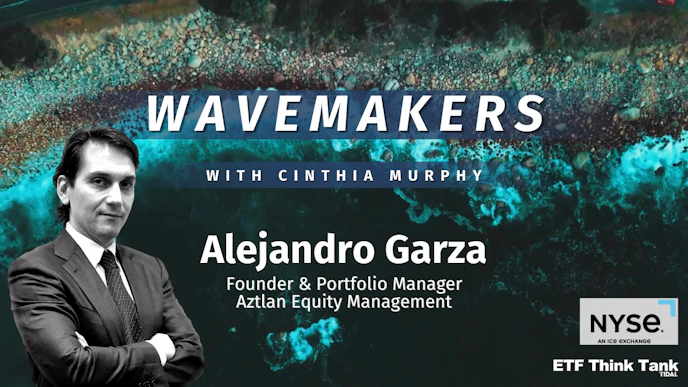
Wavemakers: Going Global with AZTLAN’s Alejandro Garza
ETF Think Tank’s Head of Research Cinthia Murphy hosts a series about innovation, disruption and entrepreneurship in the ETF industry told first-hand by those who are leading the effort: ETF providers.

Keep up with what matters in ETFs
Get timely ETF insights, market trends, and top ideas straight to your inbox.
Your newsletter subscriptions with us are subject to ETF Central's Privacy Policy and Terms and Conditions.
The ETF industry has been in the business of disrupting and improving investor outcomes for 30 years. ETF issuers sit on the frontline of this innovation. Here they share the choices, the pivotal moments, the lessons and the battle scars that make up their journey into an industry that has democratized and revolutionized market access for investors everywhere.
Our guest this week is Alejandro Garza, Founder and CEO of AZTLAN Equity Management.
Like what you're reading?
Stay in the loop — get the latest ETF insights: trends, analysis, and expert picks.
In this episode, Alejandro tells us that this business is challenging but delivering real value in the form of a best-in-class structure is very rewarding:
- Starting a global advisory business and entering the ETF space is a lot more difficult than most imagine. You need a “rebellious” inner voice to make the leap.
- The line between passive and active management can be blurry. Foreign market constraints led to innovation in the toeing of that line for their ETF.
- Getting the word out is key. It can take a lot of marketing effort to find an investor segment.
Watch the episode here:
Cinthia Murphy: Alejandro, tell us a little bit about the history of AZTLAN. You come from the investment banking world, and in 2016 you started the firm, which is an investment advisor. How did it all come to be?
Alejandro Garza: AZTLAN Equity Management is a registered management advisor. We've been in business for seven years now. Our focus was originally to manage small and mid-cap strategies. We started with an emerging market small mid-cap strategy, and then after the first year, we launched our second strategy, which is the developed markets small mid-cap. It was a 180-degree change from emerging to developed. Since then, the developed market small mid-cap strategy has become the largest strategy we manage, and from that others have branched out. We manage both strategies and the funds, and we also advise institutional investors, family offices and high net worth individuals, so we are managing funds as well as separately managed accounts.
Going back to my story, I started AZTLAN in 2016 after I had spent 10 years with a large investment management firm that was a pioneering investment manager in emerging markets. Actually, they coined the term emerging markets back in the 1980s. It was an interesting group - a large multinational firm with all emerging markets nationalities represented in the investment committee, and we managed money for pension funds, endowments, family offices, etc.. I started that in 2006, and in 2011 the Ashmore Group came in and acquired the company. I stayed on, managing the equities side up until 2016. At that point, I had this strong view that investments could be done and should be done in an optimal way, which was different from what we were doing. These were all great institutions, but I thought there were a couple of things that were being missed out in the investment process. That led me to leave and start an equity management firm.
Murphy: How difficult was that leap, going from a comfortable job to starting from scratch a new business? What was it like – that decision-making moment?
Garza: It's a mix of things. First of all, you have to have an inner voice that is really pushing you to do all the crazy things. I was 40-something at that time, so I wasn't getting any younger. It was something that I always wanted to do. But at that point, I felt like I had the experience, and I had some good things to bring to the table as an entrepreneur.
But it was really that rebellious voice pushing me from the inside to do this crazy thing because, as you know, I was backed by a great institution; I had the opportunity to work with amazing people. But it was that inner voice that said, ‘No, there's a better way to do this and implement this.’ Also, ignorance. I was completely ignorant as to all the challenges that starting a business would entail. It's super challenging. Even when you have a good track record and come from one of the large investment management houses, and you have all this experience, it’s still super difficult to start a new firm, to build a team, to crystallize what your vision is in terms of the investment strategy, and then putting it all together to convince investors to trust you with their assets.
You have to be a little bit crazy to make that leap.
Murphy: So, rebelliousness, drive and ignorance are the secret to entrepreneurship here. I love it.
Garza: That's right. A combination.
Murphy: Let's talk a little bit about the focus of the firm on small mid-cap global equities. Was the choice of niche, if you will, based on your experience before starting AZTLAN, or did you find many investors are underallocated to this space, so there was opportunity to differentiate yourself here? Why this area of focus?
Garza: It's a segment where the investable universe is generally underrepresented. Most investors are over exposed to the mega caps nowadays, to the American market, and to their own domestic or local markets, real estate, real assets. Small and mid-cap space is underrepresented.
But, also, it’s an interesting space. There are all these very interesting companies in Brazil and Mexico and Chile and Colombia that are under the radar, under explored, and that provides for an interesting investment opportunity. In fact, these names started to trade out of discounts because they're there under owned, so valuation multiples tend to reflect that. So, it's a combination of attractiveness, experience in the space, and the idea that this could help us differentiate ourselves.
Murphy: About a year ago, you launched your first ETF, ‘AZTD’. Tell us about that effort. Why did the ETF wrapper appeal to you and how did it fit into your business strategy?
Garza: That's a great part of our story. As a firm, we like to say we're problem solvers and we bring creative solutions to problems that our clients face. It all came about out of a necessity or a certain requirement from one of our institutional clients in Mexico. We were managing a stock picking small mid-cap strategy globally. We had a private fund and we also managed the strategy through SMAs. But for this particular client, we were implementing the strategy through a model-kind of arrangement – we provide the strategy and they implement across many accounts within that firm in Mexico. We wanted to implement a strategy that invests in great stock picks in Japan, the Nordics, in Canada, in the U.S., France, Germany, all the developed markets, and you have to bring those names to the local market through a specific process, to the local exchange in Mexico, and then implement in the local accounts. There’s a lot of inefficiencies, as you can imagine. It takes a lot of time to go from identifying the opportunity to making it available for investment, plus all the inefficiencies in terms of trading and currencies and managing numerous accounts. So, the client said, ‘Can we implement this strategy but through a wrapper that is efficient that we can implement across all these things?’ We went to the drawing board, did our research and found that the ETF wrapper is especially designed for this kind of solution.
But then we had another impediment to bring an ETF to Mexico, which was you cannot have an actively managed ETF list in Mexico and have tax benefits or tax incentives passive funds get. You have to be indexed. So, we had to figure out how do we replicate what we do on the stock picking active side with an index strategy? Again, we went to the drawing board and came up with a solution that’s a quantitative model that’s also fundamentally driven. We launched our first index, which is going to be two years old next month, in November.
Murphy: That’s interesting because you’d think with your global footprint – boots on the ground everywhere – AZTD would be an active strategy. Has the need to be indexed constrained the strategy in any way, or is there enough flexibility, elasticity in a passive strategy to deliver the value you seek? Does it fit for purpose?
Garza: It's an adaptation and it's always a learning process. We're always on that learning path. In terms of the passive strategy, the way we think about it, it's really an active strategy whether it’s within a passive framework. In other words, we have rules that are published for the index and the ETF follows those rules. In the end, it's a stock selection ETF. We designed it to have the best stocks. And the rules are simple: cash flow generation, valuations, rate of return, earnings growth. Based on those fundamentals that are desirable attributes for any investor to have, and for a company that they own. We're just applying that for the stock picking process in a rules-based environment to create this highly concentrated strategy.
Murphy: Throughout your website you talk about the concept of highly concentrated but diverse. What does that balance look like?
Garza: One of the problems we had to tackle when we were creating the index for the ETF was, first, how do we select the top names in the world? That was easy in the sense that we just apply the rules and take the best names with highest cash flow, return, equity growth, etc, and look for some of the lowest valuations. But then, how do we pick those 27 names or 30 or 40 or 50? How many names do we want to pick? And how do we mix them together? After many iterations and analysis, we got the final product. What I love about the final product and the outcome is that we came up with a simple solution, which was to go equal weight. We're picking from three regions, nine sectors, we excluded high volatility sectors like energy, biopharma and biotech, and we ended up with a matrix, so we're going to have a third in each region, one ninth or 11% in each sector, and 3.7% for each stock. That will give us concentration because it's 27 stocks out of 4000, and it's a really interesting sample of companies that have very strong fundamentals with this very systematic and very simple diversification. You're exposed to the three regions, to the nine sectors in an equal in an equal weight environment.
Murphy: Tell us a little bit about your experience as an ETF provider. What's been the toughest part or the most rewarding part of being in this industry?
Garza: There are very rewarding aspects to it, and very tough parts to it as well. There's a funny quote that says we didn’t do this because we thought it would be hard, we did it because we thought it would be easy. You’re always unaware of all the difficulty ahead, so the rewarding part comes after we have gone through the process. We have now just created our second index, it's a thematic strategy, and there will be a strategy obviously coming soon.
One the rewarding things is that we have learned there's a lot of value in this wrapper, in this way of bringing a strategy to the market. That allows us to bring other strategies we know are of interest to both our current client investors and the broader market in general. The other rewarding part is that the word is getting out there, the innovation, especially for the Mexican market because of restrictions. We found a way to bring products to the market with a passive structure while keeping those active attributes we describe. That’s rewarding.
The challenging parts as an entrepreneur is that you're always very optimistic and you always think that things will be easier, faster, cheaper, and it's almost 100% of the time the opposite. We were really struggling at first, on the first three months of the original launch, which was a little over a year ago, with a fund that was not known, below $20-$30 million in assets, and you're not viable at that level long term. It's costing you quite a bit. We were there.
But we worked really hard in marketing and convincing investors to invest. And we were also lucky. That's usually a good combination. We grew assets and while we are still small, we’re viable and of good size.
Murphy: Thanks Alejandro for coming on the show. Congratulations on the anniversary of the first ETF and on the success of the firm.

Latest ETF News
See all ETF newsThis is How Calamos Turned Wall Street’s $100 Billion Secret Into an ETF




From Dot-Com to ETFs: How One Entrepreneur Helped Spark an Investment Revolution

How Blossom Social Is Revolutionizing Retail Investing and ETF Marketing

Is 2025 the Year for Financing Food Fast?


 Advantages of ETFs over Mutual Funds1/6
Lower Costs
In this guide, we'll explore the advantages of ETFs over mutual funds, giving you valuable insights into why ETFs have gained significant popularity among investors like yourself.
Leveraged ETFs: Unlocking the Potential for Amplified Returns1/6
Understanding Leveraged ETFs
Explore leveraged ETFs: potential for amplified returns & risks. 5 ETFs to consider across equities, commodities & fixed income.
What is a Leveraged ETF?1/6
Introducing Leveraged and Inverse ETFs
In this guide, we'll dive into the world of leveraged ETFs, exploring their definition, mechanics, potential risks, and rewards.
Recent educational content

ETF Trends
ETF Industry KPIs September 14, 2026
This week’s KPI data overview highlights key metrics and trends shaping the ETF landscape.

ETF Trends
ETF Industry KPIs September 8, 2026
This week’s KPI data overview highlights key metrics and trends shaping the ETF landscape.
ETF Trends
ETF Industry KPIs August 31, 2026
This week’s KPI data overview highlights key metrics and trends shaping the ETF landscape.
ETF Trends
ETF Industry KPIs August 24, 2026
This week’s KPI data overview highlights key metrics and trends shaping the ETF landscape.
Browse all educational columns



Expert-Built ETF Portfolios, All in One Place
Don’t start from scratch. Discover ready-made ETF portfolios built by professionals to match different goals, timelines, and market views. Use them as inspiration or as a starting point for your own allocation.