Ready-made ETF portfolios built for real investor needs. Explore now →



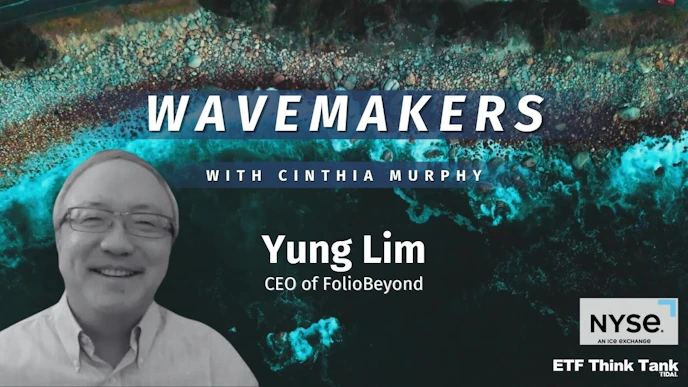
Wavemakers: Finding Alternative Income with Folio Beyond’s Yung Lim
ETF Think Tank’s Head of Research Cinthia Murphy hosts a series about innovation, disruption and entrepreneurship in the ETF industry told first-hand by those who are leading the effort: ETF providers.

Keep up with what matters in ETFs
Get timely ETF insights, market trends, and top ideas straight to your inbox.
Your newsletter subscriptions with us are subject to ETF Central's Privacy Policy and Terms and Conditions.
The ETF industry has been in the business of disrupting and improving investor outcomes for 30 years. ETF issuers sit on the frontline of this innovation. Here they share the choices, the pivotal moments, the lessons and the battle scars that make up their journey into an industry that has democratized and revolutionized market access for investors everywhere.
Our guest this week is Yung Lim, Co-founder and CEO of Folio Beyond. In this episode, Yung tells us that the ETF business requires patience:
Like what you're reading?
Stay in the loop — get the latest ETF insights: trends, analysis, and expert picks.
- Fixed income as a category remains under-explored by the ETF wrapper. There are lots of opportunities in this space.
- Good products are key to success, but education is at the heart of an ETF business. And it’s hard to be consistently good at it. It requires a lot of work.
- Distribution and platform access remain a big hurdle to smaller providers, but model portfolios are an interesting path to investors.
Watch the episode here:
Cinthia Murphy: Our show is named Wavemakers, and you and your firm are doing some really interesting things in the ETF space – you’re definitely making waves. I’d love to hear about your journey into this industry. How did a Caltech electrical engineer end up in the ETF business?
Yung Lim: Good question. There were a lot of trips in between, but in general, when I graduated from Caltech, I wanted to be in the financial industry. One way to do that would be to get an MBA, so I did at the University of Chicago. I ended up in a more quantitative area of the fixed income markets: mortgage- backed securities.
That was in the late ‘80s when the mortgage market was still sort of in the early stages, or the securitization market was in its early stages, and we were creating four tranche structures. Fast forward to today, these deals are made up of 50 tranches or so. In a way, my quantitative experience and background help in analyzing mortgage-backed securities and structures, and how these strategies can be utilized. It also helps out in portfolio analysis and stress testing, and stuff like that.
Murphy: It's interesting that, as a firm, you define yourself as a technology platform. That can be interpreted in so many ways. You talk a lot about modular algorithms you use, and about advancing sophistication – things that aren’t exactly run of the mill for ETF providers. So, tell us about Folio Beyond and how it tackles the business of improving investment management?
Lim: Folio Beyond was set up to deliver advanced portfolio solutions using the latest analytical tools, including AI whenever appropriate. Going back to the ‘80s when I started in the business, some of the advanced analytics involved using spreadsheets and macros on Excel. Fast forward to five years ago,there were a lot of advanced analytics that were available that allowed for customization. Data had also become cheaper. You were able to access a lot of different data.
The genesis of Folio Beyond was to apply these advanced tools to the fixed income market. The nice thing about the ETF market was that, unlike 20 years ago, it had grown quite a bit in the fixed income segment, and you had all these sector ETFs. Our first product was an advanced optimization fixed income model utilizing 24 ETFs.
We are a technology platform in the sense that we are using optimization techniques, calculating forward looking option adjusted yields on these different ETFs. We're incorporating risk analysis, correlation effects, momentum effects. All of that is what supports our technology platform, but at the same time, we're an investment manager because we're not just using a black box.
Our collective experience and our understanding of capital market risks, which are trade-offs, have helped us develop the right tools that are appropriate for investment managers and institutions as well as retail investors.
Murphy: How has the ETF, as a product and as a technology in itself, helped your business and helped you deliver solutions?
Lim: I'll talk about two different levels. One is, with our fixed income model, ETFs have allowed us to optimize a portfolio. We were careful not to include overlapping ETFs. The 24-sector ETF, which includes our RISR ETF, have exposures that are fairly discrete: you have short, intermediate, long term Treasuries. You also have corporates, high yield, TIPS. What we're doing is taking these ETFs and constructing an optimization model with the right risk constraints. Our initial model was to optimize the portfolio targeting the volatility of the Barclays Agg, which is roughly 3.5%, and trying to do better than the Agg. There, ETFs are critical. If we were to try to implement this using actual bonds, buying individual corporate bonds and TIPS, it would have been very challenging. You wouldn't be able to do it in small sizes. The ETF market and the diversity in the ETF market made it possible.
Now, the fixed income market in the ETF space is a little behind equities in terms of diversity of products. We've found some major gaps in the ETF space. One was mortgage interest-only strips. It’s a sector of the market where institutions have invested in this sector for decades. When we saw an opportunity to introduce that product as a first mover, and work with Tidal, we did.
Murphy: Is the focus on income because this is an area that you are very passionate about or because you saw an under-explored space, so there was opportunity there for product development?
Lim: It was a combination of income and having a risk profile that was very beneficial in our eyes. In my experience, having income is a great thing. Whenever you are in a trading range, or if markets are volatile, the income component gives you a cushion. We thought it was a good product to introduce to the ETF market because it's a fairly large sector, it has a unique profile of producing income, and at the same time gives you interest rate protection.
That combination is hard to find in the fixed income world. If you generate a lot of income, you're going to be long the market or long duration. In our case, we are short duration, generating very flexible income to the tune of 7%-plus in the current environment. It’s a risk return profile we thought was very helpful for portfolio managers and has multiple applications.
Murphy: The ETF space is very competitive. The model space is very competitive. What have you learned that that has helped to grow your footprint, get your story out there? How challenging has that been?
Lim: Part of the challenge with our kind of ETF is the complexity. For people in the mortgage market, it's almost second nature – you’re getting interest only cash flows from the underlying MBS. If you think about the sensitivity to prepayment changes as rates go up, prepayment slowed down and you have interest cash flows for a longer time period. That gives you that negative duration profile.
But for people who have not been involved with different types of collateralized mortgage obligations, there's an education process. It’s fairly straightforward in terms of building the relationships and how the portfolio is constructed, but it still requires education. So, we've spent time on that. We've spent time on discussing ideas on how it could be utilized, whether it's in combination with other ETFs or how it diversifies a typical fixed income portfolio or even equity portfolio. Education has been challenging, and we have worked hard on providing the right set of materials to cater to all different types of investors.
Distribution has also been challenging. It’s a challenge that everyone faces. As a baseline you need to have a good product, but certainly the product doesn't sell itself. We are in the process of getting on different platforms, but size begets size, and we have to work on getting beyond certain thresholds before we can qualify for certain platforms. All of that requires patience. We still believe that having a robust underlying strategy is certainly a key ingredient to success, but we have been turning over all stones in terms of expanding our distribution effort.
Murphy: The longer we are in this business, the more we learn that you cannot overestimate the power of good content. You have to go meet the investor where they are – education is a big effort. But, as you say, first, the product has to be good. We talk about that as a necessary condition for success: the product has to solve an investor problem. RISR is a really unique product. It’s an alternative income product that lacks direct competitors and it’s about to hit its second anniversary.
Lim: Time flies. We have generated strong returns relative to benchmarks last year when rates went up a lot. That was part of the return attribution. But there were other elements in the returns. One is security selection. We’re an actively managed fund, and you have a variety of coupons, maturities, different collateral characteristics, so there’s an opportunity for experienced traders and investors like us to identify undervalued spots. Picking securities and managing the overall portfolio risk the right way, we're adding security selection alpha and that's demonstrated by the return comparison versus the benchmark. Another thing I want to point out is our strategy does better when all your spread products are suffering. And that's been another component of returns that has helped us.
Murphy: As you look back on your experience in the ETF industry, have you found the journey rewarding? It’s a tough and competitive business, but has it been rewarding? Anything you’d have done differently?
Lim: It's certainly been rewarding. Let me talk about the pros first. This is a business where you can scale very effectively. It's an efficient process for creating new shares. It's an efficient way of bringing in an institutional product to the retail marketplace. And certainly institutions have embraced ETFs as well. As a side note, our ETF is also approved by the National Association of Insurance Commissioners, and we
have the second highest rating, so insurance companies can invest in our ETF and get very favorable capital treatment. So those things are all good.
It’s also rewarding to offer a risk return profile that’s complementary to what people own and it's certainly a value add to existing portfolios. But the challenges are also real as it relates to distribution, to education, to application.
As an anecdote, we were talking to a fairly large wealth management shop, and they liked our product. They liked the underlying securities. The hurdle for them was educating their investor base on a new product, and they were concerned about providing the right level of education. We see a herd mentality sometimes. If a competitor were offering our product to their clients, this wealth manager plobably would jump on it too, but they don't want to be the first ones. It’s those kinds of challenges that make the first few years a slog. You really have to be patient. Once you're past, say, $250 million in size, there's a huge amount of scalability.
Murphy: We love to talk about ‘overnight success’ stories, but in truth, there rarely is such a thing. It takes time to build. The education hurdle is interesting because the ETF industry has often been about simplicity, but in truth, products are getting more complex. I’m curious to see how education and ultimately adoption adapts to complexity. What’s catching your eye when it comes to trends in the ETF space, both in product development and/or in the way people are allocating and investing in ETFs?
Lim: I guess certain strategies have caught on very quickly, such as option overlay strategies where you're generating a lot of current income. But what investors have to be mindful of is the overall risk profile. We've been in a certain environment the past 12 months where some of strategies have worked well. But how do they when you have a bigger move or when you have a whipsaw scenario? Understanding some of the scenario analysis and stress testing is important. That's part of the role of some of the model portfolio managers. Ours as well.
Model portfolios are an interesting area. But what would hurt the industry for some of these unique products would be if the product is misunderstood and there are surprises when you have unforeseen circumstances. I’ve come across fixed income products where the risk profile is misunderstood by investors. And as a fixed income guy, if I look at the underlying portfolio, I can sort of summarize the risk profile, but that may not be how the investor understands it. Education is important. Transparency is important. There's no free lunch.
Murphy: And patience is important. Yung, congratulations on the upcoming milestone for RISR and de success. Thank you so much for joining me today.
Lim: Thank you very much.
Segments
See all
No specific market segments were tagged
Mentioned ETFs
No specific ETFs were tagged
Further reading

Latest ETF News
See all ETF newsThis is How Calamos Turned Wall Street’s $100 Billion Secret Into an ETF




From Dot-Com to ETFs: How One Entrepreneur Helped Spark an Investment Revolution

How Blossom Social Is Revolutionizing Retail Investing and ETF Marketing

Is 2025 the Year for Financing Food Fast?


 Advantages of ETFs over Mutual Funds1/6
Lower Costs
In this guide, we'll explore the advantages of ETFs over mutual funds, giving you valuable insights into why ETFs have gained significant popularity among investors like yourself.
Leveraged ETFs: Unlocking the Potential for Amplified Returns1/6
Understanding Leveraged ETFs
Explore leveraged ETFs: potential for amplified returns & risks. 5 ETFs to consider across equities, commodities & fixed income.
What is a Leveraged ETF?1/6
Introducing Leveraged and Inverse ETFs
In this guide, we'll dive into the world of leveraged ETFs, exploring their definition, mechanics, potential risks, and rewards.
Recent educational content

ETF Trends
ETF Industry KPIs September 14, 2026
This week’s KPI data overview highlights key metrics and trends shaping the ETF landscape.

ETF Trends
ETF Industry KPIs September 8, 2026
This week’s KPI data overview highlights key metrics and trends shaping the ETF landscape.
ETF Trends
ETF Industry KPIs August 31, 2026
This week’s KPI data overview highlights key metrics and trends shaping the ETF landscape.
ETF Trends
ETF Industry KPIs August 24, 2026
This week’s KPI data overview highlights key metrics and trends shaping the ETF landscape.
Browse all educational columns



Expert-Built ETF Portfolios, All in One Place
Don’t start from scratch. Discover ready-made ETF portfolios built by professionals to match different goals, timelines, and market views. Use them as inspiration or as a starting point for your own allocation.