Explore professionally built ETF model portfolios. Discover now →



Wavemakers: Exploring the Brave New World of Disruptive ETFs - Insights and Strategies with Christian Cooper
ETF Think Tank’s Head of Research Cinthia Murphy hosts a series about innovation, disruption and entrepreneurship in the ETF industry told first-hand by those who are leading the effort: ETF providers.

Keep up with what matters in ETFs
Get timely ETF insights, market trends, and top ideas straight to your inbox.
Your newsletter subscriptions with us are subject to ETF Central's Privacy Policy and Terms and Conditions.
The ETF industry has been in the business of disrupting and improving investor outcomes for 30 years. ETF issuers sit on the frontline of this innovation. Here they share the choices, the pivotal moments, the lessons and the battle scars that make up their journey into an industry that has democratized and revolutionized market access for investors everywhere.
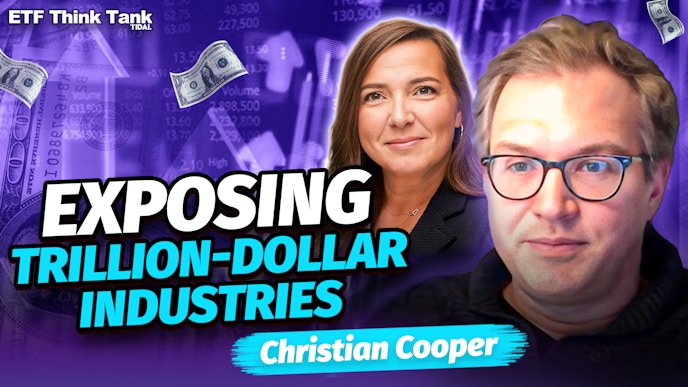
Our guest this week is Christian Cooper, Portfolio Manager at Subversive ETFs.
Like what you're reading?
Stay in the loop — get the latest ETF insights: trends, analysis, and expert picks.
In this episode, Christian tells us that a problem-solving mindset is key to building product:
- In thematic ETFs centered on solving a problem, consider owning the entire vertical of that theme.
- Not all great stories make for great trades. That’s the real challenge of building thematic ETFs.
- It’s easy to underestimate the amount of operational work that goes into running an ETF.
Transcript:
Cinthia Murphy: Hi Christian. Kick us off by telling us a little bit about Subversive, which is a unique firm.
Christian Cooper: Sure. Michael Auerbach started Subversive as a venture portfolio over a decade ago now. The Subversive venture side is distinct and separate from the ETF side. But about two years ago, we decided to look into launching an ETF practice that focuses on trillion-dollar problems.
I'll probably keep saying that a lot as we talk about the individual silos, but it is a very different business as an ETF provider than the venture capital side. It’s been an interesting start and certainly an interesting platform to try to tell stories.
Murphy: I'm curious about the approach and investment philosophy. On your website, you describe yourselves as active managers that invest in “radical companies that are bold, daring and uninhibited.” How do measure boldness and inhibition in a business, and what does that mean in terms of how you approach solving these trillion-dollar problems?
Cooper: It is difficult to drive through losers as innovative or compelling. I would say that certainly plays more to the venture capital side as opposed to the ETF side, because when we think about ETFs, good stories don't necessarily make good trades. We can think about a narrative around food security or around metabolic health, as we have, but you still have to trade within the context of those securities. We're looking for those things that are making incredible discoveries or building in new and creative ways or have a real focus on cash flow. I think that has been missed in the last several years. We're looking for companies that have the capacity to execute and generate cash flows based on those transformative ideas.
The ETF business has more than 3000 equity holdings at the moment. It’s a very broad net. But we are in this moment of transformation where we are shifting from a growth mindset to a value mindset, and trying to trade that within the silos has been challenging. This is a very long-winded answer to your question about how we find these companies – it's a lot of work. It's a lot of investigation.
Murphy: If you look at the lineup, there's definitely a “future lens” to the ETFs you are bringing to the market – mental health, food security, decarbonization, cannabis – but then you have these Congressional ones, NANC and KRUZ. Walk us through how you actually build a lineup of ETFs, a family of ETFs?
Cooper: There's one thing with respect to NANC and KRUZ, which is that I don't see those as outside of the mindset of solving trade problems. We'll come back to why that's the case a little bit later, but it is casting a wide net.
When you think about food security, we've had seed companies, fertilizer companies, water companies, consumer facing organic storefronts. The key thing is that we want to own that entire vertical. In food security, it's a vertical of seeds, fertilizer, water, consumer facing distribution, production – that whole cycle. If you think about the metabolic health space, we have the drug manufacturers and the needle manufacturers for the Dexcom devices, for example. There are Japanese companies that are doing some interesting development in this space.
Owning the vertical is probably the only common theme among all six ETFs, with the exception of the Congressional. That's our core approach. What's the vertical look like? Who do I want to own within that vertical? And do I want to make sure that I'm owning cash or growth within that?
Murphy: To clarify, by vertical you mean the entire value chain of a theme – all the moving parts in that whole story.
Cooper: Yes. And sometimes we focus on free cash flow or more consumer facing growth focus within a vertical, or on low P/Es for a value investing lens. The challenge is knowing which lens to apply to which part of that chain for sure.
Murphy: Is the focus on free cash flow and attractive value an effort to find quality, if you will, because when we talk disruptive companies, we often talk growth-y, risky and volatile names. Is it a deliberate approach to stock selection to navigate that?
Cooper: It's very deliberate. While we were thinking of launching an ETF, we were looking at what’s going to happen within the next 2 to 5 years that can drive the valuations within the space that we can trade.
For example, the entire food space is down 20% this year. My thinking around launching that theme was that we were going to see a lot of the same things that we saw around the Arab Spring with respect to food security. If you look at the Ukrainian war in Europe, how that impacts fertilizer prices, nitrogen, the natural gas supply chain – all of these things add up to complex problems for them within these issues. KCAL is a perfect example of something that is trading very differently from what we saw a year ago. I thought with the war in Ukraine, that it would break differently. Fertilizer has been one of the worst performing portions of that because of the decline in the input expense. But that's also an example of great stories don’t always trade well. It's about finding the tradable theme within these segments to generate returns.
Murphy: This reminds us that themes are often long-term plays as opposed to quick short tactical plays. Themes can take time to deliver their value.
Cooper: That's a good point with respect to NANC and KRUZ. Let's talk a little bit about those congressional ETFs and why they're a little bit different. When we might talk to advisors, they’ll say, ‘Listen, I don't talk politics to my customers. I don't care about politics. I'm going to avoid these like the plague.’
Well, NANC is beating the S&P 500 both on an absolute return basis and on a risk adjusted basis. The reason that we partnered with Unusual Whales to create the Congressional ETFs was to be a statement about how Congress should not be doing this. And we split them up so that NANC is the growth version of that vehicle, and KRUZ is the value version of that vehicle. Right now, we are in a growth state of the world, so NANC is leading on a risk adjusted basis, better Sharpe ratio, lower standard deviation.
When we think about those funds, it's not about the politics. It's about the worldview that each side of the aisle has, and using the wisdom of the crowd to guide that portfolio construction. That’s really important to understand – we're not investing in politics. We're beating the S&P 500 on a return basis and on a risk basis. It's not about politics. It's about alpha.
Murphy: I love the concept of launching ETFs to make a statement about something that shouldn’t be happening in the first place. It’s almost a flavor of impact investing, even if only to the extent of raising awareness and education through the partnership with Unusual Whales. It’s super interesting.
Cooper: I don’t want to speak for Unusual Whales, but I think they might be a little more optimistic about getting Congressional trading bans than I am. I think it's near zero chance. Congress will never do anything for the benefit of the American public. We would love for it to change, but it's not going to happen now.
Murphy: Let’s talk about the the decision process of launching an ETF. Was there a point when you guys sat there and said, ‘Hey, how do we better deliver value to our investors?’ Was there a whole due diligence process evaluating all investment vehicles? What was that conversation like?
Cooper: The ETF is the closest thing you can get to a hedge fund in the publicly traded space, and maybe both in terms of cost and reach. That was issue number one. Issue number two was getting back to this trillion-dollar problem idea.
Take, for example, our mental health fund. When you talk about mental health, people immediately think about depression. That was certainly seen in many of the things that we invest in. That's not the whole story, though. If you take if you take a population of 30 year-olds, and you limit their glucose intake, keeping their A1C at, let's call it, 5.8, 98% of that population will be Alzheimer's free 40 years later. What we're realizing is that traditional hypothesis of Alzheimer's treatment is wrong and misguided. The real root is metabolic disorders. We are fixing the trillion-dollar Alzheimer's problem that both India and China and the United States are confronting in a different way through metabolic assets. So, we own Dexcom, the glucose testing manufacturer, and manufacturers of drugs.
One of the realizations is the only way that we're going to solve this trillion-dollar problem is by solving the metabolic disorders first. But in a very long way, how do you scope out any of these problems? That’s something that I personally had been just trying to figure out for a long time. That was top of my mind. Food security was a top of mind. Decarbonization was too. Maybe it's just a personality quirk – that I worry about these things everyday – but that’s how these ETFs get launched. It’s an interesting way to think about these problems as a set of complex systems as opposed to just a stock that you pick.
Murphy: The name of your firm is Subversive. The concept of being subversive means upending the establishment, disrupting the status quo, and you guys are approaching investment solutions by challenging ideas. It's fascinating. Is that the reason behind the name? How does that concept help when talking to advisors?
Cooper: I think there's some power to it. That’s definitely a creation of Michael Auerbach, the firm's founder. It fits the tone of what we're trying to do. But the rest of the world has to think about these problems in the same way as well. That gets back to the idea that great stories don't make great trades. It’s difficult to balance that long term narrative with the shorter turn out of these trades. Advisors are faced with ‘What did you do for me today?’ That’s challenging.
Murphy: I wanted to talk for a minute about lessons learned in the ETF business. On the Subversive Capital Advisors website there’s a dropdown item called “Failures” that links to the investments and ETF that didn't work out – the metaverse ETF. I love the notion of learning from mistakes, and having it right there on the website is the kind of transparency everyone can benefit from. So, what stands out to you from these “failures” as lessons worth sharing?
Cooper: No one really cares about what you're doing or thinking or saying 99% of the time. That is the one thing we learned starting out in the ETF space. You have to really understand no one really cares until you have a track record, 3-year returns and, call it, $100 million under your belt before you're really considered as existing. That’s been eye opening. That was not something we expected in the ETFs as a business. That would be lesson learned number one.
Number two is just trying to be more personally effective with time management and being deliberate on allocating time to efforts. We published a Substack recently that was really interesting on how to work around the clock. It was built around a trade idea. This started at 2 a.m. with a news story and we went all the way through the day, from me developing the quantitative model to placing the trades, to execution, all of the operational mechanics from start to finish during a day. The extraordinary amount of complexity and systems that it takes to get all of these things – securities, trades, delivery of the basket files, making sure your market makers know what they're trading – it's amazing. Operationally, I underestimated the amount of work. That is the business.
Murphy: As a final thought, Christian, what’s the next theme you are looking at? What’s on the radar?
Cooper: We have filed one that is public, and I think we're outside the quiet period, around Chat GPT and the AI space. We're debating now whether part of that should be shorting China securities, but the point is that you have to think about these portfolios from where these themes will be two years ahead of time. That's another thing that I think about a lot: What's the state of the world going to be, like, in two years? Do we need to launch this now or wait or pivot? Those are those are the things I'm thinking about every day.
Segments
See all
No specific market segments were tagged
Mentioned ETFs
Further reading

Latest ETF News
See all ETF newsThis is How Calamos Turned Wall Street’s $100 Billion Secret Into an ETF



From Dot-Com to ETFs: How One Entrepreneur Helped Spark an Investment Revolution
How Blossom Social Is Revolutionizing Retail Investing and ETF Marketing
Is 2025 the Year for Financing Food Fast?


 Advantages of ETFs over Mutual Funds1/6
Lower Costs
In this guide, we'll explore the advantages of ETFs over mutual funds, giving you valuable insights into why ETFs have gained significant popularity among investors like yourself.
Leveraged ETFs: Unlocking the Potential for Amplified Returns1/6
Understanding Leveraged ETFs
Explore leveraged ETFs: potential for amplified returns & risks. 5 ETFs to consider across equities, commodities & fixed income.
What is a Leveraged ETF?1/6
Introducing Leveraged and Inverse ETFs
In this guide, we'll dive into the world of leveraged ETFs, exploring their definition, mechanics, potential risks, and rewards.
Recent educational content

ETF Trends
ETF Industry KPIs September 14, 2026
This week’s KPI data overview highlights key metrics and trends shaping the ETF landscape.

ETF Trends
ETF Industry KPIs September 8, 2026
This week’s KPI data overview highlights key metrics and trends shaping the ETF landscape.
ETF Trends
ETF Industry KPIs August 31, 2026
This week’s KPI data overview highlights key metrics and trends shaping the ETF landscape.
ETF Trends
ETF Industry KPIs August 24, 2026
This week’s KPI data overview highlights key metrics and trends shaping the ETF landscape.
Browse all educational columns



Have you tried our ETF Compare tool?
Compare ETFs like a pro. Analyze fees, performance, exposure & holdings side-by-side.