NYSE CRTR Economy Event Watch the replay →



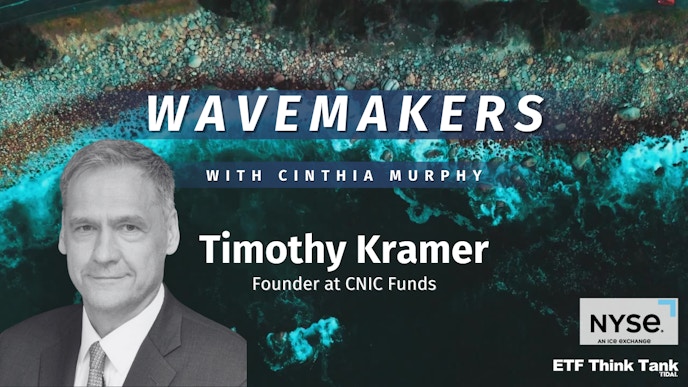
Wavemakers: Electrification of America with CNIC’s Tim Kramer
ETF Think Tank’s Head of Research Cinthia Murphy hosts a series about innovation, disruption and entrepreneurship in the ETF industry told first-hand by those who are leading the effort: ETF providers.

Keep up with what matters in ETFs
Get timely ETF insights, market trends, and top ideas straight to your inbox.
Your newsletter subscriptions with us are subject to ETF Central's Privacy Policy and Terms and Conditions.
Wavemakers: Electrification of America with CNIC’s Tim Kramer
The ETF industry has been in the business of disrupting and improving investor outcomes for 30 years. ETF issuers sit on the frontline of this innovation. Here they share the choices, the pivotal moments, the lessons and the battle scars that make up their journey into an industry that has democratized and revolutionized market access for investors everywhere.
Like what you're reading?
Stay in the loop — get the latest ETF insights: trends, analysis, and expert picks.
Our guest this week is Timothy Kramer, founder and CEO of CNIC Funds.
In this episode, Tim tells us that the ETF business offers many lessons to newcomers:
- Electricity is such an important commodity and yet no one had explored it as an investment theme. There’s still white space in the ETF industry.
- ESG investing faces a “bifurcated” crowd between those eager to adopt and those staying completely out.
- Clean, simple messaging and nailing down that initial big investment (seed) are crucial in an ETF journey.
Cinthia Murphy: Hi Tim. Let’s talk about your business and your journey into the ETF space. Tell us a little bit about CNIC Funds.
Tim Kramer: Our theme is the electrification of America. We break that down into three legs of a stool. The first is importance; the second is inflation; and the third is imbalance.
The broad strokes in terms of importance, electricity is the most consumed commodity in the U.S. on a retail notional basis. But up until now, it hasn't been in any mutual fund, any ETF, any index, and we thought there should be something of an opportunity there.
With respects to inflation, when the CPI comes out month after month, electricity is 2.5% of the overall number and there's also an indirect component of that. Electricity, going back to like 2014, is about 85% correlated to inflation. There’s an interesting angle with that. And the third tenant is the imbalance. We think demand is grossly understated in the U.S. for electricity, and supply is grossly overstated. One simple example on the demand is Elon Musk, who was in the Wall Street Journal maybe two months ago and he said, ‘Whatever you think the demand is for electricity in the future, multiply it by X and you're still too low.’ That’s an opportunity.
So, we first created an electricity index, and we partnered with ICE, and then we co-branded an ETF with them and launched the ETF in May 2023.
Murphy: It's an important theme, and so under-explored as an investment. Did you see this as an opportunity and decided to get into this space, or how did you get into asset management?
Kramer: Before this I did commodity hedging for a very large private equity/infrastructure shop. They had a bunch of power assets - all the different fuels, electricity, and other commodities such as metals as well as interest rates, some currencies, etc. In doing that, I could see how certain commodities were mature and investable, and other ones were not. It really didn't make any sense. Before that, I was the chief commercial officer at a number of different energy trading shops, so I had experience in the energy space, and then it just clicked.
It was like, ‘wow, why is everything else so commercially accepted and this isn't?’ so we thought we'd take a shot and see what would happen.
Murphy: There was many ways to package an investment strategy. How did you ultimately decide on the ETF wrapper?
Kramer: That was an interesting journey. Originally when we decided to do this, we said, ‘Let's just let's be a hedge fund.’ It's what I call the rule of fives.
If you want to be a hedge fund investor, we want to see a five-year track record where you manage $5 billion, and you get a 55% rate of return. On the five-year track record, if you have anything less than that, they just say that you're a flash in the pan. tf you have less than $5 billion, they say, ‘oh, well, you can't scale.’ And if it's less than something egregious, like 55% rate of return, they say, ‘oh, well, it doesn't matter to us.’ I don't really know how you overcome that, so we decided to do this as an actual fund. The first thing we looked at was doing this as a mutual fund. We approached a couple different platforms about doing this with them, and the attitude steered us into ETFs. When we started talking to a number of people, they're like, ‘look, everything is switching over to an ETF platform right now.’
So, all the pieces kind of fell together. The ETF just seemed like the cleanest shot on goal - using the index and then doing the ETF as a passive investment. It was the simplest way to make this thing happen.
Murphy: Walk us through the decision to go passive and the construction of the index.
Kramer: We took a look at how to create this index and we wanted to do it. We thought it would be commercially viable and easily understood. If you look at other commodities like gold or crude oil or wheat, they're traded on an exchange and they've got the different months of future contracts. Electricity has the same thing. It's traded on the Intercontinental Exchange (ICE.) The structure was there, the clearing mechanism, ready for this. We're surprised nobody did it before us.
We did this based on electricity contracts. We also included carbon offsets. We did the calculation to determine what it would take to make the entire thing carbon neutral, because there's a decent ESG movement in the U.S. We use the phrase ‘carbon neutral’ when it gives you exposure to electricity as an asset class. In the electricity universe, you've got the generators, you've got a power plant that makes electricity, a lot of the generators tend to want to hedge that or sell it forward, so they're active in the marketplace. You've got retail providers, who are the ones you see advertising on billboards or sending letters trying to get you to switch who sells your electricity to your house. They’re in the marketplace doing some active hedging. You've got developers. The U.S. has a goal to be 85% renewable by 2030 and 100% renewable by 2035. In order to do that, they're building a lot of wind and solar, and in order to build those things, you need to finance them, and you need to hedge that so that you can pay your debt, pay your interest. So the developers are out there actively trading this thing. And then you've got the commercial, industrial guys who are hedging their exposure. You've got speculators, arbitrage, liquidity. There's a whole host of people that are trading this stuff.
Unlike most commodity indexes that just the front month, when we created the index, because electricity is not storable and there's a seasonality aspect to it, we took a 12-month strip. That reduces the volatility and it gives you access to the seasonality.
Murphy: It’s interesting to put this strategy in the broader context of an ESG conversation, which is a broad and noisy space we are still trying to define. Have you found that going narrowly focused, very specific was important in terms of a business edge?
Kramer: That's a great question. We've talked to some potential investors and they're like, ‘If you spell ESG in my office, I will kick you out because I've got a lot of high net worth individuals and they made their money off of oil and natural gas, so get out of here.’ We've had other ones who say, ‘If you can spell ESG, we'll give you money.’ It's really a bifurcated crowd right now. Europe seems to be a lot farther down the road in terms of what they're willing to accept and how big their appetite is for things that are deemed carbon neutral or ESG compliant.
Murphy: What do you think is the next catalyst for broader ESG adoption here, or to help us turn the page on our rocky relationship with ESG?
Kramer: What you're seeing right now is the government mandates, which are more regional. Take a look at New York State right now. You can no longer hook up a gas stove in a residential building and that's actually spreading now. I think Illinois and Michigan are headed there too. If you take a look at California, all delivery trucks in the state have to be electric by 2030, or around that. New Jersey has said you cannot buy a brand new combustion engine car in New Jersey after Jan. 1, 2035. You're starting to see the governments put some things in place that accelerate this move to ESG. What that looks like, whether or not they stick, how practical they are, all of that's going to be interesting.
Murphy: The infrastructure is not there yet. The idea is great, but how we get there is harder than it looks. Let’s talk a little bit about the ETF business. Your strategy complements any portfolio that’s tuned in to this future of infrastructure conversation, right?
Kramer: Yes. Generically, you'll read where modern portfolio theory says you should have somewhere between 5% and 15% of your money tied to commodities. That's for inflation protection and for portfolio diversification. When we talk about those existing commodity indexes, there’s anywhere between $800 billion and $1 trillion tied to those commodity indexes. In our business model, we are the only ones that do this. We have a five-year exclusive on the index and the data, so we're the only ones that can do this for five years.
It would make sense if you want commodity exposure to have something that includes the most consumed commodity in the U.S., and we think that just only gets bigger and better because with electric vehicles and the shift to renewable generators, etc., the consumption of electricity in the U.S. is only expected to go up and the consumption of fossil fuels is only expected to go down.
Murphy: As far as being an actual ETF provider, you are an energy expert who brought that expertise into the ETF space. Are there things you wish you had done differently when entering ETFs, any lessons on being an ETF entrepreneur?
Kramer: There's a saying that says if you own a camera, you're a professional photographer, but if you buy a flute, you have a flute. That means if something looks easy, you think you're an expert at it, but you probably aren't. We felt pretty good about our ability to do things in the energy and in the commodities space. And so, we thought this ETF thing should be a breeze, too, right? Yeah. No. We learned that pretty quickly.
We chose the ETF structure because it’s simple and quick. It's an efficient vehicle people recognize, it's transparent, you can access the trades, so it all matches up. Those are things we just kind of stumbled into.
In terms of the cons, and just on the ETFs themselves, some institutional investors will say, ‘We don't play in ETFs. We only play in separately managed accounts or things like that.’ But this is the only thing out there. If somebody is approaching you with another growth equity fund, you can find hundreds of ways to express that in terms of ETFs, mutual funds, separately managed accounts, etc. But what we have, there is no other way to express this view. That's how we landed on the ETF piece.
Some of the things we did right when we did this ETF is, we outsourced everything. Originally when we talked about doing a hedge fund, the ideas was, ‘Yeah, I'm going to hire all my friends and I'm going to have all these data sources.’ And then you start to add it up, and it’s a lot of friction you need to overcome just to open the doors every day. The ETF structure, and using a white label ETF provider to outsource the demand, the back office, the compliance, the legal, all of that just made it a lot more cost efficient. What we did right was outsourcing that.
The second thing we did right was to try to publish a white paper on our website that answers questions the investors are asking. We try to do that once a month, and we try to do one podcast or webcast. Those things have been pretty well received, and we usually see a volume pick up after we do those things.
The third thing we did is we just that we really simplified what the message was. Originally when we talked about this, we're talking about the term structure of commodities and roll yield and everyone’s eyes glazed over. So, we simplified: it’s the electrification of America.
Just by simplifying the message and making it a direct shot, it’s given us another lesson learned in that I'd say we underestimated social media. When we started doing social media, we saw that the change in volume and the receptivity, the questions was impressive. It’s something we need to pay attention to.
A second misstep we made was when we launched. We had a certain amount of asset commitment initially that when it came to it, wasn't really a firm commitment. There are some things we could have done structurally to get that money locked down a little bit tighter, but at the beginning, we didn't know we needed to. But now we do.
One final thing to remember is that everybody has a business model, and we had a really ambitious goal of how much we’d have reached after six months. The issue is that if you talk to the platforms, you've got to have a certain minimum time that you exist and a certain amount of assets before they put you on the platform. Everybody wants to be the second investor, but getting someone to become that big first anchor investor is a little bit of tricky. If I had known that, I’d probably have focused things a little bit differently.
Murphy: As we wrap up, what is on your radar for what’s next in ETFs, or for CNIC? What are you excited about going forward?
Kramer: We've received a number of inbounds, and I think this ETF is poised to pick up some attention. We feel good about it. But we’ve also received some other really interesting inbounds about, say, permutations and combinations with other things that are out there, so there are some other product and partnership opportunities we are excited to explore. There's enough buzz and sough possibilities around this that we feel good we should be able to make a go of this and have an interesting business. But, you know, I’m right until I'm wrong.
Murphy: One day at a time. Thank you so much for coming on the show and telling us your story.
Segments
See all
Mentioned ETFs
No specific ETFs were tagged
Further reading


Latest ETF News
See all ETF newsThis is How Calamos Turned Wall Street’s $100 Billion Secret Into an ETF




From Dot-Com to ETFs: How One Entrepreneur Helped Spark an Investment Revolution
How Blossom Social Is Revolutionizing Retail Investing and ETF Marketing

Is 2025 the Year for Financing Food Fast?


 Advantages of ETFs over Mutual Funds1/6
Lower Costs
In this guide, we'll explore the advantages of ETFs over mutual funds, giving you valuable insights into why ETFs have gained significant popularity among investors like yourself.
Leveraged ETFs: Unlocking the Potential for Amplified Returns1/6
Understanding Leveraged ETFs
Explore leveraged ETFs: potential for amplified returns & risks. 5 ETFs to consider across equities, commodities & fixed income.
What is a Leveraged ETF?1/6
Introducing Leveraged and Inverse ETFs
In this guide, we'll dive into the world of leveraged ETFs, exploring their definition, mechanics, potential risks, and rewards.
Recent educational content
Asset TV
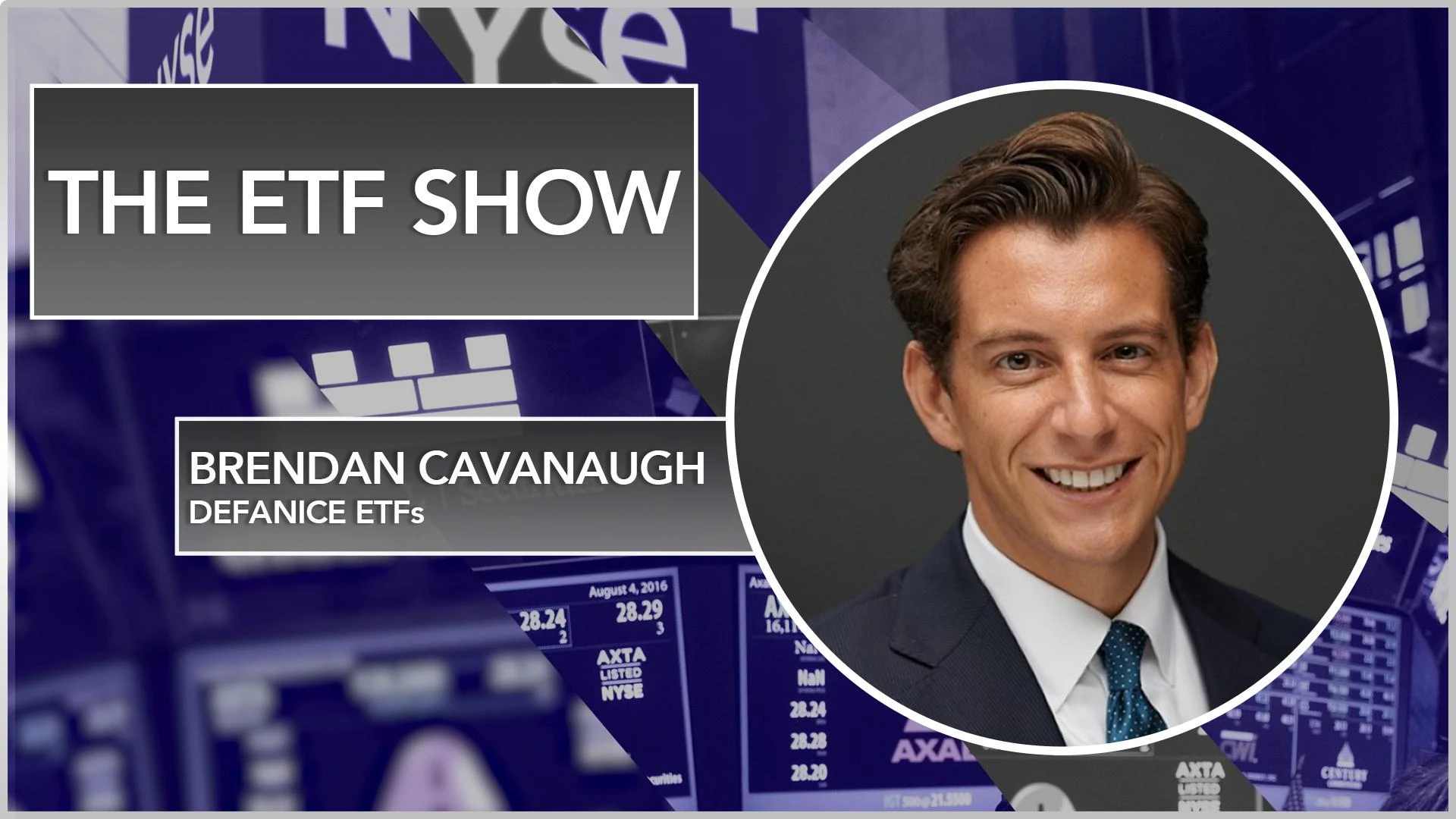
The ETF Show - New Autism-Impact ETF Launched
Defiance ETFs has launched the first ETF, $ASD, focused on the autism ecosystem, investing in companies that provide services, products, and research related to autism and neurodivergence.


ETF Trends
ETF Industry KPIs June 1, 2026
The ETF Industry saw 22 New Launches, 1 Ticker Change and 1 closure last week.

ETF Trends
ETF Industry KPIs May 20, 2026
The ETF Industry saw 44 New Launches, 3 Mutual Fund Conversions and 9 closures last week.
Asset TV
The ETF Show - Politics Becomes Investable Trade through ETFs
Dan Weiskopf, Senior Portfolio Manager at Tidal Financial Group spoke with the ETF Show about Subversive ETFs that help investors trade like politicians.
Browse all educational columns



Build and Analyze Your ETF Portfolio Like a Pro
Create your own ETF portfolio in minutes and instantly see allocations, exposures, performance, and risk. Visualize diversification across asset classes, regions, and sectors. Stress-test ideas, compare benchmarks, and refine your strategy with professional-grade analytics.