From idea to ETF portfolio in minutes. Build yours now →



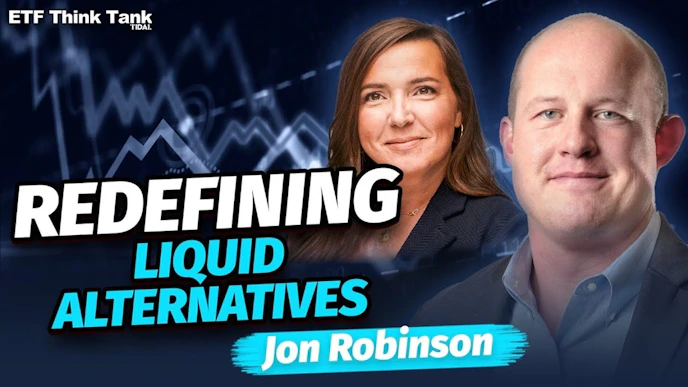
Wavemakers: Disrupting the ETF Industry: Navigating Trend Following with Expert Jon Robinson
ETF Think Tank’s Head of Research Cinthia Murphy hosts a series about innovation, disruption and entrepreneurship in the ETF industry told first-hand by those who are leading the effort: ETF providers.

Keep up with what matters in ETFs
Get timely ETF insights, market trends, and top ideas straight to your inbox.
Your newsletter subscriptions with us are subject to ETF Central's Privacy Policy and Terms and Conditions.
The ETF industry has been in the business of disrupting and improving investor outcomes for 30 years. ETF issuers sit on the frontline of this innovation. Here they share the choices, the pivotal moments, the lessons and the battle scars that make up their journey into an industry that has democratized and revolutionized market access for investors everywhere.
Our guest this week is Jon Robinson, co-founder of Bluepoint Investment Partners and Blueprint Fund Management.
Like what you're reading?
Stay in the loop — get the latest ETF insights: trends, analysis, and expert picks.
Read the Full Transcript below:
Cinthia Murphy: The ETF industry has been in the business of disrupting and improving investor outcomes for the last 30 years. ETF product providers sit on the front line of all that innovation. Here we get to hear their stories and learn what it takes to be an ETF disruptor. This is Wave Makers. Welcome to Wave Makers. I am Cinthia Murphy, head of research for the ETF think tank. And today I'm joined by John Robinson, who is co-founder of Blueprint Investment Partners and later Blueprint Fund Management. We're going to go over how these companies are intertwined and how he is shaking out the ETF business. In the meantime, John, thanks for joining me today.
Jon Robinson: Yeah, thanks for having me.
Cinthia Murphy: So you guys, you know, as a firm, I want to get to it. Who is blueprint? I know you come from the CTA world. So let's start there and then we'll get to the to the business of ETFs in a little bit. So tell us a little bit about, you know, when you co-founded Blueprint Investment Partners, what was the vision there? What do you guys set out to do? And then later, how did blueprint fund management come into the picture? And what's the purpose of that business unit?
Jon Robinson: Okay. Sure. Yeah. It's hard to talk about Blueprint and what we do without talking about how we got here. So, as you said, we started out Brandon Langley and I started Blueprint back in 2013. And he and I have been running a business together since 2007, where our first business was being a CTA and running a futures fund. And so if you recall back in, let's say, 26, 27, there weren't a lot of great 40 ACT options or public market options for manage futures. So we had several investment advisory firms, independent investment advisory firms come to us with the idea that they wanted to provide, manage futures to their clients, but do it in a limited partnership structure. So they would start the limit. And keep in mind to this is pre oh eight compliance. Okay. So this is kind of a different world in many ways. But nevertheless, in, in oh seven, we had a few firms come to us and say, look, we'll start the limited partnership. We'll put our qualified investors in the partnership and you run it and we'll split fees. And so for us, that's a great deal. All we're doing is what we always do. So we started running that and we had a great 2007 and we had an even better wait just because of the nature of our strategy, which is trading volume, which we have carried through to now. And at the end of oh eight, two of these firms came to us and said, Hey, look, the only thing that made money in the portfolio last year, but you're in the wild west of Futures. And operationally and from a bandwidth perspective, we're only we can only put 5% of 5% of our assets with you. So it's fairly inefficient for us if you would consider mapping the things you're doing on the future side trend following being systematic, having an eye on on behavior, etc., being widely diversified. You can map that from the Wild West over to things that people actually hold in a Schwab account or a fidelity account. And you can prove that to us. We would consider outsourcing our whole investment book to you, and we'll go do the things that and this is their words, you know, we'll go do the things that we're good at, like prospecting, serving clients and financial planning. So at the time for us, our variety of the futures business was a very hot money business, so we'd have a good quarter attract a lot of assets, have an average to mediocre quarter in those assets, plus 20% would leave. So it was a godfather offer for us to to to have the idea or the the opportunity to have some continuity in the business by having these pools of assets where we're both the money manager. But then also a service provider. So we developed those strategies. We launched them in 2011 at Schwab for one of the firms on a white label basis where they were. We were, you know, to boil that down simply, we're doing all the work on the back end and they're putting their brand on top, which is, you know, totally fine with us. And then demand for what we were doing kept growing. So we started Blueprint in 2013 and made that original relationship a sub advisory relationship. So, you know, Blueprint was founded on the idea that we wanted to take the core concepts of trend following and deliver them to the real world. Because most of investors exposure to trend following is through manage futures. And so in that that is done in a in a the implementation of that is done in the most orthodox trend following way possible. And what we realized when we were in the managed futures world and just having talked to investors who were involved in investing in other strategies, is, hey, look, when managed futures is is doing great, it's the thing that everybody wants to talk about in the portfolio and it's extremely additive. When managed futures is not doing great. It diverges against the things that people watch the most, like the S&P and there again, it's also the thing that everybody wants to talk about, even though it's only 5% of the portfolio, but it becomes a real problem. So for us, we wanted to try to solve if that's a problem and we believe that it was we wanted to try to solve that in terms of reining in or bringing in some of those while you still using try and following out, really reducing the distribution of outcomes for the advisor to allow them to have the strategy that they resonate with and that they wanted without these tough conversations.
Cinthia Murphy: What's interesting is the whole concept of the alternative, the liquid alternative, which managed futures would get into that space, is a diversification. And the toughest part of the conversation is, well, if this is about diversification by design, at times it will perform well. At times it won't. That means it actually works. I just think it's fascinating how we constantly talk about diversification, but that is in a way the hardest part to get people to stick with it because they want to be diversified as long as all the diverse suppliers are working in the same trend line. Right. So have you found that that conversation is surprisingly old, but still surprisingly difficult?
Jon Robinson: A 100%. That's the case in our experience. And I just think it goes back to human nature. You know, human nature is just not going to change. And so we resented that for a long time until we wised up and listened to guys like Charlie Munger who preach that on, you know, on a daily basis. Yeah, those it's really interesting because well, for a lot of reasons, I think some of it has to do with programing, the programing in the minds of the advisor and therefore and maybe it's the in the minds of the investor and therefore the advisor has to place an importance on it is that I should be invested in stocks and then the bonds are a breaking mechanism. They don't think about it, at least in our experience in terms of two non correlated things in one portfolio that zig and zag at different times, they think about it like I want to be exposed to stocks up to a point and then the bonds dilute the stock return so that if I'm 5050 and the stocks go down 20, I'm only down ten. Right. That's to smooth, smooth the ride. But with perfect correlation to stocks, they may not express it like that, but I think emotionally that's that's generally how they feel about it. So the advisor has to pay attention to that or they're they're going to get in a fight with clients once or twice, and then the client's going to fire them. I think advisors by and large understand the benefit of having no correlation, but to me it's like the difference between saying I'm going to get in shape and then having to go through the incremental pain of every day going to the gym, living through that is much different than then saying, okay, you know, I'm in shape or I'm now in shape. It takes a lot of days of not wanting to go to the gym and actually going while if you're holding an uncorrelated asset, it takes a lot of days to hold on to it when it diverges from your expectation, which is by and large driven by the S&P. So it there's like this existential problem that they're facing. I want to make it like some grandiose problem, but for them it's a problem because taking one step away from the traditional diversifier, which is fixed income is not the same distance as the incremental step they took from diversifying from equities. It's 50 times that in terms of the distance. And so I think that's why you also see a them ride the middle, right. Manage futures is not riding the middle in terms of diversification. It is at least in our view. And in looking at the data, one of the purest forms of reliable, consistent non correlation over long periods of time because it doesn't care what stocks and bonds are. If stocks can go down, it can go short, stock bonds can go down, they can go short and vice versa. And a myriad of other assets. I think they ride the middle in that they pick things that while stocks are going up, they're non correlated, but when stocks go down, they're highly correlated. And you know, that's not that's a form of diversification, but it's pretty weak and they end up feeling that when bear markets happen. So circling all the way back to your your original point that conversation has not changed. The tenor the tenor of that conversation hasn't changed. I think the context has changed a little bit over the years. And one of the things we try to do with our separately managed account strategies at Blueprint is to use trend following and our portfolio, the construction of the portfolio to deliver that sort of that the hedging properties or the braking mechanism against traditional assets, but doing it in a way that's more behaviorally friendly.
Cinthia Murphy: So let's talk a little bit about the concept of trend following in in your business. I love the concept you guys talk about as core to investment philosophy that Price is king, quote unquote. And the idea of you've got to be systematic, you've got to follow the price and you've got to try to clear your emotions as much as possible and stick with it. So but it trend following isn't for everybody. It's interesting that some people love it. Some people want nothing to do with it. So, you know, talk a little bit about why trend following. Why are you guys such believers in this approach?
Jon Robinson: Well, it's I think, first and foremost, you nailed the big reasons. Trend following is is price it at least trend following in the way we do it and the way many others do it. It uses price as its chief input and sometimes it's only input. And I think that's really important because what sits on top of that is objectivity, price, you know, saying that another way, prices, the way we believe is the one thing that cannot lie to us. Financials can be doctored. Company executives can say what they want. You know, predictions are what they are. And I have provided there are very little value in our view to the investment process. So using price, we feel like that is the only thing that is and it is not. What what will happen, it is what is happening. And so that's the purest way to measure what is happening is by looking at the price. Now, price inherently is a very noisy data point, particularly, you know, if you use the resonance of daily prices, you know, that can be extremely noisy regardless of the market you're looking at. So we try to take that data. We and other trend followers try to take that data and turn it into information. And the way we do that at Blueprint is by taking each data point, which is the price data, the closing price, and smoothing it out over past days in terms of a moving average to take this very noisy, choppy data point and create a smooth curve out of it. And, you know, we didn't invent that. We're not the only ones that do that, but we found that to be a very effective way as to not only give us a pure signal. So we use price, which we believe is pure, and then we use a series of prices smoothed out to form a set or a set of information. And we feel like that's a very pure way to do it and objective. But the second part of that is we feel like by being objective, you have to be systematic and for me, the important part about that is, is emotions are the Achilles heel of investors. This is widely documented. I don't think there's an investor out there of who's had any success that wouldn't say the same thing. And so for us, being systematic doesn't remove the emotion from us. I can assure you that, but it does remove emotion from the decision making process. So by circumventing the thing that may kill you the most and the fastest, we feel like that just that inherently right there raises our odds of success. And so there's this these building blocks that we feel like trend following and other systematic strategies. But for us, it's trend following, you know, offer both investors and advisors, particularly advisors in their advisory practice. And we feel like our unique.
Cinthia Murphy: You brought this here there's this philosophy to the ETF market in an ETF blueprint partnered up with Chesapeake Capital. It's a trend following ETF strategy ticker T fpn. So you know ten years in the hassle culminated into the your first ETF. So tell us how did the ETF as a product structure has helped to deliver access to the way you see the world to your investment philosophy? And why now? Why an ETF now? Did you just see whitespace? Because there's not a lot of, you know, funds in that segment, surprisingly. Is it just the right time for the business? So it was more of a business decision than a market opportunity decision. Walk us through the process of deciding to bring that ETF to the market.
Jon Robinson: Yeah. So for us, it was both it was a both in on those two fronts of seeing the whitespace in the market. I mean, TSP and you know, that's the ticker and it the moniker behind it is trend following plus nothing. So as we looked at the market and even now as more entrants have come into the space, we feel like that there is a moat from a business perspective around TSP and because of how unique it is, its diversification, the fact that it uses single stocks versus the index, it's really set apart from other funds that implement a a broad basket trend following type approach, whether you call that managed futures or not, you know, that's that's the alternative effectively. It's the other angle for that, though, is so blueprint. You know, our first 40 act fund was through Blueprint Fund Management back in 2020 and then we became a sub advisor to another ETF along the way. So as we we look at what we're really trying to do is we're trying to look at the investors we serve, the advisors we serve, the portfolios that we operate for them, and the portfolios that they outsource to other managers and say, what's missing? And we got the opportunity. So this is where the opportunistic piece comes in. We got the opportunity to partner with Chesapeake to deliver TPN. I mean, Chesapeake has a 30 year track record. Jerry Parker's the head of Chesapeake. I'm sure most of your listeners are familiar with Jerry. If you're not, all you have to do is watch one podcast with Jerry and you'll you'll know exactly who he is. And so taking what they've been running in a limited partnership structure for a lot of years back to 94 and be able to support that. The strategy for this take the same strategy over to the public markets and offer that at a at a price. So number one, access to it, if you're an individual investor, which you otherwise couldn't get because it was an LP structure or likely couldn't get, and then if you could you now pay a lower sticker price, a likely lower sticker price for that being that it's in an ETF structure with potentially better tax attributes, that's a pretty attractive offering for individual investors. And it also helped blueprint in its managed account portfolios deliver more non correlation to the portfolio in a systematic way where we could trust the discipline of the manager because we're their partner and do it in a way that is, at least in our view, behaviorally friendly. So it's really like the convert confluence of of those three factors that made it. You know, there aren't too many obvious decisions for us in business. I don't know if we're unique in that way, but that's the truth. And this was just such a beautifully obvious decision to make and go for it. And that ended up launching in in July.
Cinthia Murphy: What's interesting about that is we talked so much about it as being an axis story and it's beautiful that it actually really is. It's not just lip service. It's it's especially in a product like this. You really see it's opening a whole new segment that most people don't access. I'm curious, I mean, you guys just started in July, so it sounds it's you know, the early innings. But what has that conversation been like? I think when you think of the liquid all space in the ETF space, there seems to be some entrenched views of, you know, to your point earlier, the 5% of the portfolio and only a part of that 5% is it's kind of like this little outlier strategy that's more like, you know, checking the list then really going all in on it. What has that been like for you guys? How has the conversation, an education process been like about talking, what the strategy does, the benefits, the pros and cons, you know, worry threads? Has it been easier than you expected? Harder, surprising in any way?
Jon Robinson: All of the above. I, I, I think in the way we look at it is on a continuum. So we knew going into it that we're, we're not likely we may change the mindset of, of advisors and investors to, to add more to liquid alts to make a larger portion of the, of the allocation of their portfolio liquid alts. But that that's going to take a long time. So the conversations we're having now are still in hey, I allocate between I mean, there's a 99.9% chance that, you know, going into a conversation, they're going to say about 5 to 10% to liquid alts. Right. And we know we can make a dent in that. We believe we can make a dent in that over time, but not now. So who we're focusing on now is the early adopters, let's say, are those that have access to strategies like this in less liquid forms who now want really like the fact that they can put it in their IRA, they can put it in their custodial account and do it efficiently. The other side of that is those that have been accessing the strategy in mutual fund form, and they look at it and say, okay, I really like the exposure and I'm comfortable with the potential divergences over time, but I really have always wanted to do this in an ETF because it's likely more tax efficient than than a mutual fund, you know, apples to apples looking at the similar strategies. So the conversation there is not been too difficult. Where the conversations get murky is not murky, but a little more difficult is when we get brought into, okay, your portfolio, I understand manage futures, John. I get that. But you're not exactly doing manage futures although you're trading, you know, hundreds of futures markets and hundreds of of individual stocks long and short in the portfolio. How do I look at that? What should my expectation be going forward for? Okay. If I understand the Manage Futures divergence from stocks and I'm comfortable with that, how might you diverge then from Manage Futures? Right. And that's a there's probably people on our team that anticipated that that conversation. I didn't anticipate that conversation very much. And it's not a hard conversation to get to get past. When you start talking about the attributes of what the ETF does, you know, effectively it has a larger equity allocation than than most managed futures products do. To my knowledge, it's the only one that uses single stocks to express that. And we just believe that the more granular you get in terms of your exposure, meaning, you know, you've got the index and then you've got the underlying components of that index. So drilling down is more granularity which allows more inflow. It, it, first of all, it's more diversification because all the stocks are perfectly correlated, but then it allows you trend following to have a greater influence over driving the exposure inside of the fund via the strategy. And we've just found that the more authority, so to speak, we can give trend following to dictate asset allocation decisions, the better. So later on it will become that I know the conversations will change, but at least on this end of that adoption curve, the early adopters have resonated with it pretty well.
Cinthia Murphy: Yeah, it's, it's what we call internally here, the structural alpha that the ETF brings to the table relative to everything else. I mean, it's always, always cool and rewarding to see that in real life. So I think that's very exciting. But it's also fascinating just the importance of the benchmark, how all of these investment decision. So we come into these conversations as investors with a benchmark in our head, whether that's the S&P 500, to your point, whether that's the AG or TLT, whether that's, you know, our basket of managed futures. And it's like almost before you go into any of these conferences about product, you have to first establish what's the benchmark you're looking at, because at the end of the day, it always ends up being some version of comparison shopping. And I just think that's really interesting about ETF investing.
Jon Robinson: It for sure. And there's some some of that you can know, at least in our experience you can overcome and some of that you can I mean, some of it is hard wired in terms of everyone seems to look at the S&P as a hard benchmark ourselves benchmark. Right. And we can say all day long, you know, pretend when you're looking at TPM that the S&P doesn't exist. And they'll say and intellectually they'll say, great, got it. That sounds good. But then when their gut gets involved, all of a sudden it reverts back to, well, let me just keep an eye on how it tracks against stocks. And, you know, that's the beauty of having roughly half the portfolio exposed to two individual equities. Now, that's long and short, but because the trend following drives it, you know, we can get of that 50%, you theoretically could have 50% of that exposure long at any one time, which, you know, when you boil that down to tracking error, it's our expectation that in a bull market, the tracking error for testing is going to be lower than than other funds that either don't have the exposure to equities that ESPN does, or they trade the index and may get chopped out more because of the trend following rules then than we might.
Cinthia Murphy: Yeah. Yeah. And managing that expectation is, is a two tier challenge because you have the advisor who then has to do it to the client and the client comes up with their own set of expectations. And this is a client business. So it's, it's very challenging. So, John, you know, in the time you've been in the business, the process of launching an ETF coming to market the first few months out of the gate, you know, anything stands out to you, as, you know, lessons learned, either things you were happily surprised about in terms of how the ecosystem works, about all the relationships or something that you, you know, wish you had done differently, that knowing what you know now, you would have thought twice about it. So, you know, if you think about this as a conversation with people, with ETF entrepreneurs or would be product providers, considering the space, any any advice or lessons you can bring to the table?
Jon Robinson: I would say a couple of things. There's a lot, but as I try to boil it down to a few, one is micro and one is more macro. The micro one that I would give piece of advice that I would give to a would be ETF entrepreneur is just launching a product does not mean the product will gain assets so what does that mean? Well, it means that there you can have the best idea in the world. And if nobody knows about it, then, you know, you really don't have much. And that blends into the macro one, which is early on for us. You know, our whole marketing and sales strategy was, why don't you like math? And we there's a longer story behind this, but we effectively took on a capital partner in 2015 whose stipulation was, I love what you guys are doing, but we have to use some of the capital to invest in a marketing apparatus to learn how to tell the story in a way that people might resonate with. And I can speak for myself. You know, there was a part of me early on that resented that because I just it should speak for itself. And now that's a total lie. It's a total lie. But I believe that and what I've seen and what it's been a really pleasant surprise is that we've made that investment and in a nickel hands as our director of marketing and she's fantastic and runs a marketing apparatus where, you know, we are investing a lot of time and resources into education and into content development and really trying to meet people where they are, not where we want them to be. Right. And that's a very trend following like lends to to see marketing through because if we're using price, which is right, then we need to see everything we're doing through that same lens. Now that dad had not connected with me, you know, ten years ago, but as we started stepping through this, that made more and more sense. So I would just say anybody in the business focus on the thing or bring somebody in to focus on those things that you may not do well, which are, you know, the educational piece, content development. And when I say content, I mean anything from from video content to to written content to blogs, to social, anything in that in that sphere, you will you have a high likelihood of seeing a huge r a Y by shifting some resources there. And so if you're planning on starting a product or launching a firm that's in the future, going to start products, make sure that's part of your plan and a meaningful part of the plan.
Cinthia Murphy: Yeah, it's it's yeah. I like to say it's our stories that need to be told and that marketing slash distribution is potentially the hardest nut to crack in this business and the biggest stumbling block for sure. So that's a very, very, very useful, insightful advice. John, thank you so much for coming on the show. Congratulations on the launch again. The Blueprint Chesapeake for unfollowing plus nothing. TFA been very excited you guys are in the market and best of luck with the business.
Jon Robinson: Thank you very much. This was fun.
Topics
See all
This article does not have a tagged topic
Segments
See all
No specific market segments were tagged
Mentioned ETFs
No specific ETFs were tagged
Further reading

Latest ETF News
See all ETF newsThis is How Calamos Turned Wall Street’s $100 Billion Secret Into an ETF




From Dot-Com to ETFs: How One Entrepreneur Helped Spark an Investment Revolution

How Blossom Social Is Revolutionizing Retail Investing and ETF Marketing

Is 2025 the Year for Financing Food Fast?


 Advantages of ETFs over Mutual Funds1/6
Lower Costs
In this guide, we'll explore the advantages of ETFs over mutual funds, giving you valuable insights into why ETFs have gained significant popularity among investors like yourself.
Leveraged ETFs: Unlocking the Potential for Amplified Returns1/6
Understanding Leveraged ETFs
Explore leveraged ETFs: potential for amplified returns & risks. 5 ETFs to consider across equities, commodities & fixed income.
What is a Leveraged ETF?1/6
Introducing Leveraged and Inverse ETFs
In this guide, we'll dive into the world of leveraged ETFs, exploring their definition, mechanics, potential risks, and rewards.
Recent educational content

ETF Trends
ETF Industry KPIs September 14, 2026
This week’s KPI data overview highlights key metrics and trends shaping the ETF landscape.

ETF Trends
ETF Industry KPIs September 8, 2026
This week’s KPI data overview highlights key metrics and trends shaping the ETF landscape.
ETF Trends
ETF Industry KPIs August 31, 2026
This week’s KPI data overview highlights key metrics and trends shaping the ETF landscape.
ETF Trends
ETF Industry KPIs August 24, 2026
This week’s KPI data overview highlights key metrics and trends shaping the ETF landscape.
Browse all educational columns



Build and Analyze Your ETF Portfolio Like a Pro
Create your own ETF portfolio in minutes and instantly see allocations, exposures, performance, and risk. Visualize diversification across asset classes, regions, and sectors. Stress-test ideas, compare benchmarks, and refine your strategy with professional-grade analytics.