Create, analyze, optimize your ETF portfolio. Start now →



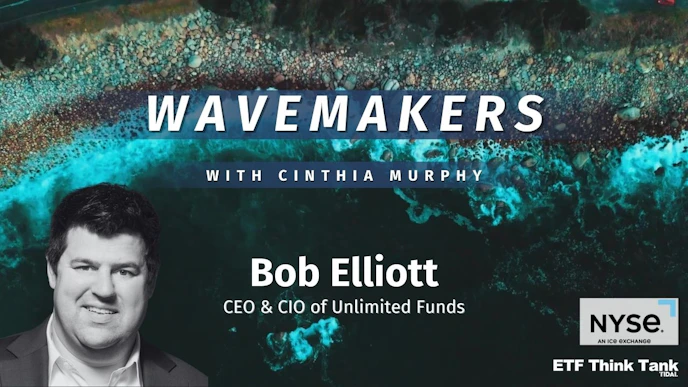
Wavemakers: Bob Elliott Shakes Up Alternatives ETF Space
ETF Think Tank’s Head of Research Cinthia Murphy hosts a series about innovation, disruption and entrepreneurship in the ETF industry told first-hand by those who are leading the effort: ETF providers.

Keep up with what matters in ETFs
Get timely ETF insights, market trends, and top ideas straight to your inbox.
Your newsletter subscriptions with us are subject to ETF Central's Privacy Policy and Terms and Conditions.
The ETF industry has been in the business of disrupting and improving investor outcomes for 30 years. ETF issuers sit on the frontline of this innovation. Here they share the choices, the pivotal moments, the lessons and the battle scars that make up their journey into an industry that has democratized and revolutionized market access for investors everywhere.
Our guest this week is Bob Elliott, co-founder, CEO, CIO of Unlimited Funds, an ETF firm that's been shaking up things in the alternative space.
Like what you're reading?
Stay in the loop — get the latest ETF insights: trends, analysis, and expert picks.
In this episode, Bob tells us about his transition from the hedge fund world into the ETF industry:
- The ETF structure allowed Unlimited Funds to deliver a complex alternatives strategy in an accessible, low cost and tax efficient way, as it helped streamline the firm’s operations. It was a win-win relative to all other vehicles.
- This industry is unlike any other in its practice of collaborative competition. Throughout the ETF ecosystem, participants are quick to share their expertise and experience with each other. It can be surprising to newcomers, but it’s a hallmark of the ETF space.
- As an entrepreneur, partnership and reliance on service providers such as white label providers proved crucial to success at Unlimited. ETFs are a relationship business.
Watch the episode here:
Murphy: Welcome to Wavemakers, Bob. We've been fascinated by your arrival in the ETF industry from the hedge fund space. Tell us how you got into ETFs in the first place.
Elliott: My career has been 20 years as a systematic investor. I was at Bridgewater Associates, the world's largest hedge fund for quite a while, almost 15 years, where I developed systematic strategies and ran the founder, Ray Dalio's investment research team, and was part of the small handful of investors that helped take Bridgewater from being a challenger to being the incumbent that it is today.
I left there about five years ago. As you become the incumbent, things slow down. And I had a lot of innovation left in me. I got to thinking about whether there was a way to bring the sophisticated hedge fund style strategies, which we were creating and offering to the institutional investors at Bridgewater, in a form that could be available to the everyday investor. That got me to thinking about whether there was a way to build technology that would allow us to use our experience combined with modern approaches to understanding modern statistical approaches to infer what managers were doing. From that, we could take that and create something akin to index type products, and because we're using technology instead of star RPMs, we could do it at a much lower cost point.
So, we built the technology, and it was looking pretty good, and we were looking around for the best structure for this idea. A low cost idea to infer the types of exposures managers had on. We looked at limited partnership structures, which is what hedge funds are traditionally in. We looked at mutual funds to see whether that made sense. Then I listened to a podcast about starting your own ETF, and I was like, ‘that is interesting!’ It was such a compelling pitch. I learned a lot about the efficiency, liquidity, transparency, and tax efficiency.
And frankly, building an ETF is also a good way to manage and to develop the business because instead of having a huge back office the way you would a hedge fund-type structure, you can partner with white label providers that provide a lot of that very efficiently and at modest cost to you. All together it’s best for the investor, best for the running of the business, and developing the business. It was a no brainer to get into the ETF business.
Murphy: The first time you came across ETFs was five years ago when you left Bridgewater? That’s amazing. It was news to you at that point?
Elliott: Yeah. Had I not listened to a podcast about the fact that you could just build your own ETF it would not have occurred to me that it was such a plausible option. As a startup asset manager, when I heard that and started to roll my sleeves and dig into it, it became more and more clear that it was one of the best ways to do this.
In particular, we all think about ETFs as the low cost index structure, but the reality is that our diverse multi-asset diversified portfolios get even more benefit from the tax efficiency and structuring that an ETF provides. In many ways, what I learned was that if you're running a multi-asset portfolio, this is ideal in terms of how to put it together for an investor relative to all the different structures that are out there.
Murphy: I love this idea because we like to throw around the word ‘democratization’ when it comes to ETFs but that was actually one of the things that attracted you to the wrapper – the concept of making it available to everyone. When you think about your learning curve from beginning to today, what was the most surprising realization, or capabilities? What was that learning curve like?
Elliott: The biggest thing I would say is that being new to the ETF space and coming in with no experience in the structure and no knowledge of the space, it was incredible how great the ETF industry is in terms of helping to bring people up the curve on how to get started.
I always like to highlight that I started thinking about ETFs when I listen to a podcast from Wes Gray, from Alpha Architect, but when I talked to him he said, ‘I think you would be better served with a different white label provider.’ In what industry does someone say, ‘Hey, look, I know we're competitors, but you you've got a good idea and these other people are better at executing that idea, given the nature of it and given the support that you need. Let me introduce you.’
It really speaks to the fact that, at a high level, all of us in the ETF business are sitting there fighting against traditional asset management that is too expensive, to illiquid, not transparent enough. We are at the cutting edge of developing the next generation of financial products for the everyday investor. So, it’s incredible to see that so many people in the industry recognize that, and recognize that success of the overall industry, and the increasing sophistication of it, is going to improve everyone who’s involved. It's incredible when you go to these ETF conferences where ostensibly people are competing with each other, but it's like a big family getting together, talking about what are the best ways to launch your ETF, what are the best service providers, what are the best ways to get your message out there. In many ways, we're all in the same boat challenging the status quo of asset management.
Murphy: It’s almost like a cause – we’re in a cause together. I like to think of it as the happy corner of Wall Street. It’s unique in that way. So, let’s talk a little bit about Unlimited and the strategies. How do you approach investing, and how has the ETF wrapper as a structure enabled you to deliver your expertise in the best way?
Elliott: Our goal, and the technology we've developed, in many ways allows us to look over the shoulder of the best asset managers in the world, see what they're doing in close to real time, and take that understanding and reflect it in long and short positions in liquid securities. When you think about what an ETF is really great at in terms of the wrapper, ETF structures are really good at liquid portfolios - portfolios of liquid securities that have moderate turnover.You're not going to trade intraday super tactically and so, you have a moderate portfolio of liquid securities. We use a universe of roughly 60 long and short positions at any time in order to reflect the exposures in the hedge fund industry.
The ETF wrapper also works well for running the business. That’s really important when you're sitting in the ETF entrepreneur shoes. It’s not just about what's best for the consumer; it’s also about how do you run a business. As an entrepreneur, some of my time is spent working on the investment strategy, but also a big chunk of my time is running a business and trying to get it to be as efficient as possible. The ETF structure affords a lot of efficiencies because you can work with folks who have expertise in trade execution and with a third party trust that allows you to socialize the operational costs of running the product across a wide variety of products, particularly when you're getting started. Those’re the things we were thinking about.
My co-founder Bruce and I had been in small and moderately sized hedge funds in our careers, and the biggest thing you see is ‘oh, my gosh, all of this time, effort and personnel is dedicated to all the back office aspects of running the business.’ Typically, in a small fund you might see 50-75% of the people focused on back office activities. The beautiful thing about partnering with a white label provider is we can focus on what we're good at, which is we have a great technology that is delivering a unique investment strategy to the market.
Murphy: In that context, if you are coming into this business, your partners, your collaborators, are key and that’s a big due diligence job. What have you learned in the process of selecting partners, of figuring out how to build the best possible business to deliver on your value proposition?
Elliott: I think many times the choice to partner with a white label provider for an ETF entrepreneur is a critical strategic decision. It's not a decision to be made lightly. What you have to do is you have to go through a process of getting to know the providers out there, understanding their strengths and their weaknesses - where are their areas of expertise. To be clear, each one of the major providers has areas of expertise, particularly around different types of investment strategy. It really is about getting to know the partners that are on the field and understanding where their strengths are. It is also about going out there and talking to people who have already partnered with some of these providers and getting that unvarnished, real perspective, which the ETF community has been great in doing.
I try to pass along whenever I can, given I was in the ‘I'm just getting started’ shoes recently. That's an important triangulation. You also want to think about how much support you need. Some people have launched ETFs in the past, so they want less support. In that case, if you already havea lead market maker relationship, you know who's going to do trade execution, then you're talking about getting very selective providers. You might want a further level of control because you have more experience than if were new to the space and have less experience with different providers necessary to launch the product. You might lean on a partner more to help guide you through that process, and that's what we did. And I'll tell you, it's incredible how much I learned over the course of the last year – all the different network of different providers and the different trade-offs to make along the way. I could not have done it without a supportive partner like the white label provider.
Murphy: You've mastered the messaging business - the being out there and telling the story. ETFs are stories that need to be told. But the ETF market is noisy. There's so much product out there. What has been the coolest part of the effort to tell the story, and the most challenging? Based on what you’ve learned, what’s the vision for growth?
Elliott: The thing that is amazing about the ETF market is the accessibility. Anyone can issue an ETF. The flip side of that is there're 3,200 ETFs and you need to figure out a way to differentiate yourself relative to all the different ETFs out there. If you're issuing an ETF with a parallel structure or a parallel investment process to some of the big names that are out there, recognize that you're going to compete against some of the most efficient and effective marketing and sales/distribution engines in the world. As an indie, how do you differentiate yourself from those folks?
A big part of what we did at Unlimited was first to look for a product that was relatively differentiated in terms of seeking to replicate hedge fund-style returns. There aren’t hundreds of those products out in the market by any stretch. The other thing we did was create value and meet advisors and investors where they are. It wasn't just about ‘I have an ETF, let me tell you about my product.’
Increasingly, in the age where there's 3,200 products, advisors get dozens of emails a day about products. The question is less about the product and more about how you can develop a strategic partnership with the clients. It comes down to thinking through what your edge is, not in creating an investment strategy which you need to have a product, but as a partner to the investment advisory community and the everyday investor. What can you bring to them that can help them along their journey?
In a lot of ways, we've invested a lot in that partnership - Twitter, podcasts, meeting people where they are. From our perspective, what I've been really excited about is not only whether we want to give returns but are these returns accessible that were typically only available to big institutional or very wealthy folks through the ETF?
The other big thing we've focused on is how do we bring institutional quality insight into what's going on in the markets to a smart but underserved universe of investment advisors and everyday investors who are just trying to navigate through this incredibly challenging environment. Whether it's blogs or podcasts or very active Twitter, all of that is around access to information and insights.
Murphy: I love that. An ETF begins with a strong value proposition that’s centered on solving an investor problem. Outside of that, it’s just contributing to noise. In that respect, as a last note, I wanted to give you an opportunity to tell us about your fund, ‘HFND’. Give us the pitch.
Elliott: A lot of advisors have allocated part of their portfolio to hedge fund strategies, and a lot of them run into a number of classic problems: they're expensive and concentrated and illiquid and nontransparent and involve a lot of paperwork.
Our idea was to create a product for the advisor community that helps address each one of those different issues. HFND seeks to replicate the gross-of-fees returns of the hedge fund industry at a much lower cost (0.95 basis point management fee) as opposed to a typical 2-20 structure. And the ETF wrapper is a lot more tax efficient.
For advisors who are saying, ‘I want to add hedge fund style strategies to my clients’ portfolios because that will help improve their diversification or their risk return,’ our goal is instead of you going to a platform and getting stuck with those expensive illiquid concentrated offerings, we have something that's available to the everyday investor that doesn't need accreditation and that gives similar institutional quality returns in a way that's a lot easier and lower cost.

Latest ETF News
See all ETF newsThis is How Calamos Turned Wall Street’s $100 Billion Secret Into an ETF




From Dot-Com to ETFs: How One Entrepreneur Helped Spark an Investment Revolution

How Blossom Social Is Revolutionizing Retail Investing and ETF Marketing

Is 2025 the Year for Financing Food Fast?


 Advantages of ETFs over Mutual Funds1/6
Lower Costs
In this guide, we'll explore the advantages of ETFs over mutual funds, giving you valuable insights into why ETFs have gained significant popularity among investors like yourself.
Leveraged ETFs: Unlocking the Potential for Amplified Returns1/6
Understanding Leveraged ETFs
Explore leveraged ETFs: potential for amplified returns & risks. 5 ETFs to consider across equities, commodities & fixed income.
What is a Leveraged ETF?1/6
Introducing Leveraged and Inverse ETFs
In this guide, we'll dive into the world of leveraged ETFs, exploring their definition, mechanics, potential risks, and rewards.
Recent educational content

ETF Trends
ETF Industry KPIs September 8, 2026
This week’s KPI data overview highlights key metrics and trends shaping the ETF landscape.

ETF Trends
ETF Industry KPIs August 31, 2026
This week’s KPI data overview highlights key metrics and trends shaping the ETF landscape.
ETF Trends
ETF Industry KPIs August 24, 2026
This week’s KPI data overview highlights key metrics and trends shaping the ETF landscape.
What’sTheFund
What's the Fund | Ocean Park Diversified Income ETF (DUKZ)
James St Aubin, Chief Investment Officer at Ocean Park Asset Management, discuss the DUKZ ETF, exposing investors to the whole spectrum of asset classes in the fixed income markets, through their rules-based process.

Browse all educational columns



Have you tried our ETF Compare tool?
Compare ETFs like a pro. Analyze fees, performance, exposure & holdings side-by-side.