Keep tabs on your favorite ETFs with a personalized weekly tracker. Create a Watchlist now →



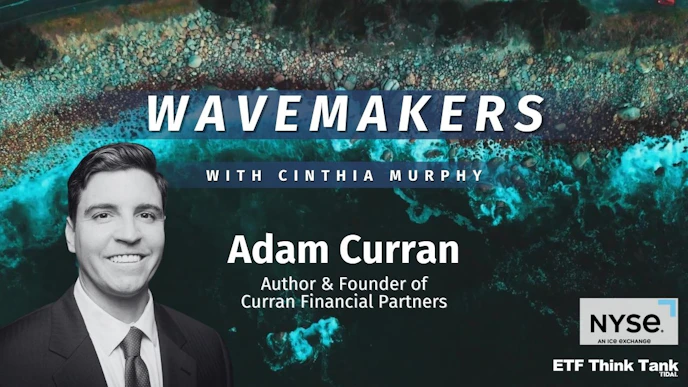
Wavemakers: Aligning Investing to Values with Adam Curran
ETF Think Tank’s Head of Research Cinthia Murphy hosts a series about innovation, disruption and entrepreneurship in the ETF industry told first-hand by those who are leading the effort: ETF providers.

Keep up with what matters in ETFs
Get timely ETF insights, market trends, and top ideas straight to your inbox.
Your newsletter subscriptions with us are subject to ETF Central's Privacy Policy and Terms and Conditions.
The ETF industry has been in the business of disrupting and improving investor outcomes for 30 years. ETF issuers sit on the frontline of this innovation. Here they share the choices, the pivotal moments, the lessons and the battle scars that make up their journey into an industry that has democratized and revolutionized market access for investors everywhere.
Our guest this week is Adam Curran, Founder of Curran Financial Partners
Like what you're reading?
Stay in the loop — get the latest ETF insights: trends, analysis, and expert picks.
In this episode, Adam tells us an ETF was the right answer to a fiduciary calling:
- Investing sophistication isn’t only for ultra-high net worth investors. ETFs are a great equalizer of access.
- Launching an ETF is a lot of work, but if you have conviction – in this case, in a values-based approach – then it’s worth the effort. There’s a niche for it.
- When it comes to retirement planning, it turns out you may be better positioned than you think – most people are.
Watch the episode here:
Cinthia Murphy: Hi Adam. You’ve built a business around retirement planning, and you built an ETF for that. You have a radio show called “Retire Y’all” and you’ve written a couple books about retirement planning. Tell us about this strong focus on retirement planning.
Adam Curran: I think most people who get into the money business have some sort of a-ha moment early in their life that causes them to have a pension for personal finance or capital markets. Growing up, my dad was always on the chopping block, worried about his job security – he worked for a defense contractor up in Connecticut. So, financial security and job security was a topic we regularly discussed at the kitchen table, so much so that my mom started her own little side hustle as a professional clown. She did birthday parties and animal balloons and face painting, the whole thing. I grew up in a household with an entrepreneur mother and a mechanical engineer father, and I was enamored with capital markets and hustling and saving money.
I got a job on the Philadelphia Stock Exchange trading floor as a runner and parlayed that position into a role at a large hedge fund. You had to have $20 million to invest with the company, and most people had hundreds of millions of dollars. It’s a surreal experience, being the son of a clown, giving advice to people who have hundreds of millions of dollars on what they should be doing with their money. S started my career in “high” finance in the Northeast with Wall Street types, and then my career brought me down to Charleston, South Carolina. There is no Wall Street epicenter down here. o had to very quickly learn how to use my skill set and services to help Middle America, Main Street investors who were wanting to live an abundant, peaceful retirement but with maybe less zeros and commas on their net worth statement.
But I always felt I could deliver a similar experience to what the individuals who had hundreds of millions of dollars were getting to Main Street Americans. People like my mom and my dad – they yeserve the same level of care and the same level of sophistication of people who had a lot of money.
So, I created our own firm, Curran Financial Partners. We want to help retirees and preferably the people who gravitate to my messaging, which is God fearing, flag waving, unapologetic conservative people. I understand some of the viewers who vote with their left hand might have immediately gagged or changed the channel, and that’s fine. We want them to live in abundant retirement, too. But we've got a pretty clear target client.
Murphy: Having a clear niche and a focus area of expertise is important to finding success. I'm curious: Once you cut three zeros or six zeros from people's investment accounts, does that change the advice significantly? Or at the end of the day, when it comes to retirement planning, the principles are the same?
Curran: It's a good question. Naturally, there's some tax planning involved with ultra-high net worth people that we don't even need to consider with a middle-class millionaire or a millionaire next door. But truth be told, I liken it almost to this: Do Jeff Bezos and Elon Musk eat different food than you or me? The answer is probably no, but they get served in a more theatrical way; they pay for bigger ambiance.
The reason I use that analogy is because what I came to learn is a lot of these hedge funds are very good at theatrics. They're very good at putting up a facade of sophistication when in reality the lion's share of them fail to beat the S&P 500. It’s a bit of a dog and pony show, suggesting sophistication, and all of us like to virtue signal a little bit, but most people who've been involved in capital markets for long enough know that if you just buy a Vanguard index fund, you have a tremendously efficient financial investment chassis.
To answer your question, no doubt ultra-high net worth people do need a level of sophistication that most kitchen table financial planners are unable to provide. But once you reach a certain level within this business, I think a lot of what individuals are paying for with high finance institutions is theatrics.
Murphy: That world is about exclusive access, about high minimums. To your point about doing this for everyday people, is that what led you to launch an ETF?
Curran: ETFs are a great equalizer. No doubt the big three ETF issuers make up the lion's share of inflows because they charge next to nothing in expense ratios. But it is encouraging. And I root for all people who launch ETFs because I've come to realize how hard it is to bring one of these things through fruition. The labor intensiveness of it, the capital intensiveness of it, the manpower intensiveness of it is enough to make a lot of people tap out.
But we listen to our clients. And I kept hearing time and time again that they wanted to invest in the stock market because the stock market had been great wealth generation tool over the course of their lives, and they wanted to continue to put money into stocks because of their growth proposition. But they no longer wanted to put their money into businesses that were spouting off on topics that they deemed to be controversial and activists in nature. Over the course of the past five years, we have never seen more publicly traded companies take stances on divisive activist issues, and my clients said to me they didn’t want to support these businesses if they didn’t share their world view.
I didn't really want to go about the process of creating an ETF. I just wanted to focus on kitchen table financial planning and retirement planning, but I needed to find some sort of investment instrument that these individuals could plug into that would honor their beliefs and their desires. Some may say that when you invest in a low-cost index fund or a mutual fund, there's a good chance some of your money might be invested into businesses you don’t want, but they perform well. I don't believe that's honoring your fiduciary duty as an investment advisor. Your fiduciary duty is to honor your clients’ wishes and live up to the expectations that they're setting for you.
If a client says, ‘I don't want to support that business,’ I need to honor that. When I searched Wall Street for a product that would fit that bill, I wasn't seeing anything out there that I could put my clients' money into. There were some Christian-based, biblically-responsible investing funds, and there were some ‘conservative’ funds out there, but when you think of a conservative fund, you think all the money is going to be in like big, crusty sectors of the overall economy, like oil, industrials and utility companies. Over the last 10 years, most of the growth of the stock market has been driven by the technology sector. So, I wanted to create an instrument that gives our clients broad market exposure to all 11 sectors of the S&P 500, but eliminates woke companies from our investment universe and weights companies according to their emphasis on the overall stock market. That’s the God Bless America ETF.
When we created the fund, there was no goal to achieve outperformance. In reality, all we were trying to do was mirror a broad market index with exclusions, and we understood that there would be years when we underdelivered and years when we overdelivered. But now that the fund's been launched for about a year, I'm starting to see that when companies are focused on activism or ideology, they aren’t really focused on producing wonderful products and services, growing their customer base, and delighting their employees. I've been pleasantly surprised at the performance of our fund and I'm starting to believe that it's a real investment thesis. People are voting with their wallets, they're voting with their investments.
Murphy: What’s cool about the ETF space is exactly that – the concept of an equalizer or democratizer of market access to all sorts of ideas and values. You suggest the idea that there may be a perception that to invest in your values, the trade off is underperformance. And that's something that has plagued a little bit the values-based and even ESG categories. The minute you go exclusionary, if you will, you are leaving money on the table, but you sort of address that by trying to make sure you have exposure to all sectors. The concept that this isn’t necessarily a tradeoff is interesting for the strategy.
Curran: Yes. You know, I'm a Boggle head in my own right. I get low-cost indexing. I get next to nothing expense ratios. But what teople who are cut from that cloth don't always understand is there are large swaths of society who’ve been banished from polite society, told their beliefs are all of the ugliest words in the dictionary. I think these people are willing to pay extra to invest in their values. I can't compete – none of small issuers can compete with a Vanguard. You’d go broke overnight at a 5 basis point expense ratio. But people are willing to pay a little more for that access, and that’s not something BlackRock or Vanguard or State Street offer.
I had an a-ha moment with a client, who looked me in the eye and said, ‘Adam, I would be willing to sacrifice one or two percentage points if I knew none of my money was going to support certain businesses.’ People may question what kind of impact are you really making by not putting, say, a million-dollar investment in Apple given the company’s total market cap, but every little bit counts. I like to think our little ETF is just one force among many others out there working to make a difference.
Murphy: One of the biggest challenges for every ETF provider is marketing and distribution. On LinkedIn you call yourself the “all around swell guy who also doesn't check his own LinkedIn very often.” Tell me a little bit about how branding has been important in differentiating and finding traction?
Curran: I love the term branding because I don't think too much about it. My brand is really me being authentic. I'm an entrepreneur. I'm self-employed. I don't plug into LinkedIn. I don't put too much time and effort into it. I, like many financial advisors, wasted 10 years of my career trying to be this fake human being that everyone could like; I would do radio bits where I would thoughtfully use my words in a way as to not offend anyone, and be approachable by people from all different walks of life, and I just got kind of sick and tired of it. I'm in Charleston. There's a lot less of that loop of “what do you do for a living?”
I just got sick of the theatrics. From my perspective, I get to sit down with thousands and thousands of individuals and I've come to see that people are all the same. Once you peel back the curtain, we start to see a lot of people aren’t as financially flush as they project. It's the people who beat to the sound of their own drum who are living fulfilled lives of abundance, who are charitable, and who are having a real impact on the world. Maybe I just took a page out of their book.
My advice? Double down on yourself. You're not going to compete with Vanguard on fees. You're not going to compete with a big hedge fund on sophisticated trading algorithms and technology. But no one can be you. I think people gravitate to that level of authenticity. And I guess you can call it my brand.
Murphy: We hear that a lot – the importance of authenticity and a unique value prop. It's a crowded marketplace, and if you’re not going to bring something true and unique, then the chances of success are much smaller. As we wrap up, given your focus on retirement, are there any lessons you want to share, any anecdotes when it comes to retirement planning? Impart some wisdom before we go.
Curran: Overwhelmingly, people are worried about ‘insert financial fear here’: inflation, the presidential election cycle, the stock market crashing, interest rates popping or dropping, a war in Ukraine. Generally, people who accumulate wealth have what I call a healthy level of paranoia.
The reason they have $1,000,000 is because they are concerned about their financial future. So, they made the business decision to stash away 10% of their income into their 401k. They made the business decision to pay off their house mortgage and drive cars until the wheels fall off.
The idea of retiring is a terrifying proposition. People have spent their entire lives squirreling money away, accumulating, and then somewhere along the way, they say, ‘I should retire. I have enough money here.’ Most financial marketing surrounds this idea that you'll never outlive your money, or, worse, ‘if you don't work with us, you're going to outlive your money and end up welcoming people to Walmart and eating cat food.’
What I find overwhelmingly is that people can retire significantly sooner than they ever thought possible, and they could be spending more money on a month by month basis than they ever thought possible. But most retirees, because they have this healthy level of paranoia, are pecking at their money because they're worried about the next financial disaster or calamity. And they're cruising to be the wealthiest person in the cemetery.
You and I both know our 60s and 70s are tremendously precious, before we all slow down or get dealt a medical diagnosis. People who are healthy and able bodied in their 60s and 70s ought to be spending money more joyfully and giving themselves permission to create experiences. Because you will worry about money until your final breath. The good news is most of you could be spending more money and retiring sooner.

Latest ETF News
See all ETF newsThis is How Calamos Turned Wall Street’s $100 Billion Secret Into an ETF



From Dot-Com to ETFs: How One Entrepreneur Helped Spark an Investment Revolution
How Blossom Social Is Revolutionizing Retail Investing and ETF Marketing

Is 2025 the Year for Financing Food Fast?


 Advantages of ETFs over Mutual Funds1/6
Lower Costs
In this guide, we'll explore the advantages of ETFs over mutual funds, giving you valuable insights into why ETFs have gained significant popularity among investors like yourself.
Leveraged ETFs: Unlocking the Potential for Amplified Returns1/6
Understanding Leveraged ETFs
Explore leveraged ETFs: potential for amplified returns & risks. 5 ETFs to consider across equities, commodities & fixed income.
What is a Leveraged ETF?1/6
Introducing Leveraged and Inverse ETFs
In this guide, we'll dive into the world of leveraged ETFs, exploring their definition, mechanics, potential risks, and rewards.
Recent educational content

ETF Trends
ETF Industry KPIs September 14, 2026
This week’s KPI data overview highlights key metrics and trends shaping the ETF landscape.

ETF Trends
ETF Industry KPIs September 8, 2026
This week’s KPI data overview highlights key metrics and trends shaping the ETF landscape.
ETF Trends
ETF Industry KPIs August 31, 2026
This week’s KPI data overview highlights key metrics and trends shaping the ETF landscape.
ETF Trends
ETF Industry KPIs August 24, 2026
This week’s KPI data overview highlights key metrics and trends shaping the ETF landscape.
Browse all educational columns



Have you tried our ETF Compare tool?
Compare ETFs like a pro. Analyze fees, performance, exposure & holdings side-by-side.