Turn ETF ideas into real portfolios. Try the builder now →



The Warren Buffett 90/10 ETF portfolio
Here's how to recreate Warren Buffett's 90/10 portfolio using low-cost ETFs.


Keep up with what matters in ETFs
Get timely ETF insights, market trends, and top ideas straight to your inbox.
Your newsletter subscriptions with us are subject to ETF Central's Privacy Policy and Terms and Conditions.
The "Oracle of Omaha" Warren Buffett may have made his vast fortune buying the shares of downtrodden, undervalued U.S. large-cap stocks, but Buffett had different ideas regarding his estate.
In a 2013 letter to Berkshire Hathaway (BRK.A/BRK.B) shareholders, Buffett indicated that the trustee of his estate would take a very different investment strategy upon his passing. Instead of trying to pick value stocks or invest with a hedge fund-like many billionaires do, Buffett instructed his trustee to buy simple, low-cost index funds.
Specifically, Buffett's estate will be invested 90% into an S&P 500 index fund (Buffett suggested Vanguard's), and the remaining 10% invested in short-term U.S. Treasury bonds. Let's dive deeper into Buffett's 90/10 portfolio, assess its construction and risk/return profile, and figure out the best way to replicate it.
Like what you're reading?
Stay in the loop — get the latest ETF insights: trends, analysis, and expert picks.
How does the 90/10 work?
Despite his stock picking, Buffett is a big fan of index investing. In 2008, Buffett made a bet with the hedge fund industry to the tune of $1,000,000 that net of fees, costs, and expenses, a simple S&P 500 index fund would beat the performance of a portfolio of hedge funds over ten years.
The rest is history. Buffett won that deal easily, demonstrating the power of passive investing vs active management yet again. While hedge funds have their uses (providing non-correlated positive returns in all market scenarios for risk management), for most investors, an index fund is the easiest, most reliable way to attain real wealth.
And herein lies the beauty of Buffett's portfolio – 90% of his estate's capital will be deployed into the most well-known liquid stock market index, the S&P 500, a benchmark difficult for even professional fund managers to beat. The remaining 10% is put in short-term Treasurys as a way to store cash. Given Buffett's estate's large size, his wife and family could survive off the Treasurys and interest income even if the S&P 500 tanked sharply.
Even for retirees, Buffett's 90/10 portfolio is quite sound. Javier Estrada, professor of finance at the IESE Business School in Barcelona, Spain, found that Buffett’s 90/10 asset allocation had a low failure rate when stress-tested at a 4% withdrawal rate in retirement. Over rolling 30-year periods, Buffett's 90/10 allocation failed only 2.4% of the time, which was close to the rate experienced by the traditional 60/40 portfolio.
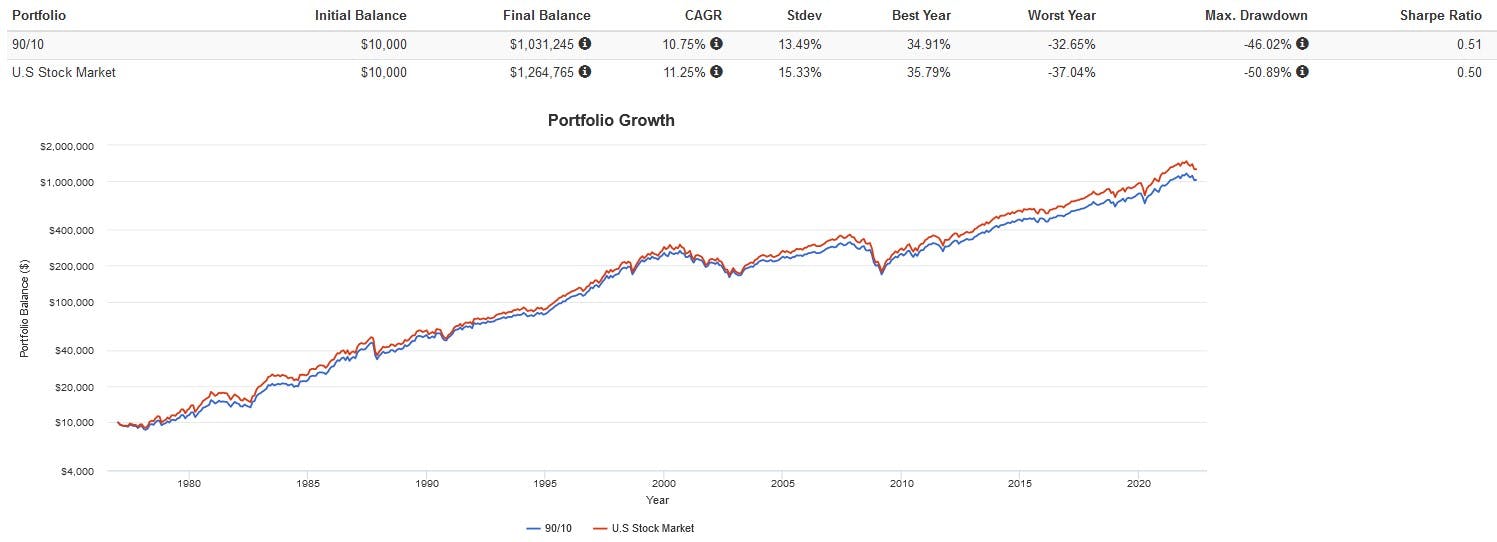
I backtested Buffett's 90/10 portfolio compared to the total U.S. stock market. The results show an overall lower total return but a higher risk-adjusted return and lower volatility and drawdowns. This is due to the 10% short-term treasury allocation, which slightly reduces the portfolio's risk.

Building the 90/10 portfolio
To build the 90/10 portfolio, we must find the right ETFs that hold our two assets of choice. A great way to do this is via the ETF Central screener, by filtering for equity index and fixed-income EFTs.
The first ETF chosen should be a low-cost S&P 500 index fund. The goal here is to keep expense ratios low. Some great options include:
- Vanguard S&P 500 ETF (): 0.03% expense ratio.VOO
- iShares Core S&P 500 ETF (): 0.03 expense ratio.IVV
The second ETF chosen should be a short-term Treasury fund. The goal here is to limit interest rate risk, so we want a low duration for our bonds. Some great options include:
- Vanguard Short-Term Treasury ETF (): 0.04% expense ratio.VGSH
- iShares 1-3 Year Treasury Bond ETF (): 0.15% expense ratio.SHY
Once you have selected your ETF of choice, simply allocate them in a 90/10 proportion and rebalance the portfolio on an annual or quarterly basis. The trick here is to not fiddle with it. Think of it as a bar of soap – the more you handle it, the smaller it gets.
Improving the 90/10 portfolio
Buffett's portfolio is sound but could be optimized with some different assets. Keep in mind that these variations will affect the risk-return profile of the 90/10 in different ways, which may outperform or underperform depending on the investing environment moving forward.
Personally, I would swap the short-term Treasurys for long-term Treasurys. From a portfolio management perspective, I want the higher volatility and negative correlation of long-term Treasurys to offset my equity risk. Most of the risk in the 90/10 portfolio is being contributed by the stocks. From a risk parity view, I want this to be less skewed. By replacing the short-term Treasurys with long-term ones, I can reduce volatility and drawdowns further, at the cost of increased interest rate risk. Examples of long-term Treasury ETFs include:
- Vanguard Long-Term Treasury ETF (): 0.04% expense ratio.VGLT
- iShares 20+ Year Treasury Bond ETF (): 0.15% expense ratio.TLT
On the equity side, I would swap out the S&P 500 for the total U.S. stock market. The S&P 500 is great and all, but there's no good reason to ignore the other mid and small-cap stocks that comprise the U.S. market. From a passive investing point of view, buying the entire investable market is preferable. There's also a higher risk from small-cap stocks, which can produce better returns over time. Examples of total U.S. stock market ETFs include:
- Vanguard Total Stock Market ETF (): 0.03% expense ratio.VTI
- iShares Core S&P Total U.S. Stock Market ETF (): 0.03% expense ratio.ITOT
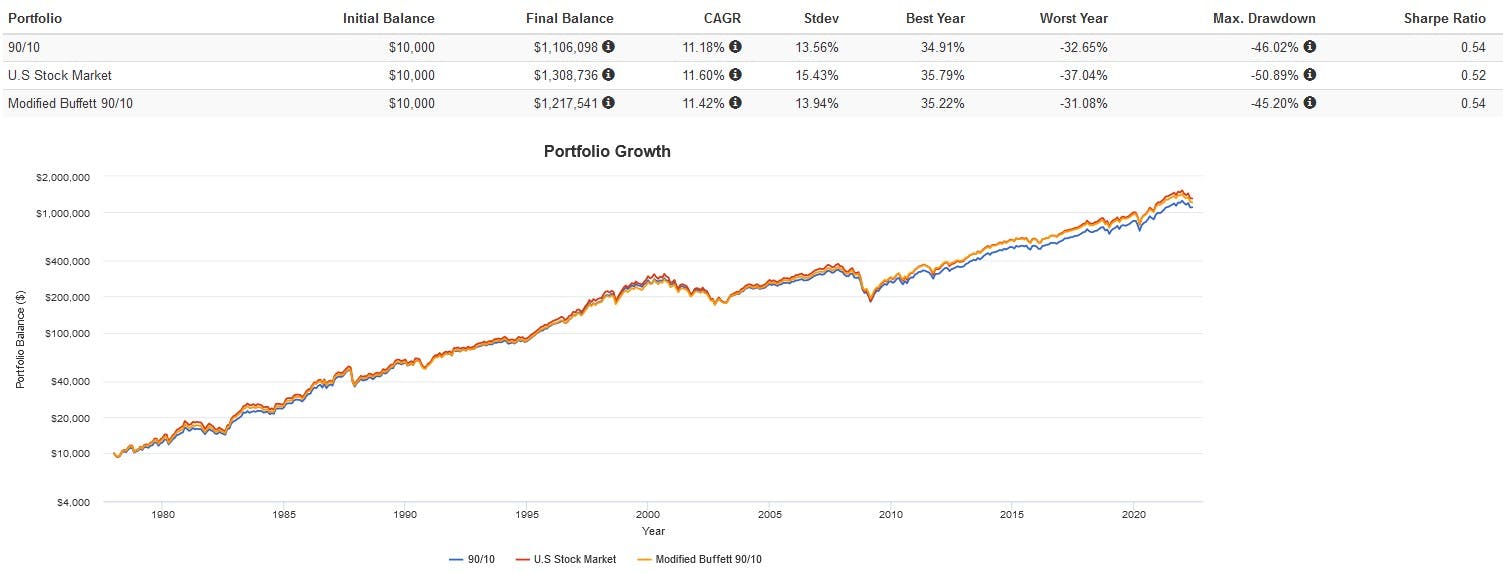
Modifying Warren Buffett's 90/10 portfolio using long-term Treasurys and the total U.S. stock market historically improved performance, with a better risk-adjusted return.
Then again, who am I to argue against Buffett's advice?
Segments
See all
Mentioned ETFs
Further reading

Latest ETF News
See all ETF news10-Year Treasury Yield Hits 5%: Which Bond ETFs Offer the Most Direct Exposure?

ETF comparison: NEOS S&P 500 High Income ETF (SPYI) Versus Goldman Sachs S&P 500 Premium Income ETF (GPIX)

There’s an ETF for That? Investing Like University Endowments

Could Water ETFs Be the Next AI Bottleneck Trade?

What is a Boomer Candy ETF?



 Advantages of ETFs over Mutual Funds1/6
Lower Costs
In this guide, we'll explore the advantages of ETFs over mutual funds, giving you valuable insights into why ETFs have gained significant popularity among investors like yourself.
Leveraged ETFs: Unlocking the Potential for Amplified Returns1/6
Understanding Leveraged ETFs
Explore leveraged ETFs: potential for amplified returns & risks. 5 ETFs to consider across equities, commodities & fixed income.
What is a Leveraged ETF?1/6
Introducing Leveraged and Inverse ETFs
In this guide, we'll dive into the world of leveraged ETFs, exploring their definition, mechanics, potential risks, and rewards.
Recent educational content

ETF Trends
ETF Industry KPIs September 22, 2026
This week’s KPI data overview highlights key metrics and trends shaping the ETF landscape.

First Look ETF
First Look ETF: Income, Corporate Arbitrage, and Growth and Value Investing
First Look ETF September 2026: iCapital, Mast Investments and North Square unpack new ETFs targeting monthly income, merger arbitrage and complementary growth and value exposure.

ETF Trends
ETF Industry KPIs September 14, 2026
This week’s KPI data overview highlights key metrics and trends shaping the ETF landscape.
ETF Trends
ETF Industry KPIs September 8, 2026
This week’s KPI data overview highlights key metrics and trends shaping the ETF landscape.
Browse all educational columns



Expert-Built ETF Portfolios, All in One Place
Don’t start from scratch. Discover ready-made ETF portfolios built by professionals to match different goals, timelines, and market views. Use them as inspiration or as a starting point for your own allocation.