From idea to ETF portfolio in minutes. Build yours now →



Wall Street Isn't The Housing Problem
Policy-driven fears around institutional ownership of housing sparked a sharp selloff in single-family rental REITs, but fundamentals and valuations suggest the reaction may be overdone.


Keep up with what matters in ETFs
Get timely ETF insights, market trends, and top ideas straight to your inbox.
Your newsletter subscriptions with us are subject to ETF Central's Privacy Policy and Terms and Conditions.
- Single Family Rental REITs and private-equity stocks sold off sharply this week after President Trump floated the idea of banning large institutional investors from purchasing single-family homes.
- While we doubt this sweeping policy ultimately becomes law, there is a non-zero chance some version advances, as housing affordability becomes a major focus in 2026 ahead of midterms.We believe it is reasonable that any policy would include a public REIT carve-out, consistent with existing legal precedent that treats REITs as transparent, regulated, and distinct from private equity.
- Investor ownership is a convenient scapegoat: institutions own under 0.5% of U.S. single-family homes. Affordability constraints, instead, stem from structural undersupply, driven by underbuilding and higher construction costs.
- Invitation Homes and American Homes 4 Rent trade near 30% discounts to NAV, implying roughly 20% upside even in a highly unlikely forced-sale scenario, making policy-driven selloffs a buying opportunity.
Single-Family Rentals: Renting the American Dream?
Single-Family Rental REITs and private-equity-linked real estate stocks sold off sharply this week after President Trump floated the idea of banning large institutional investors from purchasing single-family homes, framing the proposal as a way to address housing affordability.
Shares of Invitation Homes (INVH) and American Homes 4 Rent (AMH) tumbled 5%, while private equity giant Blackstone (BX) also traded lower. Large private owners of single-family rentals include Pretium (Progress Residential), Cerberus (FirstKey Homes), Amherst (Main Street Renewal), NexPoint (Vinebrook Homes), and Brookfield (Conrex).Single-Family Rentals: Renting the American Dream?
Single-Family Rental REITs and private-equity-linked real estate stocks sold off sharply this week after President Trump floated the idea of banning large institutional investors from purchasing single-family homes, framing the proposal as a way to address housing affordability.
Shares of Invitation Homes (INVH) and American Homes 4 Rent (AMH) tumbled 5%, while private equity giant Blackstone (BX) also traded lower. Large private owners of single-family rentals include Pretium (Progress Residential), Cerberus (FirstKey Homes), Amherst (Main Street Renewal), NexPoint (Vinebrook Homes), and Brookfield (Conrex).
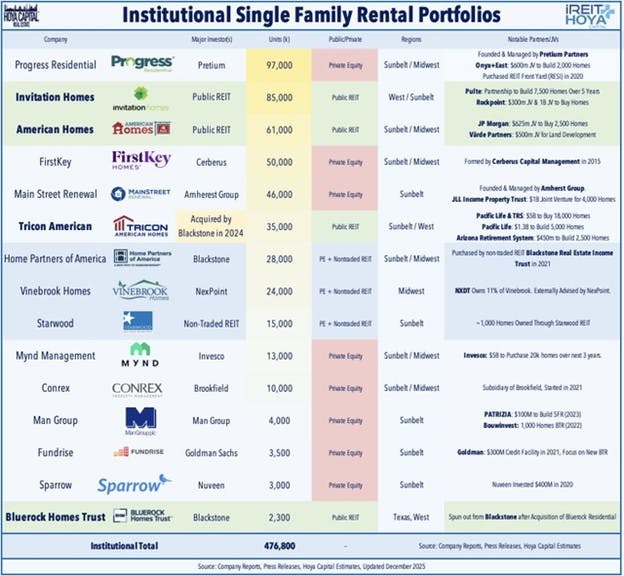
We have doubts that proposals like this will ultimately make it into law. Beyond the political and legal hurdles, there are substantial practical challenges that would be difficult to resolve in any workable legislation, starting with how to define both a “single-family home” and an “institutional investor.”
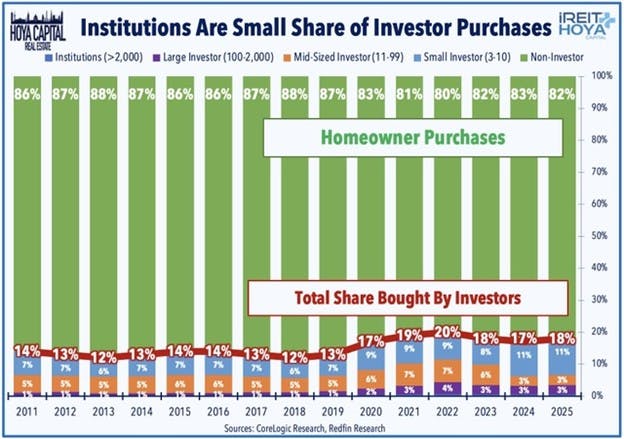
Investor ownership has become a convenient scapegoat in the housing affordability debate. Institutional investors owning more than 2,000 homes account for less than 0.5% of the U.S. single-family housing stock. Even large investors owning at least 100 homes collectively control less than 5% nationally, a share that is simply too small to drive a nationwide affordability crisis.
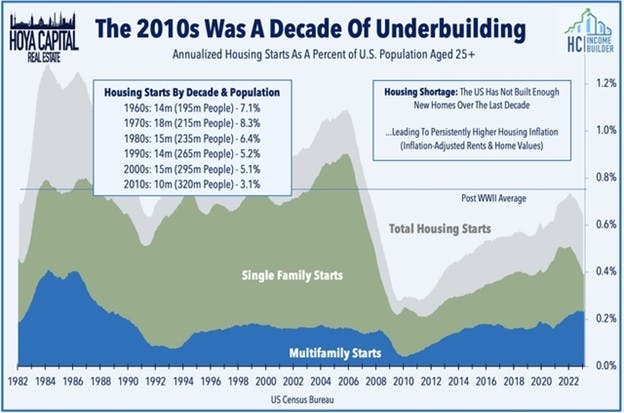
The core issue remains structural undersupply, driven by a decade of underbuilding after the Great Financial Crisis and compounded by a host of headwinds that have driven up the cost of land, construction, and ownership, including restrictive zoning, building code-driven cost inflation, higher financing rates, insurance rates, and property taxes. Policies that target ownership structure without addressing these supply constraints are unlikely to meaningfully move home prices or rents.
But the concept itself is not new, nor should it be written off entirely as a pipe dream. Versions of this proposal have previously been floated by Senators Warren and Sanders. The concept resonates politically across both sides of the aisle - even if the math doesn't necessarily add up - and it's increasingly clear that housing policy will be a major focus in 2026 ahead of the midterms.
If the discussion were to advance into serious legislative drafting, history strongly suggests that any workable framework could - and should - carve out publicly traded REITs. There is a clear precedent across tax, securities, and housing policy for treating REITs differently from private institutional capital, reflecting their transparency, public ownership, and regulatory oversight.
Most notably, under FIRPTA, publicly traded REITs were explicitly exempted from punitive foreign ownership rules to avoid disrupting liquid public markets and indirect retail ownership through pensions and funds. Similarly, the REIT Modernization Act and subsequent tax legislation distinguished REITs from private funds by preserving pass-through status while also imposing disclosure and governance requirements instead of ownership restrictions.
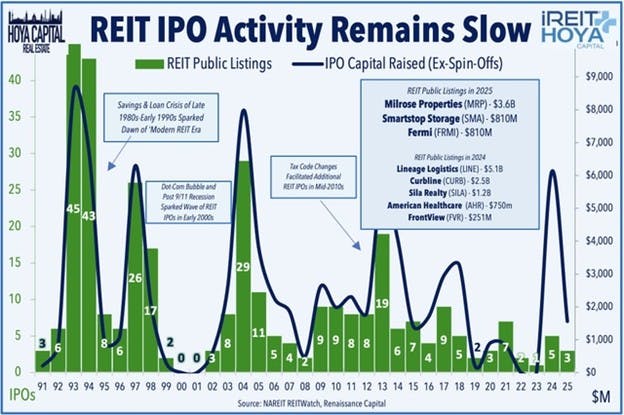
A REIT carve-out would certainly not be novel, and such an outcome would surely push capital toward more transparent, regulated ownership structures. This would, of course, favor the existing SFR REITs while encouraging institutional capital to migrate out of opaque private vehicles and into the public markets, potentially even spurring new SFR REIT IPOs.
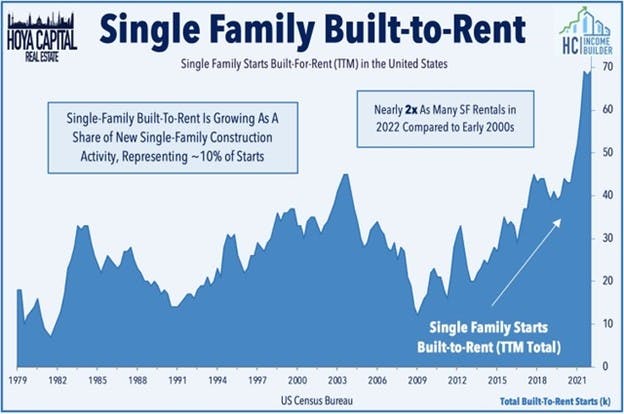
There are also important second-order effects to consider if the administration pushes ahead with this initiative. Institutional buyers, including SFR REITs, have provided stabilizing liquidity throughout this recent 2-3 year "housing recession" by absorbing distressed inventory and, more recently, emerging as a buyer of last resort for many single-family homebuilders via built-to-rent communities. Restricting this capital could increase cyclicality, raise the cost of capital for new housing, and ultimately work against affordability goals.
It's also worth pointing out that while most rental homes are owned by small mom-and-pop landlords, our research consistently finds that large-scale operators, particularly SFR REITs, often outperform smaller landlords on objective measures of renter satisfaction, maintenance responsiveness, and operational consistency. SFR residents are in no hurry to move out, with an average tenure of over 5 years. At under 20%, SFR REIT annual turnover rates are below the industry average and half that of their multifamily peers.
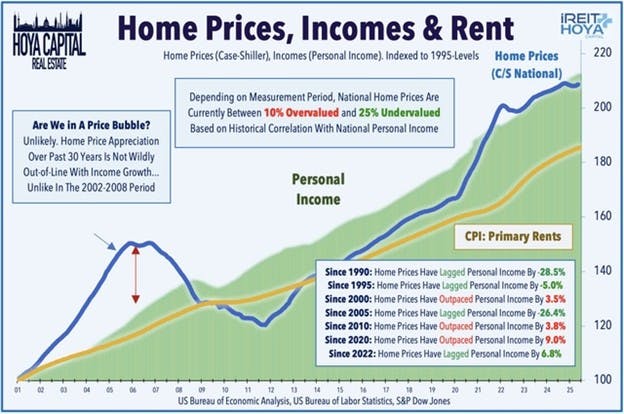
The broader affordability narrative around home prices deserves closer analysis as well. Below, we chart trends in national home prices against changes in personal incomes, highlighting that current home values are not materially out-of-line with historical correlations. Over extended measurement periods, changes in nominal household incomes show the strongest and most stable relationship with nominal home values, a pattern that holds not only in the U.S. but across most developed housing markets globally.
While home prices surged rapidly in the post-pandemic period, the subsequent slowdown in price growth, combined with steady gains in personal incomes, has helped realign valuations with historical norms. Using incomes as the baseline, home prices are between 10% overvalued and 25% undervalued, depending on the "base year" used for the analysis, dating back to 1990.
Global ETF Survey 2026 is Live!
With 1,790 new products launched by July 2026, choosing is harder than ever. Our Global ETF Survey 2026, built on 620 professional investors and allocators, shows how active, fixed income, options-based and thematic ETFs are reshaping fund selection.
Deeper Dive: Single-Family Rental REITs
Taking a deeper dive, Single-Family Rental REITs ("SFR REITs") are one of the notable success stories of the Modern REIT Era, becoming a "core" institutional asset class and quieting the critics that questioned their ability to operate efficiently. In the Hoya Capital Single-Family Rental Index, we track the two major SFR REITs: Invitation Homes and American Homes.
We also track two newer entrants: NexPoint Diversified (NXDT) - which owns minority interests in Vinebrook and NexPoint Home Trust - along with Bluerock Homes (BHM) - a micro-cap spin-off resulting from Blackstone's acquisition of former apartment REIT Bluerock Residential in 2021.
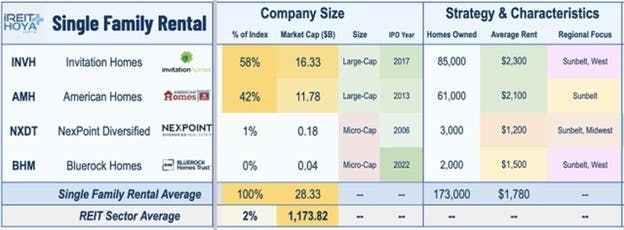
The average single-family rent is $1,500 per month, but REIT portfolios skew towards the higher end of the quality spectrum with an average rent of around $2,000/month in 3-4 bedroom homes that are typically around 1,800 square feet. These four SFR REITs own a combined 173,000 SFR units with an average vintage of 20-25 years.
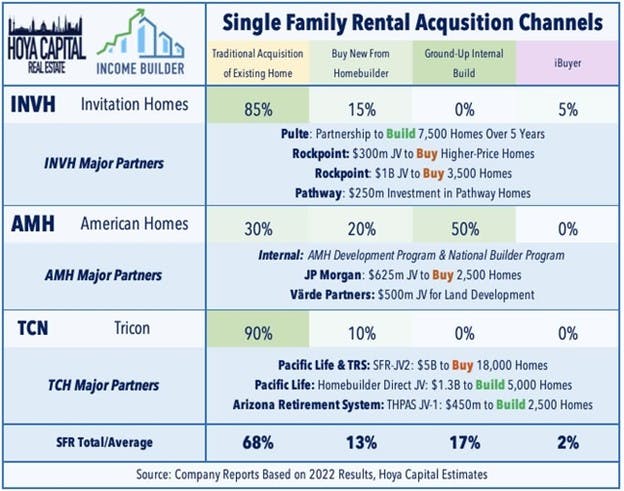
These REITs utilize varied acquisition strategies to fuel external growth. Invitation Homes utilizes the most conventional (and lowest risk) strategy of the SFR REITs, leaning heavily on traditional acquisition channels supplemented by partnerships with outside homebuilders to buy built-to-rent homes. American Homes, meanwhile, has led the charge on the "built-to-rent" strategy, investing heavily in its internal homebuilding capabilities.
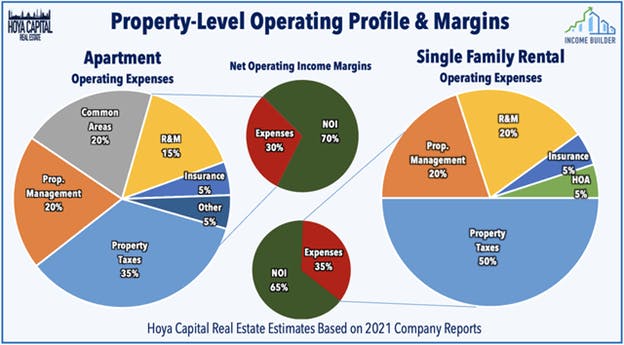
Scale is a key competitive advantage for these large institutional SFR owners, and relative to apartment buildings, where each property can have several hundred units, geographical fragmentation makes it more difficult to acquire a substantial number of units to achieve scale. Density within markets is especially critical for SFR REITs for achieving efficiencies in leasing, acquisition, and maintenance. We estimate that 500-1,000 units per market are needed to achieve minimum scale, but that 2,000 units or more are needed to reach a "critical mass" whereby the REIT can localize operations within that market and achieve cost efficiencies on par with apartment REITs.
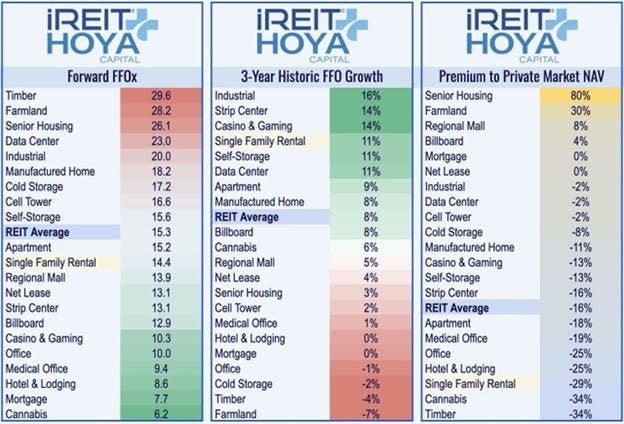
From a valuation perspective, we view the recent sell-off as a buying opportunity rather than a reason to run. Invitation Homes is currently our largest holding in our Dividend Growth portfolio and one of our highest conviction names across our portfolios. Already trading at attractive valuations before the dip, INVH and AMH now trade at roughly 30% discounts to estimated net asset value ("NAV"). Even in a highly unlikely liquidation scenario, selling homes into the private market and assuming 10% transaction costs would still imply approximately 20% upside to current share prices.
Bottom line - while we doubt this sweeping policy ultimately becomes law, there is a non-zero chance some version advances, as housing affordability becomes a major focus in 2026 ahead of midterms. But we believe it is reasonable that any policy would include a public REIT carve-out, consistent with existing legal precedent that treats REITs as distinct from private equity. Under any scenario, we believe that current valuations of these SFR REITs provide a substantial margin of safety for a pair of REITs that have historically ranked as among the top performers.
Disclosure: Hoya Capital Real Estate advises two Exchange-Traded Funds listed on the NYSE. In addition to any long positions listed below, Hoya Capital is long all components in the Hoya Capital Housing 100 Index and in the Hoya Capital High Dividend Yield Index. Index definitions and a complete list of holdings are available on our website.
Please note that this article reflects the author’s personal views and does not represent the opinions of the publication or its affiliates. It is for informational purposes only and does not constitute investment advice. It is essential to seek guidance from a registered financial professional before making any investment decisions.

Latest ETF News
See all ETF news
Your ETF Is a Tool. Investors Will Decide How to Use It.


How Much ETF Infrastructure Do You Really Need?

Are ETFs Getting Too Complicated? Not Necessarily, But Complexity Has a Cost

Form 4 Has 20 Transaction Codes. None Say "Section 351 ETF Swap"


Who Really Owns a White-Label ETF?


 Advantages of ETFs over Mutual Funds1/6
Lower Costs
In this guide, we'll explore the advantages of ETFs over mutual funds, giving you valuable insights into why ETFs have gained significant popularity among investors like yourself.
Leveraged ETFs: Unlocking the Potential for Amplified Returns1/6
Understanding Leveraged ETFs
Explore leveraged ETFs: potential for amplified returns & risks. 5 ETFs to consider across equities, commodities & fixed income.
What is a Leveraged ETF?1/6
Introducing Leveraged and Inverse ETFs
In this guide, we'll dive into the world of leveraged ETFs, exploring their definition, mechanics, potential risks, and rewards.
Recent educational content

First Look ETF
First Look ETF: Income, International, and Cash Flow ETFs
In this season 6 episode of First Look ETF, Stephanie Stanton @etfguide examines the latest ETF marketplace trends with NYSE and guests.


ETF Trends
ETF Industry KPIs October 5, 2026
This week’s KPI data overview highlights key metrics and trends shaping the ETF landscape.

ETF Trends
ETF Industry KPIs September 28, 2026
This week’s KPI data overview highlights key metrics and trends shaping the ETF landscape.
ETF Trends
ETF Industry KPIs September 22, 2026
This week’s KPI data overview highlights key metrics and trends shaping the ETF landscape.
Browse all educational columns



ETFs’ Next Act: From Access to Selection
With 1,790 new products launched by July 2026, choosing is harder than ever. Our Global ETF Survey 2026, built on 620 professional investors and allocators, shows how active, fixed income, options-based and thematic ETFs are reshaping fund selection.