Open Now: The Global ETF Survey Take the Survey →



Unlocking the Power of US High Dividend Investing
Growth or consistency, both are important when it pertains to dividend investing.


Keep up with what matters in ETFs
Get timely ETF insights, market trends, and top ideas straight to your inbox.
Your newsletter subscriptions with us are subject to ETF Central's Privacy Policy and Terms and Conditions.
Though broadly understood, the contributing aspects of dividends when examining the total return performance of equities is somewhat understated. This article will focus on dividend investing, highlighting their seminal importance to total return performance and investment solutions that provide investors with a pure-play dividend focus.
The ETF Industry Is Evolving Fast
From AI infrastructure to active strategies, the ETF landscape is shifting. Share your perspective in the 7th Annual Global ETF Survey and get exclusive early access to the final report.
Dividends: Looking through history
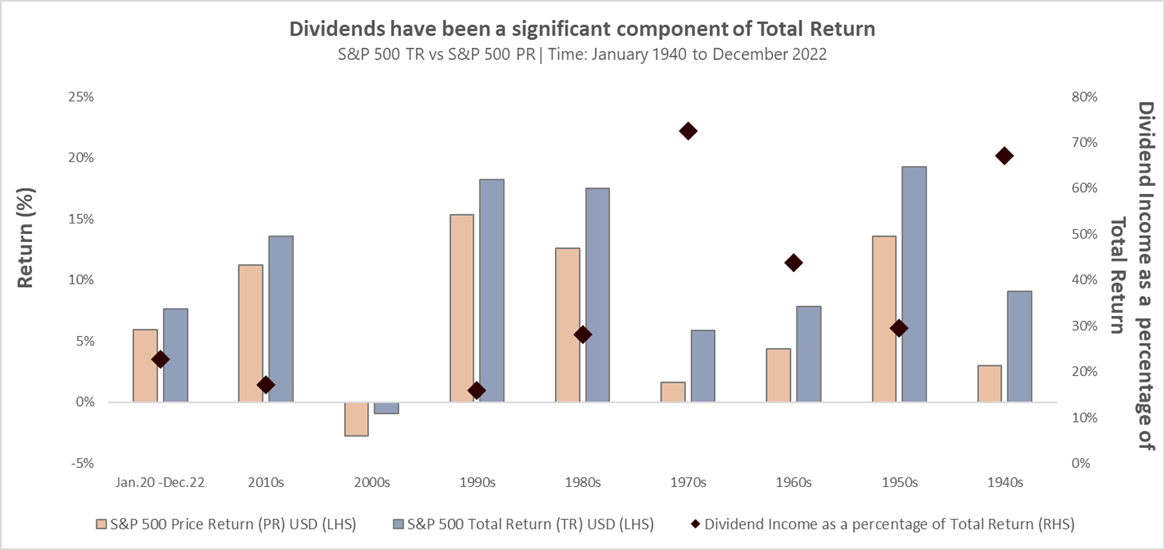
In examining the performance of the S&P 500 Price Return Index and S&P 500 Total Return Index over the past eight decades, we are able to demonstrate the seminal importance of dividends across differing time periods. As observed in the following chart, while the contributing impact of dividends does vary in each decade, from 1940 to 2022, approximately 40% of the annualized total return of the S&P 500 was derived from the payment and reinvestment of dividends, with capital appreciation contributing the rest.
Dividend Policy & Equity Performance
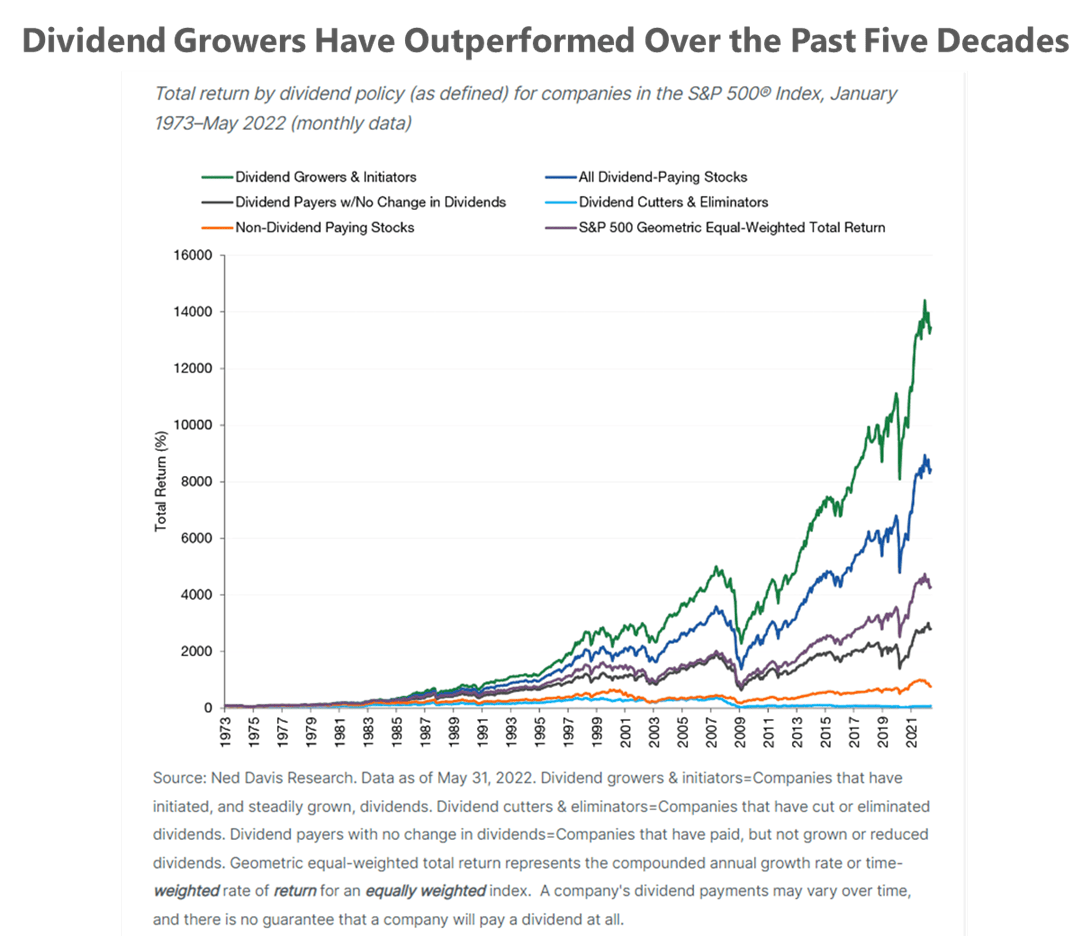
The importance of dividends in regard to total equity return performance has led to research examining the dividend policy actions taken by companies. In the US, Ned Davis Research (NDR), a global provider of independent investment research, conducted a research study to learn more about the relative performance of companies according to their dividend policies. In NDR’s study, they divided companies into two groups based on whether or not they paid a dividend during the previous 12 months; they named these two groups “dividend payers” and “dividend non-payers.”
The “dividend payers” were then divided further into three groups based on their dividend-payout behavior during the previous 12 months. Companies that kept their dividends per share at the same level were classified as “no change.” Companies that raised their dividends were classified as “dividend growers and initiators.” Companies that lowered or eliminated their dividends were classified as “dividend cutters or eliminators.” Companies that were classified as either “dividend growers and initiators” or “dividend cutters and eliminators” remained in these same categories for the next 12 months, or until there was another dividend change.
For each of the five categories (dividend payers, dividend non-payers, dividend growers and initiators, dividend non-payers, and no change in dividend policy) a total-return geometric average was calculated; monthly rebalancing was also employed.
As observed from the following chart, shares of companies that have initiated, and steadily grown, dividends have outperformed companies with different dividend policies, including paying but not growing their dividend, cutting, or eliminating the dividend, or not paying a dividend at all. This long-term outperformance is attributable to the typical profile of a dividend grower: a stable business model, a strong balance sheet, a history of capital discipline, and management teams committed to returning value to shareholders. Companies exhibiting both the willingness and ability to persistently grow their dividends have delivered value over a variety of market and economic cycles and through difficult operating environments.
Investing in Dividend Growers & Initiators
For investors interested in having concentrated exposure to companies classified as ‘Dividend Growers & Initiators, the S&P 500 Dividend Aristocrats Index is a good barometer for assessing overall performance. A Dividend Aristocrat is a company in the S&P 500 Index that has paid – and increased – its base dividend every year for at least 25 years consecutively. In looking at the long-run performance relative to the S&P 500 Index, the S&P 500 Dividend Aristocrats Index has clearly outperformed over the long term.
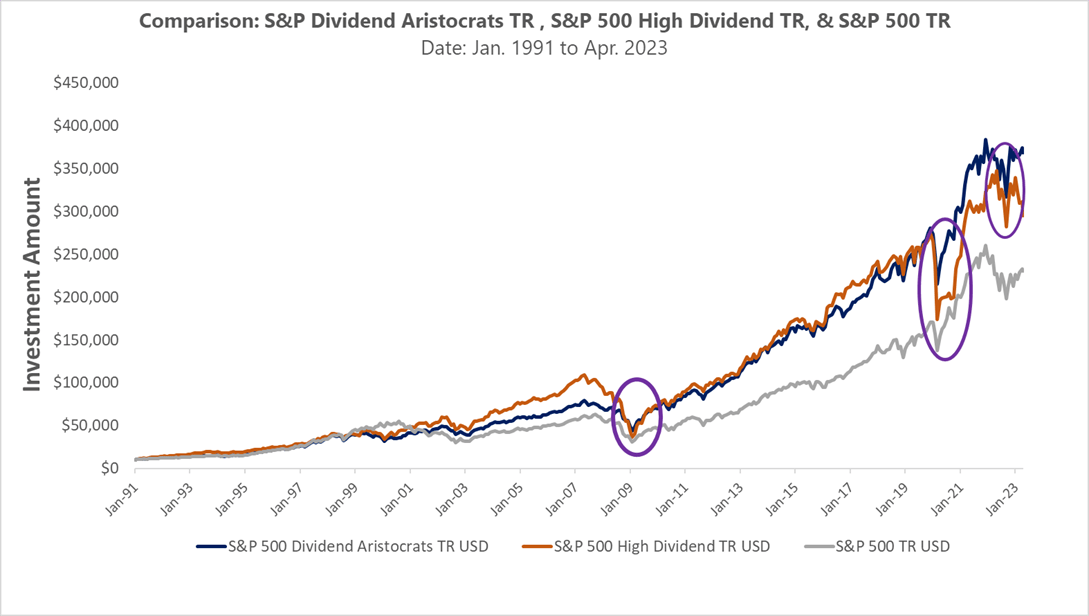
While some investors may choose to focus on companies that consistently grow their dividends over time, others may focus on companies that offer the highest level of dividend payout. The S&P 500 High Dividend Index reflects this ideology, as it provides exposure to the highest quintile of dividend-paying stocks in the S&P 500. While the absolute performance of focusing on high dividend equities is strong, said performance comes at slightly higher volatility over the total time period and higher drawdowns. This can be expected, as there is no filter on the quality of the dividend payments, but only on the magnitude of the payments relative to the price. As observed in the preceding chart, the drawdowns of the S&P 500 High Dividend Index appear to be much steeper, relative to its immediate peers.
For dividend focused investors, the message is clear, dividend growers and initiators have historically provided greater total return with less volatility relative to companies that either maintained or cut their dividends. Furthermore, investors should only use yield as one consideration when selecting a dividend-paying investment – as a high yield does not always mean a smooth investment performance over the long run.
Wisdom Tree’s Dividend Suite
As a prominent, multi-dimensional asset manager, Wisdom Tree provides investors with a diverse offering of investment solutions to help them actualize their long-term goals. For dividend focused investors within the large cap value segment, Wisdom Tree has three specific solutions, namely, Wisdom Tree U.S. Total Dividend Fund (Ticker: DTD), Wisdom Tree U.S. Large Cap Dividend Fund (Ticker: DLN), and Wisdom Tree U.S. High Dividend Fund (Ticker: DHS), that provides exposure to companies that pay a regular cash dividend.
Though a surface level assessment of each solution may lead an individual to believe they are the same, there are nuances inherent to their respective investment strategy that results in meaningful difference regarding their investment experience; this is detailed below.
Wisdom Tree U.S. Total Dividend Fund
The WisdomTree U.S. Total Dividend Fund seeks to track the price and yield performance, of the WisdomTree U.S. Dividend Index. To be eligible for inclusion in the Index, a company must meet the following criteria, (i) payment of regular cash dividends on shares of common stock during the preceding 12 months; (ii) market capitalization of at least $100 million; and (iii) average daily dollar trading volume of at least $100,000 for the preceding three months.
Wisdom Tree U.S. Large Cap Dividend Fund
The WisdomTree U.S. Large Cap Dividend Fund seeks to track the price and yield performance of the WisdomTree U.S. Large Cap Dividend Index. The Index is comprised of the 300 largest companies ranked by market capitalization, which as of June 2022, had a market capitalization range from $6 billion to $2.3 trillion, with an average market capitalization of $80.1 billion. To be eligible for inclusion in the Index, a company must meet the following criteria, (i) payment of regular cash dividends on shares of common stock during the preceding 12 months; (ii) market capitalization of at least $100 million; and (iii) average daily dollar trading volume of at least $100,000 for the preceding three months.
Wisdom Tree U.S. High Dividend Fund
The WisdomTree U.S. High Dividend Fund seeks to track the price and yield performance of the WisdomTree U.S. High Dividend Index. To be eligible for inclusion in the Index, a company must meet the following criteria as of the annual Index screening date: (i) payment of regular cash dividends on shares of common stock during the preceding 12 months; (ii) market capitalization of at least $200 million; and (iii) average daily dollar trading volume of at least $200,000 for the preceding three months.
Additionally, equities eligible for inclusion in the Index are ranked by dividend yield. Equities ranking in the highest 30% by dividend yield are selected for inclusion. If a company currently in the Index is no longer ranked in the top 30% by dividend yield at the time of the annual Index
screening date but remains ranked in the top 35% by dividend yield, the company will remain in the Index.
For investors interested in dividend-focused investing, these solutions provide exposure to a diverse grouping of U.S. companies capable of making regular cash dividend payments.
Please note this article is for information purposes only and does not in any way constitute investment advice. It is essential that you seek advice from a registered financial professional prior to making any investment decision.

Latest ETF News
See all ETF newsHow Investors can Maximize Tax Efficiency with Income ETFs


Trump Accounts: Here's Which ETFs You Can Invest In

The Two Best Types of Fixed-Income ETFs For Managing Cash

ETF Comparison: Roundhill Generative AI & Technology ETF Versus iShares A.I. Innovation and Tech Active ETF




 Advantages of ETFs over Mutual Funds1/6
Lower Costs
In this guide, we'll explore the advantages of ETFs over mutual funds, giving you valuable insights into why ETFs have gained significant popularity among investors like yourself.
Leveraged ETFs: Unlocking the Potential for Amplified Returns1/6
Understanding Leveraged ETFs
Explore leveraged ETFs: potential for amplified returns & risks. 5 ETFs to consider across equities, commodities & fixed income.
What is a Leveraged ETF?1/6
Introducing Leveraged and Inverse ETFs
In this guide, we'll dive into the world of leveraged ETFs, exploring their definition, mechanics, potential risks, and rewards.
Recent educational content

ETF Trends
ETF Industry KPIs July 20, 2026
This week’s KPI data overview highlights key metrics and trends shaping the ETF landscape.

ETF Trends
ETF Industry KPIs July 13, 2026
This week’s KPI data overview highlights key metrics and trends shaping the ETF landscape.

First Look ETF
First Look ETF: Cash Deployment, Bond, and Hedged ETFs
In this season 6 episode of First Look ETF, Stephanie Stanton examines the latest ETF marketplace trends with NYSE and guests.

ETF Trends
ETF Industry KPIs July 6, 2026
This week’s KPI data overview highlights key metrics and trends shaping the ETF landscape.
Browse all educational columns



Expert-Built ETF Portfolios, All in One Place
Don’t start from scratch. Discover ready-made ETF portfolios built by professionals to match different goals, timelines, and market views. Use them as inspiration or as a starting point for your own allocation.