Ready-made ETF portfolios built for real investor needs. Explore now →



Turning Carbon Into Capital: The Investment Case for EUAs
Every ton of carbon will soon carry a price, and that’s an opportunity in disguise.

Keep up with what matters in ETFs
Get timely ETF insights, market trends, and top ideas straight to your inbox.
Your newsletter subscriptions with us are subject to ETF Central's Privacy Policy and Terms and Conditions.
The European Union Emissions Trading System (EU ETS) is the largest and most liquid mandatory carbon market in the world. The goal of the system is to incentivize companies to change their behavior by making the acquisition of European Union Allowances (EUAs) more expensive than investing in new technology.
Like what you're reading?
Stay in the loop — get the latest ETF insights: trends, analysis, and expert picks.
How EUAs Work
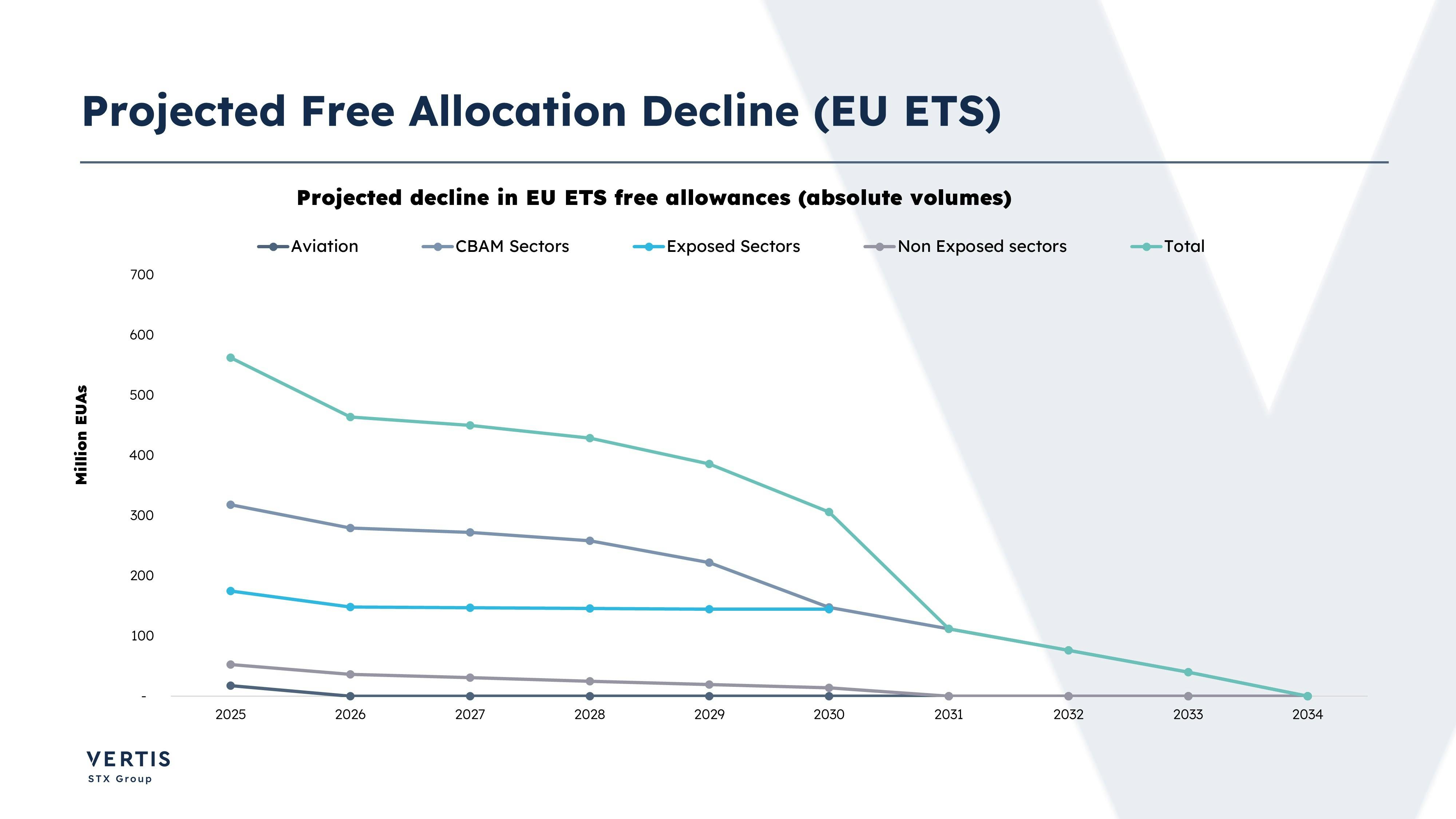
Each EUA acts as a permit allowing for emission of 1 metric ton of greenhouse gases; companies must turn in an EUA for every ton emitted. To aid companies in adjusting to the new cost structure, the EU freely allocated a large percentage of EUAs. As the chart shows, the free allocations will end by 2034- at which point companies must purchase all required EUAs.
Supply and Demand
Long viewed as a commodity, EUAs generally price because of supply/demand dynamics. Each year the EU reduces the number of EUAs issued while expanding the list of industries covered.
EUAs are a commodity where a central regulator sets both the supply and the demand in the furtherance of governmental policy.
Source: Vertis Environmental Group
This chart shows how free allocations of EU carbon allowances (EUAs) are being phased out under the EU Emissions Trading System.
In 2025, about 550 million allowances are distributed for free, but this number declines steadily to zero by 2034.
Non-exposed sectors¹, which face little international competition and lower risk of moving production abroad, lose their free allocations the fastest.
Exposed sectors², such as steel, cement, and aluminum, which are at higher risk of carbon leakage due to global competition, see a slower phase-out.
CBAM sectors³, like cement, fertilizers, and electricity, are phased out between 2028 and 2031 as the Carbon Border Adjustment Mechanism begins to impose equivalent carbon costs on imports.
Aviation also declines steadily, and by 2034 all industries must purchase 100% of their allowances, reinforcing the carbon price signal and accelerating decarbonization.
Impact for Investors
Investor ownership of physical EUAs is potentially one of the most environmentally impactful investments that can be made in public markets. Every physical EUA owned by an investor is one less available for companies to use, increasing their scarcity value.
EUAs as a Hedge
Portfolios with exposure to the EU economy can also use EUAs as a strategic hedge against rising carbon costs. Recent academic studies are showing how the price of carbon can impact equity market prices.
Whether you are investing as a hedge for an existing portfolio, seeking an impactful ESG investment or interested in a commodity play, EUAs offer a compelling investment thesis.
Definitions
- Non-Exposed Sectors: Industries with low risk of carbon leakage, either because they face little international competition or have lower emissions intensity. Their free allocations are reduced more quickly than those of exposed sectors.
- Exposed Sectors: Industries at high risk of carbon leakage because they face strong global competition and are highly carbon-intensive (e.g. steel, chemicals, glass). They received more free allowances in the past to remain competitive but will see a gradual phase-out.
- CBAM Sectors: Industries included in the Carbon Border Adjustment Mechanism (e.g. cement, steel, aluminum, fertilizers, electricity, hydrogen). Free allowances are being phased out as imports will face equivalent carbon costs at the EU border.
Disclaimer
Historical trends and past performance is no guarantee of future results. The information above is not intended to represent the performance of any product, fund or strategy and the performance of a particular product, fund or strategy will differ based on a number of factors, including the investment strategy, risks, fees and expenses.
An investor should consider the Fund’s investment objectives, risks and fees and expenses carefully before investing. This and other important information can be found in the Fund’s prospectus, Please read the prospectus, carefully before making an investment.
Information is for illustrative and educational purposes ONLY. This material is provided for informational purposes only and nothing herein constitutes financial investment, legal, accounting or tax advice. Nothing herein constitutes a prediction or projection of future events or future market behavior. This material is intended as a broad overview of the European Union Allowance market. Nothing herein constitutes investment advice or a recommendation to buy, sell or hold a security. It should not be assumed that any investments in securities, companies, sectors or markets identified and described were or will be profitable.
This material is general in nature and is not directed to any category of investors and should not be regarded as individualized, a recommendation, investment advice or a suggestion to engage in or refrain from any investment-related course of action. This material is not intended as a formal research report and should not be relied upon as a basis for making an investment decision. Investment decisions and the appropriateness of this material should be made based on an investor’s individual objectives and circumstances and in consultation with his or her advisors. Information is obtained from sources deemed reliable, but there is no representation or warranty as to its accuracy, completeness or reliability. This material may include estimates, outlooks, projections and other “forward-looking statements.” Due to a variety of factors, actual events may differ significantly from those presented. Past performance is no guarantee of future results. Investing entails risks, including possible loss of principal.


Latest ETF News
See all ETF newsEntering A New Era of Defense Tech Spending

How SPXD Delivers a More Balanced S&P 500 Exposure

Autocallable Yield Advantage and Market Reception

Time to rethink the “plus” in core-plus bond funds



 Advantages of ETFs over Mutual Funds1/6
Lower Costs
In this guide, we'll explore the advantages of ETFs over mutual funds, giving you valuable insights into why ETFs have gained significant popularity among investors like yourself.
Leveraged ETFs: Unlocking the Potential for Amplified Returns1/6
Understanding Leveraged ETFs
Explore leveraged ETFs: potential for amplified returns & risks. 5 ETFs to consider across equities, commodities & fixed income.
What is a Leveraged ETF?1/6
Introducing Leveraged and Inverse ETFs
In this guide, we'll dive into the world of leveraged ETFs, exploring their definition, mechanics, potential risks, and rewards.
Recent educational content

ETF Trends
ETF Industry KPIs September 8, 2026
This week’s KPI data overview highlights key metrics and trends shaping the ETF landscape.

ETF Trends
ETF Industry KPIs August 31, 2026
This week’s KPI data overview highlights key metrics and trends shaping the ETF landscape.
ETF Trends
ETF Industry KPIs August 24, 2026
This week’s KPI data overview highlights key metrics and trends shaping the ETF landscape.
What’sTheFund
What's the Fund | Ocean Park Diversified Income ETF (DUKZ)
James St Aubin, Chief Investment Officer at Ocean Park Asset Management, discuss the DUKZ ETF, exposing investors to the whole spectrum of asset classes in the fixed income markets, through their rules-based process.

Browse all educational columns



Expert-Built ETF Portfolios, All in One Place
Don’t start from scratch. Discover ready-made ETF portfolios built by professionals to match different goals, timelines, and market views. Use them as inspiration or as a starting point for your own allocation.