From idea to ETF portfolio in minutes. Build yours now →



Trump’s “Big Beautiful Bill” Passes Final Vote: ETF Winners & Losers
Here’s a look at which ETFs might see increased activity in the wake of this bill becoming law.

Keep up with what matters in ETFs
Get timely ETF insights, market trends, and top ideas straight to your inbox.
Your newsletter subscriptions with us are subject to ETF Central's Privacy Policy and Terms and Conditions.
The House of Representatives’ Fiscal Year 2025 reconciliation package, officially titled the One Big Beautiful Bill Act of 2025 (OBBBA), has passed its final vote, and not without stirring controversy.
The sweeping legislation drew criticism and praise from across the aisle, reflecting just how broad and politically charged its provisions really are.
According to the Committee for a Responsible Federal Budget, a centrist fiscal think tank, the bill is projected to add $2.4 trillion to the federal deficit over the next decade. The group also released a helpful breakdown of the core policies responsible for the bulk of the projected deficit expansion.
Now, I’m not a tax attorney or a political analyst, and I won’t attempt to unpack the implications of each provision from a legislative or constitutional perspective. But it’s still worth speculating on what these changes might mean for the ETF market.
This bill didn’t directly target ETFs, and rightly so, given they’re neither the source of deficit growth nor particularly useful as tax shelters in the way private vehicles can be.
Still, the bill’s scope is broad enough that some of its downstream effects may ripple through parts of the ETF ecosystem. Some categories could benefit. Others might be caught off guard. Here’s a breakdown of the two ETF categories I’ll be watching most closely.
Like what you're reading?
Stay in the loop — get the latest ETF insights: trends, analysis, and expert picks.
Winners: Aerospace & Defense ETFs
The Armed Services Committee portion of the One Big Beautiful Bill Act includes $144 billion in new spending, with the potential to balloon to $410 billion if extended permanently.
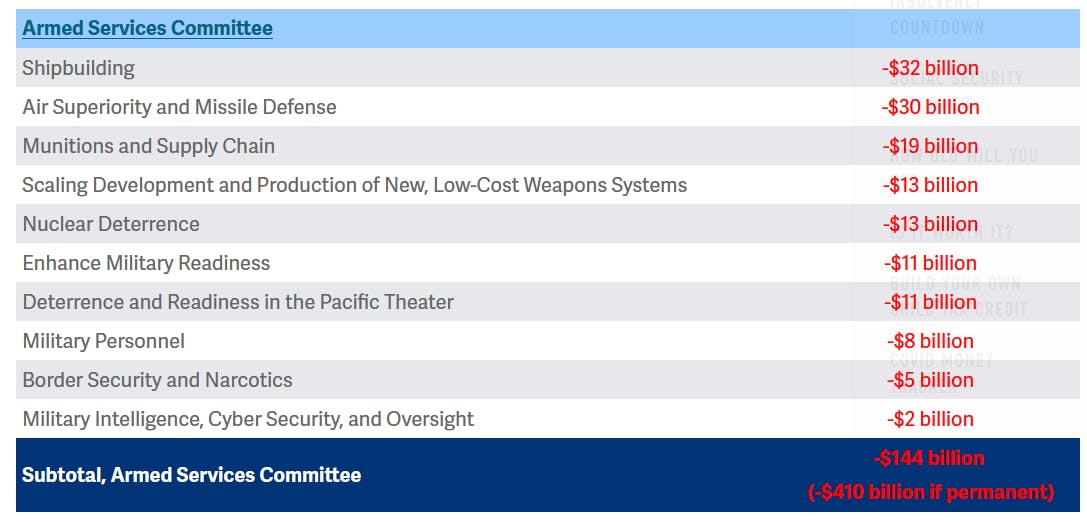
At the top of the list are $32 billion for shipbuilding and $30 billion for air superiority and missile defense, two categories that directly benefit U.S. defense contractors.
On the shipbuilding front, Huntington Ingalls essentially holds a de facto monopoly. It’s the only company in the U.S. building nuclear-powered aircraft carriers and amphibious assault ships, making it a major beneficiary of expanded naval funding.
Meanwhile, Northrop Grumman, Lockheed Martin, RTX, and Boeing dominate the air and missile defense space. Each contributes a key platform:
- Northrop Grumman is behind the B-21 Raider, the U.S. Air Force’s next-generation stealth bomber.
- Lockheed Martin makes the F-35, the most widely deployed modern fighter jet.
- RTX leads in missile defense with systems like Patriot and NASAMS.
- Boeing builds the F-15EX and the AH-64 Apache attack helicopter.
The natural ETF to benefit from this spending surge is the NYSE-listed Invesco Aerospace & Defense ETF
PPA is also less top-heavy than its better-known peer, the iShares U.S. Aerospace & Defense ETF
Losers: Clean Energy ETFs
There’s no such luck for clean energy industries like solar and wind in this bill. Former President Trump has long made his preferences clear: he’s consistently favored coal and fossil fuels over renewables, and this legislation reflects that stance.
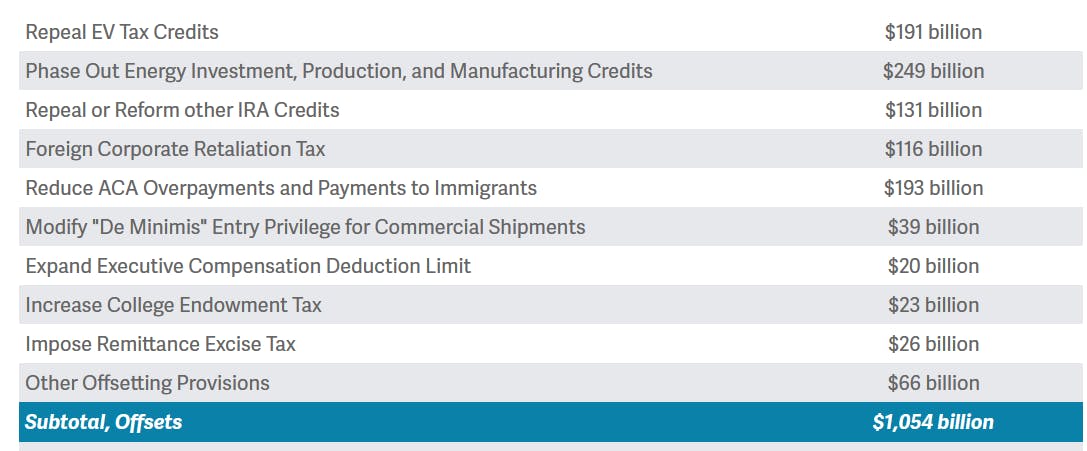
A significant chunk of the bill’s offsets come from rolling back clean energy incentives. The two largest items are telling: $191 billion from repealing EV tax credits, and $249 billion from phasing out energy investment, production, and manufacturing credits.
That second one is especially impactful. It refers to the suite of subsidies introduced under the Inflation Reduction Act (IRA), which supported renewable infrastructure, domestic clean energy manufacturing, and project development through generous tax incentives. Wiping these out removes the financial scaffolding many companies were relying on.
This puts clean energy ETFs directly in the crosshairs. Many of the firms in this space, especially smaller players in wind, solar, and battery tech struggle to achieve consistent profitability. The sector remains highly capital-intensive and subsidy-dependent, making it especially vulnerable to policy risk.
The Invesco Solar ETF
Please note that this article reflects the author’s personal views and does not represent the opinions of the publication or its affiliates. It is for informational purposes only and does not constitute investment advice. It is essential to seek guidance from a registered financial professional before making any investment decisions.
Latest ETF News
See all ETF newsWhich Fixed-Income ETFs Benefit from Rising Interest Rates?

MoneyShow Chart of the Day 9/4/26: Don't Just Watch Oil. Watch THESE.


Chart of the Day 8/14/26: The Great "Hot Money" Migration

MoneyShow Chart of the Day 7/29/26: Now, THAT's What I Call Market Rotation!




 Advantages of ETFs over Mutual Funds1/6
Lower Costs
In this guide, we'll explore the advantages of ETFs over mutual funds, giving you valuable insights into why ETFs have gained significant popularity among investors like yourself.
Leveraged ETFs: Unlocking the Potential for Amplified Returns1/6
Understanding Leveraged ETFs
Explore leveraged ETFs: potential for amplified returns & risks. 5 ETFs to consider across equities, commodities & fixed income.
What is a Leveraged ETF?1/6
Introducing Leveraged and Inverse ETFs
In this guide, we'll dive into the world of leveraged ETFs, exploring their definition, mechanics, potential risks, and rewards.
Recent educational content

ETF Trends
ETF Industry KPIs September 14, 2026
This week’s KPI data overview highlights key metrics and trends shaping the ETF landscape.

ETF Trends
ETF Industry KPIs September 8, 2026
This week’s KPI data overview highlights key metrics and trends shaping the ETF landscape.
ETF Trends
ETF Industry KPIs August 31, 2026
This week’s KPI data overview highlights key metrics and trends shaping the ETF landscape.
ETF Trends
ETF Industry KPIs August 24, 2026
This week’s KPI data overview highlights key metrics and trends shaping the ETF landscape.
Browse all educational columns



Expert-Built ETF Portfolios, All in One Place
Don’t start from scratch. Discover ready-made ETF portfolios built by professionals to match different goals, timelines, and market views. Use them as inspiration or as a starting point for your own allocation.