Keep tabs on your favorite ETFs with a personalized weekly tracker. Create a Watchlist now →



Trump Tariff Volatility Puts Short VIX Futures ETFs to the Test
Renewed trade war fears are shaking markets. Here’s how the current roster of short VIX futures ETFs is holding up under pressure.

Keep up with what matters in ETFs
Get timely ETF insights, market trends, and top ideas straight to your inbox.
Your newsletter subscriptions with us are subject to ETF Central's Privacy Policy and Terms and Conditions.
The 2025 market has been defined by rollercoaster volatility, much of it triggered by sweeping tariff threats from the Trump administration. Blanket import taxes have reintroduced a sense of global economic uncertainty, and that’s showing up in the numbers.
The CBOE Volatility Index (VIX), widely viewed as the market’s fear gauge, is sitting at 30.75 year to date as of the April 22 market close. It spiked as high as 52.33 on April 8—nicknamed “Liberation Day”—after the administration officially rolled out its aggressive new trade war playbook.
Major equity indices have taken a beating. ETFs tracking the S&P 500 and Nasdaq-100 are deep in the red over this period. But one niche of the market that’s flown under the radar is inverse volatility ETFs—funds designed to profit when volatility falls.
These products have a troubled history. After the infamous 2018 “Volmageddon” event wiped out some of their predecessors, many investors understandably question whether this new crop of ETFs is built to survive another VIX spike.
Here’s a look at the two most notable short VIX futures ETFs and how they’ve held up so far in 2025.
Like what you're reading?
Stay in the loop — get the latest ETF insights: trends, analysis, and expert picks.
What investors need to know about these ETFs
First, a quick refresher: the VIX is an index, not a tradable asset. You can’t invest in it directly. Instead, ETFs and other products gain exposure by using derivatives, mainly futures contracts tied to the VIX.
That’s exactly what the short VIX futures ETFs we are about to cover do. Each of them tracks or replicates the inverse performance of the S&P 500 VIX Short-Term Futures Index. As of April 22, that means exposure is tied to the May and June VIX futures contracts.
These ETFs are designed to move opposite the direction of short-term volatility. They’re somewhat correlated to inverse spot VIX exposure, but not perfectly. Because they use futures rather than the index itself, their return profile reflects both changes in volatility and the dynamics of the futures curve.
In calm markets, these ETFs can steadily gain value as volatility falls back to its long-term average. They also benefit from contango—a condition where longer-dated VIX futures are priced higher than near-term ones. When the VIX curve is in contango, rolling futures contracts forward allows the ETF to sell low and buy high, which works in their favor when they’re short the contracts.
But these benefits come with serious risks. A sudden spike in the VIX generally causes front-month futures to jump sharply in price. Because these ETFs reset exposure daily, they’re forced to cover at a loss and re-enter at higher prices—locking in the hit. One bad day can trigger a major drawdown or even cause the product to collapse.
That’s exactly what happened in February 2018. The now-defunct VelocityShares Daily Inverse VIX Short Term ETN (XIV) lost over 90% of its value in a single day when the VIX spiked, forcing issuer Credit Suisse to liquidate the fund. The event, dubbed “Volmageddon,” was a painful reminder of just how quickly inverse volatility products can unravel when markets panic.
How the current options fared
Today’s products are more tightly regulated and better understood—but the underlying mechanics remain the same. These are not buy-and-hold ETFs. They’re high-risk tools that require a strong stomach, tight risk management, and a clear understanding of how volatility derivatives behave.
Investors now have access to two key products in this space: the ProShares Short VIX Short-Term Futures ETF
SVXY tracks the S&P 500 VIX Short-Term Futures Index with only 0.5x daily inverse exposure. This means it shorts front-month VIX futures contracts—currently the May and June 2025 contracts.
But this is only to the extent of 50% of the fund’s net asset value. The rest of the portfolio is held in cash, reducing notional exposure and softening the blow from sudden volatility spikes.
SVIX, on the other hand, maintains full -1x inverse exposure but hedges more directly. Like SVXY, it shorts the May and June VIX futures contracts. But in addition, SVIX holds a long position in a May 21, 2025 VIX 55 call option.
This contract gains value if the VIX suddenly surges past 55, offering a built-in hedge against violent upward moves in volatility. In other words, rather than reducing its exposure, SVIX insures it.
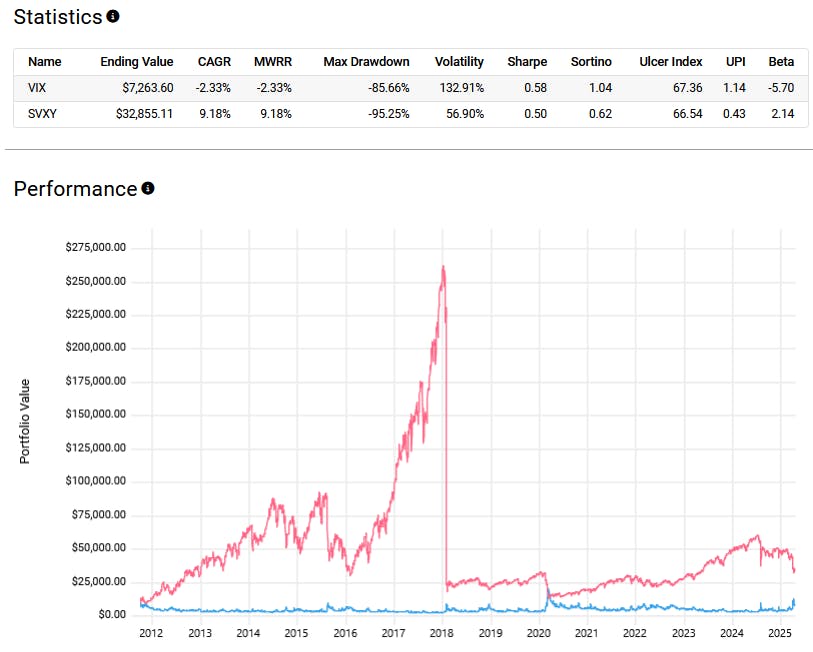
Year to date, both SVXY and SVIX have made it through the April VIX spike, though not without taking losses. As seen in the backtest data, both ETFs saw significant drawdowns when the VIX hit 52.33 on April 8. But they survived (so far), and it’s very likely that without these hedges, neither fund would have made it through intact.

It’s worth noting that SVIX wasn’t around during the 2018 Volmageddon event, but SVXY was, and back then it offered full -1x inverse exposure. When the VIX exploded higher in early February 2018, SVXY lost 95% of its value in a single session, nearly wiping out the fund. ProShares learned from that incident and has since scaled back SVXY’s exposure to -0.5x, which limits the downside risk in extreme scenarios.
The moral of the story is this: holding short volatility ETFs for longer than a day is the definition of picking up pennies in front of a steamroller. With the Trump administration back in power and ramping up economic uncertainty, there’s a good chance volatility remains elevated. If you’re using these products, tread very carefully.
Please note that this article reflects the author’s personal views and does not represent the opinions of the publication or its affiliates. It is for informational purposes only and does not constitute investment advice. It is essential to seek guidance from a registered financial professional before making any investment decisions.
Latest ETF News
See all ETF newsMoneyShow Chart of the Day 9/4/26: Don't Just Watch Oil. Watch THESE.


Chart of the Day 8/14/26: The Great "Hot Money" Migration

MoneyShow Chart of the Day 7/29/26: Now, THAT's What I Call Market Rotation!

MoneyShow Chart of the Day 7/16/26: Good News/Bad News on Inflation (and the Fed)




 Advantages of ETFs over Mutual Funds1/6
Lower Costs
In this guide, we'll explore the advantages of ETFs over mutual funds, giving you valuable insights into why ETFs have gained significant popularity among investors like yourself.
Leveraged ETFs: Unlocking the Potential for Amplified Returns1/6
Understanding Leveraged ETFs
Explore leveraged ETFs: potential for amplified returns & risks. 5 ETFs to consider across equities, commodities & fixed income.
What is a Leveraged ETF?1/6
Introducing Leveraged and Inverse ETFs
In this guide, we'll dive into the world of leveraged ETFs, exploring their definition, mechanics, potential risks, and rewards.
Recent educational content

ETF Trends
ETF Industry KPIs September 8, 2026
This week’s KPI data overview highlights key metrics and trends shaping the ETF landscape.

ETF Trends
ETF Industry KPIs August 31, 2026
This week’s KPI data overview highlights key metrics and trends shaping the ETF landscape.
ETF Trends
ETF Industry KPIs August 24, 2026
This week’s KPI data overview highlights key metrics and trends shaping the ETF landscape.
What’sTheFund
What's the Fund | Ocean Park Diversified Income ETF (DUKZ)
James St Aubin, Chief Investment Officer at Ocean Park Asset Management, discuss the DUKZ ETF, exposing investors to the whole spectrum of asset classes in the fixed income markets, through their rules-based process.

Browse all educational columns



Expert-Built ETF Portfolios, All in One Place
Don’t start from scratch. Discover ready-made ETF portfolios built by professionals to match different goals, timelines, and market views. Use them as inspiration or as a starting point for your own allocation.