ETF model portfolios designed for real investor needs. Discover →



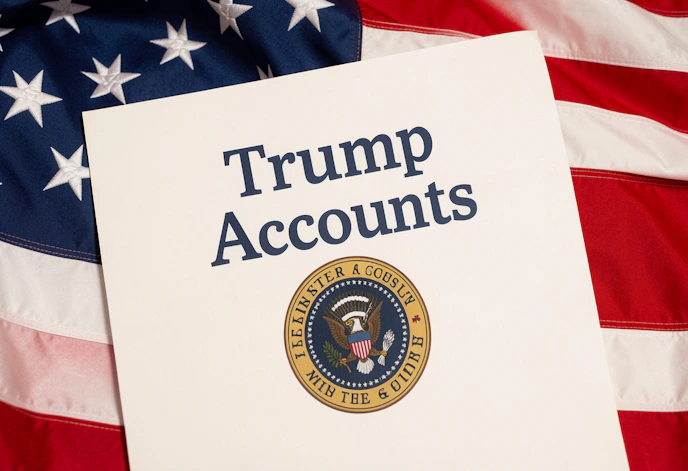
Trump Accounts: Here's Which ETFs You Can Invest In
Learn which are available within a Trump Account and how to build a low-cost, diversified investment portfolio within the program's rules.

Keep up with what matters in ETFs
Get timely ETF insights, market trends, and top ideas straight to your inbox.
Your newsletter subscriptions with us are subject to ETF Central's Privacy Policy and Terms and Conditions.
American parents saving for their children's financial future now have another option alongside familiar accounts such as 529 college savings plans, custodial brokerage accounts, Coverdell Education Savings Accounts, and Roth IRAs for children with earned income. They're called Trump Accounts.
Under the program, every eligible U.S. child born between January 1, 2025, and December 31, 2028 receives a one-time $1,000 contribution from the U.S. Treasury. The account is established in the child's name, with a parent or legal guardian serving as custodian until the child reaches age 18. Families can also contribute up to an additional $5,000 per year to help the account compound over time.
The initiative has also attracted support from several major U.S. companies, including Dell, Uber, BlackRock, Mastercard, BNY, and Visa, which have announced employer contribution programs for eligible employees. Philanthropists Michael and Susan Dell as well as Ray and Barbara Dalio have also pledged funding to expand participation.
To be eligible, a child must generally be under age 18 when the account is established and have a valid Social Security number. Parents or guardians can open an account by submitting IRS Form 4547 through their IRS online account or the official Trump Accounts app.
One feature that immediately caught my attention is the investment lineup. Unlike many workplace 401(k) plans that primarily rely on mutual funds, Trump Accounts currently invest through a limited menu of low-cost index ETFs and mutual funds tracking broad U.S. equity benchmarks.
Today, we'll walk through each of the five ETF choices currently available, explain how they differ, and give my thoughts on the strengths and weaknesses of each option.
Global ETF Survey 2026 is Live!
With 1,790 new products launched by July 2026, choosing is harder than ever. Our Global ETF Survey 2026, built on 620 professional investors and allocators, shows how active, fixed income, options-based and thematic ETFs are reshaping fund selection.
State Street SPDR Portfolio S&P 500 ETF SPYM
SPYM serves as the default investment option for all Trump Account contributions. A default investment simply means that if parents or guardians don't actively select another ETF, contributions are automatically invested in SPYM. That's a big win for the fund, which has already grown to roughly $160 billion in assets under management.
If I had to guess why it was selected, the answer is probably cost. SPYM is the cheapest S&P 500 ETF on the market, charging just a 0.02% expense ratio. On a $10,000 investment, that's only about $2 per year in fees. It also trades at a relatively accessible share price of about $88 as of July 15, 2026, making it easy for new investors to purchase whole shares.
iShares Core S&P 500 ETF IVV+0.44%
Investors who prefer another S&P 500 ETF can also choose IVV. It charges a slightly higher 0.03% expense ratio, although the difference is negligible in practice. Where IVV stands out is its enormous size, with approximately $893 billion in assets under management.
The main drawback is its much higher share price of roughly $758. Most investors will likely need to purchase fractional shares, so I suspect SPYM will remain the more popular choice for many families.
Vanguard Total Stock Market ETF VTI+0.39%
VTI, along with its mutual fund counterpart VTSAX, was John Bogle's preferred way of "buying the haystack." Instead of limiting investors to the 500 large-cap companies in the S&P 500, VTI tracks the CRSP U.S. Total Market Index, providing exposure to more than 3,500 market-cap-weighted large-, mid-, and small-cap U.S. stocks for a very low 0.03% expense ratio.
Personally, I prefer VTI over a traditional S&P 500 ETF because it provides a more complete representation of the U.S. stock market. That said, long-term performance has historically been very similar since both approaches remain heavily weighted toward the largest companies.
State Street SPDR Portfolio S&P 1500 Composite Stock Market ETF SPTM+0.43%
The CRSP index tracked by VTI isn't the only way to gain exposure to the entire U.S. equity market. SPTM charges the same 0.03% expense ratio while tracking the S&P Composite 1500 Index.
Although it holds fewer stocks than VTI, roughly 1,500 instead of more than 3,500, the market-cap-weighted methodology means the top holdings, sector allocations, and long-term performance should remain very similar.
iShares Core S&P Total U.S. Stock Market ETF ITOT+0.39%
Rounding out the lineup is ITOT. Like VTI and SPTM, it charges a 0.03% expense ratio, but it tracks the S&P Total Market Index instead. The portfolio contains just over 2,400 stocks, sitting between VTI and SPTM in terms of breadth.
Again, because the fund is market-cap weighted, investors should expect similar sector exposures, similar top holdings, and broadly comparable long-term returns. Outside of a Trump account, investors may find this ETF useful as a tax-loss harvesting partner.
Which ETFs are Missing?
One omission I found surprising is the Vanguard S&P 500 ETF
One ETF I also would have liked to see included is the BNY Mellon U.S. Large Cap Core Equity ETF
Please note this article is for information purposes only and does not in any way constitute investment advice. It is essential that you seek advice from a registered financial professional prior to making any investment decision.


Latest ETF News
See all ETF newsThere's an ETF for That? Humanoid Robotics and Physical AI

How Some ETF Issuers Use Their Own Funds for Cash Management

These Public-Private ETFs Invest in Polymarket and Anduril

There's an ETF for That? Frontier Markets




 Advantages of ETFs over Mutual Funds1/6
Lower Costs
In this guide, we'll explore the advantages of ETFs over mutual funds, giving you valuable insights into why ETFs have gained significant popularity among investors like yourself.
Leveraged ETFs: Unlocking the Potential for Amplified Returns1/6
Understanding Leveraged ETFs
Explore leveraged ETFs: potential for amplified returns & risks. 5 ETFs to consider across equities, commodities & fixed income.
What is a Leveraged ETF?1/6
Introducing Leveraged and Inverse ETFs
In this guide, we'll dive into the world of leveraged ETFs, exploring their definition, mechanics, potential risks, and rewards.
Recent educational content

ETF Trends
ETF Industry KPIs October 5, 2026
This week’s KPI data overview highlights key metrics and trends shaping the ETF landscape.

ETF Trends
ETF Industry KPIs September 28, 2026
This week’s KPI data overview highlights key metrics and trends shaping the ETF landscape.
ETF Trends
ETF Industry KPIs September 22, 2026
This week’s KPI data overview highlights key metrics and trends shaping the ETF landscape.
First Look ETF
First Look ETF: Income, Corporate Arbitrage, and Growth and Value Investing
First Look ETF September 2026: iCapital, Mast Investments and North Square unpack new ETFs targeting monthly income, merger arbitrage and complementary growth and value exposure.

Browse all educational columns



ETFs’ Next Act: From Access to Selection
With 1,790 new products launched by July 2026, choosing is harder than ever. Our Global ETF Survey 2026, built on 620 professional investors and allocators, shows how active, fixed income, options-based and thematic ETFs are reshaping fund selection.