Keep tabs on your favorite ETFs with a personalized weekly tracker. Create a Watchlist now →



Time to rethink the “plus” in core-plus bond funds
High yield bonds once fueled alpha in core-plus strategies, but today's tight spreads and macro risks may require investors to seek other sources of alpha.

Keep up with what matters in ETFs
Get timely ETF insights, market trends, and top ideas straight to your inbox.
Your newsletter subscriptions with us are subject to ETF Central's Privacy Policy and Terms and Conditions.
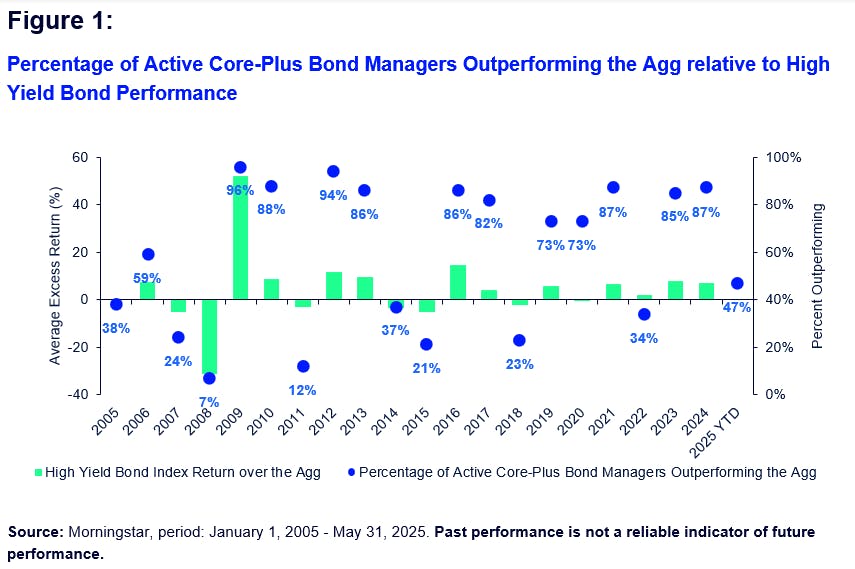
Owning high yield bonds has historically been a source of alpha for core-plus bond managers. As shown in the chart above, there is a high correlation between the percentage of core-plus bond managers beating the Bloomberg US Aggregate Bond Index (“the Agg”) and the relative performance of high yield bonds versus the Agg. On average, 76% of active managers outperformed the Agg in the fourteen years in which high yield bonds outperformed the Agg too, compared to just 28% of managers beating the Agg in the six years when Agg bested high yield bonds¹.
However, the risks are asymmetrical for this source of alpha today. High yield credit spreads are near all-time tights, trading around the 90th percentile since 1994². As a result, further spread tightening to generate upside/returns is unlikely. Meanwhile, the uncertain macro outlook raises the potential for spread widening if growth dynamics weaken and risk premia’s are repriced. Against this backdrop, an actively managed strategy allocating to both public and private investment grade credit markets – but not high yield credit – to generate alpha can act as a replacement to a below investment grade credit heavy core bond allocations.
Like what you're reading?
Stay in the loop — get the latest ETF insights: trends, analysis, and expert picks.
State Street Investment Management
This commentary is provided by the ETF Research team at State Street Investment Management. For investors seeking a core-plus bond solution with limited exposure to below investment grade, consider exploring our innovative SPDR® SSGA IG Public & Private Credit ETF
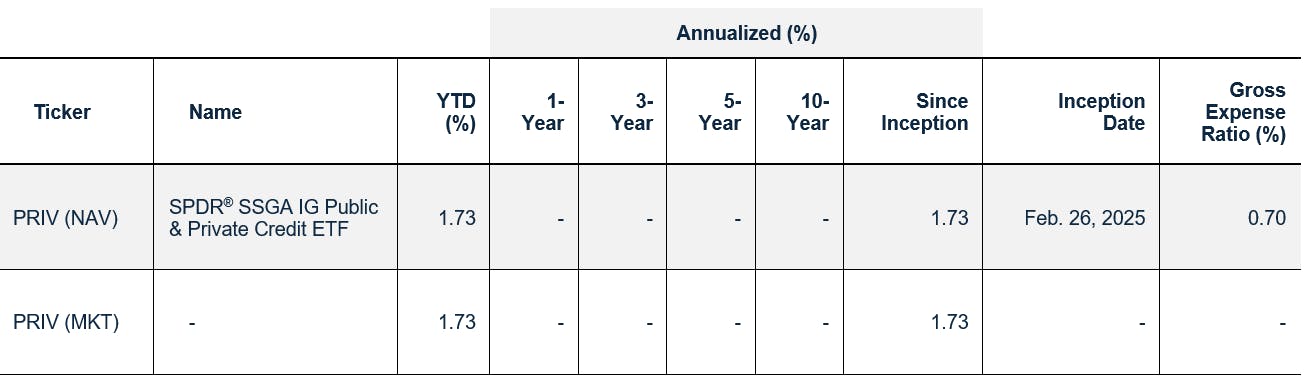
Past performance is not a reliable indicator of future performance. Investment return and principal value will fluctuate, so you may have a gain or loss when shares are sold. Current performance may be higher or lower than that quoted. All results are historical and assume the reinvestment of dividends and capital gains. Visit www.ssga.com for most recent month-end performance. Performance returns for periods of less than one year are not annualized. The performance figures contained herein are provided on a gross and net of fees basis. Gross of fees do not reflect and net of fees reflect the deduction of advisory or other fees which could reduce the return. The performance includes the reinvestment of dividends and other corporate earnings and is calculated in USD. The gross expense ratio is the fund’s total annual operating expenses ratio. It is gross of any fee waivers or expense reimbursements. It can be found in the fund’s most recent prospectus.
Footnotes
¹ Source: Morningstar, period: January 1, 2005 - December 31, 2024
² Source: Bloomberg Finance L.P, period: January 31, 1994 - May 31, 2025

Latest ETF News
See all ETF newsEntering A New Era of Defense Tech Spending


How SPXD Delivers a More Balanced S&P 500 Exposure


Autocallable Yield Advantage and Market Reception






 Advantages of ETFs over Mutual Funds1/6
Lower Costs
In this guide, we'll explore the advantages of ETFs over mutual funds, giving you valuable insights into why ETFs have gained significant popularity among investors like yourself.
Leveraged ETFs: Unlocking the Potential for Amplified Returns1/6
Understanding Leveraged ETFs
Explore leveraged ETFs: potential for amplified returns & risks. 5 ETFs to consider across equities, commodities & fixed income.
What is a Leveraged ETF?1/6
Introducing Leveraged and Inverse ETFs
In this guide, we'll dive into the world of leveraged ETFs, exploring their definition, mechanics, potential risks, and rewards.
Recent educational content

ETF Trends
ETF Industry KPIs September 8, 2026
This week’s KPI data overview highlights key metrics and trends shaping the ETF landscape.

ETF Trends
ETF Industry KPIs August 31, 2026
This week’s KPI data overview highlights key metrics and trends shaping the ETF landscape.
ETF Trends
ETF Industry KPIs August 24, 2026
This week’s KPI data overview highlights key metrics and trends shaping the ETF landscape.
What’sTheFund
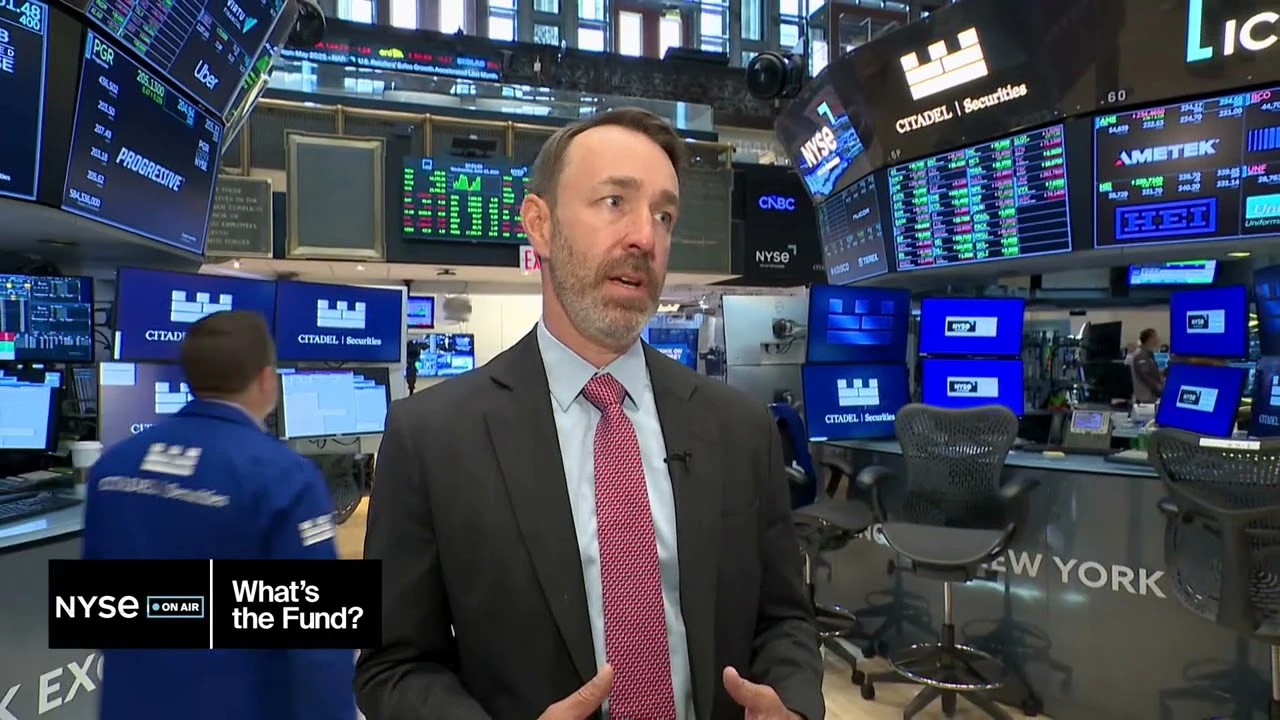
What's the Fund | Ocean Park Diversified Income ETF (DUKZ)
James St Aubin, Chief Investment Officer at Ocean Park Asset Management, discuss the DUKZ ETF, exposing investors to the whole spectrum of asset classes in the fixed income markets, through their rules-based process.

Browse all educational columns



Expert-Built ETF Portfolios, All in One Place
Don’t start from scratch. Discover ready-made ETF portfolios built by professionals to match different goals, timelines, and market views. Use them as inspiration or as a starting point for your own allocation.