From idea to ETF portfolio in minutes. Build yours now →



Three Ways to Get Your High-Yield Bond Fix Via ETFs
These Xtrackers ETFs provide exposure to untapped and underappreciated segments of the U.S. high-yield bond market.


Keep up with what matters in ETFs
Get timely ETF insights, market trends, and top ideas straight to your inbox.
Your newsletter subscriptions with us are subject to ETF Central's Privacy Policy and Terms and Conditions.
If you’ve been eyeing high-yield bonds lately, you’re not alone. With yields sitting near 7.5%, income-seeking investors are giving this segment of the fixed income market a fresh look.
“High yield bonds could present an investment opportunity due to their attractive yields, strong credit fundamentals, moderate volatility, and potential for capital appreciation,” says Ben Spalding, senior portfolio manager & team lead for the Xtrackers fixed income ETFs at DWS Group.
While spreads have widened from their tightest levels earlier this year, Spalding notes they still sit around 310 basis points—well below the 15-year average of about 450.
“Despite this, yields remain elevated at around 7.5% compared to their 15-year average of about 6.7%, creating a compelling entry point for investors seeking income,” he says.
Historically, high-yield ETFs have seen increased inflows when yields rise above 7%, especially as they become more attractive relative to equities. And today’s elevated Treasury curve is helping keep those yields elevated, even if credit spreads are tighter than usual.
“High yield bonds tend to trade based on default expectations,” Spalding adds. “A primary risk we see at the moment is how tariffs will impact growth expectations.”
Xtrackers’ flagship high yield bond ETF is the Xtrackers USD High Yield Corporate Bond ETF
With that backdrop in mind, here are three Xtrackers ETFs offering exposure to underappreciated corners of the U.S. high-yield bond market.
Like what you're reading?
Stay in the loop — get the latest ETF insights: trends, analysis, and expert picks.
Xtrackers Low Beta High Yield Bond ETF HYDW-0.22%
One of the innovations Xtrackers brought to the high-yield bond space was the increased ability to segment the high yield bond space based on a variety of factors, such as yield.
“The USD high yield bond market has reached a level of maturity that allows it to be further segmented by yield profile while broadly maintaining sector diversification, allowing investors to manage their high yield credit exposure with greater precision,” Spalding explains.
A great example is HYDW, which tracks the Solactive USD High Yield Corporates Total Market Low Beta Index. This benchmark takes the broader Solactive USD High Yield Total Market Corporates Index and divides it into sectors.
Within each sector, bonds are ranked by their yield-to-worst and then split at the median. The lower-yielding (i.e., higher quality) half from each sector is selected for inclusion, effectively applying a fixed-income-specific quality screen.
“This higher quality credit rating profile can help mitigate some of the risks associated with high yield bonds, as historically 79% of high yield defaults come from the CCC and below segments,” Spalding adds. “Broad HY products generally allocate 9–12% to CCC, while HYDW generally has less than 1% exposure to that segment.”
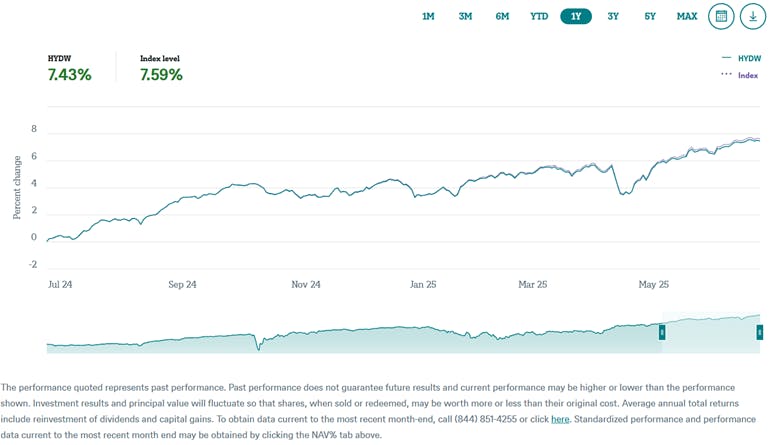
HYDW remains cost-effective for a targeted high-yield ETF, charging a 0.20% expense ratio while delivering a 5.65% 30-day SEC yield.
Xtrackers USD High Yield BB-B ex Financials ETF BHYB-0.13%
Another trend borrowed from equity strategies is the rise of sector-exclusion indexing—for example, funds that track the S&P 500 but exclude technology to manage concentration risk.
BHYB takes a similar approach in the high-yield bond space by tracking the ICE BofA BB-B Non-Financial Non-Distressed US High Yield Constrained Index. This means it specifically excludes financial sector issuers while focusing on higher-quality high-yield bonds rated BB or B
In practice, that results in more exposure to sectors like consumer discretionary, industrials, communications, and energy, offering a different mix than traditional high-yield ETFs, which often have meaningful weight in financials.
“The rationale for excluding the financial sector is that often times insurance clients are not allowed to own their own bonds (or potentially bonds held by their competitors),” Spalding explains. “BHYB gives exposure to the BB-B segment of the high yield market, which is the higher quality segment of credit ratings within the HY complex.”
This structure may appeal to insurers managing their float, where reducing correlated risk with their own or peer-issued financial debt makes sense. The goal is to maintain credit quality and income potential without owning paper from institutions in the same industry.
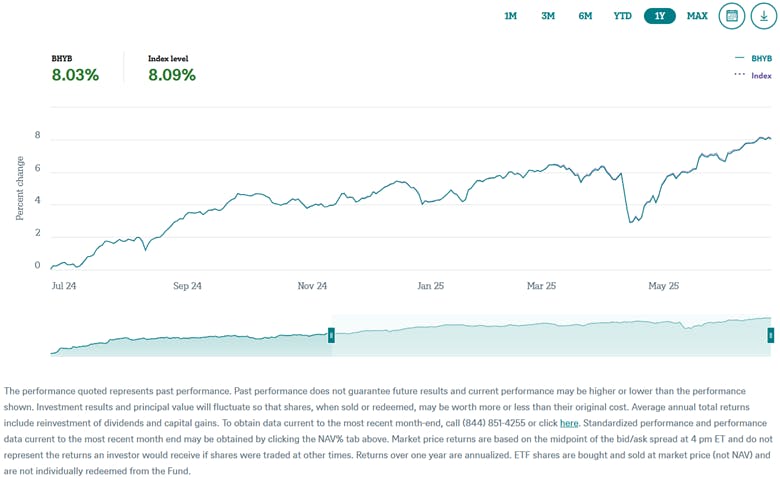
BHYB charges the same reasonable 0.20% expense ratio as HYDW and currently delivers a 6.58% 30-day SEC yield.
Xtrackers Short Duration High Yield Bond ETF SHYL-0.26%
Investors hoping to shield their cash from interest rate swings often turn to short-term Treasury ETFs or money market funds, but the trade-off is painfully low yields.
For those willing to take on more credit risk in exchange for better income potential, the Xtrackers Short Duration High Yield Bond ETF (SHYL) presents an appealing alternative.
SHYL tracks the Solactive USD High Yield Corporates Total Market 0-5 Year Index, which limits holdings to bonds maturing in five years or less.
This keeps the fund’s average duration significantly lower than that of the broader Solactive USD High Yield Corporates Total Market Index, making it less sensitive to interest rate movements.
“SHYL offers a yield premium over short-term investment-grade bonds while minimizing duration risk,” Spalding says. “It’s ideal for investors concerned about rising rates but still seeking income.”
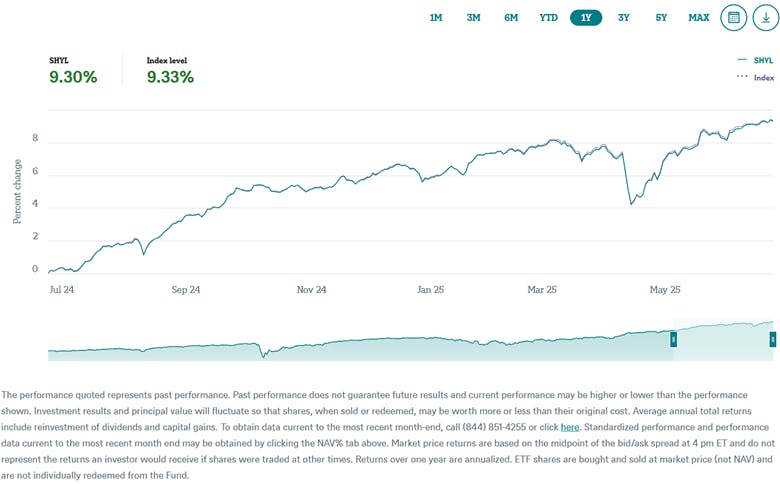
Despite its focus on shorter maturities, SHYL doesn’t skimp on yield. As of the most recent data, it boasts a 7.25% 30-day SEC yield, all while keeping expenses in check with a 0.20% expense ratio.
What these ETFs have in common
Across all four of these Xtrackers high yield bond ETFs is a consistent structural advantage: they each track indices that apply strict liquidity screens. Specifically, bonds in HYDW and SHYL must have at least $400 million outstanding ($250 million for BHYB), and for the Solactive indices, the issuer must have over $1 billion in total debt.
“We think targeting this more liquid segment of high yield is important for maintaining a strong liquidity profile, particularly during distressed periods of the market,” Spalding explains.
Liquidity is critical when packaging high-yield debt into an ETF wrapper. When credit markets become volatile, ETFs exposed to thinly traded, illiquid securities may experience wider spreads, poor pricing, or forced sales at unfavorable terms—all of which hurt the end investor’s experience.
And while it may be tempting to stretch for yield by scooping up smaller, more distressed issuers, this strategy has clear risks.
“Other high yield funds may use a lower threshold and include bonds with less than $250 million outstanding.” Spalding adds. “While these specific bonds could offer a higher yield, it comes at the expense of taking on higher CCC risk and illiquidity, which may underperform their higher quality peers in a drawdown environment.”
What’s most notable about the Xtrackers lineup is how it reflects the growing ability for investors to surgically target specific risk and return characteristics within high yield bonds.
Whether it’s isolating duration, filtering out financials, dialing down beta, or simply avoiding distressed paper, today’s ETFs offer more ways than ever to fine-tune your income exposure, without sacrificing liquidity or diversification. For advisors and investors alike, that level of precision is a big step forward.
Please note that this article reflects the author’s personal views and does not represent the opinions of the publication or its affiliates. It is for informational purposes only and does not constitute investment advice. It is essential to seek guidance from a registered financial professional before making any investment decisions.
Mentioned ETFs

Latest ETF News
See all ETF newsThere’s an ETF for That? Investing Like University Endowments

Could Water ETFs Be the Next AI Bottleneck Trade?

What is a Boomer Candy ETF?

ETF Comparison: NEOS Nasdaq-100 High Income ETF (QQQI) Versus Goldman Sachs Nasdaq-100 Premium Income ETF (GPIQ)




 Advantages of ETFs over Mutual Funds1/6
Lower Costs
In this guide, we'll explore the advantages of ETFs over mutual funds, giving you valuable insights into why ETFs have gained significant popularity among investors like yourself.
Leveraged ETFs: Unlocking the Potential for Amplified Returns1/6
Understanding Leveraged ETFs
Explore leveraged ETFs: potential for amplified returns & risks. 5 ETFs to consider across equities, commodities & fixed income.
What is a Leveraged ETF?1/6
Introducing Leveraged and Inverse ETFs
In this guide, we'll dive into the world of leveraged ETFs, exploring their definition, mechanics, potential risks, and rewards.
Recent educational content

ETF Trends
ETF Industry KPIs September 14, 2026
This week’s KPI data overview highlights key metrics and trends shaping the ETF landscape.

ETF Trends
ETF Industry KPIs September 8, 2026
This week’s KPI data overview highlights key metrics and trends shaping the ETF landscape.
ETF Trends
ETF Industry KPIs August 31, 2026
This week’s KPI data overview highlights key metrics and trends shaping the ETF landscape.
ETF Trends
ETF Industry KPIs August 24, 2026
This week’s KPI data overview highlights key metrics and trends shaping the ETF landscape.
Browse all educational columns



Have you tried our ETF Compare tool?
Compare ETFs like a pro. Analyze fees, performance, exposure & holdings side-by-side.