Global ETF Survey Is Live! 600+ ETF Professionals Weigh In. See Results →



This Unique Thematic ETF is Aligned with America’s Innovation Agenda
The Xtrackers US National Critical Technologies ETF (CRTC) offers investors access to the 14 themes driving the U.S. government’s strategic technology priorities, along with a unique geopolitical risk screen.


Keep up with what matters in ETFs
Get timely ETF insights, market trends, and top ideas straight to your inbox.
Your newsletter subscriptions with us are subject to ETF Central's Privacy Policy and Terms and Conditions.
Warren Buffett famously said, “Never bet against America.” The quote reflects his long-standing belief in the country’s unmatched capacity for innovation, productivity, and reinvention. For decades, that optimism has proven right. U.S. markets have consistently outperformed global peers, driven by companies that turn breakthrough ideas into lasting industries.
Many investors have taken the Oracle of Omaha’s advice to heart, holding ETFs that track broad benchmarks like the S&P 500 or Nasdaq 100. Others take it a step further by focusing on specific sectors, most often technology, in the belief that American ingenuity will continue to lead global growth.
Still, supporting U.S. innovation goes beyond simply overweighting the technology sector. Under the Global Industry Classification Standard (GICS), many companies advancing innovation fall under other categories such as communications, consumer discretionary, or industrials. These firms are deeply involved, even if their classifications suggest otherwise.
That is why it can be useful to view the market through a different framework. Instead of grouping companies by traditional sectors, investors can focus on those contributing directly to the technologies that underpin national competitiveness and security. The U.S. Department of War’s 2023 National Defense Science and Technology Strategy identifies 14 such areas across three categories: emerging opportunity, adoption, and defense-specific technologies.
This is the foundation of the Xtrackers US National Critical Technologies ETF
Like what you're reading?
Stay in the loop — get the latest ETF insights: trends, analysis, and expert picks.
Understanding the 14 Critical Technology Sectors
The 14 critical technology sectors defined by the U.S. Department of War have long anchored America’s innovation and national security agenda. These areas shape military readiness, economic competitiveness, and technological leadership in a world increasingly polarized along geopolitical and technological lines.
As major powers race for advantage in science, defense systems, and industrial capacity, U.S. leadership across these sectors has been treated as a core element of national resilience. However, the playbook just changed.
This week, Under Secretary for Research and Engineering Emil Michael formally consolidated the 14 critical technology areas into a much narrower list of six priority categories. The move is meant to reduce fragmentation, direct funding toward the most urgent warfighter needs, and accelerate technology delivery on 12–36-month “sprints.”
While the framework has changed, all of the individual technologies covered under the original 14 sectors still matter. Most will simply be folded into one of the new umbrella categories.
The new six priority areas are:
- Applied Artificial Intelligence (AAI)
- Biomanufacturing (BIO)
- Contested Logistics (LOG)
- Quantum and Battlefield Information Dominance (Q-BID)
- Scaled Hypersonics (SHY)
- Scaled Directed Energy (SCADE)
These categories replace and consolidate the prior list. But it’s still instructive to understand the previous 14 critical technology areas, since they formed the foundation for this new framework and continue to describe the underlying capabilities the Department aims to accelerate. Previously, they were grouped into three overarching categories.
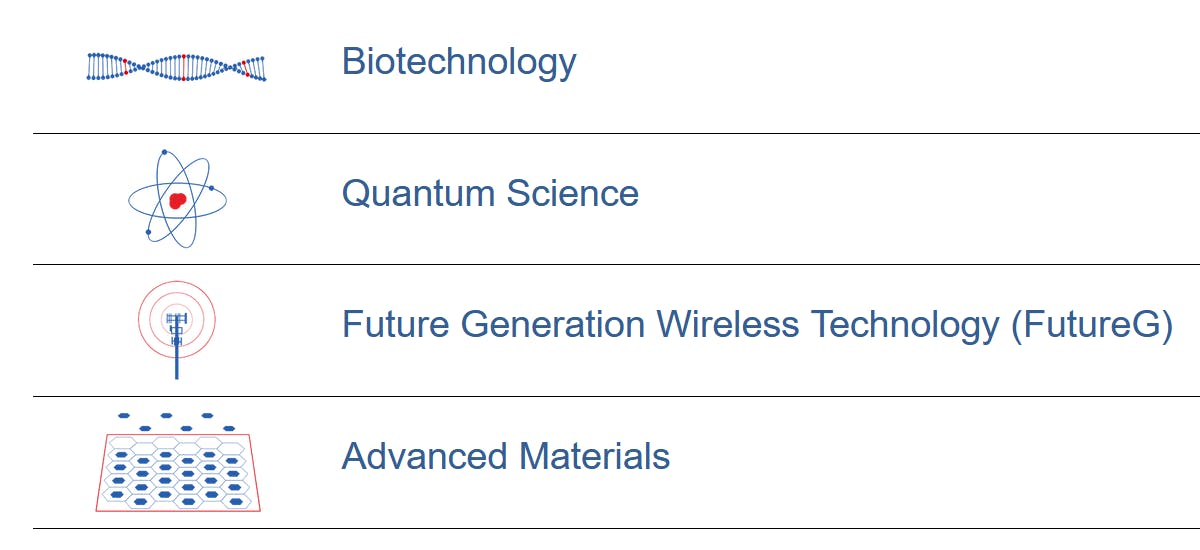
Seed Areas of Emerging Opportunity
These are frontier technologies that are still in the early stages of development. They remain largely unproven but hold immense potential to shape the next generation of industries and national capabilities. Companies working in these fields are often engaged in research, experimentation, and prototype design rather than commercial production.
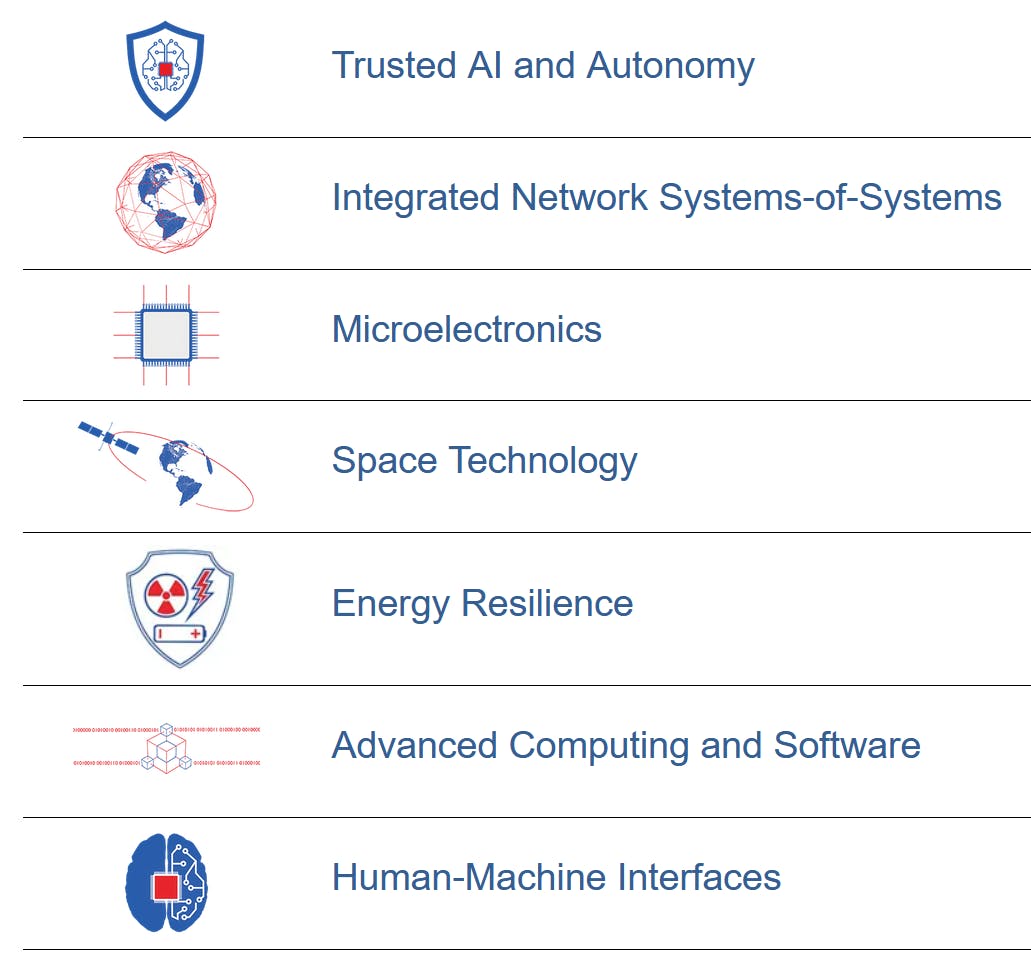
Effective Adoption Areas
These represent technologies that are already being integrated across industries but continue to evolve in scope and scale. The goal here is to accelerate adoption, improve coordination across systems, and enhance resilience. They reflect areas where innovation is translating into measurable economic and strategic advantage.
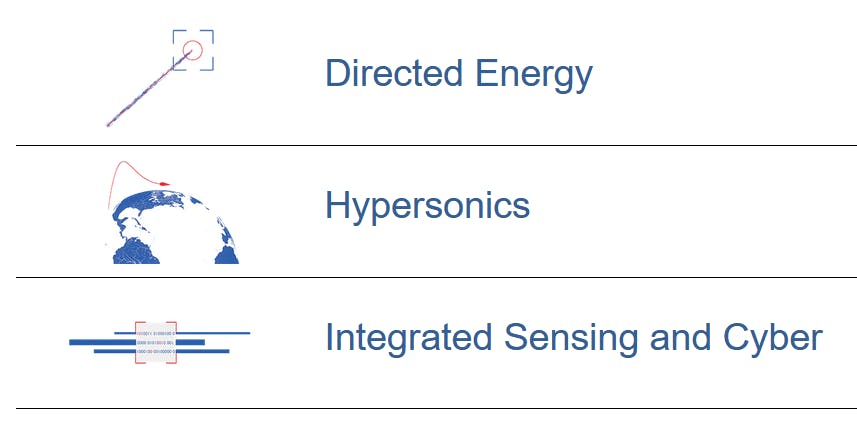
Defense-Specific Areas
These are technologies developed primarily for military use but with potential for civilian applications over time. Historically, many transformative innovations, from GPS to the internet originated in defense research.
How CRTC Puts This in Play
CRTC is a clear example of how the right index can turn broad policy goals and complex ideas into investable opportunities for everyday investors. Rather than simply guessing which tech themes will matter most in the coming decade, the ETF translates the U.S. government’s strategic priorities into a diversified, rules-based portfolio.
CRTC tracks the Solactive Whitney U.S. Critical Technologies Index, a custom-built benchmark designed to capture companies aligned with the 14 technology sectors outlined in the Department of War’s national innovation framework.
The index begins with a universe of companies drawn from the Solactive GBS Developed Markets Large & Mid Cap USD Index. From there, it selects firms that show meaningful involvement in one or more of the critical technology areas, effectively mapping an abstract concept like “national innovation” into a concrete list of securities.
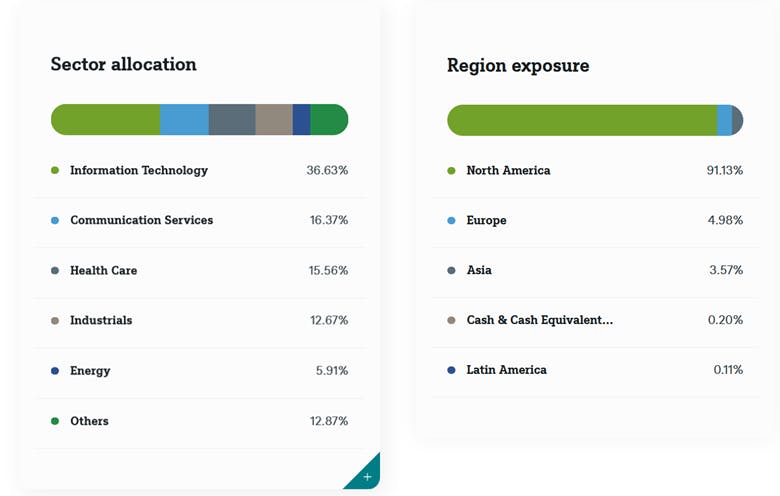
But the index construction doesn’t stop there. Given the global nature of U.S. capital markets and the growing risk of geopolitical tension from foreign rivals, CRTC’s benchmark includes an additional safeguard: a Geostrategic Risk Rating (GSRR).
Developed by J.H. Whitney Data Services LLC, this multi-factor quantitative metric evaluates how closely a company is connected to nations considered adversarial in the U.S. Intelligence Community’s annual threat assessment. It screens out companies with heavy exposure to countries viewed as strategic risks, reducing potential vulnerabilities tied to future global conflicts.
CRTC is priced competitively with a 0.35% expense ratio and has delivered a 48.09% cumulative net asset value (NAV) return since its launch on November 16, 2023 (as of November 14th, 2025), a strong showing for a thematic ETF that bridges the gap between national strategy and investor access.
Why It Matters for Investors
The intersection of national policy, corporate capital, and geopolitics is reshaping where innovation happens and who benefits. Investors who overlook this alignment risk missing one of the most important structural shifts in modern markets.
Capital is following the “critical tech” playbook. J.P. Morgan just launched a 10-year, $1.5T Security & Resiliency Initiative to finance and invest in industries tied to national security, with up to $10B of the bank’s own equity earmarked for defense, energy, advanced manufacturing, and frontier tech. That is Wall Street-scale validation of the theme.
Policy risk is now a portfolio risk. The U.S. has raised or maintained Section 301 tariffs on a range of China-linked technologies and inputs, with specific actions targeting EVs, chips, batteries, and critical minerals. China has tightened rare-earth export controls. These moves shape supply chains, margins, and investability across semis, energy storage, and advanced manufacturing.
Critical minerals are the pressure point. 2025 saw fresh U.S. trade actions on graphite anode materials and copper products, underlining how minerals policy feeds directly into tech and energy security. Markets have started to price this as a form of “resource nationalism.”
So, what should investors notice? I believe there are two key takeaways:
- There is durable, bipartisan momentum to onshore and “de-risk” strategic tech. That tends to channel public and private capital to the same sectors.
- Geopolitics is a fundamental, not a headline. Tariffs, controls, and industrial policy can change cash-flow paths as much as product cycles do.
You could try to capture this two-part dynamic with thematic tech funds, defense funds, or critical-minerals funds, but these generally screen on business lines or factor rules.
CRTC layers a purpose-built index that maps to 14 U.S. critical technology priorities and adds a Geostrategic Risk Rating to curb exposure to adversarial-linked revenue and supply-chain entanglements. That breadth plus a systematic geopolitical screen is not common across peer thematics
Policy and capital are converging on the same set of technologies. If you want exposure that is aligned with that trajectory and explicitly accounts for geopolitical counterparty risk, CRTC is the only ETF purpose-built to express that view.
Please note this article is for information purposes only and does not in any way constitute investment advice. It is essential that you seek advice from a registered financial professional prior to making any investment decision.
Latest ETF News
See all ETF newsBeyond Big Tech: The Increasing Specialization of AI ETFs

There's an ETF for That? Humanoid Robotics and Physical AI

How Some ETF Issuers Use Their Own Funds for Cash Management

These Public-Private ETFs Invest in Polymarket and Anduril

There's an ETF for That? Frontier Markets



 Advantages of ETFs over Mutual Funds1/6
Lower Costs
In this guide, we'll explore the advantages of ETFs over mutual funds, giving you valuable insights into why ETFs have gained significant popularity among investors like yourself.
Leveraged ETFs: Unlocking the Potential for Amplified Returns1/6
Understanding Leveraged ETFs
Explore leveraged ETFs: potential for amplified returns & risks. 5 ETFs to consider across equities, commodities & fixed income.
What is a Leveraged ETF?1/6
Introducing Leveraged and Inverse ETFs
In this guide, we'll dive into the world of leveraged ETFs, exploring their definition, mechanics, potential risks, and rewards.
Recent educational content

First Look ETF
First Look ETF: Income, International, and Cash Flow ETFs
In this season 6 episode of First Look ETF, Stephanie Stanton @etfguide examines the latest ETF marketplace trends with NYSE and guests.


ETF Trends
ETF Industry KPIs October 5, 2026
This week’s KPI data overview highlights key metrics and trends shaping the ETF landscape.

ETF Trends
ETF Industry KPIs September 28, 2026
This week’s KPI data overview highlights key metrics and trends shaping the ETF landscape.
ETF Trends
ETF Industry KPIs September 22, 2026
This week’s KPI data overview highlights key metrics and trends shaping the ETF landscape.