ETF model portfolios designed for real investor needs. Discover →



There’s an ETF for that? MicroStrategy (MSTR) Stock
These ETFs can provide leveraged or inverse exposure to MicroStrategy but come with very high risk.


Keep up with what matters in ETFs
Get timely ETF insights, market trends, and top ideas straight to your inbox.
Your newsletter subscriptions with us are subject to ETF Central's Privacy Policy and Terms and Conditions.
Bitcoin hit a new all-time high of $107,000 this year, finally breaking the coveted $100,000 mark. Year to date as of Dec. 17, Bitcoin is up 158.19%.
But it’s not Bitcoin itself that delivered the most eye-popping returns. That title goes to MicroStrategy (MSTR), which has surged an astonishing 463.95% over the same period.
Under the leadership of Michael Saylor, MicroStrategy has essentially become a leveraged way to gain exposure to Bitcoin, thanks to its massive holdings of the cryptocurrency and some questionable financial engineering.
Seeing this, some ETF providers decided to package MSTR into leveraged and inverse single-stock ETFs — offering amplified returns (or losses) for investors willing to take the gamble.
Well, as the title says — yes, there’s an ETF for that. But fair warning: These products are extremely risky, not for the faint of heart, and definitely not suitable as a long-term buy-and-hold investment. Here’s how they work.
Like what you're reading?
Stay in the loop — get the latest ETF insights: trends, analysis, and expert picks.
How MicroStrategy works
The best way to describe MicroStrategy’s business model — which has moved far beyond its roots in software and business intelligence — is as a “Bitcoin-debt flywheel.”
Here’s how it works: MicroStrategy’s stock price trades at a significant premium above the net asset value (NAV) of its Bitcoin holdings. This premium is largely fueled by the use of convertible bonds to raise capital.
Investors lend MicroStrategy money through bonds with low interest rates and the option to convert their bonds into MSTR shares. This setup gives bondholders downside protection — fixed interest payments and repayment of principal — while also offering upside tied to Bitcoin’s price.
If Bitcoin rallies, MSTR’s stock price tends to soar. Bondholders can then convert their bonds into shares, profiting from the premium that MSTR trades at relative to Bitcoin’s NAV. Since MicroStrategy often trades well above the value of its underlying Bitcoin, the conversion can be quite lucrative.
What does MicroStrategy do with the capital raised from these convertible bonds? It buys even more Bitcoin. The result is a self-reinforcing cycle: as Bitcoin’s price rises, MicroStrategy’s stock rallies, allowing it to keep raising capital at favorable terms to acquire more Bitcoin — all while maintaining that premium valuation.
The flywheel spins beautifully… as long as Bitcoin keeps going up and MicroStrategy trades at a premium high enough to offset dilution.
How the MicroStrategy ETFs work
The single-stock leveraged and inverse MicroStrategy ETFs serve as tactical trading tools for investors looking to magnify their exposure to MSTR — either long or short.
Why is MicroStrategy such an attractive trading vehicle? For starters, it’s incredibly volatile, with a staggering 75.22% standard deviation. It also tends to move more or less in line with Bitcoin’s price while remaining liquid with an active options chain.
The problem, however, is that shorting MSTR typically requires a ton of margin, and options are usually prohibitively expensive given the stock’s extreme volatility. For investors who want to amplify their exposure, these ETFs simplify the process — all you need to do is buy shares and sit on them.
Two main providers dominate this niche:
- Defiance ETFs, which offers the Defiance Daily Target 2X Long MSTR ETF MSTX-0.87%and Defiance Daily Target 2X Short MSTR ETFSMST+1%
- REX Shares, which operates the T-REX 2X Long MSTR Daily Target ETF and T-REX 2X Inverse MSTR Daily Target ETFMSTUMSTZ+1.44%
These ETFs work by using derivatives, primarily swaps with counterparties, collateralized by money market instruments. Options may also be used if necessary.
Swaps are the tool of choice for leveraged and inverse ETFs because they offer a cost-effective and efficient way to gain amplified exposure to the underlying stock, especially when the stock is volatile and shorting directly would be complex or expensive.
What are the risks with these ETFs?
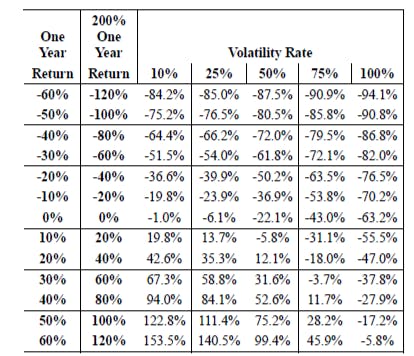
A crucial point to note is that all four ETFs have the word “Daily” in their names. This means their leverage and inverse targets are designed to be accurate only for a single day. Over longer periods, due to the effects of daily compounding, the results can drift significantly from the expected return.
This drift can work in your favor during trending markets but can be devastating in choppy ones. To understand how compounding affects returns, T-Rex offers a handy chart in its prospectus that illustrates this effect, as seen below:
Finally, a burning question many readers likely have: Can these ETFs blow up? My answer is an emphatic yes. The T-Rex prospectus explicitly outlines scenarios where this could occur:
“The Fund could theoretically lose an amount greater than its net assets in the event of a security decline of more than 50%. This would result in a total loss of a shareholder’s investment in one day even if MSTR subsequently moves in the opposite direction and eliminates all or a portion of its earlier daily change. A total loss may occur in a single day even if MSTR does not lose all of its value.”
In short, these ETFs are not for the faint of heart. Trade at your own risk.
This article is for informational purposes only and does not in any way constitute investment advice. The author may express their own opinions, which may not represent the opinions of ETF Central or its affiliated partners. It is essential that you seek advice from a registered financial professional prior to making any investment decisions.
Latest ETF News
See all ETF news10-Year Treasury Yield Hits 5%: Which Bond ETFs Offer the Most Direct Exposure?

ETF comparison: NEOS S&P 500 High Income ETF (SPYI) Versus Goldman Sachs S&P 500 Premium Income ETF (GPIX)

There’s an ETF for That? Investing Like University Endowments

Could Water ETFs Be the Next AI Bottleneck Trade?

What is a Boomer Candy ETF?



 Advantages of ETFs over Mutual Funds1/6
Lower Costs
In this guide, we'll explore the advantages of ETFs over mutual funds, giving you valuable insights into why ETFs have gained significant popularity among investors like yourself.
Leveraged ETFs: Unlocking the Potential for Amplified Returns1/6
Understanding Leveraged ETFs
Explore leveraged ETFs: potential for amplified returns & risks. 5 ETFs to consider across equities, commodities & fixed income.
What is a Leveraged ETF?1/6
Introducing Leveraged and Inverse ETFs
In this guide, we'll dive into the world of leveraged ETFs, exploring their definition, mechanics, potential risks, and rewards.
Recent educational content

ETF Trends
ETF Industry KPIs September 22, 2026
This week’s KPI data overview highlights key metrics and trends shaping the ETF landscape.


First Look ETF
First Look ETF: Income, Corporate Arbitrage, and Growth and Value Investing
First Look ETF September 2026: iCapital, Mast Investments and North Square unpack new ETFs targeting monthly income, merger arbitrage and complementary growth and value exposure.

ETF Trends
ETF Industry KPIs September 14, 2026
This week’s KPI data overview highlights key metrics and trends shaping the ETF landscape.
ETF Trends
ETF Industry KPIs September 8, 2026
This week’s KPI data overview highlights key metrics and trends shaping the ETF landscape.
Browse all educational columns



Have you tried our ETF Compare tool?
Compare ETFs like a pro. Analyze fees, performance, exposure & holdings side-by-side.