Keep tabs on your favorite ETFs with a personalized weekly tracker. Create a Watchlist now →



There's an ETF for that? Investing in BRICS Countries
These ETFs offer exposure to the emerging market nations that are part of the BRICS coalition.

Keep up with what matters in ETFs
Get timely ETF insights, market trends, and top ideas straight to your inbox.
Your newsletter subscriptions with us are subject to ETF Central's Privacy Policy and Terms and Conditions.
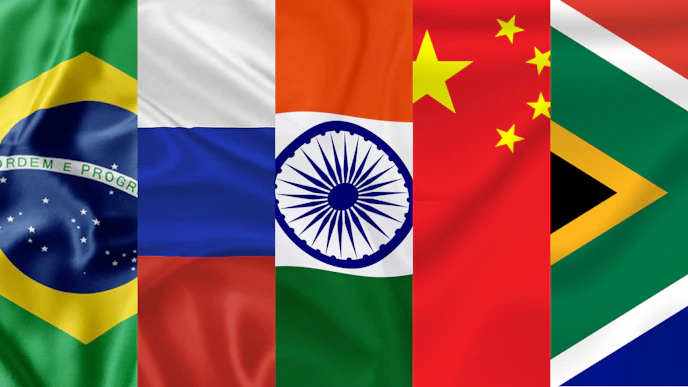
The acronym "BRICS" stands for Brazil, Russia, India, China, and South Africa—five major emerging national economies that have increasingly collaborated in recent years.
This coalition gained additional attention from October 22 to 24 when it held its first-ever summit, not only featuring its core members but also expanding its influence by inviting Egypt, Ethiopia, Iran, Saudi Arabia, and the United Arab Emirates to join, forming what is now called BRICS+.
This expansion is significant as it positions BRICS as a modern bloc and a potential counterpart to NATO, signaling a strategic realignment in global politics.
Some analysts believe that this development could lead to de-dollarization, referring to a reduction in the dominance of the U.S. dollar in global transactions, which could realign financial and economic power globally. This shift is seen as a move to challenge the prevailing Western financial systems and could potentially heighten future geopolitical tensions.
On the other hand, skeptics view the coalition as more of a paper tiger, with limited actual power or cohesion among its members.
Regardless of one's view on the political implications of BRICS, the economic narrative provides a tangible investment opportunity. As geopolitical themes continue to influence the market, a range of ETFs now offer investors exposure to the economies within the BRICS coalition.
Global ETF Survey 2026 is Live!
With 1,790 new products launched by July 2026, choosing is harder than ever. Our Global ETF Survey 2026, built on 620 professional investors and allocators, shows how active, fixed income, options-based and thematic ETFs are reshaping fund selection.
iShares MSCI BIC ETF BKF-0.66%
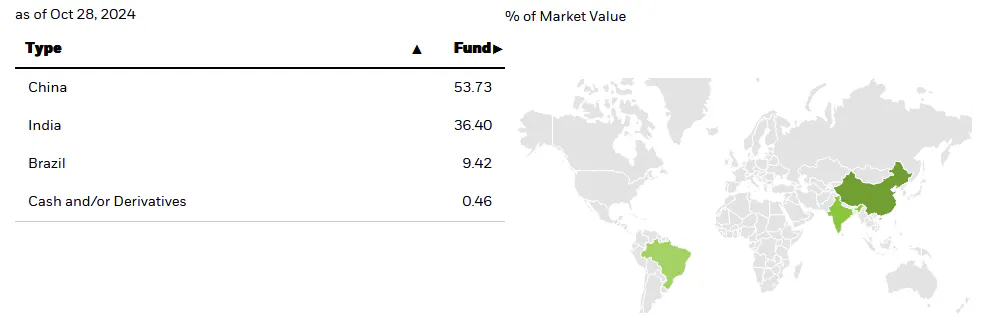
BKF offers investors core exposure to three of the largest and most investable BRICS nations—Brazil, India, and China—capturing their market performance through the MSCI BIC Index.
This index reflects the significance of these emerging economies, noted for their higher GDP and accessibility to investors. BKF follows a market capitalization-weighted approach, predominantly featuring Chinese equities, followed by Indian and Brazilian stocks, with a total of 677 holdings.
Investors considering BKF should note its characteristics: The ETF displays considerable volatility, typical of emerging markets, with a 30-year standard deviation of 20.89%. Despite this, it holds a beta of 0.45 relative to the U.S. market, suggesting lower correlation and potential diversification benefits.
However, BKF's liquidity is less than that of ETFs tracking U.S. equities due to the lighter trading volume of its underlying stocks, leading to a larger 30-day median bid-ask spread of 0.25%. Additionally, the expense ratio stands at 0.7%, which is relatively high compared to many domestic ETFs.
It's also important to recognize that BKF does not include all BRICS countries, notably excluding Russia and South Africa. The absence of Russian equities is significant, as many Russian ETFs have faced collapse or severe challenges following geopolitical tensions and sanctions related to its invasion of Ukraine.
iShares MSCI South Africa ETF EZA-1.03%
Aside from the exclusion of Russia in BKF, investors looking to cover all BRICS countries might consider augmenting their exposure with EZA, which tracks the MSCI South Africa 25/50 Index.
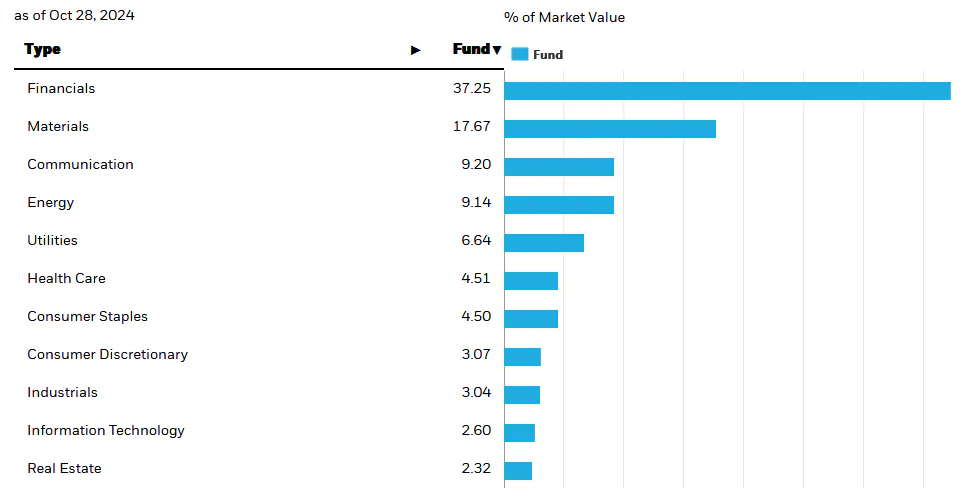
This ETF offers a focused view into the South African market with a relatively narrow benchmark consisting of 32 market-cap weighted companies. The portfolio is heavily concentrated in financials, materials, and consumer discretionary sectors.
Among the top holdings, you'll find a diverse array of leading South African companies:
- Naspers Limited (NPN) is a giant in consumer discretionary, known primarily for its investments in internet companies, including a significant stake in Tencent.
- FirstRand Ltd (FSR) is a major player in the financial sector, providing a range of banking and insurance services.
- Gold Fields Ltd (GFI) represents the materials sector, specifically gold mining, and is one of the world's largest gold mining firms.
As with BKF, it's important to note that EZA is not the most liquid ETF, with a 0.18% bid-ask spread, and it carries an expense ratio of 0.59%.
BRICS+ countries
Among the new BRICS+ countries—Egypt, Ethiopia, Iran, Saudi Arabia, and the United Arab Emirates—only a few are investable through U.S.-listed ETFs.
Currently, investment opportunities via ETFs are available primarily for Saudi Arabia and the UAE. Notably, there used to be an ETF for Egypt, the VanEck Egypt Index ETF, but it was delisted on March 8, 2024.
For those interested in gaining exposure to these Arab countries, the iShares MSCI UAE ETF
In terms of holdings, both ETFs are heavily weighted towards financial sector companies. For the UAE, notable holdings include Abu Dhabi Commercial Bank and Abu Dhabi Islamic Bank. Saudi Arabia's ETF
Please note this article is for information purposes only and does not in any way constitute investment advice. It is essential that you seek advice from a registered financial professional prior to making any investment decision.
Topics
See all
Mentioned ETFs
Further reading

Latest ETF News
See all ETF news
Beyond TLT: Treasury ETFs For the Long Duration Trade

MoneyShow Chart of the Day 9/30/26: Are Hyperscalers the New "Sovereigns?"


Which Fixed-Income ETFs Benefit from Rising Interest Rates?




 Advantages of ETFs over Mutual Funds1/6
Lower Costs
In this guide, we'll explore the advantages of ETFs over mutual funds, giving you valuable insights into why ETFs have gained significant popularity among investors like yourself.
Leveraged ETFs: Unlocking the Potential for Amplified Returns1/6
Understanding Leveraged ETFs
Explore leveraged ETFs: potential for amplified returns & risks. 5 ETFs to consider across equities, commodities & fixed income.
What is a Leveraged ETF?1/6
Introducing Leveraged and Inverse ETFs
In this guide, we'll dive into the world of leveraged ETFs, exploring their definition, mechanics, potential risks, and rewards.
Recent educational content

ETF Trends
ETF Industry KPIs October 5, 2026
This week’s KPI data overview highlights key metrics and trends shaping the ETF landscape.

ETF Trends
ETF Industry KPIs September 28, 2026
This week’s KPI data overview highlights key metrics and trends shaping the ETF landscape.
ETF Trends
ETF Industry KPIs September 22, 2026
This week’s KPI data overview highlights key metrics and trends shaping the ETF landscape.

First Look ETF
First Look ETF: Income, Corporate Arbitrage, and Growth and Value Investing
First Look ETF September 2026: iCapital, Mast Investments and North Square unpack new ETFs targeting monthly income, merger arbitrage and complementary growth and value exposure.

Browse all educational columns



ETFs’ Next Act: From Access to Selection
With 1,790 new products launched by July 2026, choosing is harder than ever. Our Global ETF Survey 2026, built on 620 professional investors and allocators, shows how active, fixed income, options-based and thematic ETFs are reshaping fund selection.