ETF model portfolios designed for real investor needs. Discover →



There’s an ETF for That? Betting on the VIX
These alternative ETFs can help you express a view on market volatility, but beware of high fees and risk.


Keep up with what matters in ETFs
Get timely ETF insights, market trends, and top ideas straight to your inbox.
Your newsletter subscriptions with us are subject to ETF Central's Privacy Policy and Terms and Conditions.
On Wednesday, Dec. 18, Federal Reserve Chair Jerome Powell announced a slower pace of rate cuts for 2025 during the Fed’s latest meeting. Markets didn’t take kindly to the news, with the Dow Jones Industrial Average extending its five-day losing streak, now down over 3%.
In the grand scheme of things, this may just be a blip for long-term investors. But for the Cboe Volatility Index, or VIX, it’s a different story. The VIX has surged 72.19% over the same period, marking what CNBC called its “second-biggest spike.”
The VIX, often referred to as Wall Street’s “fear gauge,” isn’t just a sentiment indicator. It’s a real-time measure of the market’s expectations for 30-day volatility derived from S&P 500 index options.
However, you can’t invest directly in the VIX. Instead, there are several ETFs that allow investors to bet on market volatility, whether you’re bullish, bearish, or simply looking for alternative sources of income. Here’s a quick guide to the types of VIX ETFs you’ll encounter and what they aim to do.
Get data on 14,000+ ETFs
Access Trackinsight's reliable and comprehensive data with 500M+ points on 14,000+ ETFs.
Long VIX futures ETFs
Remember, the VIX is an index, meaning you can’t invest directly in it. Instead, most traders use VIX futures, which are contracts to buy or sell the index’s future value at a predetermined date. Futures are highly liquid and easily packaged into ETFs, making them accessible to retail investors.
If you’re betting on the VIX to rise, a popular option is the ProShares Short VIX Short-Term Futures ETF
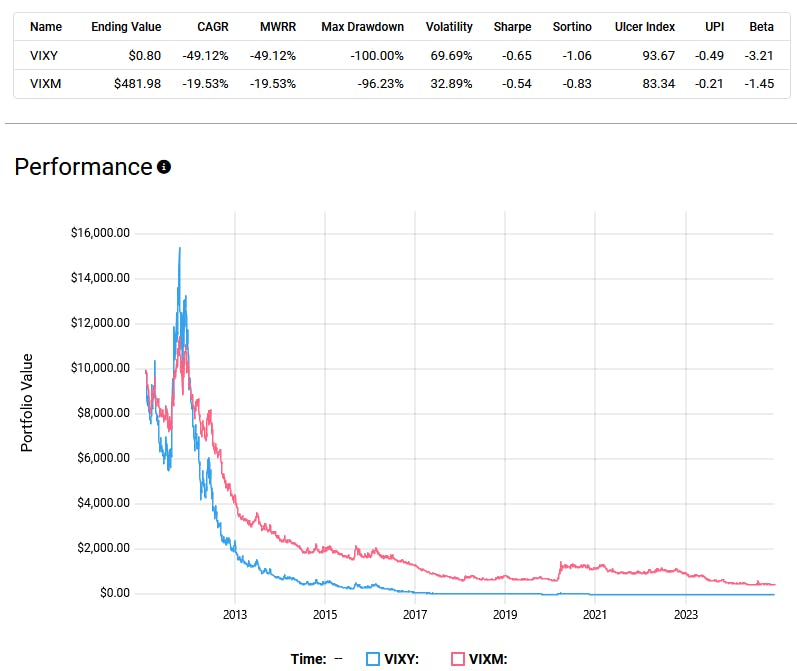
The difference lies in the futures contracts they use. VIXY holds short-term VIX futures, which are weighted to reflect the next one-month expiration. VIXM, on the other hand, holds mid-term VIX futures, which are weighted to reflect the average of futures contracts expiring in the next five months.
VIXY tends to correlate more closely with spot VIX movements but is more prone to contango (when future prices are higher than spot prices), leading to faster price decay. VIXM, while less volatile and less correlated to the spot VIX, decays at a slower rate due to the longer time horizon of its futures contracts.
This decay is further exacerbated by the fact that the VIX is mean reverting, meaning it tends to move back toward its long-term average over time, reducing the likelihood of sustained high volatility.
If you’re using these as a hedge, the trade-off is clear: VIXY is better for short-term bets on rising volatility, while VIXM works for a longer-term hedge. For example, VIXY has a higher negative beta of -3.21, offering more sensitivity to the VIX, compared to -1.45 for VIXM. However, this comes with much faster decay over time.
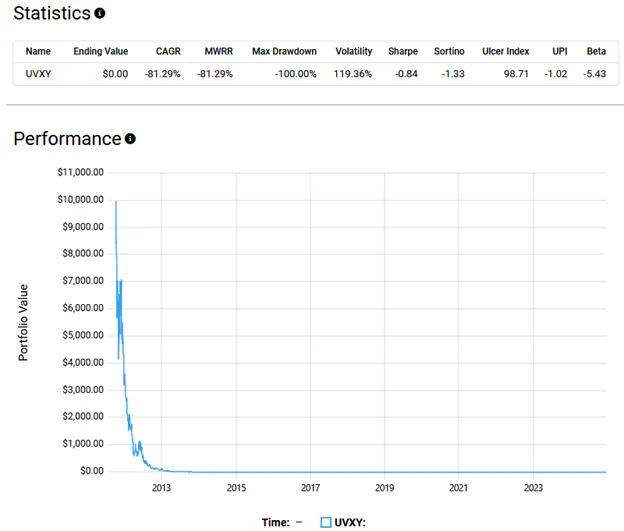
For even more sensitivity to a short-term rise in volatility, consider applying leverage with the ProShares Ultra VIX Short-Term Futures ETF
But this also comes at a cost—UVXY decays heavily over time due to leverage and frequent reverse splits. It’s best used only for very short-term bets on increased market volatility.
Short VIX futures ETF
The VIX tends to rise when markets fall, so with markets trending upward over the long term, you’d expect the VIX to decline. Shorting VIX futures that are in contango and mean-reverting can seem like a winning strategy, offering steady gains in most market environments.
This is the premise behind short VIX futures ETFs like the Short VIX Short-Term Futures ETF
These funds provide -0.5x and -1x daily inverse exposure, respectively, to the S&P 500 VIX Short-Term Futures Index and the Short VIX Futures Index. While SVXY focuses on VIX futures with a one-month weighted average to expiration, SVIX incorporates first- and second-month VIX futures rolled daily.
What’s the use case for these ETFs? It’s often referred to as “picking up pennies in front of a steamroller” – you earn steady, incremental gains most of the time, but a single bad day can erase years of progress.
This dynamic was illustrated during the 2018 Volmageddon, when the VIX surged by 115% in a single day, reaching 37 in February. Many ETFs and ETNs shorting VIX futures collapsed, with SVXY suffering a staggering -95.25% drawdown.
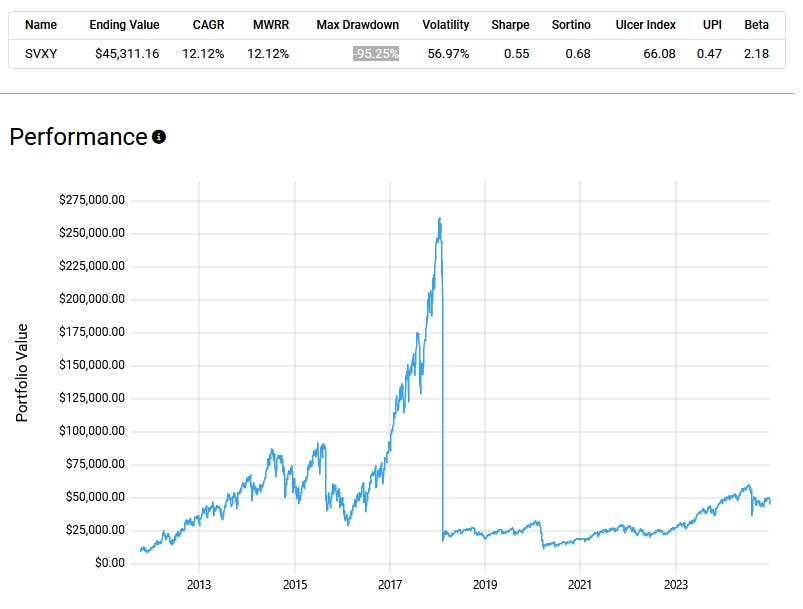
While SVXY wasn’t liquidated, its exposure was reduced to -0.5x to mitigate the risk of another catastrophic event. Interestingly, despite this drawdown, SVXY has delivered a lifetime total return of 12.12% CAGR, matching the broader market.
Now, short VIX futures ETFs aren’t limited to these two options. One standout is the Simplify Volatility Premium ETF
Unlike SVXY or SVIX, SVOL hedges tail risk by holding VIX call options. These options, while inexpensive, exhibit convexity, which provides significant upside protection in the event of a sharp volatility spike, helping cushion the ETF from extreme losses.
So far, SVOL has performed admirably. It holds a five-star Morningstar rating, indicating strong risk-adjusted returns relative to 1,276 funds in the Large Blend category, and has delivered an 11.3% annualized three-year total return.
However, it’s worth noting that the ETF debuted in May 2021, so it hasn’t faced a Volmageddon-style event like 2018. That said, SVOL deserves credit for holding up well during the recent surge in the VIX.
This article is for informational purposes only and does not in any way constitute investment advice. The author may express their own opinions, which may not represent the opinions of ETF Central or its affiliated partners. It is essential that you seek advice from a registered financial professional prior to making any investment decisions.
Latest ETF News
See all ETF newsThese Public-Private ETFs Invest in Polymarket and Anduril

There's an ETF for That? Frontier Markets

10-Year Treasury Yield Hits 5%: Which Bond ETFs Offer the Most Direct Exposure?

ETF comparison: NEOS S&P 500 High Income ETF (SPYI) Versus Goldman Sachs S&P 500 Premium Income ETF (GPIX)




 Advantages of ETFs over Mutual Funds1/6
Lower Costs
In this guide, we'll explore the advantages of ETFs over mutual funds, giving you valuable insights into why ETFs have gained significant popularity among investors like yourself.
Leveraged ETFs: Unlocking the Potential for Amplified Returns1/6
Understanding Leveraged ETFs
Explore leveraged ETFs: potential for amplified returns & risks. 5 ETFs to consider across equities, commodities & fixed income.
What is a Leveraged ETF?1/6
Introducing Leveraged and Inverse ETFs
In this guide, we'll dive into the world of leveraged ETFs, exploring their definition, mechanics, potential risks, and rewards.
Recent educational content

ETF Trends
ETF Industry KPIs September 28, 2026
This week’s KPI data overview highlights key metrics and trends shaping the ETF landscape.

ETF Trends
ETF Industry KPIs September 22, 2026
This week’s KPI data overview highlights key metrics and trends shaping the ETF landscape.
First Look ETF
First Look ETF: Income, Corporate Arbitrage, and Growth and Value Investing
First Look ETF September 2026: iCapital, Mast Investments and North Square unpack new ETFs targeting monthly income, merger arbitrage and complementary growth and value exposure.

ETF Trends
ETF Industry KPIs September 14, 2026
This week’s KPI data overview highlights key metrics and trends shaping the ETF landscape.
Browse all educational columns



Expert-Built ETF Portfolios, All in One Place
Don’t start from scratch. Discover ready-made ETF portfolios built by professionals to match different goals, timelines, and market views. Use them as inspiration or as a starting point for your own allocation.