Keep tabs on your favorite ETFs with a personalized weekly tracker. Create a Watchlist now →



There’s an ETF for That? Betting Against the U.S. Dollar
Bearish on the U.S. dollar? These ETFs can help you express that thesis in a liquid and accessible manner.


Keep up with what matters in ETFs
Get timely ETF insights, market trends, and top ideas straight to your inbox.
Your newsletter subscriptions with us are subject to ETF Central's Privacy Policy and Terms and Conditions.
The U.S. dollar, often affectionately dubbed the Benjamin, greenback, or buck, holds a formidable place in the global economic landscape. It’s not just the primary reserve currency and a major medium for international transactions; it’s also a popular safe haven during market turmoil.
But despite its popularity, the dollar has actually seen a dramatic decrease in purchasing power over the last century.
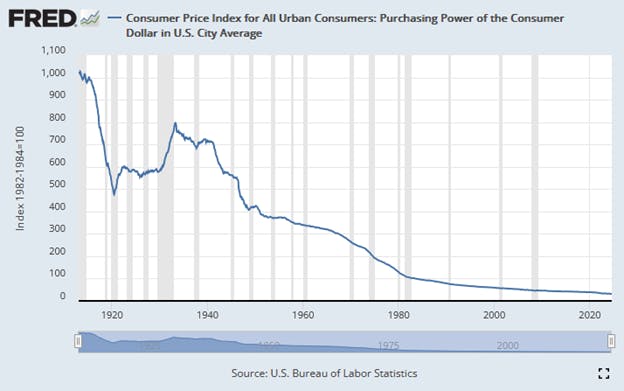
Looking at the Federal Reserve Economic Data (FRED), managed by the Research division at the Federal Reserve Bank of St. Louis, we find the “Consumer Price Index for All Urban Consumers: Purchasing Power of the Consumer Dollar in U.S. City Average,” – quote a mouthful, but it’s actually pretty simple.
This index essentially tracks the inverse of the Consumer Price Index (CPI), illustrating how the purchasing power of the dollar decreases as the CPI increases—which means rising prices make it so that consumers can buy less with the same amount of money. From a peak of 1017 in January 1913, it plummeted to just 31.8 by August 2024.
For those bearish on the U.S. dollar, certain ETFs can serve as strategic tools. These ETFs are specifically designed to benefit from the dollar’s decline, allowing investors to express a bearish stance in a liquid and accessible manner. Here’s a look at two, one for short-term traders, and one for long-term investors.
Like what you're reading?
Stay in the loop — get the latest ETF insights: trends, analysis, and expert picks.
Betting against the U.S. dollar: short-term
A popular choice for those looking to make a short-term bet against the U.S. dollar is the Invesco DB US Dollar Index Bearish ETF
UDN seeks to track the performance of the Deutsche Bank Short USD Currency Portfolio Index - Excess Return. This includes not just the returns from the index but also any interest income earned from its holdings of U.S. Treasuries and money market instruments.
The index operates by holding short positions in U.S. Dollar Index futures contracts that trade on the ICE futures exchange. This strategy provides investors with exposure that is inversely related to the movement of the U.S. dollar against a basket of six major world currencies—the euro, Japanese yen, British pound, Canadian dollar, Swedish krona, and Swiss franc.
However, this ETF is not without its risks and complexities. Historically, even though the U.S. dollar has generally been on a declining trend, it has had periods of strength against these six currencies. This natural volatility, compounded by the costs associated with rolling futures contracts, has resulted in UDN underperforming with a total return of -2.45% over the last decade.
Furthermore, with an expense ratio of 0.78%, UDN might be better suited as a tactical, short-term instrument rather than a long-term investment solution. It’s a speculative tool primarily used when there’s a strong conviction that the U.S. dollar will weaken relative to other major currencies in the near term.
Betting against the U.S. dollar: long-term
For a longer-term bet against the U.S. dollar, I think it is more prudent to avoid products based on expensive futures and instead focus on equities. Equities not only allow investors to benefit from the market risk premium but also capitalize on the growth of profitable enterprises.
In considering which companies might benefit from a decline in the U.S. dollar, it’s insightful to look towards those primarily domiciled in the BRICS countries—Brazil, Russia, India, China, and South Africa. These nations often have ambitions and economic policies that position them as alternatives to U.S. dominance in global markets, aiming for greater independence and regional influence.
For investors seeking broad exposure to these markets, the iShares MSCI BIC ETF
It’s worth noting the absence of Russian equities in typical BRIC funds. Most Russian equity ETFs faced significant challenges following the country’s invasion of Ukraine, with many being liquidated after their values plummeted due to international sanctions and the ensuing market rout.
Please note this article is for information purposes only and does not in any way constitute investment advice. It is essential that you seek advice from a registered financial professional prior to making any investment decision.
Mentioned ETFs
Further reading
Latest ETF News
See all ETF newsThere’s an ETF for That? Investing Like University Endowments

Could Water ETFs Be the Next AI Bottleneck Trade?

What is a Boomer Candy ETF?

ETF Comparison: NEOS Nasdaq-100 High Income ETF (QQQI) Versus Goldman Sachs Nasdaq-100 Premium Income ETF (GPIQ)




 Advantages of ETFs over Mutual Funds1/6
Lower Costs
In this guide, we'll explore the advantages of ETFs over mutual funds, giving you valuable insights into why ETFs have gained significant popularity among investors like yourself.
Leveraged ETFs: Unlocking the Potential for Amplified Returns1/6
Understanding Leveraged ETFs
Explore leveraged ETFs: potential for amplified returns & risks. 5 ETFs to consider across equities, commodities & fixed income.
What is a Leveraged ETF?1/6
Introducing Leveraged and Inverse ETFs
In this guide, we'll dive into the world of leveraged ETFs, exploring their definition, mechanics, potential risks, and rewards.
Recent educational content

ETF Trends
ETF Industry KPIs September 14, 2026
This week’s KPI data overview highlights key metrics and trends shaping the ETF landscape.

ETF Trends
ETF Industry KPIs September 8, 2026
This week’s KPI data overview highlights key metrics and trends shaping the ETF landscape.
ETF Trends
ETF Industry KPIs August 31, 2026
This week’s KPI data overview highlights key metrics and trends shaping the ETF landscape.
ETF Trends
ETF Industry KPIs August 24, 2026
This week’s KPI data overview highlights key metrics and trends shaping the ETF landscape.
Browse all educational columns



Expert-Built ETF Portfolios, All in One Place
Don’t start from scratch. Discover ready-made ETF portfolios built by professionals to match different goals, timelines, and market views. Use them as inspiration or as a starting point for your own allocation.