Keep tabs on your favorite ETFs with a personalized weekly tracker. Create a Watchlist now →



There’s an ETF for That? Optics and Photonics
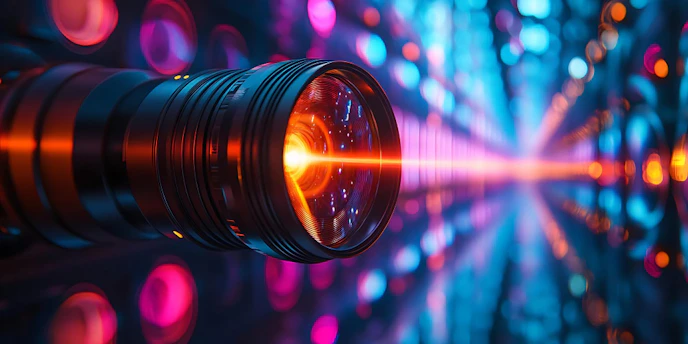
Thematic ETFs targeting the AI buildout have become increasingly concentrated, with optics and photonics exposure being the latest hot trend.

Keep up with what matters in ETFs
Get timely ETF insights, market trends, and top ideas straight to your inbox.
Your newsletter subscriptions with us are subject to ETF Central's Privacy Policy and Terms and Conditions.
I miss the days when ETF investors gravitated toward low-cost, broadly diversified products. These days, it often feels like investors are doing the exact opposite, willingly paying more for increasingly concentrated exposure.
One of the best recent examples is the Roundhill Memory ETF
AI applications require enormous amounts of memory. DRAM serves as the working memory of AI servers and data centers, while NAND flash memory provides long-term data storage. Both have become critical components of the AI infrastructure buildout and, for a time, represented one of the industry's most significant supply bottlenecks.
Now ETF providers are already moving on to the next bottleneck: optics and photonics. Broadly speaking, optics refers to the manipulation and transmission of light, while photonics focuses on generating, controlling, and detecting photons.
In practical terms, these technologies are what allow massive amounts of information to move between AI chips, servers, networking equipment, and data centers at extremely high speeds while consuming less power than traditional electrical connections.
One company many investors are already familiar with is ASML. Its lithography systems use highly sophisticated optical technologies to manufacture advanced semiconductors. But optics and photonics extend well beyond ASML.
The theme also includes companies producing optical networking equipment, laser systems, photonic integrated circuits, fiber-optic components, sensing technologies, and other hardware essential to modern data infrastructure.
As AI models become larger and data centers become more interconnected, moving information efficiently is becoming almost as important as processing it. That shift has increasingly placed optics and photonics at the center of the investment conversation.
And, as the theme of this column goes, yes, there is an ETF for that. Today, we're going to look at the two optics and photonics ETFs currently trading, followed by a quick roundtable of some of the more notable ETF filings that could give investors additional ways to access the theme in the future.
Get data on 14,000+ ETFs
Access Trackinsight's reliable and comprehensive data with 500M+ points on 14,000+ ETFs.
What's currently available?
As of the start of June, there are really only two notable pure-play optics and photonics ETFs available to investors. The first comes from Corgi Funds.
The firm itself is a bit unusual by ETF industry standards. While its parent company is better known for its online insurance business and ties to the Y Combinator startup ecosystem, it has expanded aggressively into ETFs, launching roughly three dozen products in a very short period of time.
I've got a lot to say about Corgi as a company. Their branding, marketing, and product lineup feel very Gen Z-oriented, and they're clearly trying to do things differently than the traditional Wall Street playbook. Whether that ultimately works remains to be seen, but they have certainly been willing to experiment with everything from thematic strategies to buffer ETFs.
One of their more successful launches so far has been the Corgi Optics & Photonics ETF
The portfolio itself is fairly concentrated and targets what Corgi describes as the optics and photonics value chain. That includes EUV lithography systems used in semiconductor manufacturing, laser and optical components for fiber networks and LiDAR systems, silicon photonics technologies used inside AI data centers, and precision measurement and inspection equipment.
The holdings reflect that approach. The portfolio is essentially a who's who of semiconductor and advanced manufacturing companies. Taiwan Semiconductor Manufacturing Company is currently the largest holding at just over 10%, followed by ASML, Lam Research, Applied Materials, and Corning.
Competing against EUV is the Tuttle Capital Pure Play Photonics ETF
Rather than owning a broad collection of semiconductor and equipment companies, Tuttle's approach focuses on what he calls the "photonic stack." The fund looks across five interdependent layers of the ecosystem, including lasers, optical transceivers, silicon photonics, indium phosphide (InP) wafers, and the foundries that manufacture these components.
Importantly, holdings are selected primarily using revenue-based screens designed to maintain pure-play exposure to the photonics theme. The ETF is also actively managed, giving the adviser flexibility to overweight and underweight positions as opportunities emerge.
That flexibility can be a benefit or a drawback depending on the manager's execution, but it does make FOTO meaningfully different from the more benchmark-driven approach taken by EUV.
So far, investors seem receptive. Despite only launching on May 27, the ETF has already accumulated just over $22 million in assets under management. That active approach does come at a cost, however. FOTO charges a 0.75% expense ratio, more than double that of EUV.
Looking through the current 16-stock portfolio, I actually like how differentiated it is. You don't see the same mega-cap semiconductor names dominating the top holdings. Instead, the largest positions include Lumentum Holdings, IPG Photonics, Fabrinet, Ciena, and Coherent.
What’s on the horizon?
EUV and FOTO may be early to the party, but they are unlikely to remain alone for long. There is already a growing pipeline of ETF filings looking to capitalize on investor interest in optics and photonics. Unsurprisingly, two of the more notable proposals come from providers already known for thematic investing: Tema ETFs and KraneShares.
The first is the proposed Tema Optical & Photonic ETF. Like FOTO, Tema intends to use a revenue-based screen, requiring companies to derive at least 50% of their revenue from photonics-related activities. However, the methodology also allows for exceptions. Pre-revenue companies and firms that are actively pivoting toward photonics can potentially qualify even if they do not yet meet the 50% threshold.
Personally, this strikes me as a bit broad. I understand the rationale. If you want exposure to emerging technologies, some of the most interesting opportunities may not yet have meaningful revenue. But at some point, you have to ask why the revenue screen exists in the first place if exceptions become too common. The risk is that you end up drifting away from a pure-play optics and photonics portfolio and into a broader collection of speculative technology companies.
Investors should also remember that once you move beyond the larger established players found in products like EUV, you are inevitably entering more speculative territory. Some of these businesses may still be unprofitable. Others may be dependent on continual capital raises, shareholder dilution, or technologies that have yet to prove themselves commercially.
Competing against Tema's proposal is the KraneShares Optical AI Infrastructure ETF. KraneShares appears to be taking a somewhat stricter approach. The filing requires companies to derive at least 50% of revenue or gross profit from one of four targeted categories: transceivers and pluggable optics, integrated circuits and silicon photonics, optical fiber assemblies, and optical networking systems.
Again, it remains to be seen exactly what the final portfolio construction will look like, but my initial impression is that each provider is trying to carve out a distinct niche. They're not only competing against existing semiconductor and AI infrastructure ETFs; they’re also competing against one another.
That differentiation is probably necessary. The optics and photonics ecosystem is still relatively small compared to semiconductors as a whole, so simply launching another generic AI thematic ETF is unlikely to gain much traction.
My thoughts on optics and photonics thematic ETFs
If I had to make one observation about the space, though, it is that Corgi currently has a significant advantage on cost. A 0.35% expense ratio is difficult to beat for a niche thematic ETF. That said, the success of DRAM has demonstrated that investors are willing to pay higher fees if active management provides something genuinely useful.
Optics and photonics are a rapidly evolving industry. New winners can emerge quickly, supply chains can shift, and technologies can become commercially relevant faster than many index methodologies can adapt. A rules-based approach provides transparency, but it can also inadvertently exclude companies that become important after the index construction rules have already been established.
Please note this article is for information purposes only and does not in any way constitute investment advice. It is essential that you seek advice from a registered financial professional prior to making any investment decision.

Latest ETF News
See all ETF newsHow Some ETF Issuers Use Their Own Funds for Cash Management

These Public-Private ETFs Invest in Polymarket and Anduril

There's an ETF for That? Frontier Markets

10-Year Treasury Yield Hits 5%: Which Bond ETFs Offer the Most Direct Exposure?



 Advantages of ETFs over Mutual Funds1/6
Lower Costs
In this guide, we'll explore the advantages of ETFs over mutual funds, giving you valuable insights into why ETFs have gained significant popularity among investors like yourself.
Leveraged ETFs: Unlocking the Potential for Amplified Returns1/6
Understanding Leveraged ETFs
Explore leveraged ETFs: potential for amplified returns & risks. 5 ETFs to consider across equities, commodities & fixed income.
What is a Leveraged ETF?1/6
Introducing Leveraged and Inverse ETFs
In this guide, we'll dive into the world of leveraged ETFs, exploring their definition, mechanics, potential risks, and rewards.
Recent educational content

ETF Trends
ETF Industry KPIs October 5, 2026
This week’s KPI data overview highlights key metrics and trends shaping the ETF landscape.

ETF Trends
ETF Industry KPIs September 28, 2026
This week’s KPI data overview highlights key metrics and trends shaping the ETF landscape.
ETF Trends
ETF Industry KPIs September 22, 2026
This week’s KPI data overview highlights key metrics and trends shaping the ETF landscape.

First Look ETF
First Look ETF: Income, Corporate Arbitrage, and Growth and Value Investing
First Look ETF September 2026: iCapital, Mast Investments and North Square unpack new ETFs targeting monthly income, merger arbitrage and complementary growth and value exposure.

Browse all educational columns



ETFs’ Next Act: From Access to Selection
With 1,790 new products launched by July 2026, choosing is harder than ever. Our Global ETF Survey 2026, built on 620 professional investors and allocators, shows how active, fixed income, options-based and thematic ETFs are reshaping fund selection.