Turn ETF ideas into real portfolios. Try the builder now →



There's an ETF for That? A Look at Luxury Equity ETFs
There are some truly interesting ETFs out there. Today's focus is on those tracking luxury stocks.


Keep up with what matters in ETFs
Get timely ETF insights, market trends, and top ideas straight to your inbox.
Your newsletter subscriptions with us are subject to ETF Central's Privacy Policy and Terms and Conditions.
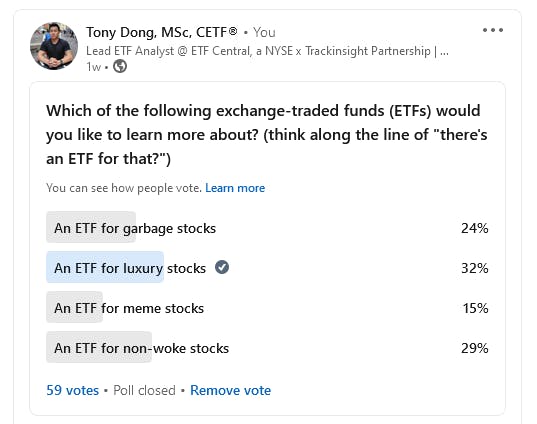
Last week, I threw a curveball at my LinkedIn followers with a poll that might have raised a few eyebrows. The question was simple: Which of these offbeat exchange-traded funds (ETFs) piques your interest the most? Think in the vein of "there's an ETF for that."
The choices were as eclectic as they come – from garbage stocks and luxury stocks to meme stocks and even non-woke stocks. With 59 voters chiming in, the top pick, with 32% of the vote, was – drumroll, please – luxury stocks!
In the ever-expanding universe of ETFs, where the ETF Central Screener tallies a whopping 3,328 as of November 15th, there's a fund for just about every whim or investment thesis you can dream up.
And for those who have had their fill of splurging on high-end goods and now fancy the idea of investing in the very companies that have been lightening their wallets, luxury ETFs are just the ticket. These funds offer a way to get in on the action on the other side of the cash register.
So, if you're ready to turn the tables and have luxury brands work for you instead of the other way around, stay tuned as we explore these ritzy, glitzy investment options.
Get data on 14,000+ ETFs
Access Trackinsight's reliable and comprehensive data with 500M+ points on 14,000+ ETFs.
Why invest in luxury?
While luxury stocks don't form a market sector of their own, they typically nestle within the consumer discretionary sector, known for its cyclical nature. Why cyclical?
Well, this sector thrives when the economy is doing well, as consumers have more disposable income to spend on non-essentials. However, during economic downturns, discretionary spending is often the first to take a hit.
But here's where it gets interesting: within the consumer discretionary sector, luxury stocks often dance to their own tune, displaying characteristics that arguably make them more resilient than their more mundane peers.
First off, luxury brands have something akin to a moat based on their intangible attributes. Their heritage and allure don't fade with time, making these brands a perennially attractive choice for consumers – think about how long Rolex, Hermes, and Cartier have been around.
Add to this their significant pricing power. With stronger gross margins, luxury brands show an ability to consistently grow organically, largely due to their status and the premium quality of their offerings, further amplified by today's creator economy and social media.
The industry is further shielded by its emphasis on quality, not just in products but also in business operations, evidenced by high operating margins and returns on capital.
Moreover, there's still a lot of room for luxury brands to grow, particularly in emerging markets, among younger demographics, and in e-commerce. This relative under-penetration offers substantial volume growth potential.
Then there's the defensive nature of luxury markets. Unlike other consumer goods, luxury items tend to see only mild fluctuations in demand, buoyed by the affluence of their customer base and the unique nature of the products.
During economic downturns and periods of inflation, the luxury industry's resilience shines through. With strong brand reputations and loyal customer bases, these companies can weather economic storms better than others.
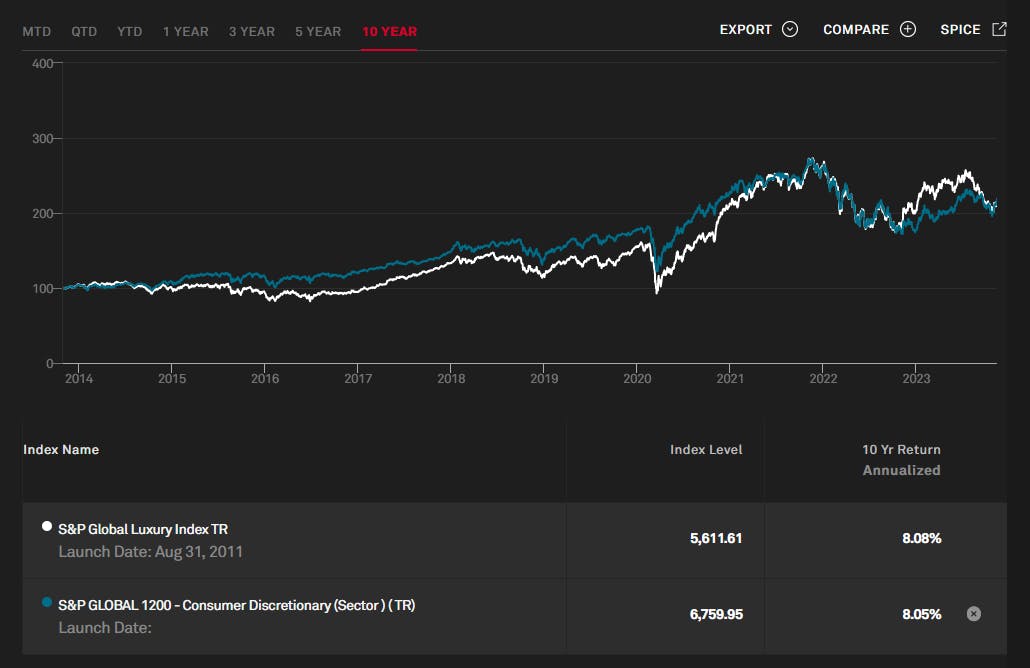
Over the last 10 years, the S&P Global Luxury Index, a benchmark for this industry, has posted an annualized 8.08% total return, slightly beating the S&P Global 1200 Consumer Discretionary Sector Index.
Why a luxury ETF?
The allure of investing in luxury brands is undeniable, with a range of options from diversified holding companies like LVMH and Richemont to luxury car manufacturers such as BMW and Mercedes Benz, and high-end fashion brands like Burberry and Prada. However, directly investing in these stocks comes with its own set of challenges.
Firstly, many luxury stocks are listed on foreign exchanges. To invest in these, U.S. investors typically need to use American Depositary Receipts (ADRs). If ADRs aren't available, investors might need to engage in currency conversion, adding an extra layer of complexity and potential cost to their investment.
Secondly, the perils of individual stock picking cannot be understated. Picking individual stocks requires a deep understanding of each company, its market position, financial health, and future growth prospects. This approach demands significant research and carries a higher risk, as your investment is tied to the fortunes of specific companies.
A more streamlined and arguably safer approach can be found in ETFs or exchange-traded funds. The NYSE currently lists three luxury-focused ETFs, offering a simplified way to invest in this sector. Two of these are passively managed and track a luxury index, while one is actively managed.
The current NYSE-listed luxury ETFs
The passively managed options are the KraneShares Global Luxury Index ETF (
The actively managed ETF in this space is the Tema Luxury ETF (
All three ETFs share some notable similarities: they are globally diversified, with high allocations to international developed markets like France, Italy, and Switzerland, have a high allocation to the consumer discretionary sector, and have a limited number of holdings (under 100).
Please note this article is for information purposes only and does not in any way constitute investment advice. It is essential that you seek advice from a registered financial professional prior to making any investment decision.
Segments
See all
Mentioned ETFs
No specific ETFs were tagged
Further reading


Latest ETF News
See all ETF newsThere’s an ETF for That? Investing Like University Endowments

Could Water ETFs Be the Next AI Bottleneck Trade?

What is a Boomer Candy ETF?

ETF Comparison: NEOS Nasdaq-100 High Income ETF (QQQI) Versus Goldman Sachs Nasdaq-100 Premium Income ETF (GPIQ)




 Advantages of ETFs over Mutual Funds1/6
Lower Costs
In this guide, we'll explore the advantages of ETFs over mutual funds, giving you valuable insights into why ETFs have gained significant popularity among investors like yourself.
Leveraged ETFs: Unlocking the Potential for Amplified Returns1/6
Understanding Leveraged ETFs
Explore leveraged ETFs: potential for amplified returns & risks. 5 ETFs to consider across equities, commodities & fixed income.
What is a Leveraged ETF?1/6
Introducing Leveraged and Inverse ETFs
In this guide, we'll dive into the world of leveraged ETFs, exploring their definition, mechanics, potential risks, and rewards.
Recent educational content

ETF Trends
ETF Industry KPIs September 14, 2026
This week’s KPI data overview highlights key metrics and trends shaping the ETF landscape.

ETF Trends
ETF Industry KPIs September 8, 2026
This week’s KPI data overview highlights key metrics and trends shaping the ETF landscape.
ETF Trends
ETF Industry KPIs August 31, 2026
This week’s KPI data overview highlights key metrics and trends shaping the ETF landscape.
ETF Trends
ETF Industry KPIs August 24, 2026
This week’s KPI data overview highlights key metrics and trends shaping the ETF landscape.
Browse all educational columns



Expert-Built ETF Portfolios, All in One Place
Don’t start from scratch. Discover ready-made ETF portfolios built by professionals to match different goals, timelines, and market views. Use them as inspiration or as a starting point for your own allocation.