Open Now: The Global ETF Survey Take the Survey →



The US labor market continues to hold up
The US labor market has held up exceptionally well this year. We consider the investment implications of this tight labor market.


Keep up with what matters in ETFs
Get timely ETF insights, market trends, and top ideas straight to your inbox.
Your newsletter subscriptions with us are subject to ETF Central's Privacy Policy and Terms and Conditions.
Given the aggressive rate hike cycle, many predicted the US economy would be pushed to the brink of a recession. Yet a counterintuitive trend - the strength in the US labor market – suggests that (as of yet) this has not come to pass. While headlines have been filled with layoffs in big tech – the overall labor market has remained relatively resilient, with the latest jobs report in November showing that 263,000 jobs had been added in the month with this number continuing to increase (albeit at a slower pace). The unemployment rate remained at an extremely low 3.7%, with wages increasing by 5.1%.
However, while a tightening labor market might initially protect against a pending recession, it can result in increased pressure on inflation. After all, inflation is caused by rising prices, and when there are more employed workers, higher levels of spending generally follow with increased pressure on prices. It could be argued that this is a “good” form of inflation since workers are not only spending but working to produce goods and/or provide services to support economic growth. This is in stark contrast to the “bad” type of inflation which has persisted since the Covid-19 pandemic, battered the labor market and led to supply-driven inflation wherein prices were driven up by disrupted supply chains, and shortages of materials, goods, services, and labor.
The ETF Industry Is Evolving Fast
From AI infrastructure to active strategies, the ETF landscape is shifting. Share your perspective in the 7th Annual Global ETF Survey and get exclusive early access to the final report.
Bright spots & weak spots of the US labor market
Within the labor market, there has been variation relating to where jobs have been added the most. Some bright spots within the labor market were:
- Leisure & Hospitality – adding 88,000 jobs, however remaining 5.8% below pre-pandemic levels; keeping in mind that this was one of the hardest hit job markets during the pandemic.
- Health Care – adding 45,000 jobs
- Construction – adding 20,000 jobs
- Information Technology – adding 19,000 jobs
- Manufacturing – adding 14,000 jobs
Note: above figures are seasonally-adjusted
In contrast, there have been some weak spots in the labor market as well, such as:
- Transportation & Warehouse – losing 15,000 jobs
- Retail Trade – losing 30,000 jobs
Note: above figures are seasonally-adjusted
Some surprises in terms of job additions were in the construction and information technology sectors. When interest rates are rising it is typical for the construction industry to slow down given that real estate is a heavily debt-financed asset class. However, this has not been the case - instead the increases in construction jobs lend support to the real estate market and mortgage lenders. And in light of the many headlines surrounding large tech company layoffs, the growth in information technology jobs is also somewhat of a surprise.
Investment implications of the tight labor market
So, what next? If the labor market continues to remain tight, then from a macro-perspective this would lead to inflationary pressure and likely further interest rate hikes.
If this scenario arises then possible investment strategies to consider could be shorting the yield curve i.e., profiting when yields rise. This can be accomplished across different maturities of the yield curve such as:
ProShares Short 20+ Year Treasury ETF (TBF), which provides -1x the return of the daily performance of the ICE US Treasury 20+ Year Bond Index and essentially increases in value when 20+ year US treasury bond yields rise.
ProShares Short 7-10 Year Treasury ETF (TBX), which provides -1x the return of the daily performance of the ICE US Treasury 7-10 Year Bond Index and essentially increases in value when 7-10 year US treasury bond yields rise.
This strategy has worked very well this year, with TBF returning ~34% YTD and TBX returning ~16% YTD. However, as recession fears take hold, longer-term yields have fallen which poses a risk in this investment strategy.
Another investment strategy to consider could be investing in financial companies such as banks and brokerages, in other words businesses that make money off increasing interest rates. ETFs in this area to consider are:
SPDR S&P Regional Banking ETF (KRE), a highly liquid and low-cost ETF that provides exposure to US regional banks within the S&P Regional Banks Select Industry Index
iShares US Broker-Dealers ETF (IAI), a large, low-cost ETF that provides exposure to investment banks, brokerages and stock exchanges within the US.
Data for this article is as of December 6, 2022.
Please note this article is for information purposes only and does not constitute investment advice.
Mentioned ETFs
Further reading

Latest ETF News
See all ETF newsMoneyShow Chart of the Day 7/16/26: Good News/Bad News on Inflation (and the Fed)


MoneyShow Chart of the Day 7/1/26: The H1 Scorecard – and What Comes Next

MoneyShow Chart of the Day 6/22/26: Are World Cup Videos Helping US Companies Clean Up?

MoneyShow Chart of the Day 6/3/26: AI. AI. AI. (And a Handful of Other Stocks, Too)




 Advantages of ETFs over Mutual Funds1/6
Lower Costs
In this guide, we'll explore the advantages of ETFs over mutual funds, giving you valuable insights into why ETFs have gained significant popularity among investors like yourself.
Leveraged ETFs: Unlocking the Potential for Amplified Returns1/6
Understanding Leveraged ETFs
Explore leveraged ETFs: potential for amplified returns & risks. 5 ETFs to consider across equities, commodities & fixed income.
What is a Leveraged ETF?1/6
Introducing Leveraged and Inverse ETFs
In this guide, we'll dive into the world of leveraged ETFs, exploring their definition, mechanics, potential risks, and rewards.
Recent educational content

ETF Trends
ETF Industry KPIs July 20, 2026
This week’s KPI data overview highlights key metrics and trends shaping the ETF landscape.

ETF Trends
ETF Industry KPIs July 13, 2026
This week’s KPI data overview highlights key metrics and trends shaping the ETF landscape.
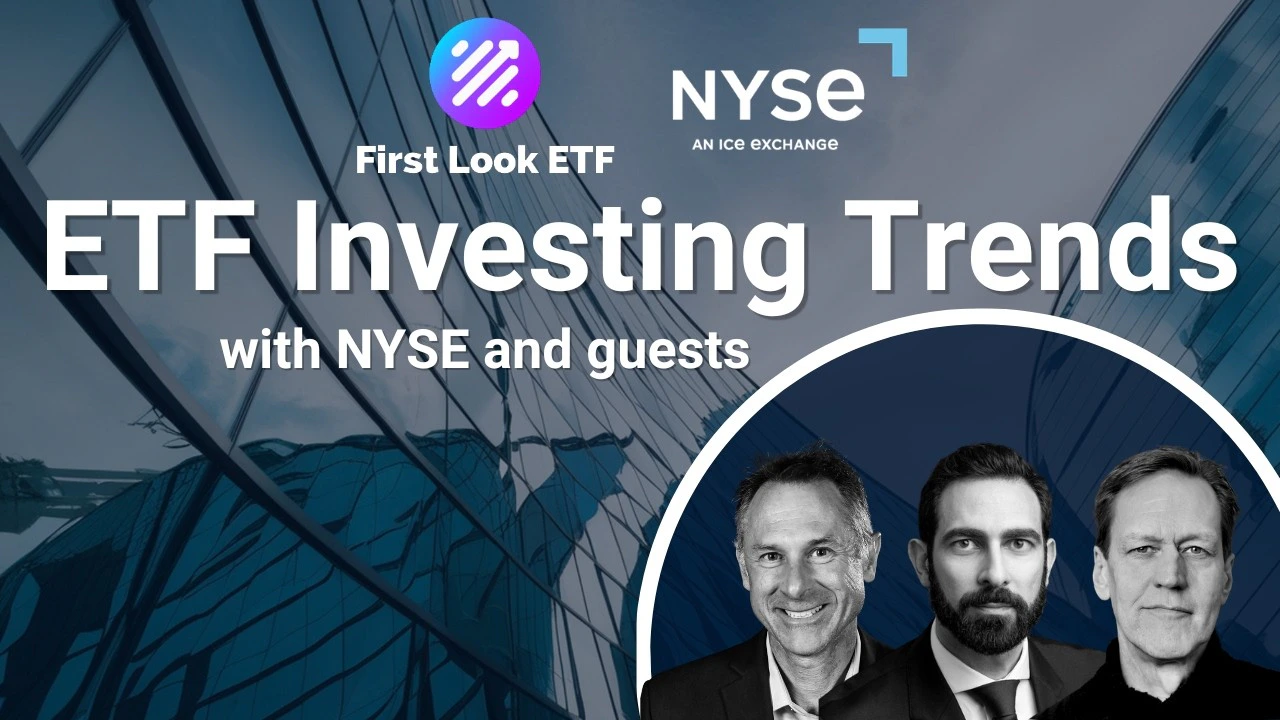
First Look ETF
First Look ETF: Cash Deployment, Bond, and Hedged ETFs
In this season 6 episode of First Look ETF, Stephanie Stanton examines the latest ETF marketplace trends with NYSE and guests.

ETF Trends
ETF Industry KPIs July 6, 2026
This week’s KPI data overview highlights key metrics and trends shaping the ETF landscape.
Browse all educational columns



Build and Analyze Your ETF Portfolio Like a Pro
Create your own ETF portfolio in minutes and instantly see allocations, exposures, performance, and risk. Visualize diversification across asset classes, regions, and sectors. Stress-test ideas, compare benchmarks, and refine your strategy with professional-grade analytics.