Open Now: The Global ETF Survey Take the Survey →



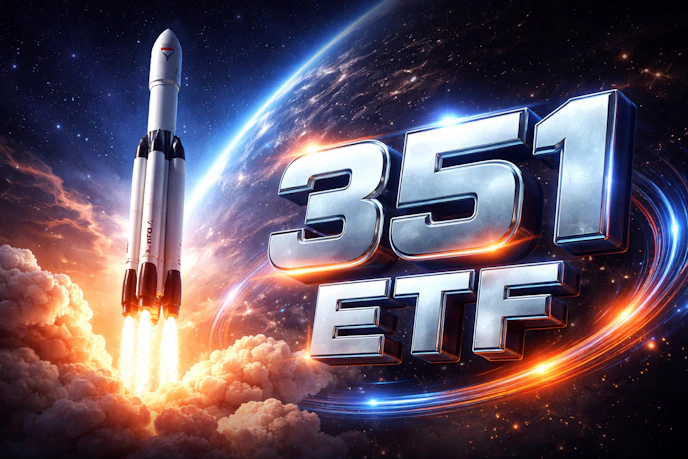
The SpaceX Trade No One’s Talking About: ETFs and the 351 Loophole
SpaceX is the test case, but the real question is whether Section 351 works for other private market shares.

Keep up with what matters in ETFs
Get timely ETF insights, market trends, and top ideas straight to your inbox.
Your newsletter subscriptions with us are subject to ETF Central's Privacy Policy and Terms and Conditions.
SpaceX confidentially filed for an IPO this week, and if all goes according to plan, we can expect the largest public offering in history this June.
The company expects to raise $75 billion, more than three times the size of Alibaba's record-setting IPO in 2014, at a valuation above $1.75 trillion, larger than all but five S&P 500 companies.
This is a lofty valuation for a rocket-satellite company that just merged with an AI venture to build orbital data centers whose economic viability is, well, optimistic at best.
This could also be the largest IPO flop in history. Nonetheless, everyone wants some pre-IPO shares anyway.
Thanks to SEC Rule 22e-4, anyone can get access to pre-IPO SpaceX shares by buying any number of ETFs, mutual funds, and closed-end funds that hold up to 15% (and sometimes more) in SpaceX.
Given the demand for other hot private companies, investors' love affair with ETFs, and the ability for ETFs to hold a portion of their assets in private market stocks, the more interesting question isn't whether you can buy SpaceX, or should, it's whether private company shareholders can exchange their illiquid, private shares into a publicly traded ETF, tax-deferred, using Section 351 of the tax code.
The ETF Industry Is Evolving Fast
From AI infrastructure to active strategies, the ETF landscape is shifting. Share your perspective in the 7th Annual Global ETF Survey and get exclusive early access to the final report.
The ETF-Industrial Complex Discovers SpaceX
Recently, the single best marketing strategy in the ETF business has required no particular genius: get some SpaceX, even a little bit, then advertise that you have it, and watch the money pour into your fund.
The Destiny Tech100 closed-end fund, ticker DXYZ, holds about 16% of its portfolio in SpaceX, and at one point in 2024, DXYZ traded at a 2,000% premium to its net asset value.
When the Fundrise Innovation Fund was listed recently, with exposure to SpaceX, it quickly traded at over 3000% of NAV.
It doesn’t seem to matter if the access is through a high-expense SPV or direct; it just has to have some access to SpaceX.
Of course, this is late-cycle nuttiness and uninformed retail investors with some extra cash in their Robin Hood account, but the premium is mostly due to SpaceX exposure.
What If You Already Own SpaceX?
Here is a different problem.
Say you are a qualified investor with access to private companies like SpaceX.
You are sitting on large gains and want to exchange those shares tax deferred for shares in a new ETF via a 351 exchange.
It is a proven playbook for public securities, and nothing in the tax code specifically prohibits private shares.
As Brent Sullivan of Tax Alpha Insider explains, "Section 351 allows you to contribute your securities to a newly formed ETF in exchange for ETF shares, tax deferred. You don't realize a gain, you just swap assets for shares of a RIC that owns your assets."
He adds that "351 seems on solid ground as long as the control and diversification requirements are satisfied and there's no step transaction shenanigans."
Since ETFs now hold SpaceX shares up to the 15% illiquid threshold, you could theoretically contribute your private shares alongside a basket of diversified listed stocks.
Sullivan notes that contributing private shares to an ETF seems possible, but "the contribution needs to be consistent with the investment policy statement in the approved prospectus and should include extra disclosure around the risk on illiquid assets and that the specific private shares will be included in the portfolio for the very long term or until there's a liquidity event." The legal framework exists, the issue is execution.
The Valuation Problem, the Custody Problem, and the Everything Else Problem
Of course, just because something is legally possible doesn't mean it's operationally simple.
Contributing SpaceX shares to a 351 ETF exchange introduces a cascade of complications that don't arise when you're contributing shares of Apple.
Valuation. Private stocks are like qubits; they can have multiple values at once. The last fundraising round pegged the combined SpaceX/xAI entity at $1.25 trillion, according to Musk. Secondary market prices fluctuate based on who's selling and how desperate they are, and an independent valuation raises the obvious question of by whom. Any contributor to a 351 exchange would likely need a side letter or fund-wide agreement establishing a mutually accepted valuation that satisfies not just the participants and the fund manager, but the IRS and the SEC as well.
Custody. ETF assets are typically held by major custodians such as, BNY Mellon, State Street, US Bank, and UMB, the usual suspects. These custodians have well-oiled systems for holding publicly traded securities. However, private shares often come with transfer restrictions, rights of first refusal, board approval requirements, and various other encumbrances that make traditional custody arrangements somewhere between difficult and impossible.
Liquidity. The SEC's Rule 22e-4 prohibits ETFs from holding more than 15% of net assets in illiquid investments, defined as assets that can't be sold within seven days without significantly moving the price. SpaceX shares, by any reasonable definition, are illiquid. If a SpaceX-heavy ETF experiences significant redemptions, the manager might be forced to sell public holdings first, inadvertently concentrating the portfolio further into the illiquid position.
Taxes. Forced selling of SpaceX shares would trigger capital gains tax distribution, assuming they are sold at a gain, since there is currently no swapping mechanism with an authorized participant to an ETF, the way there is for listed stocks.
Pricing. ETFs publish a net asset value every day, and market makers use that NAV to keep the trading price in line. But private company valuations are only updated quarterly, which means they can be months out of date. If the market crashes in between updates, the published NAV won't reflect reality, and the ETF could trade at wild premiums or discounts to true valuations.
How A 351 Exchange of Private Shares Would Work
For anyone attempting to replicate this, and you can bet that people are, the basic process goes as follows.
First, you identify the contributors, the private company shareholders who want in on the tax-deferred exchange. Whether employees, early investors, or SPV holders, each needs to agree on a valuation methodology and contribute their shares alongside enough other assets to satisfy the 25/50 diversification test.
Second, you form the new ETF entity and file the regulatory paperwork. The sponsor handles SEC registration, custodial arrangements, and listing. Contributors receive ETF shares proportional to their contribution, with cost basis carried over.
Third, the contributing group must collectively own 80% of the new entity's shares immediately after the exchange. Private share exposure must stay under 15% of the fund, unless you are a billionaire and a special friend to Elon Musk.
Fourth, ongoing compliance. The fund must monitor illiquidity exposure, manage the 15% cap or obtain SEC relief, publish NAV using defensible valuations, and handle the unique challenges of holding private company stock in a daily-trading vehicle.
SpaceX Is Just the Beginning
The SpaceX IPO will eventually resolve the illiquidity problem for SpaceX shareholders, but SpaceX is just the test case.
OpenAI just closed a $122 billion funding round at an $852 billion valuation and is expected to IPO later this year. Anthropic is reportedly in early discussions about a listing.
Then there are hundreds of unicorns and decacorns that may never IPO.
These are the exciting growth names that public market investors want to own but don't have access to except through an ETF with private market allocations. The Section 351 exchange makes that possible.
It's complex, it's novel, and it requires careful navigation of tax law, securities regulation, and operational infrastructure. But the demand is there, the legal framework exists, and the precedent has been set, and the financial services industry has never been one to leave a lucrative innovation unexploited.
Disclaimer
Please note this contributor article is for informational purposes only and does not constitute investment advice, a recommendation, or an offer to buy or sell any financial instrument. While the content is provided by a third party and believed to be reliable, we make no representations or warranties as to its accuracy or completeness and accept no liability for any errors, omissions, or outcomes arising from its use. You should seek advice from a qualified and registered financial professional before making any investment decisions.
Segments
See all
No specific market segments were tagged
Mentioned ETFs
No specific ETFs were tagged
Further reading
Latest ETF News
See all ETF news








 Advantages of ETFs over Mutual Funds1/6
Lower Costs
In this guide, we'll explore the advantages of ETFs over mutual funds, giving you valuable insights into why ETFs have gained significant popularity among investors like yourself.
Leveraged ETFs: Unlocking the Potential for Amplified Returns1/6
Understanding Leveraged ETFs
Explore leveraged ETFs: potential for amplified returns & risks. 5 ETFs to consider across equities, commodities & fixed income.
What is a Leveraged ETF?1/6
Introducing Leveraged and Inverse ETFs
In this guide, we'll dive into the world of leveraged ETFs, exploring their definition, mechanics, potential risks, and rewards.
Recent educational content

ETF Trends
ETF Industry KPIs July 20, 2026
This week’s KPI data overview highlights key metrics and trends shaping the ETF landscape.

ETF Trends
ETF Industry KPIs July 13, 2026
This week’s KPI data overview highlights key metrics and trends shaping the ETF landscape.
First Look ETF
First Look ETF: Cash Deployment, Bond, and Hedged ETFs
In this season 6 episode of First Look ETF, Stephanie Stanton examines the latest ETF marketplace trends with NYSE and guests.

ETF Trends
ETF Industry KPIs July 6, 2026
This week’s KPI data overview highlights key metrics and trends shaping the ETF landscape.
Browse all educational columns



The ETF Industry Is Evolving Fast
From AI infrastructure to active strategies, the ETF landscape is shifting. Share your perspective in the 7th Annual Global ETF Survey and get exclusive early access to the final report.