Turn ETF ideas into real portfolios. Try the builder now →



The Next ETF Battleground Isn't Just Fees. It's Strategy
ETFs won the battle to make investing cheaper. The next battle is over who can use the wrapper to build better portfolios.


Keep up with what matters in ETFs
Get timely ETF insights, market trends, and top ideas straight to your inbox.
Your newsletter subscriptions with us are subject to ETF Central's Privacy Policy and Terms and Conditions.
I'm Nicholas Phillips, President of ETF Capital Markets Advisors LLC, with 27 years of experience in ETF trading and capital markets.
I provide fractional capital markets support to ETF issuers and asset managers, helping them navigate launches, liquidity, ETF market structure, market maker relationships, and sales and execution support.
Through my contributions to ETF Central, I aim to provide practical insights for investors and issuers navigating the ETF landscape.
In my latest piece, I look at why strategy could become the ETF industry's next major growth engine, and what that means for managers, fees and investors.
Like what you're reading?
Stay in the loop — get the latest ETF insights: trends, analysis, and expert picks.
Beyond the ETF Fee War
For much of the ETF industry's history, one of the biggest stories has been fees.
Passive ETFs changed asset management by giving investors inexpensive access to markets that previously cost considerably more to own.
As competition increased, fees fell. In some of the largest and most established categories, management fees eventually fell to just a handful of basis points.
That was great for investors.
But after years of product development and fee competition, most of the obvious passive exposures have already been built.
There are plenty of ways to own the S&P 500, large-cap growth stocks, investment-grade bonds, emerging markets and most other major asset classes.
The next phase of ETF growth may look very different.
Goldman Sachs' recently announced acquisition of NEOS Investments is another indication of where the industry may be heading.
NEOS has built its business largely around options-based income strategies, while Goldman previously acquired Innovator Capital Management, a major player in defined-outcome ETFs.
I don't think the takeaway is simply that options ETFs are popular.
The bigger story may be that the ETF wrapper is evolving from a vehicle primarily designed to provide inexpensive market exposure into one capable of delivering increasingly sophisticated investment strategies.
ETFs Are Moving From Exposure to Outcomes
The first generation of ETFs largely answered a straightforward question:
What market exposure do you want?
Today, more ETFs are attempting to answer a different question:
What investment outcome are you trying to achieve?
Maybe the investor wants additional income.
Maybe they want equity participation with some downside protection.
Maybe they want to reduce volatility or create a different risk/reward profile than simply owning an index.
Options give portfolio managers an enormous toolkit for creating those outcomes.
Many of these strategies aren't new. Institutional investors, separately managed accounts and private wealth managers have used options for decades.
What's changing is the delivery mechanism.
Wealth managers have been doing versions of this for years in separately managed accounts and individual portfolios.
A client might own a portfolio of stocks while an adviser or overlay manager writes calls, buys protection or adjusts exposures around the client's objectives.
The ETF industry is increasingly taking strategies that once required an individual account and packaging them for the broader market.
The ETF Wrapper Is Standardized. The Strategy Isn't
Buy-write and option-income ETFs are a good example.
At its simplest, a portfolio can own equities and sell calls against those positions.
The investor maintains equity exposure while option premium generates additional income, with the tradeoff that some upside may be sacrificed.
But that description makes the strategy sound more standardized than it really is.
A manager has a lot of decisions to make.
What strike should be sold?
How far out should the expiration be?
How much of the portfolio should be overwritten?
Should the strategy lean longer to the market and preserve more upside, or be more aggressive about collecting premium?
When should positions be rolled?
How should the strategy adjust when volatility changes?
Consider two managers starting with similar equity exposure.
One might sell calls closer to the money, prioritizing current income but potentially giving up more upside.
Another might sell further out-of-the-money calls, collect less premium and leave more room to participate in a rising market.
Neither approach is inherently better.
The important point is that the manager is making an investment decision. Over time, those decisions become part of the fund's performance.
There are also strategies designed to generate option income without simply owning a traditional equity portfolio and writing calls against it.
Options, collateral and other instruments can be combined to create different exposures and payoff profiles.
The ETF wrapper may be standardized, but the investment decisions inside it don't have to be.
Where Active Management Can Actually Matter
The manager's expertise doesn't necessarily stop with the options strategy.
Consider a manager with decades of experience in a particular industry.
That manager may understand the companies, management teams, competitive landscape and economic drivers of that sector far better than someone simply applying an options overlay to a broad index.
Combine that fundamental expertise with an actively managed options strategy and there are now multiple layers of investment decisions.
The manager isn't just deciding which calls to sell and at what strikes.
They're also deciding which companies they want to own, where they want more or less exposure, how much upside they're willing to give away and where they see the best risk/reward opportunities.
That's different from simply owning the S&P 500 and systematically selling calls against it.
There's nothing inherently wrong with a systematic approach. It can serve a useful purpose and may be exactly what an investor wants. But it's also easier to replicate.
The more decisions a strategy requires, the more opportunity there is for genuine manager expertise to matter.
Higher Fees Mean Higher Expectations
This also changes the conversation around ETF fees.
If two ETFs are essentially providing the same passive market exposure, cost is understandably one of the most important considerations.
There may be little reason to pay substantially more for essentially the same beta.
An actively managed options strategy is different.
Investors aren't simply paying for access to an index. They may be paying for portfolio construction, security selection, options expertise, risk management, trading and ongoing implementation.
That can justify a higher management fee, but only if the manager delivers value.
Higher distribution rates alone shouldn't be confused with better management.
A manager can often generate additional option premium by becoming more aggressive, but that income comes with tradeoffs.
The real question is whether the manager delivers the risk and return characteristics the investor expected.
With these products, the manager's decisions, and ultimately the manager's performance, are attached to the strategy.
Sophisticated Strategies Still Come Down to Execution
A strategy can look great on paper, but options still have to be traded.
As funds grow, execution quality becomes increasingly important. Liquidity, spreads, strike selection, expiration dates, roll schedules and trading costs can all affect the results investors ultimately receive.
That's one reason sophisticated ETF strategies require more than simply coming up with a good investment idea.
Portfolio management and capital markets increasingly intersect. The larger and more complex the strategy becomes, the more important that intersection can be.
The Next ETF Growth Story May Be Portfolio Management
The ETF industry made market exposure cheaper and more accessible. Its next opportunity may be making sophisticated portfolio management more accessible as well.
The first major wave of ETF growth was about access.
The next was about cost. Increasingly, the industry's next chapter may be about outcomes.
That doesn't make fees irrelevant.
It changes what investors should expect in return for paying them.
When a manager is making real decisions about exposure, risk, income and execution, investors are no longer buying cheap beta alone. They're buying a portfolio management strategy.
And that strategy, along with the manager behind it, ultimately needs to justify the cost.
Disclaimer
Please note this article is for information purposes only and does not in any way constitute investment advice. It is essential that you seek advice from a registered financial professional prior to making any investment decision.
Latest ETF News
See all ETF newsAre ETFs Getting Too Complicated? Not Necessarily, But Complexity Has a Cost

Form 4 Has 20 Transaction Codes. None Say "Section 351 ETF Swap"


Who Really Owns a White-Label ETF?

What If a Futures-Based ETF Never Had to Roll Again?

How Do You Build a Winning ETF Business?

Losers Of Q2 2026 REIT Earnings Season



 Advantages of ETFs over Mutual Funds1/6
Lower Costs
In this guide, we'll explore the advantages of ETFs over mutual funds, giving you valuable insights into why ETFs have gained significant popularity among investors like yourself.
Leveraged ETFs: Unlocking the Potential for Amplified Returns1/6
Understanding Leveraged ETFs
Explore leveraged ETFs: potential for amplified returns & risks. 5 ETFs to consider across equities, commodities & fixed income.
What is a Leveraged ETF?1/6
Introducing Leveraged and Inverse ETFs
In this guide, we'll dive into the world of leveraged ETFs, exploring their definition, mechanics, potential risks, and rewards.
Recent educational content

ETF Trends
ETF Industry KPIs September 28, 2026
This week’s KPI data overview highlights key metrics and trends shaping the ETF landscape.

ETF Trends
ETF Industry KPIs September 22, 2026
This week’s KPI data overview highlights key metrics and trends shaping the ETF landscape.
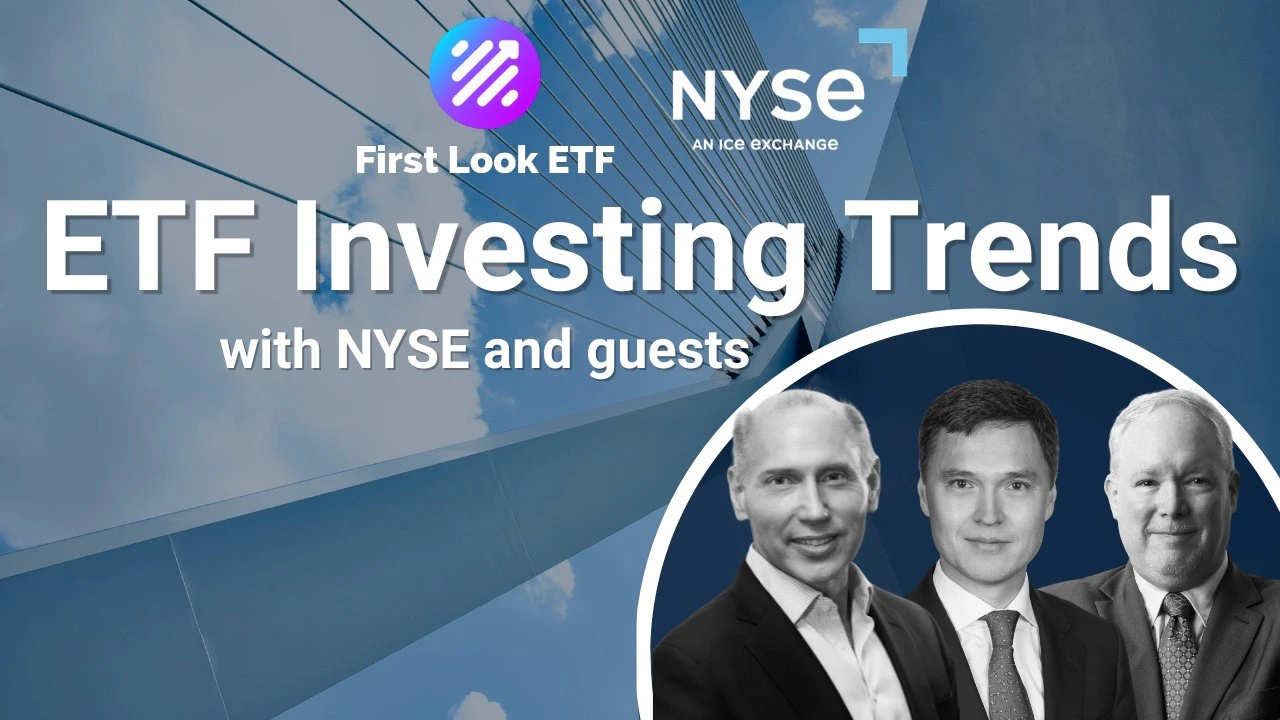
First Look ETF
First Look ETF: Income, Corporate Arbitrage, and Growth and Value Investing
First Look ETF September 2026: iCapital, Mast Investments and North Square unpack new ETFs targeting monthly income, merger arbitrage and complementary growth and value exposure.

ETF Trends
ETF Industry KPIs September 14, 2026
This week’s KPI data overview highlights key metrics and trends shaping the ETF landscape.
Browse all educational columns



Build and Analyze Your ETF Portfolio Like a Pro
Create your own ETF portfolio in minutes and instantly see allocations, exposures, performance, and risk. Visualize diversification across asset classes, regions, and sectors. Stress-test ideas, compare benchmarks, and refine your strategy with professional-grade analytics.