Create, analyze, optimize your ETF portfolio. Start now →



The ETF Underdogs, Part 10: Tail-Risk Selling Strategies
These lesser-known ETFs generate income by selling tail risk rather than relying on covered calls.

Keep up with what matters in ETFs
Get timely ETF insights, market trends, and top ideas straight to your inbox.
Your newsletter subscriptions with us are subject to ETF Central's Privacy Policy and Terms and Conditions.
When most investors think about tail risk, their first instinct is to hedge it. After all, few investments risks are more damaging than the rare, extreme market events that sit several standard deviations to the left of the return distribution. These are the sharp selloffs that can permanently impair capital and are notoriously difficult to predict.
That has given rise to an entire category of ETFs designed to insure against these events. Among the best known are the Cambria Tail Risk ETF
The trade-off is something known as negative carry. Tail-risk protection is not free. Investors purchasing protective options must pay premiums to the counterparties selling. If the market never experiences the anticipated crash, those premiums gradually erode returns over time, much like paying homeowner insurance without ever filing a claim.
Of course, every insurance contract has two sides. Rather than buying protection, another approach is to sell it. Instead of paying premiums for downside insurance, investors collect those premiums by accepting the risk that an extreme market event could occur.
The mechanics are essentially reversed: the seller earns recurring income during normal market conditions but assumes potentially significant losses if a true tail event materializes. As with most income strategies, there is no free lunch. The higher yields available from selling tail risk represent compensation for accepting risks that many other investors prefer to avoid.
While this approach remains far less common than traditional tail-risk hedging, it has begun making its way into the ETF industry. Today, we'll examine two NYSE-listed examples with under $100 million in AUM that approach tail-risk selling in different ways: one from Brookmont Capital Management and another from Simplify Asset Management.
Like what you're reading?
Stay in the loop — get the latest ETF insights: trends, analysis, and expert picks.
Brookmont Catastrophic Bond ETF ILS
One of the fundamental principles of investing is that returns generally come from assuming risk. Equity investors are compensated for accepting business risk, economic uncertainty, and market volatility. Bond investors earn income by taking on interest rate risk, credit risk, inflation risk, and liquidity risk.
That raises an interesting question. Rather than simply diversifying across assets, what if investors diversified across entirely different sources of risk? One of the more unconventional ways to do that is through ILS, which gives investors exposure to one of the least common risk premia available in public markets via catastrophe bonds.
These are specialized fixed-income securities used by insurance and reinsurance companies to transfer the financial risk of major natural disasters to capital market investors. If no qualifying disaster occurs during the life of the bond, investors receive their principal back along with the coupon payments. If a predefined event does occur, some or all of that principal may instead be used to cover insured losses.
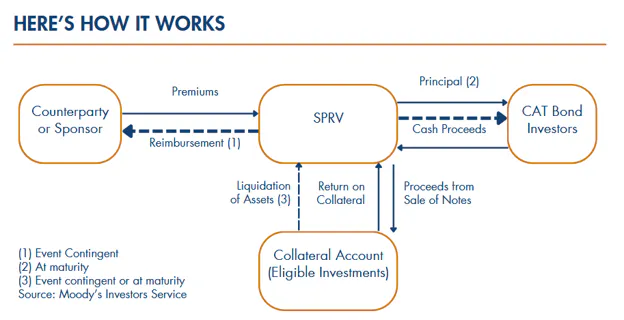
Source: Brookmont Capital Management
The events covered are typically large-scale natural disasters such as hurricanes, earthquakes, floods, wildfires, severe storms, or other catastrophic events. Investors are therefore being compensated for assuming environmental risk rather than economic or corporate risk, which can provide diversification.
Most traditional portfolios are driven by macroeconomic forces such as earnings growth, interest rates, inflation, and credit conditions. The occurrence of a hurricane or earthquake generally has little relationship to whether the stock market is experiencing a bear market.
Brookmont highlights this characteristic by pointing to the asset class's resilience during the March 2020 COVID crash. While that was a bad period in history for financial assets, it was not an unusually severe year for insured natural disasters. As a result, catastrophe bonds largely avoided the losses experienced across equities and many traditional fixed-income sectors.
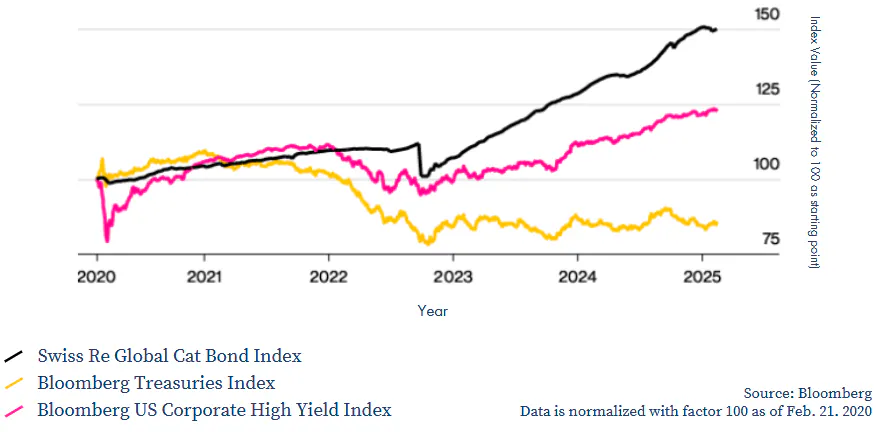
Source: Brookmont Capital Management
Historically, access to this asset class was largely limited to institutional investors using Bermuda-domiciled special purpose vehicles. ILS makes the strategy accessible through an ETF structure. Notably, the fund owns catastrophe bonds directly rather than synthetically through swaps. That physical replication helps reduce counterparty risk.
The trade-off is liquidity. Because catastrophe bonds themselves trade in a relatively specialized over-the-counter market, the ETF has exhibited a wider 0.15% 30-day median bid-ask spread, the fund has also experienced a noticeable difference between its market return and NAV return since inception.
The income, however, is substantial. Even after accounting for the fund's relatively high 1.58% expense ratio, ILS currently offers a trailing 12-month yield of approximately 8.14%. Investors should also note that distributions are paid quarterly rather than monthly, unlike many traditional bond ETFs.
Remember, investors are effectively acting as insurers of last resort. If a qualifying catastrophe occurs, principal losses are possible. Reflecting that risk, the underlying portfolio carries an average credit quality broadly equivalent to a B+ rating, placing it firmly within the non-investment-grade category.
Simplify Ancorato Target 25 Distribution ETF XXV-0.19%
One line in XXV's fund description immediately stands out: "The targeted distribution goal is an annualized rate of 25% after fees and expenses. This is an aspirational goal and is not guaranteed." That is certainly one way to introduce a strategy to prospective investors.
Target-distribution ETFs have become increasingly common in recent years. Most pursue high payouts by employing synthetic covered call strategies, which combine a long call, short put, and short call to generate option premium. XXV takes a completely different approach.
This ETF primarily sells barrier put options. A barrier put resembles a standard put option but includes an additional condition known as a knockdown barrier. Unlike a conventional put, which becomes valuable whenever the underlying asset finishes below its strike price, a barrier put only becomes active if the underlying asset first breaches a predetermined barrier level during the life of the contract.
That distinction materially changes the payoff profile. If the underlying asset remains above the barrier throughout the option's life, the seller simply keeps the premium and the option expires worthless. However, if the barrier is breached, the option effectively converts into a traditional put, exposing the seller to downside losses much like a conventional short put position, offset by the premium collected.
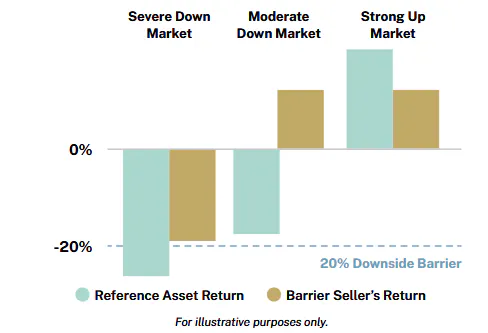
Source: Simplify Asset Management
While barrier options can reference many different assets, including broad market indexes, XXV seeks to generate its elevated income target by writing these contracts on individual stocks. The strategy primarily ladders one-year barrier puts, while dynamically adjusting barrier levels based on prevailing market conditions and the income needed to support its targeted 25% distribution.
Another important feature is the embedded callability provision. Certain positions may be called away before maturity, effectively capping the profit earned on those contracts. While this allows the strategy to recycle capital into new positions, it also limits upside during favorable market environments.
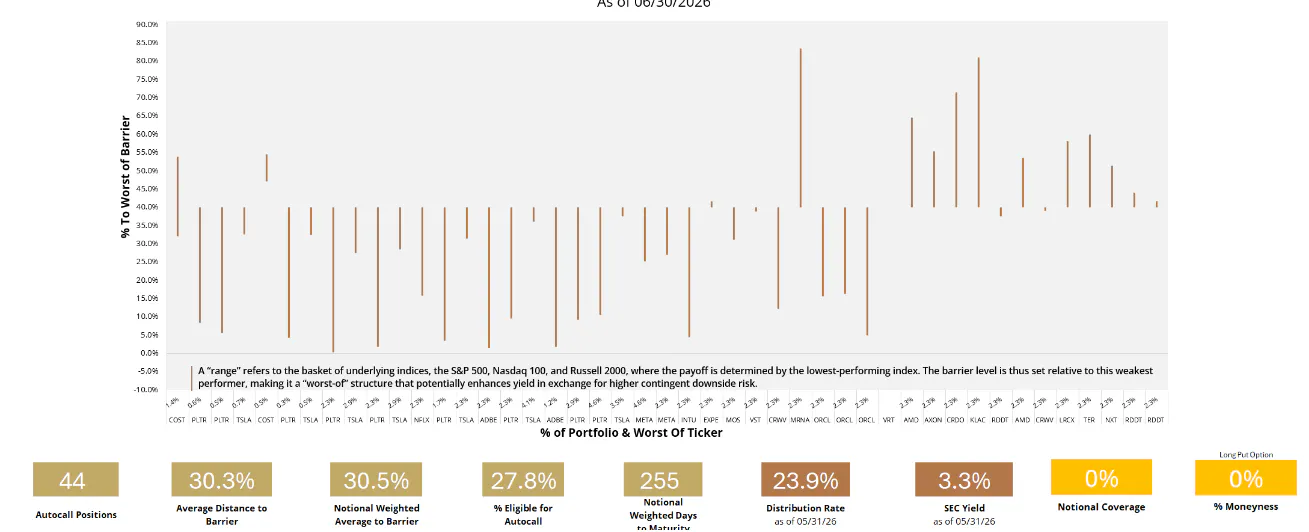
Source: Simplify Asset Management
To support these option positions, XXV maintains a substantial allocation to cash collateral, much of which is invested in the Simplify Government Money Market ETF (SBIL). The barrier options themselves are written on a collection of relatively volatile individual stocks, including Advanced Micro Devices, Axon Enterprise, CoreWeave, Reddit, Adobe, Oracle, Palantir Technologies, Tesla, Netflix, and Moderna.
Like ILS, the fund's implementation also creates some practical considerations. Because XXV owns barrier options directly, liquidity is somewhat lower than many investors may be accustomed to. That is reflected in a relatively wide 30-day median bid-ask spread of approximately 0.29%. The fund's 0.85% expense ratio, while lower than ILS's, also sits well above that of most traditional index ETFs.
Finally, another point that often surprises investors is how the ETF behaves between option inception and expiration. Although a barrier option may ultimately expire worthless if never breached, the option itself still fluctuates in value throughout its life. Because XXV marks its holdings to market each day, the ETF's NAV can experience volatility long before any option actually settles.
Although a targeted 25% distribution is certainly eye-catching, that income exists because investors are assuming substantial downside risk. I don’t think XXV is a strategy designed to serve as the core of a portfolio. Rather, it is better viewed as a satellite allocation for income investors who understand the mechanics involved and are willing to accept the possibility of meaningful principal impairment.
Please note that this article reflects the author’s personal views and does not represent the opinions of the publication or its affiliates. It is for informational purposes only and does not constitute investment advice. It is essential to seek guidance from a registered financial professional before making any investment decisions.

Latest ETF News
See all ETF newsThe ETF Underdogs, Part 11: High Dividend Strategies

The ETF Underdogs, Part 9: Wide Moats and Competitive Advantages






 Advantages of ETFs over Mutual Funds1/6
Lower Costs
In this guide, we'll explore the advantages of ETFs over mutual funds, giving you valuable insights into why ETFs have gained significant popularity among investors like yourself.
Leveraged ETFs: Unlocking the Potential for Amplified Returns1/6
Understanding Leveraged ETFs
Explore leveraged ETFs: potential for amplified returns & risks. 5 ETFs to consider across equities, commodities & fixed income.
What is a Leveraged ETF?1/6
Introducing Leveraged and Inverse ETFs
In this guide, we'll dive into the world of leveraged ETFs, exploring their definition, mechanics, potential risks, and rewards.
Recent educational content

ETF Trends
ETF Industry KPIs October 5, 2026
This week’s KPI data overview highlights key metrics and trends shaping the ETF landscape.

ETF Trends
ETF Industry KPIs September 28, 2026
This week’s KPI data overview highlights key metrics and trends shaping the ETF landscape.
ETF Trends
ETF Industry KPIs September 22, 2026
This week’s KPI data overview highlights key metrics and trends shaping the ETF landscape.

First Look ETF
First Look ETF: Income, Corporate Arbitrage, and Growth and Value Investing
First Look ETF September 2026: iCapital, Mast Investments and North Square unpack new ETFs targeting monthly income, merger arbitrage and complementary growth and value exposure.

Browse all educational columns



ETFs’ Next Act: From Access to Selection
With 1,790 new products launched by July 2026, choosing is harder than ever. Our Global ETF Survey 2026, built on 620 professional investors and allocators, shows how active, fixed income, options-based and thematic ETFs are reshaping fund selection.