Global ETF Survey Is Live! 600+ ETF Professionals Weigh In. See Results →



The Better, More Rational Way to Structure an ESG ETF
Here's how SNPE's index methodology provides ESG exposure without compromising on diversification or historical performance.


Keep up with what matters in ETFs
Get timely ETF insights, market trends, and top ideas straight to your inbox.
Your newsletter subscriptions with us are subject to ETF Central's Privacy Policy and Terms and Conditions.
I've never been satisfied with most ESG (Environmental, Social, and Governance) ETFs, especially ones from "big box" ETF managers, simply because their often-exclusionary criteria can lead to significant over- and under-sector concentrations.
Take the Vanguard ESG U.S. Stock ETF
Notably, its benchmark FTSE US All Cap Choice Index's exclusionary criteria are blanket applied at the portfolio level, leading to entire sectors being virtually devoid of representation.
Notably, Energy and Utilities have negligible representation in the ETF. The counterpart to this is overconcentration, with a whopping 42.9% in Technology.

So sure, it's "ESG compliant,” but it's also essentially just a concentrated sector fund with all the usual pros and cons—outperformance when Tech does well, and underperformance in years like 2022 where Energy stocks and Utilities outperformed.
For a more balanced approach, I like a "sector-neutral" approach to ESG investing. Here's what I mean, using the five-star Morningstar-rated Xtrackers S&P 500 ESG ETF
Global ETF Survey 2026 is Live!
With 1,790 new products launched by July 2026, choosing is harder than ever. Our Global ETF Survey 2026, built on 620 professional investors and allocators, shows how active, fixed income, options-based and thematic ETFs are reshaping fund selection.
How SNPE works
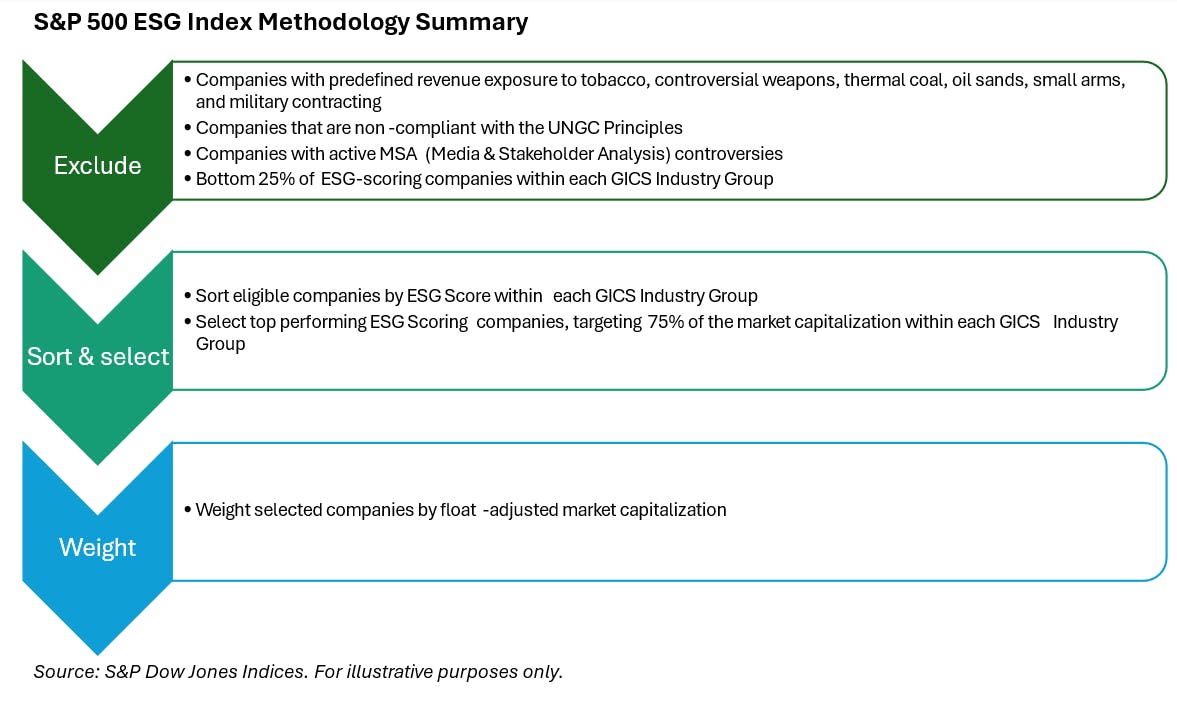
SNPE tracks the S&P 500 ESG Index, which begins by excluding companies involved in controversial activities such as tobacco or controversial weapons and those not adhering to the United Nations Global Compact (UNGC) principles.
However, here's where its methodology starts to diverge: the index then scores companies by their ESG score within GICS industry groups, rather than across the entire portfolio. Essentially, it selects the top-performing companies by ESG score within sectors and then weights them by float-adjusted market cap.
So, how do these ESG scores work? They measure a company’s performance on managing ESG risks and opportunities, using company disclosures, media analysis, and in-depth engagement via the S&P Global Corporate Sustainability Assessment (CSA). The scores compare a company’s performance to its industry peers, evaluated on about 35 key sustainability topics, each weighted and aggregated into a 0–100 scale.
Again, this is done within sectors on a peer-to-peer approach, allowing the fund to sift through sectors like Energy and compare companies that score higher for ESG criteria, choosing the best ones rather than blanket-eliminating an entire sector.
Why is this important? Well, this process allows SNPE to maintain ESG tilts while also staying sector neutral. In other words, SNPE’s sector exposure does not differ markedly from the S&P 500 Index. So, any excess outperformance is as a result of the ESG selection methodology within each sector.
Xtrackers S&P 500 ESG ETF versus S&P 500 Index sector weights (6/30/2024)
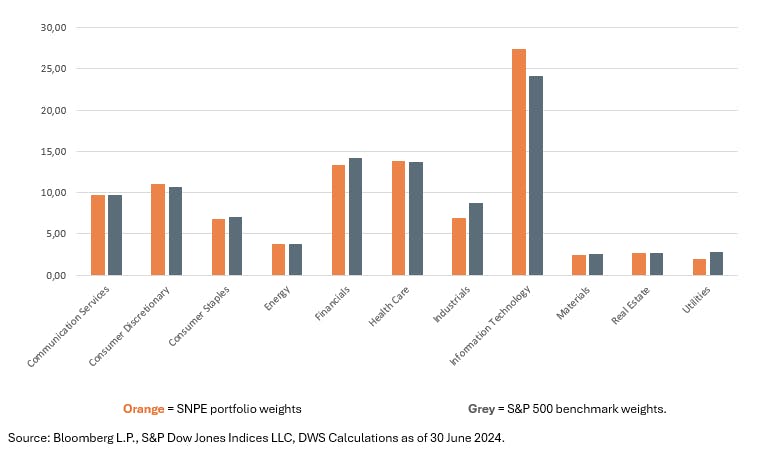
This is beneficial as it ensures broad diversification and avoids over or under-concentration in any specific sector, aligning more closely with the overall market performance while adhering to ESG principles.
SNPE: historical performance
As seen in the chart below, SNPE has outperformed the S&P 500 index by 1.5% annually, along with a cumulative outperformance of over 13% since inception, despite the minimal headwind of a 0.1% expense ratio, which the index does not have. This resulted in an annualized positive tracking error of approximately 1.56%, indicating outperformance.
Cumulative performance of Xtrackers S&P 500 ESG ETF and S&P 500 Index (6/30/2019 to 6/30/2024)
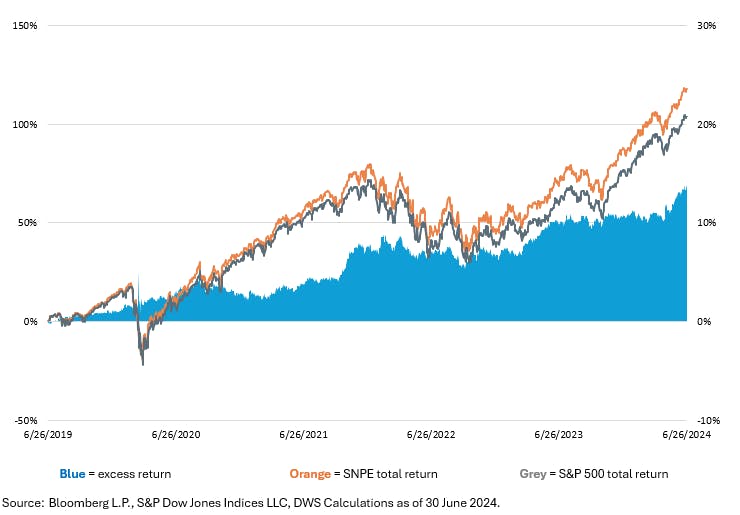
It's important to realize this outperformance wasn't due to taking on excessive risks. During this period, SNPE maintained an annualized volatility with a standard deviation of 18.1%, compared to 18% for the S&P 500 parent index, and a beta of 1.01.
In other words, SNPE provided more units of return for its level of risk, boasting a Sharpe ratio of 0.82 versus 0.76 for the S&P 500. Again, this is past performance, but it demonstrates that ESG investing, when done right, doesn't mean sacrificing returns.
Risk and Returns statistics for Xtrackers S&P 500 ESG ETF versus S&P 500 Index
In summary, I believe SNPE shows that an ETF adhering to best practices—avoiding blanket industry exclusions, scoring companies within industries, maintaining a sector-neutral approach, and keeping fees low (0.1% is very competitive in this space)—can potentially achieve solid performance while aiming to be ESG compliant.
And so far, investors have taken notice – the ETF has grown to over $1.3 billion in AUM as of July 31st, 2024, including inflows of $181 million throughout 2024. Thanks to its underlying large-cap stocks sourced from the S&P 500, the ETF is also very liquid with a low bid-ask spread.
Please note this article is for information purposes only and does not in any way constitute investment advice. It is essential that you seek advice from a registered financial professional prior to making any investment decision.
Mentioned ETFs

Latest ETF News
See all ETF newsBeyond Big Tech: The Increasing Specialization of AI ETFs

There's an ETF for That? Humanoid Robotics and Physical AI

How Some ETF Issuers Use Their Own Funds for Cash Management

These Public-Private ETFs Invest in Polymarket and Anduril

There's an ETF for That? Frontier Markets



 Advantages of ETFs over Mutual Funds1/6
Lower Costs
In this guide, we'll explore the advantages of ETFs over mutual funds, giving you valuable insights into why ETFs have gained significant popularity among investors like yourself.
Leveraged ETFs: Unlocking the Potential for Amplified Returns1/6
Understanding Leveraged ETFs
Explore leveraged ETFs: potential for amplified returns & risks. 5 ETFs to consider across equities, commodities & fixed income.
What is a Leveraged ETF?1/6
Introducing Leveraged and Inverse ETFs
In this guide, we'll dive into the world of leveraged ETFs, exploring their definition, mechanics, potential risks, and rewards.
Recent educational content
First Look ETF
First Look ETF: Income, International, and Cash Flow ETFs
In this season 6 episode of First Look ETF, Stephanie Stanton @etfguide examines the latest ETF marketplace trends with NYSE and guests.


ETF Trends
ETF Industry KPIs October 5, 2026
This week’s KPI data overview highlights key metrics and trends shaping the ETF landscape.

ETF Trends
ETF Industry KPIs September 28, 2026
This week’s KPI data overview highlights key metrics and trends shaping the ETF landscape.
ETF Trends
ETF Industry KPIs September 22, 2026
This week’s KPI data overview highlights key metrics and trends shaping the ETF landscape.