Keep tabs on your favorite ETFs with a personalized weekly tracker. Create a Watchlist now →



The Best and Worst Performing ETFs of 2025
ETFs providing precious metal mining exposure had a winning year, while the losers comprised a fairly eclectic mix of strategies.

Keep up with what matters in ETFs
Get timely ETF insights, market trends, and top ideas straight to your inbox.
Your newsletter subscriptions with us are subject to ETF Central's Privacy Policy and Terms and Conditions.
2025 turned out to be one of those years that looked calm on the surface but was anything but underneath. Markets spent much of the year grappling with sticky inflation, delayed rate cuts, episodic geopolitical shocks, and a sharp divide between “real asset” beneficiaries and more speculative corners of the market.
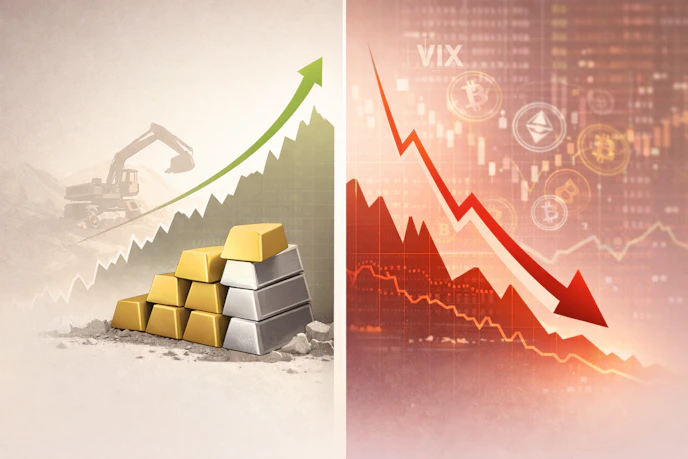
Precious metals and miners thrived as investors looked for inflation hedges and hard-asset exposure, while volatility products, long-duration hedges, and parts of the crypto ecosystem struggled badly. Equity markets broadly held up, but leadership was narrow, and risk appetite proved far more selective than many expected.
With that backdrop, we’re kicking off 2026 with our annual ETF recap. Below is a look at which ETFs delivered the strongest and weakest returns in 2025, based strictly on full-year NAV performance.
To keep the comparison fair, a few usual suspects were excluded. Leveraged and inverse ETFs were left out, as were single-stock ETFs, since both can dominate performance tables for reasons unrelated to underlying market trends.
Get data on 14,000+ ETFs
Access Trackinsight's reliable and comprehensive data with 500M+ points on 14,000+ ETFs.
The ETF Winners of 2025
On the other side of the ledger, 2025 belonged to precious-metal miners. As gold and silver prices surged to new highs, equity ETFs tied to mining companies delivered explosive gains. Importantly, these were not spot metal products. The biggest winners were miner-focused ETFs, where operating leverage and margin expansion combined to magnify moves in the underlying commodities.
That leverage effect is critical. When gold or silver prices rise, miners do not just earn a bit more revenue. Their costs are largely fixed in the short term, so higher realized prices flow disproportionately to the bottom line. As margins expand, investors often reward those earnings gains with higher valuation multiples, creating a double tailwind that spot bullion simply cannot match.
The standout performer of the year was the iShares MSCI Global Silver and Metals Miners ETF
But despite launching back in late 2012, SLVP has remained a relatively under-the-radar product, still sitting below $1 billion in AUM even after this historic run. However, if enthusiasm around silver continues into 2026, SLVP clearing the $1 billion AUM mark would not be surprising.
Close behind was the Amplify Junior Silver Miners ETF
The reason is simple: SILJ leans heavily into junior silver miners, which are inherently more speculative. These companies tend to have smaller market capitalizations, less diversified operations, and higher sensitivity to changes in metal prices and capital markets. When sentiment turns positive, they can soar. When it turns negative, they can collapse just as quickly.
In 2025, that boom-or-bust profile worked decisively in investors’ favor. The sharp rally in silver prices, combined with improving financing conditions for smaller miners, made junior-focused exposure one of the most powerful expressions of the precious-metals trade.
The ETF Losers of 2025
Among the worst performers of the year were two ETFs that, at first glance, appear unrelated. One of the most eye-catching decliners was the Grayscale Chainlink Trust ETF
That figure comes with an important asterisk. When you look at Morningstar’s annual return data based on net asset value, the actual NAV decline was closer to -40.11%. The discrepancy stems from GLNK’s history as a closed-end trust.
Prior to its conversion into an ETF, it traded at a sizable premium to NAV. When the structure shifted to an open-ended ETF, that premium evaporated, creating a sharp price drop that overstated the economic loss for investors focused on NAV performance.
In earlier Grayscale conversions, investors benefited when deep discounts to NAV narrowed after conversion. In GLNK’s case, the dynamic worked in reverse. Even after adjusting for the premium collapse, however, the NAV performance was still deeply negative.
That said, GLNK was ultimately eclipsed by the ProShares VIX Short-Term Futures ETF
Long VIX futures strategies face a structural headwind from two forces working at once: volatility’s tendency to mean-revert lower, and the persistent contango in VIX futures markets. In a mostly calm, risk-on environment punctuated only briefly by episodes like the April tariff selloff, those dynamics proved especially punishing.
2025 featured generally supportive conditions for risk assets, which created severe headwinds for long-volatility products like VIXY. At the same time, speculative crypto strategies, particularly outside of Bitcoin, failed to participate meaningfully in the risk-on tone.
For investors heading into 2026, this is a useful reminder that just because issuers continue to roll out new ETFs, it does not automatically signal a favorable environment for those strategies.
Please note this article is for information purposes only and does not in any way constitute investment advice. It is essential that you seek advice from a registered financial professional prior to making any investment decision.
Topics
See all
Mentioned ETFs
Latest ETF News
See all ETF newsWhich Fixed-Income ETFs Benefit from Rising Interest Rates?

MoneyShow Chart of the Day 9/16/26: Oil? Surging. Oil Stocks? Not So Much.


MoneyShow Chart of the Day 9/4/26: Don't Just Watch Oil. Watch THESE.
Chart of the Day 8/14/26: The Great "Hot Money" Migration




 Advantages of ETFs over Mutual Funds1/6
Lower Costs
In this guide, we'll explore the advantages of ETFs over mutual funds, giving you valuable insights into why ETFs have gained significant popularity among investors like yourself.
Leveraged ETFs: Unlocking the Potential for Amplified Returns1/6
Understanding Leveraged ETFs
Explore leveraged ETFs: potential for amplified returns & risks. 5 ETFs to consider across equities, commodities & fixed income.
What is a Leveraged ETF?1/6
Introducing Leveraged and Inverse ETFs
In this guide, we'll dive into the world of leveraged ETFs, exploring their definition, mechanics, potential risks, and rewards.
Recent educational content

ETF Trends
ETF Industry KPIs September 28, 2026
This week’s KPI data overview highlights key metrics and trends shaping the ETF landscape.

ETF Trends
ETF Industry KPIs September 22, 2026
This week’s KPI data overview highlights key metrics and trends shaping the ETF landscape.
First Look ETF
First Look ETF: Income, Corporate Arbitrage, and Growth and Value Investing
First Look ETF September 2026: iCapital, Mast Investments and North Square unpack new ETFs targeting monthly income, merger arbitrage and complementary growth and value exposure.

ETF Trends
ETF Industry KPIs September 14, 2026
This week’s KPI data overview highlights key metrics and trends shaping the ETF landscape.
Browse all educational columns



Build and Analyze Your ETF Portfolio Like a Pro
Create your own ETF portfolio in minutes and instantly see allocations, exposures, performance, and risk. Visualize diversification across asset classes, regions, and sectors. Stress-test ideas, compare benchmarks, and refine your strategy with professional-grade analytics.