Global ETF Survey Is Live! 600+ ETF Professionals Weigh In. See Results →



Tariffs, Gold, AI, and the Next Big Power Shift
From Trump’s tariff chaos to platinum’s forgotten potential and AI’s insatiable energy appetite, Clem Chambers lays out his no-nonsense market playbook.

Keep up with what matters in ETFs
Get timely ETF insights, market trends, and top ideas straight to your inbox.
Your newsletter subscriptions with us are subject to ETF Central's Privacy Policy and Terms and Conditions.
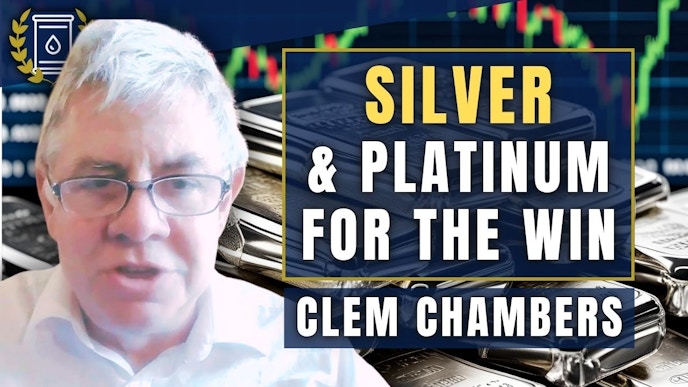
In the latest episode of Commodity Culture, host Jesse Day welcomes Clem Chambers, financial journalist, founder of ADVFN, and author of multiple investing books.
Chambers shares his candid take on tariffs, precious metals, and the unpredictable forces shaping markets. From geopolitical tensions to AI’s unstoppable energy demand, he lays out where he sees opportunity and risk ahead.
Global ETF Survey 2026 is Live!
With 1,790 new products launched by July 2026, choosing is harder than ever. Our Global ETF Survey 2026, built on 620 professional investors and allocators, shows how active, fixed income, options-based and thematic ETFs are reshaping fund selection.
Tariffs, Liquidity, and the “Stick Save” Economy
Clem Chambers is not convinced that markets have been resilient in the face of Trump’s tariff policies. In his view, they crashed and were then rescued by a rapid injection of liquidity. Whether it was jawboning such as “Now’s a good time to buy” or a quiet shove of cash into the system, the rebound was the steepest and fastest he has ever seen.
The lesson is that liquidity wins until it does not.
Chambers sees inflation as the long-term backdrop, with central banks choosing between deflationary pain and printing their way out. For investors, that means thinking hard assets like gold, silver, and even equities that hold value when inflation is high.
Geopolitics: Moving Averages of Mayhem
From Ukraine and Gaza to skirmishes in Southeast Asia, Chambers uses a mental “moving average” to measure whether global tensions are getting better or worse.
The average, he says, is ticking upward. The wild card is always the relationship between the United States and China, which overshadows everything else.
But geopolitics is not two-player chess, it is multi-player poker, where game theory breaks down and randomness rules.
In volatile times, investors tend to flee to stabilizers such as precious metals, blue-chip stocks, and defense plays, especially European ones. His own portfolio leans into those.
Gold, Silver, and the Platinum–Palladium Play
Forget just “gold and silver.”
Chambers counts four key metals, and he is particularly fond of the under-loved pair: platinum and palladium. Supply is tiny at 200 tons a year compared to gold’s 3,200 tons, and much of it comes from Russia.
Historically, they have traded at or above gold’s price, but today they are far cheaper.
For him, that is a classic “no-brainer” setup, though he admits no-brainers can still sting if you are early.
He is heavily positioned in platinum and palladium, with decent allocations to gold and some silver for retail appeal. “There is a certain pleasure in a sack of silver,” he says.
AI’s Infinite Energy Appetite
When asked about energy demand, Chambers does not just see growth, he sees an explosion. The reason is that “there’s no second place in AI.”
Nations will pour unlimited resources into artificial intelligence because the alternative is losing geopolitical dominance.
AI hardware consumes electricity at enormous rates, and efficiency gains will not slow the race. The real constraint is power supply, which is why nuclear energy is suddenly back in vogue, coal bans are being delayed, and fossil fuels are getting a reprieve.
Every source including wind, solar, gas, oil, and nuclear will be tapped, creating huge knock-on effects for energy commodities.
The Dollar, Interest Rates, and Non-U.S. Opportunities
The U.S. stock market still has upside, Chambers says, helped by the fact that American policymakers own plenty of equities and real estate themselves. But the dollar is “way, way too high,” perhaps 20 to 30 percent overvalued, and interest rates will eventually come down. When they do, so will the dollar.
That is when global investors may rotate from dollar-denominated assets into stocks priced in euros, yen, or pounds, potentially giving non-U.S. markets a lift. American investors can play that shift through ADRs.
Buffett’s Cash Pile: Not a Market Call?
Berkshire Hathaway’s giant cash position is not necessarily a bet on a crash, Chambers argues. It is estate planning.
Warren Buffett is 92, his longtime partner Charlie Munger has passed, and it is prudent to have Berkshire’s portfolio in shape for succession.
For individual investors, cash decisions should be about comfort, not crystal-ball gazing. If you are losing sleep over your portfolio, trim the positions you do not understand or that have run their course. “There’s always another bus coming.”
Time in the Market Versus Timing the Market
Chambers has successfully sidestepped every major crash since 2004 but admits that simply holding through would often have made him more money. The big takeaway is that timing is hard, inertia is powerful, and buy-and-hold remains formidable.
That does not mean never selling. Sell for specific reasons such as a price target reached or a better opportunity elsewhere, not vague feelings that “it is too expensive now.” Never ignore the personal side of risk management. If your investments are causing anxiety, rebalance until you can sleep.
Watch the Full Conversation
This article is for informational purposes only and does not in any way constitute investment advice. The author may express their own opinions, which may not represent the opinions of ETF Central or its affiliated partners. It is essential that you seek advice from a registered financial professional prior to making any investment decisions.
Mentioned ETFs
No specific ETFs were tagged
Further reading
Latest ETF News
See all ETF newsWhat To Watch This REIT Earnings Season - Q3 2026



Your ETF Is a Tool. Investors Will Decide How to Use It.


How Much ETF Infrastructure Do You Really Need?





 Advantages of ETFs over Mutual Funds1/6
Lower Costs
In this guide, we'll explore the advantages of ETFs over mutual funds, giving you valuable insights into why ETFs have gained significant popularity among investors like yourself.
Leveraged ETFs: Unlocking the Potential for Amplified Returns1/6
Understanding Leveraged ETFs
Explore leveraged ETFs: potential for amplified returns & risks. 5 ETFs to consider across equities, commodities & fixed income.
What is a Leveraged ETF?1/6
Introducing Leveraged and Inverse ETFs
In this guide, we'll dive into the world of leveraged ETFs, exploring their definition, mechanics, potential risks, and rewards.
Recent educational content
First Look ETF
First Look ETF: Income, International, and Cash Flow ETFs
In this season 6 episode of First Look ETF, Stephanie Stanton @etfguide examines the latest ETF marketplace trends with NYSE and guests.


ETF Trends
ETF Industry KPIs October 5, 2026
This week’s KPI data overview highlights key metrics and trends shaping the ETF landscape.

ETF Trends
ETF Industry KPIs September 28, 2026
This week’s KPI data overview highlights key metrics and trends shaping the ETF landscape.
ETF Trends
ETF Industry KPIs September 22, 2026
This week’s KPI data overview highlights key metrics and trends shaping the ETF landscape.