NYSE CRTR Economy Event Watch the replay →



Sustainable Investing: Navigating the Age of Data and Impact
Sustainable investing is no longer optional—it’s a strategic imperative navigating a landscape of urgency, controversy, and opportunity.

Keep up with what matters in ETFs
Get timely ETF insights, market trends, and top ideas straight to your inbox.
Your newsletter subscriptions with us are subject to ETF Central's Privacy Policy and Terms and Conditions.
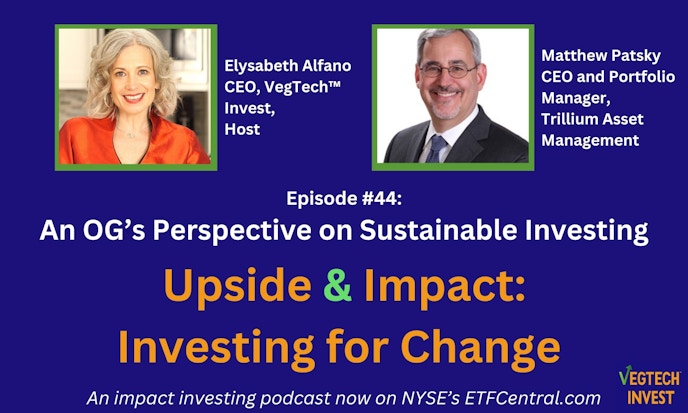
The conversation around sustainable investing has never been more urgent—or more fraught. As political rhetoric swirls and sustainable investing becomes a misunderstood and controversial topic, one thing remains clear: sustainable investing is not a trend; it is a strategic necessity. These critical themes are addressed in depth on the podcast Upside & Impact: Investing for Change, hosted by the VegTech™ Invest CEO, Elysabeth Alfano.
Get data on 14,000+ ETFs
Access Trackinsight's reliable and comprehensive data with 500M+ points on 14,000+ ETFs.
From ESG to Impact: A Necessary Evolution
The origins of sustainable investing date back decades, as shared in a recent conversation with Matthew Patsky, CEO of Trillium Asset Management, on the Upside & Impact podcast. Patsky recounted Trillium’s pioneering approach to integrating sustainability and management factors into investment decisions. Far from a recent phenomenon, this comprehensive methodology started in the 1980s and has evolved with advancements in data and reporting.
However, ESG-type considerations above were just the starting point. Sustainable investing must move beyond data integration and risk mitigation to embrace true impact, as Patsky notes in the interview. This shift involves actively screening in companies that solve systemic problems—whether in energy, food, or materials—and applying pressure through shareholder engagement to drive change. Impact around food system innovation is VegTech™ Invest’s main focus.
The Age of Misinformation to the Age of Data
One of the pressing challenges discussed in the podcast is the misinformation clouding ESG investing. Terms like “woke capitalism” have polarized the discourse, while regulatory backlash has led to “green hushing”—companies removing ESG language from their branding despite continuing the practices internally. This opacity harms investors, who benefit from transparency and access to material data.
Fortunately, the availability and accuracy of ESG data continues to improve. For example, California's requirement for companies over $1 billion in revenue to disclose scope 1, 2, and 3 emissions marks a significant step toward data-driven accountability. These developments pave the way for what Alfano calls "the age of data," where investors can align portfolios with both financial goals and sustainability metrics.
Despite the politics surrounding sustainable investing, Patsky says that clients that were once interested in sustainable investing still are and have not veered away or stopped investing in that area. He mentions this more in a clip from the interview here:
Food Systems: A Catalyst for Rapid Transformation
The food system exemplifies the transformative potential of impact investing. According to the World Bank, transitioning to sustainable food systems requires $450-650 billion annually—far less than the $3 trillion needed for energy transformation for the foreseeable future, according to Bloomberg Intelligence’s Robert Barnett, a former guest on the interview series. Yet the stakes are no less critical, with global food security, biodiversity, and public health on the line.
Unlike energy, where shifts unfold over decades, food systems are primed for rapid change. Capitalism's ability to solve problems at scale—fueled by impact investments in diversified and complementary proteins—can drive this transformation. As we focus on financially healthy companies positioned for a sustainable future, we see the potential for the food sector to catalyze progress on a global scale.
Active Ownership: Driving Accountability
Alfano and Patsky underscored that, for both VegTech™ Invest and Trillium, active ownership is central to sustainable investing. Engaging companies on sustainability and management shortcomings can lead to collaborative resolutions. For example, discussions around access to reproductive healthcare for employees in restrictive states have led many companies to quietly implement support measures. By addressing social and environmental weaknesses, active investors ensure their portfolios align with broader societal goals.
The Road Ahead: A Global and Collaborative Effort
While U.S. politics create uncertainty, global trends in sustainable investing remain robust. Europe, Asia, and Australia are setting stricter environmental and social guidelines that multinationals, many based in the U.S. and considered U.S. companies, must follow. These global standards reinforce the long-term viability of sustainable investing integration and impact strategies, regardless of political cycles.
Looking forward, 2025 emerges as a pivotal year. Many companies and governments will solidify their five-year plans to meet 2030 climate targets. For investors, this is an opportunity to lead, aligning capital with companies ready to deliver measurable impact.
Investing in Solutions
Sustainable investing is more than mitigating risks; it’s about solving large-scale, global problems. By channeling capital into scalable, impactful solutions, investors can generate long-term financial returns while addressing some of the planet’s most pressing challenges. Both CEOs underscored that VegTech™ Invest and Trillium remain committed to this dual mission—because investing for change is not just good business, but mission critical.
Listen to the full audio podcast here. Watch the full video interview here.
About the Author
Elysabeth Alfano is the CEO of VegTech™ Invest, Advisor to a food innovation ETF. She is a consultant to C-Suite of multinational companies and speaks internationally on the intersection of investing, sustainability, and food systems transformation. Elysabeth is also the host of the podcast, Upside & Impact: Investing for Change. This article was co-written by the Fractional Associate Director of Comms & Research at VegTech™ Invest, Gwendolyn Brown.
Please note this article is for information purposes only and does not in any way constitute investment advice. It is essential that you seek advice from a registered financial professional prior to making any investment decision.
Segments
See all
No specific market segments were tagged
Mentioned ETFs
No specific ETFs were tagged
Further reading
Latest ETF News
See all ETF news

Why ETF Spreads Often Mislead Investors








 Advantages of ETFs over Mutual Funds1/6
Lower Costs
In this guide, we'll explore the advantages of ETFs over mutual funds, giving you valuable insights into why ETFs have gained significant popularity among investors like yourself.
Leveraged ETFs: Unlocking the Potential for Amplified Returns1/6
Understanding Leveraged ETFs
Explore leveraged ETFs: potential for amplified returns & risks. 5 ETFs to consider across equities, commodities & fixed income.
What is a Leveraged ETF?1/6
Introducing Leveraged and Inverse ETFs
In this guide, we'll dive into the world of leveraged ETFs, exploring their definition, mechanics, potential risks, and rewards.
Recent educational content
Asset TV
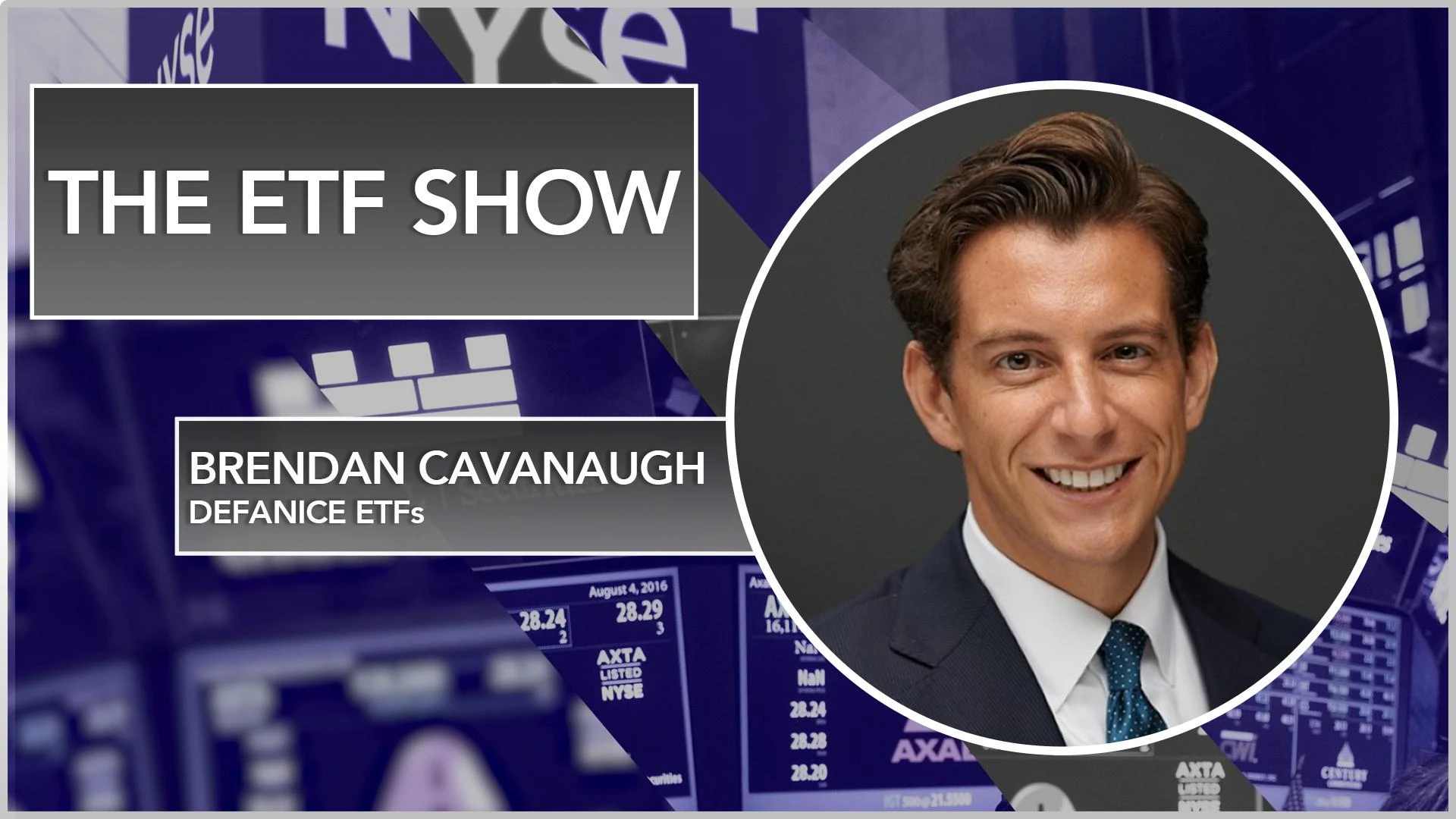
The ETF Show - New Autism-Impact ETF Launched
Defiance ETFs has launched the first ETF, $ASD, focused on the autism ecosystem, investing in companies that provide services, products, and research related to autism and neurodivergence.

ETF Trends
ETF Industry KPIs June 1, 2026
The ETF Industry saw 22 New Launches, 1 Ticker Change and 1 closure last week.

ETF Trends
ETF Industry KPIs May 20, 2026
The ETF Industry saw 44 New Launches, 3 Mutual Fund Conversions and 9 closures last week.
Asset TV
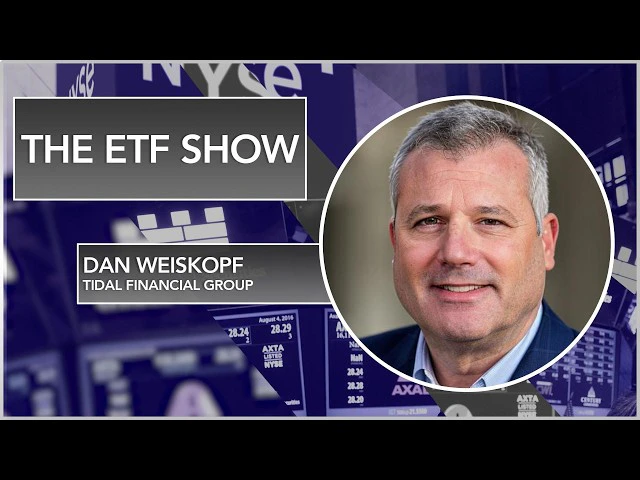
The ETF Show - Politics Becomes Investable Trade through ETFs
Dan Weiskopf, Senior Portfolio Manager at Tidal Financial Group spoke with the ETF Show about Subversive ETFs that help investors trade like politicians.
Browse all educational columns



Build and Analyze Your ETF Portfolio Like a Pro
Create your own ETF portfolio in minutes and instantly see allocations, exposures, performance, and risk. Visualize diversification across asset classes, regions, and sectors. Stress-test ideas, compare benchmarks, and refine your strategy with professional-grade analytics.