Open Now: The Global ETF Survey Take the Survey →



Sustainable Investing in Tumultuous Times: A Deep Dive with Stance Capital
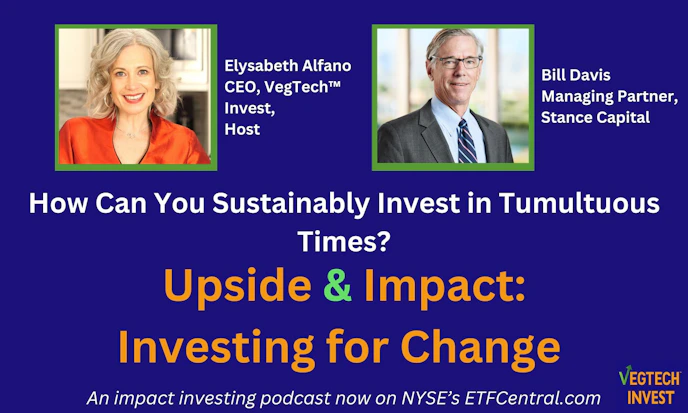
Delve into sustainable investing with Bill Davis, Managing Director at Stance Capital, and Elysabeth Alfano on Upside & Impact. Gain insights on ESG, client interests, and advice for RIAs.

Keep up with what matters in ETFs
Get timely ETF insights, market trends, and top ideas straight to your inbox.
Your newsletter subscriptions with us are subject to ETF Central's Privacy Policy and Terms and Conditions.
Bill Davis, Managing Director at Stance Capital, joins host and CEO of VegTech Invest, Elysabeth Alfano, to discuss sustainable investing in tumultuous times, taking a deep dive on this episode of Upside & Impact: Investing for Change.
Specifically, they discussed
- What is Stance Capital's investment philosophy and methodology?
- How has this changed, if at all, since the attack on ESG?
- Beyond the traditional definition of ESG, what has ESG come to mean in today's investing landscape?
- Have your clients shifted their interest/opinion in ESG investing?
- What is your advice to RIAs if they are wavering on ESG investing?
- Are you seeing that RIAs are only focused on the Mag 7?
The ETF Industry Is Evolving Fast
From AI infrastructure to active strategies, the ETF landscape is shifting. Share your perspective in the 7th Annual Global ETF Survey and get exclusive early access to the final report.
Listen here
Full Transcript
Elysabeth: Hey everyone, welcome to the VegTech Invest Upside & Impact podcast. I’m your host, Elysabeth Alfano, the CEO of VegTech Invest, Advisor to the Plant-based Innovation and Climate ETF, EATV. On Upside & Impact I chat with the leaders and movers who are shaping and growing impact investing for meaningful change. We “pull up as we go up” as the expression goes so this podcast is all about making meaningful and productive impact while also managing one’s portfolio for upside. Of course, always managing for upside.
If you’d like more information about VegTech Invest you can visit us at VegTechInvest.com and subscribe to our newsletter. You can also find us on LinkedIn and on Twitter @VegTechInvest. We record live every first and third Wednesday of the month on our LinkedIn page at 1:30pm eastern standard time. So, check us out live and be sure to bring your questions.
Now if you’re listening as part of a podcast, of course subscribe to this podcast right now so that you never miss an episode. And if you’re listening on iTunes, be sure to leave a 5-star review. It really does help.
So now let’s get down to today’s show and thanks for being with me on today’s episode of VegTech Invest’s Upside & Impact. And as always, a reminder, this podcast is for informational purposes only and is not meant to recommend any specific company or investment. Now, onto the show.
Hi everyone, I’m Elysabeth Alfano, CEO of VegTech Invest. It’s great to have you with me today on Upside & Impact: Investing for Change, distributed by the New York Stock Exchange website ETFCentral.com. We love having them as a partner in sustainability crime if you will. Of course, this podcast is also out on iTunes and VegTech Invest, for that matter. So, when you do listen to it on iTunes go ahead and leave a five-star review and share with your colleagues. It really does make a difference.
Well, my word, whoever said, “May you live in interesting times,” I think I want to smack them around a bit. It continues to be very interesting out there and the polarization of ideas, innovations and investing philosophies continues to be quite polarizing. It is with this in mind that I want to bring on today’s guest, Bill Davis of Stance Capital. He’s the managing partner there. I wanted to talk to him about how he’s seeing the landscape out there for sustainable investing, impact investing, and what Stance Capital is doing about it. Bill, it’s great to have you with me today.
Bill Davis: Elysabeth, thanks for having me. It’s great to be with you as well.
Elysabeth: So, for those of you who don’t know, you can see the ticker running across your screen, StanceCap.com. Bill, maybe you can take us through Stance Capital’s investment philosophy and if you’d like to dive into a little bit of your methodology.
Bill Davis: Yeah sure. So let me start by saying that I have four kids who are no longer kids exactly, but I sort of got into this with them in mind, which is to say that I want to leave the world a better place than the way I found it, which I’m not sure I can do that anymore. I mean, it’s proven to be very difficult, but I think climate risk as well as other risks that relate to climate risk are going to define the future of my kids and everybody else’s kids and grandkids. So that was really kind of the impetus to launch Stance Capital.
Our company is eight years old, but the underlying strategy, our flagship strategy, is ten years old. So, I began working on this in 2013 and we launched essentially one of the first of what became known as ESG strategies back in the beginning of 2014. So, we’ve been doing this for quite a while and our thesis is that investors should feel free to align capital with values. If portfolios are built a certain way, they can do so without sacrificing performance. Now, that doesn’t mean every quarter or every year you don’t underperform or for that matter outperform, but the point is over a long period of time we think that values alignment can be proven to be a free option. In effect that’s what we’ve proven.
I think our ten-year track record is pretty much identical to the S&P 500 total return. The big difference is that we achieve the same results while being weapons-free, tobacco-free, fossil-free, with substantially less risk and volatility. So, you know, one way of saying it is you get to the same place and it’s a smoother ride along the way without all those sorts of peaks and valleys that come from traditional investing. So, I’ll just pause right there and see if you want to ask anything more specific about that.
Elysabeth: Well, and just to reiterate, sadly we’re talking about investment philosophies and strategies, but I think in today’s world we even need to take a step back and just kind of underscore some of the principles about what sustainable investing is. You use the term ESG. I have to say, I don’t even use that anymore just because I think it’s so broad that it’s maybe more confusing than not, and perhaps we’ll get into that conversation later.
But just to reiterate out there, VegTech Invest and the products that we have on the market, we’re seeing the same thing. We’re going head-to-head, head to toe, head-to-head with the S&P and outperforming other sustainability indices and food indices. So, it’s possible to have both returns and sleep at night, if you will, but maybe it’s not even that. I’m going to jump ahead to one of our questions. How do you see ESG? Is it really some philanthropic endeavor or is it just data collection?
Bill Davis: So, before I answer that, to your earlier point about calling it ESG or not calling it ESG, everybody thinks about this now. We’re like, “why are we having to think about this?” but we are. I think where I knit out on it is I’m going to hide from what we believe in because there’s nothing contentious about what we believe in, and you just said it, Elysabeth. ESG is nothing but data at the end of the day and you can use it or you can ignore it and it’s just like any other form of data. We believe that it’s a proxy for finding a well-managed company and that proxy is harder to tease out if you’re simply looking at traditional, fundamental, and financial metrics.
It’s a little easier to kind of figure out whether a company is well managed sometimes by looking at some of the things that they’re doing that they don’t necessarily have to do. Things that they’re not being forced to do by regulators or the SEC or whoever and so that’s all it is. The example that I use is let’s say you, for diversification reasons, want to have a portfolio and you want to have exposure to apparel companies and you have two choices. One is an apparel company that is super thoughtful around everything having to do with their supply chain. Their resource utilization, so they’re mindful of water, they’re mindful of materials, they’re mindful of human rights, they’re mindful of all these things. That’s one company.
The other company is kind of oblivious to all those things and otherwise they sort of look the same, right? Which company would you rather invest in? So, to me, that’s kind of a simple example, but it is kind of that simple. All we’re really doing is using off balance sheet behavior, which tends to be ESG or it’s kind of rolled up into these weird headings of E, S, and G, but that’s all it is. It’s just data, and we’re using it to try and figure out if there are risks that haven’t been identified by other investment firms that give us an edge and therefore our clients an edge in terms of managing risk and generating performance.
It has got a lot of risks and has been overly politicized, but that’s going to end at some point. It’s going to kind of end the way the caravan at the southern border ended. Do you notice how suddenly, an election happens, and nobody talks about the caravan anymore? The reality is ESG is just performative politics, kind of at its worst. One of the worst examples just happened in New Hampshire. I’m based in Boston, so it’s not far away, but the New Hampshire legislature basically came reasonably close to passing a bill that would have criminalized consideration of governance and investment decision-making for pension fund fiduciaries.
Now I call out governance because it was also E and S, as well as the G, but just imagine the idea of criminalizing with jail time potentially for a planned fiduciary for considering governance which is probably one of the first things that anybody who calls themselves a fiduciary is required to consider. So, it’s just gotten to the point of being crazy, but I think at the end of the day, it's certainly a nuisance for a lot of us in the industry, but at the end of the day what we’re doing isn’t going to go away. This is a speed bump. It will pass.
I think we’ll end up maybe the way Europe has ended up or even frankly Canada where ESG consideration, just using off balance sheet data by fundamental managers to make decisions is going to become so commonplace that we’re going to earn the right to stop actually having to think about whether or not we’re going to use that term because everybody’s doing it and therefore we don’t need to talk about it.
Elysabeth: So much to unpack there. I’m going to take a little moment to do that. So, you continue to use the expression “off balance sheet.” But I tell you, I’m a real estate investor. So of course, I look at the rent roll, but I would be an awful investor if I didn’t look at other things than the rent roll like whether the roof needs to be replaced. I’m from Chicago. Do I need a very expensive new boiler system? Is the electric up to code because I don’t want a fine. I certainly don’t want a stranded asset or something like this.
So, I’m not an investor if I only look at the rent roll. To be a good real estate investor I must look at it all because it’s all material to my bottom line. This is why I started the conversation asking if ESG was just simply data and to ignore a significant portion of the data- I’ll say, you know, in real estate it’s more than 50% than the rent roll is off the sheet. To ignore a significant portion is to not be doing one’s due diligence. So, I’ll say that.
Then you’ve also talked about perhaps following in the steps of Europe and it’s going to be so commonplace. It might be commonplace because cooler heads prevail and sane logical data seeking individuals prevail. It might be commonplace because the sticks coming in the investing world are rather large as I see it. So, as we move into an AI world, we move into the transparency of supply chains. So, your example of fashion and certainly my example of food, which is currently protected either intentionally by something called an ag-gag law which is that you’re not allowed to know what happens in factories which is strange because it’s your food or just by the nature of being far away. Let’s say that you’re not seeing what’s happening in fashion factories.
That will change with AI and so it becomes a very big stick when social media gets a hold of images and labor treatment pandemic risk and animals in their own feces and this kind of stuff. So, these are very big sticks, I think, coming towards the bottom line and that’s the investment decision.
Bill Davis: Yeah, so the one thing I would say about AI is that we’re a systematic shop and we have been for over ten years. So, we’re not kind of like newcomers to AI or machine learning because it’s how our portfolio has been built. I think AI helps because it’s a fast way of aggregating data and it can be done much faster than humans can do it. But at the end of the day, I think as much as AI will kind of help lubricate the process, I think that it is the ecosystem of investors, employees, and customers that are going to prompt greater transparency by companies, which is then going to give investment firms more tools to ascertain risk.
Elysabeth: I would agree with this.
Bill Davis: There’s an initiative called Climate Action 100+ which was kind of our clergy’s name, but it was developed by the combination of the UN PRI and Series. Full disclosure, I’m a board member of Series. It was inspired by work that came out of the California retirement system. I used to say five years ago, but it’s now probably like seven or eight years ago where they were thinking about how to determine the carbon footprint for their own portfolio and of course if you’re as big as CALPERS or CALSTRS, you probably literally own almost everything, right?
So it’s a daunting undertaking, but the fascinating thing is that when they went through the process, they learned that- and I’m making these numbers up a little bit because I don’t have the exact ones, but since 1985 something like 75% of all man made carbon emissions can be attributable to about 100 companies worldwide, which if you just stop and think about it, it’s staggering, right? But on the other hand, it’s also a little bit refreshing because we just scope the problem. We now know that if we can’t change the behavior of those 100 companies, then we have no hope of decarbonizing everything. They are the issue, right?
It’s called 100+ because it turned out that there’s another 66 companies that are so enabling of those 100 companies, they got kind of lumped in too. So that initiative launched by Series and the UNPRI has now grown to I think about 700 institutional asset owners and managers throughout the world representing $69 trillion of investable assets. What these companies are doing is they are learning into those 166 companies and basically saying, “We’re your investor. We want you to be more transparent and we want you to be more ambitious and we will work with you.” I know all this because I’m part of an engagement team. I co-lead an engagement team and I have done so for the last five years, targeting one of these companies.
I would say that we’ve seen progress. Interestingly, I would also say that I think that the progress has more to do with this company, I’m not going to say who the company is, but this company’s customers who are also part of the ecosystem like big institutional customers and industrial customers who are saying, “Hey, we’re trying to improve our own emissions profile and you’re part of our scope 3. Therefore, if you’re going to be our vendor you need to change too.” So, there’s this kind of virtuous cycle of customers, clients, employees, stakeholders, investors, and NGOs that are all kind of leaning into this together.
I also think that all these businesses, a lot of them I mean, there are some that clearly don’t want to have anything to do with this, but many of them don’t want to be told what to do. But at the same time, they also see an opportunity to capture market share and attract and retain the best employees and drive new profits and new margin from new services or products that tend to be greener than they have been in the past. So, all of this is happening and it’s all moving in that direction. AI, of course, is the lubricant as you said to make it happen. But we have all this kind of white noise, sort of this clickbait-y and media-driven white noise in the middle around all of this anti-ESG behavior when I would say that for the most part nobody’s doing anything differently.
They’re just talking about it less, meaning the same companies that are looking to decarbonize or continuing to do so, they’re talking about it less. I would say investors have gotten a little bit chicken shit if I can use that expression, some of them, because the minute there was opposition and I’m not really talking about BlackRock here because I do think Larry Fink believes in the importance of this stuff deep down. I think he misread some things that have gotten them into trouble, but I would say there’s a lot of investors or investment firms that cynically viewed ESG as a ride to riches, meaning “Hey, here’s something where we can charge a little bit more money, we can make money more, and so let’s just jump into it.”
Those same firms were the first to kind of back away from it because it’s like, “Wait a second, now we’re pissing off people. How committed are we really? We don’t really want to run afoul of the SEC because we’re not all that steeped in this thing that we claim we are.” So, I think that’s a lot of the kind of noise in the industry right now.
Elysabeth: Again, so much to unpack there and I didn’t want to interrupt you so I’m going to go back and follow up on some of the crumbs, if you will. So, when you have these kinds of PR backlashes, which almost have nothing to do with investing per se, they’re just headlines for political gain, you really do get to separate the wheat from the chaff, if you will. That’s why I’m having one of the OGs here in sustainable investing, Bill Davis from Stance Capital on the podcast today.
I do want to go over some of the things that you said. If you are interested in the 100+ companies, we certainly at VegTech Invest have signed on. I do recommend an interview that is next week, I believe, with Mahesh Roy who is the Program Director for investors at the Institutional Investors Group for Climate Change. He and I on that episode talk a lot about the 100+ companies. So that’s an episode to listen to and, we, VegTech Invest, have just released a Best Practices and Top Five Things to do for Stakeholder Engagement white paper. This is what the 100+ companies are doing. They’re doing stakeholder engagement, bringing together the investors and the consumer, this large coalition that can really help to translate to the company that it is in their bottom-line interest, their best financial interest, as well as maybe some PR interest to not be on the wrong end of that stick and to move the needle.
You can go to vegtechinvest.com/white-paper to find out the best five practices in stakeholder engagement. So, as you say that we’re really not doing anything differently, but we or the collective we of sustainable investing are just maybe talking about it less. I’ll say that from our instance we’re talking about it differently because ESG is just such a large umbrella and encompassing everything that we really talk about the sustainable impact of food, obviously food systems transformation is what we do.
We talk about that in the holistic approach of energy transportation, building materials and what that looks like up and down the supply chain, specifically with food. Now, I’ll tell you from a non- well, everything is related to investing but I do some consulting for C-suite multinational companies that are interested in food and taking advantage of the white spaces there and they all told me in 2023 sustainability was all but dead in terms of their mandates from their board. In 2024 they woke up on January 1st and it was like, “Help me get to my 2025 goals, which are intended to get me to 2030 and we haven’t done anything and we’re panicking.”
So, sustainability from a food ingredient and a food supply chain issue is back on the table and that will then be reflected as everyone works on disclosing and standardizing disclosures and reaping those numbers and promoting those numbers towards their climate goals. That will make its way into the investment world, I think. So, it’s all just kind of bubbling back up to reiterate what you were saying about how it’s not going away, and it will come back in full form.
I do an enormous amount of public speaking and before I will in this interview, I was in an interview with Bloomberg Intelligence’s Rob Barnett talking about energy. He’s an analyst of Bloomberg Intelligence. He had me on his show and we were talking about the comic relief, if you will of Florida banning the business or sale or buying or the production of cultivated meat in the state of Florida. And that has passed, I believe, from the man who wrote a book on the path to freedom. So, nothing more protectionist and anti-capitalist than stopping innovation, which we always see as the freight train to wealth growth.
We innovate ourselves out of this box that we’re in right now in this climate dilemma real systems shift is where real wealth happens. So just some comic relief. We were talking about it, and you can go ahead and listen to that and find it on Bloomberg Intelligence’s Rob Barnett’s Twitter handle. Okay, so coming back to our interview together with you. So, we’re talking about the big picture, but let’s get to the nitty gritty. The poor consumer and the poor individual investor, they’re getting all this clickbait back and forth that they really don’t have time to decipher, “Is it true? Are these mudslinging things accurate?” Have you seen them just take a step back from sustainability?
Bill Davis: No, not at all. Elysabeth, I would say that consumer interest in sustainability is increasing.
Elysabeth: Agreed.
Bill Davis: And why? Well, for one thing there’s more money in the hands of younger people and women, I think and that’s important. That’s not going to change. It’s the pace of that that is going to increase. I think that the sand and the machine, maybe is more at the advisor level. I mean, I think advisors aren’t necessarily looking to get into political conversations with clients. In fact, I’d be amazed if big wire houses don’t have training programs on helping advisors avoid stepping into this quicksand at this moment in time. I don’t know that they do so, but I’d just be amazed if they aren’t doing something in that area.
So, I think that the timidity is at the advisor level at this point. It’s not at the platform level. I had the benefit of being with gatekeepers all in one room all in one event three weeks ago representing diligence teams from the biggest wire houses in the U.S. They all kind of say the same thing. They say, “Yeah, it’s kind of backburner right now. People aren’t really talking about it. But at the same time, we have advisors who are passionately interested in it on behalf of their clients. We have advisors who are passionately disinterested in it.”
Before I go further in this, I want to say something that occurred to my business partner and co-portfolio manager, Kyle Balkissoon and myself a while ago, which is that all investing in a way is ESG. It’s just different values. If somebody wants to invest in oil and gas companies and sin stocks or whatever they want to do, they can go ahead and do that. If there’s clients that agree with them and they get assets and they perform, then maybe they’ll do well. So, the real point of what we’re trying to do isn’t to tell people how they should invest, how they should think, and what they should consume. It’s up for people to decide that for themselves.
What we’re really trying to do is to create an authentic outlet for investors and their advisors in some cases because in many cases we’re working through intermediaries, to be able to build portfolios where we are doing what we think is our fiduciary job, which is to manage risk. People don’t come to us and generally say, “Hey, I want to talk about your down capture and your data and this and that.” They come and they talk about wanting to perform or wanting to preserve capital or warning to not be investing in a military industrial complex or a fossil fuel complex. Those are the things that they talk about. So, I think that there’s room for everything.
I might have told you this story at one point or another, but it was about two years ago. I got a call from one of the marketing firms that supports a lot of ETFs and they basically said, “Hey, would you be interested in doing a Twitter debate with an anti-ESG ETF?” I had my response within five seconds which was, “Yeah of course.” So we ended up lining up a practice session and the person decided that they didn’t want to do it and I’m not going to name the firm but what I will say is that when I first thought we were going to have this debate I went and looked up the firm and I wanted to see what their thesis was and just understand it, right? The thesis was that companies should stay out of politics and social issues. Companies should just focus on shareholder returns, basically to the exclusion of everything else.
I’m like, “Alright, well I don’t necessarily personally agree with that, but that’s fine. That’s a viable thesis. I’m sure there’s a lot of investors who agree and that fund will probably do well, all the things being equal.” Then I decided to go look up their largest holdings and I think Tesla was in there at 9% of the portfolio and I laughed because it’s like, “Well, wait a second. Your thesis is complete bullshit. You are basically simply using a different value lens through which to look at companies.” So, I just think that there’s way too much kind of emotion and testosterone, if you will, that’s kind of rolling around the room when people should just let everybody do what they want to do, which is freedom, right? Is there anything more un-American than telling people what they can and can’t invest in?
Elysabeth: I don’t know. Florida just said you can’t open a business.
Bill Davis: I know.
Elysabeth: Is there anything more un-American than saying you are not allowed to engage in business?
Bill Davis: It’s crazy. Let people align values the way they want. Let people manage risks the way they want and if you don’t agree with it then just don’t do it. Go do something different. That’s kind of my attitude.
Elysabeth: Yeah, so much again to unpack there. First, I want to shout out Florida because I love you. I love visiting you, Florida. I love being with you, Florida. I see all the benefits of Florida. So, this is not a slam to Florida. We sure do love you. I would agree with you. Just do what you want. I didn’t set up VegTech Invest to tell people what to do. I set up VegTech Invest to give people an option. That’s what true freedom is all about. Consumers at any level, be it food or investing, should have options.
So, I came here to give options, and I have no problem if someone wants to have a lens saying that you just want to focus on the bottom line, but if that company and if it’s a large company, then it partakes in public resources like land and water. If it gets those resources, then it’s hard for me to say that it gets a free pass on how it uses those public resources, often at little or no cost. So, if there’s any sort of government subsidizing going on or protectionism, then it kind of becomes a different conversation and we can have that conversation another time.
I wanted to get to what you’re talking about here, which is saying to invest any way you want. That’s your prerogative. For the RIAs that get it or maybe are on the fence, do you have any tips for them to help them along? I have the same kind of empathy for them that I have for consumers. It’s a lot of angst out there and I think you mentioned testosterone, but it’s a lot going on out there. Do you help them in any way?
Bill Davis: I think so. About three or four years ago I was asked to write a chapter in a book about millennials which is kind of funny because I’m obviously not a millennial, but it struck me that it’s an interesting cohort because they’re kind of the first cohort to inherit all of these problems associated with climate risk and their backs are going to be very much up against the wall on this. As part of doing the research to write that chapter I stumbled across something I guess I knew, but I never really thought about too much. That was what happens when clients of investment advisors, like wealth management firms, what happens when the clients die?
What happens is that two-thirds of the time, and this is like industry knowledge, two-thirds of the time they lose the next generation of clients. So, if you’re a wealth advisor and you’ve got a family that’s a client, you have a two-thirds chance, a 66% chance of losing that client on the death of the primary clients. So, what do you think happens, I wonder, if the next generation is millennials and Gen Zers and so forth and you don’t have products that speak to the things that they care about? Do you think your odds of losing those clients goes down? I don’t think so. I think it goes up close to 100%.
So, I think that the argument for why financial advisors need to pay attention to this is that their clients are going to and certainly the next generation of clients are going to and so I think my advice is look, I get that everybody comes at all of this from a different political orientation and a point of view. But I think what a smart thing for advisors is to start thinking about is building a vocabulary around sustainable investing, whatever that happens to be because you and I can talk about it for hours and it can mean a whole host of different things.
Simply try and learn a new vocabulary around it a little bit. It’s not very hard. Then think about having access to good products that could be in smaller accounts, right? We’re a relatively small firm. You’re a small firm. We’re boutiques. Would a million-dollar client be great? Sure, but I’m here to democratize access to this stuff for people no matter what the size of their investment account is. So, if it means putting a sustainable investing product into a grandkid’s account, and it’s got $20,000 in it, so be it. But the point is to start thinking about putting things where they belong.
Just in the same way an advisor is already thinking, “Well look, I’m not going to put my ninety-year-old client into a variable annuity or a hedge fund or maybe something that’s super growth-oriented. I need to think about where people are in their lives, and I need to think about having products that are available to people that match their risk tolerance and their ethical preferences and other things. So, I think toe dipping is not a bad idea for all advisors to consider, especially ones that aren’t really doing anything in this space.
Then of course, the other point I would ask is most advisors who I’ve bumped into who have said that their clients aren’t asking for this, will on my follow-up question, “Well, have you been talking to them about it?” they will concede, no. So sometimes if you want to get an answer to a question that hasn’t been posed, you’re almost better at posing it yourself and I think that’s kind of like an opportunity for everybody.
Elysabeth: Yeah, I love that you say that. We at VegTech Invest call it blended investing. So, you have target dates if you’ve got a young consumer, maybe it’s next gen and you’ve inherited them, and you don’t want to lose them. You can put them in solid products that are meaningful to them to keep their attention that they can watch and be engaged in, and these can have different risk profiles or sustainability sleeves, if you will, then when they’re 90 years old and you’ll move them towards a target date of something else.
So, we call it blended capital and we tell people, as the world shifts, you have a sustainable sleeve. 20% of your portfolio, 30%, 40%, 10%, whatever it is for you. Then as the world changes so will that investment portfolio to reflect the world. As we discussed I believe in the beginning, real wealth opportunities come from system shifts. They come because we went from the horse and buggy to the car and from the landline to the cell phone. They don’t come because one company had 3% more revenue or not one quarter. So, for a real pop in wealth, you’re looking for those system shifts. So, you can get in early before the market is pricey.
I speak for food systems transformation here. The market hasn’t really priced in that system shift yet, but it will. And you want to make sure you get that pop and not miss it so then at least you’re in it and when you grow it as the world shifts. As we believe here, it will shift into more sustainable investing because it must. But still, and maybe I just answered the question, but I really stay away from “ESG or not.” That’s just not the way people go through the world. It’s not binary in that way. It’s not either or, 100% or nothing. It’s this blended perspective in life, let alone in your investment portfolio. I think that gives people a chance to have short-term thinking.
There’s that pressure that I need returns now. Or there’s that long-term thinking, “Well, I’d like to have my kids live on a plant that functions,” and that’s up for grabs. We’re not sure that’s possible anyways.
Bill Davis: Elysabeth, one other point to add here is that literally right before I jumped on this with you, I was on the phone with somebody who reached out to us from the West Coast and said, “Hey, I want to talk to you about your products.” So, I hopped on the phone with him, and I said, “Well, tell me what’s your situation? What’s important to you?” His answer was, “I just want to diversify.” He said, “I own a lot of aggressive NASDAQ-y MAG7 type names and I’m looking for something different. I’m looking for something that is kind of like a little bit of a counterbalance to that.”
So, I explained what we do. I explained our focus on downsides, risk protection, and that we tend to think of the S&P 500 as a riskier bet every day. It’s market cap weighted. There are now eight companies or whatever that account for 30% of the entire S of the market cap of the S&P. We don’t think that having 8% of the portfolio in one stock is particularly sensible for most investors. I get it for people who are simply making a bet on AI. It’s a great bet, right? But if you’re thinking about it as a core investment or whatever, it’s less so. We tend to invest in more of the bottom two thirds of the S&P as opposed to the top third, because there’s greater potential for alpha. The companies there are less covered. So, you can kind of make your mark there.
I don’t think I really talked about ESG at all until the very end and I said, “Oh by the way, we happen to be fossil-free, weapons-free and tobacco-free and they’re all kind of based on my own ethical framework, I suppose.” I was the first client when I launched and therefore kind of built the portfolio that I wanted. I said, “Is that an issue?” He said, “No, that’s not an issue at all. That’s fine.” So, I think there’s also a lot of people where if they don’t ever think about it and then you explain it to them that way, they’re like, “That’s fine. That makes sense.” It’s not an emotional thing.
This is kind of going back to the last conversation a little bit, but I do think there’s an awful lot of people who are curious and just kind of not aware of the possibilities at this point, as opposed to not being open to or considering new ideas.
Elysabeth: Yes, we have the same kind of conversations daily, if not twice a day. A similar perspective in that we’re momentum with downside risk mitigation, but really, we offer diversification as well to not just the system shift, but away from the MAG7 in the sense that no matter what ETF or product you touch, it seems that you have the same seven or eight companies. So, you might think you’ve diversified because you’re in three, four, five products, but they’re all the same companies. It’s the extreme non-diversification. If this conversation has brought anything to everyone’s attention who’s listening, and thank you for listening, we’re trying to get away from the extremes.
We’re talking about blended investing, some rational data analysis to just look at a solutions-oriented portfolio as to how it makes sense and get away from the clickbait of is it ESG or not? It’s completely irrelevant if it is ESG or not. Does it make sense for the short and long term? Some kind of blended investment strategy will be able to address both that pressure on short-term returns and long-term perspective.
Bill, as we round up here just about to leave our conversation for the day, is there anything else you’d like to add, or you’d like to share about your products?
Bill Davis: Well yeah, I would probably be remiss if I didn’t tell you I have a product. So, I am a Co-Portfolio Manager of Stance Equity ESG Large Cap Core which is essentially available as a separate account either through us or through a whole lot of financial advisors. Secondly, we are portfolio managers of what I would describe as a clone ETF in the sense that the ETF is the same as our underlying strategy that has a 10-year track record. The ETF is only three years old. The ticker is STNC, as in “stance” without the vowels. We are the sub-advisor to that fund. It’s run by Hennessy Funds. Hennessy is a great organization based out in California that has I think fourteen or fifteen different funds, mostly mutual funds, all high conviction active strategies.
That’s essentially what we’re doing. We are available as an ETF and we’re available as a separate account. The last thing I’ll say is we spend a lot of time thinking about where this is all headed. I firmly believe that there are going to be some really interesting products coming down the roads that are more, I would say hybrid in nature, in the sense that they might combine private investing, in your case it might be food companies, sustainable food companies or it might even be companies that are developing services around sustainability and food.
I’m just sort of making that up right there. But the point is, I think that there’s going to be interesting products that are available for mainstream investors, probably a few years down the road, but I think that they’re coming that will allow people to not only have liquidity that comes through things like actively managed ETFs, but also allow them to participate in private companies that are doing really important and impactful things.
Elysabeth: Very exciting times and I think lots of creativity is coming forth which again we’re just talking about the options for consumers and that’s always best for free market business is options for consumers. So, lots of creativity. I’m hearing this in all my interviews that I have on the Upside & Impact: Investing for Change podcast for the New York Stock Exchange website ETFCentral.com. This interview has really been a great one, Bill.
I don’t always mention my interviews to Portfolio Manager of the VegTech Plant-based Innovation and Climate ETF, Dr. Sasha Goodman, because he’s so busy managing the ETF and other products, but this one I will mention to him. I think this is going to really capture his attention. So, I just want to thank you today for being here and for all that you do.
Everybody, if you are listening to audio and you can’t see the screen, stancecap.com is running across our screen here. You can check them out. VegTechInvest.com to get that white paper with the top five best practices for stakeholder engagement and you can find our ETF there on that site. So, everyone, you can find us every two weeks live on LinkedIn and on Twitter. I will see you all in just about two weeks’ time. Look out for next week’s interview with the Intentional Investor Group for Climate Change’s Mahesh Roy. We talked about that today. Bill don’t go away. Everybody else on LinkedIn, Twitter, and YouTube, I will see you in two weeks. Bye everybody.
Thanks for being with me everyone on today’s episode of VegTech Invest’s Upside & Impact. I hope that you’ve found this to be a knowledge drop and I’m always here to answer any questions so please feel free to reach out to me on LinkedIn. Elysabeth Alfano, you can find me there. I’m also on Twitter @ElysabethAlfano and you can find the VegTech Invest pages on both LinkedIn and Twitter.
Sign up for our newsletter at VegTechInvest.com and share this podcast with your colleagues, friends, and clients. And of course, be sure to subscribe to this podcast to never miss an episode. Remember we record live on the VegTech Invest LinkedIn page every first and third Wednesday of the month at 1:30pm eastern standard time. So come find us there to join the conversation live. Until then, thanks for leaving a 5-star review on this podcast app because it really does help.
If you’d like more information about VegTech Invest you can visit us at VegTechInvest.com and subscribe to our newsletter. Okay everyone, great show today. See you next time on VegTech Invest’s Upside & Impact.
VegTech Invest is a registered investment advisor focused on investing in sustainable food and materials. This podcast is for informational purposes only and should not be relied on as the basis for investment decisions. It does not constitute either explicitly or implicitly any provision of services or products by VegTech Invest. All statements made regarding companies and securities are strictly beliefs and points of view held by VegTech Invest or podcast guests and are not endorsements or recommendations to buy, sell, or hold any security. Clients of VegTech Invest may maintain positions in the securities discussed in this presentation. VegTech Invest believes that the information presented is accurate and was obtained from sources that VegTech Invest believes to be reliable. However, VegTech Invest does not guarantee the accuracy or completeness of any information and such information may be subject to change without notice from VegTech Invest.
Certain statements in this presentation may be statements of future expectations and other forward-looking statements that are based on VegTech Invest’s views and assumptions at the time of publication and involve risks that could cause actual results, performance or even events to differ materially from what is expressed or implied by such statements. VegTech Invest’s strategies are actively managed and not intended to replicate the performance of any cited index which may differ materially. You cannot invest directly in an index.
Please note this article is for information purposes only and does not in any way constitute investment advice. It is essential that you seek advice from a registered financial professional prior to making any investment decision.
Segments
See all
No specific market segments were tagged
Mentioned ETFs
No specific ETFs were tagged
Further reading
Latest ETF News
See all ETF newsThis is How Calamos Turned Wall Street’s $100 Billion Secret Into an ETF



From Dot-Com to ETFs: How One Entrepreneur Helped Spark an Investment Revolution
How Blossom Social Is Revolutionizing Retail Investing and ETF Marketing
Is 2025 the Year for Financing Food Fast?

 Advantages of ETFs over Mutual Funds1/6
Lower Costs
In this guide, we'll explore the advantages of ETFs over mutual funds, giving you valuable insights into why ETFs have gained significant popularity among investors like yourself.
Leveraged ETFs: Unlocking the Potential for Amplified Returns1/6
Understanding Leveraged ETFs
Explore leveraged ETFs: potential for amplified returns & risks. 5 ETFs to consider across equities, commodities & fixed income.
What is a Leveraged ETF?1/6
Introducing Leveraged and Inverse ETFs
In this guide, we'll dive into the world of leveraged ETFs, exploring their definition, mechanics, potential risks, and rewards.
Recent educational content

ETF Trends
ETF Industry KPIs July 13, 2026
This week’s KPI data overview highlights key metrics and trends shaping the ETF landscape.

First Look ETF
First Look ETF: Cash Deployment, Bond, and Hedged ETFs
In this season 6 episode of First Look ETF, Stephanie Stanton examines the latest ETF marketplace trends with NYSE and guests.

ETF Trends
ETF Industry KPIs July 6, 2026
This week’s KPI data overview highlights key metrics and trends shaping the ETF landscape.
Asset TV
The ETF Show - The Evolution of Leveraged & Inverse ETFs
Leveraged and inverse ETFs have exploded in popularity over the past decade capturing more assets as retail traders seek to capture volatility.

Browse all educational columns



Have you tried our ETF Compare tool?
Compare ETFs like a pro. Analyze fees, performance, exposure & holdings side-by-side.