Turn ETF ideas into real portfolios. Try the builder now →



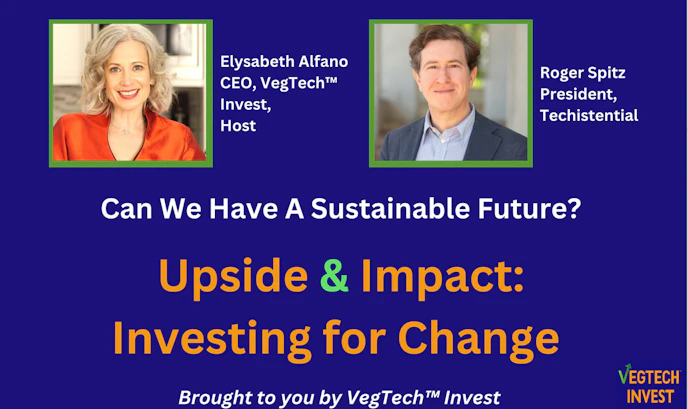
Can We Have a Sustainable Future? Futurist Roger Spitz Weighs In
On this episode of Upside & Impact: Investing for Change we discuss how we can prepare for the disruption ahead and come out financially and consciously better.

Keep up with what matters in ETFs
Get timely ETF insights, market trends, and top ideas straight to your inbox.
Your newsletter subscriptions with us are subject to ETF Central's Privacy Policy and Terms and Conditions.
Roger Spitz (M.Sc., FCA, APF) is an international bestselling author, a celebrated futurist, the president of Techistential (Climate & Foresight Strategy), and the chair of the renowned Disruptive Futures Institute, based in San Francisco. On this episode of Upside & Impact: Investing for Change we discuss how we can prepare for the disruption ahead and come out financially and consciously better. Vital information! Join us for this last interview of the year and get prepared for 2024.
- How do we have strategic foresight for an adaptive and resilient future?
Like what you're reading?
Stay in the loop — get the latest ETF insights: trends, analysis, and expert picks.
- What is a virtuous inflection point and how does it help to achieve critical mass adoption?
- What is transformation innovation and how does it encourage systems change?
- What levers are the most effective for systemic change: this may be the most holistic point of all and, thus, perhaps the most complex.
Listen here:
Transcript:
Elysabeth: Hey everyone, welcome to the VegTech Invest Upside & Impact podcast. I’m your host, Elysabeth Alfano, the CEO of VegTech Invest, Advisor to the Plant-based Innovation and Climate ETF, EATV. On Upside & Impact I chat with the leaders and movers who are shaping and growing impact investing for meaningful change. We “pull up as we go up” as the expression goes so this podcast is all about making meaningful and productive impact while also managing one’s portfolio for upside. Of course, always managing for upside.
If you’d like more information about VegTech Invest you can visit us at VegTechInvest.com and subscribe to our newsletter. You can also find us on LinkedIn and on Twitter @VegTechInvest. We record live every first and third Wednesday of the month on our LinkedIn page at 1:30pm eastern standard time. So, check us out live and be sure to bring your questions.
Now if you’re listening as part of a podcast, of course subscribe to this podcast right now so that you never miss an episode. And if you’re listening on iTunes, be sure to leave a 5-star review. It really does help.
So now let’s get down to today’s show and thanks for being with me on today’s episode of VegTech Invest’s Upside & Impact. And as always, a reminder, this podcast is for informational purposes only and is not meant to recommend any specific company or investment. Now, onto the show.
Hi, everyone. I'm Elysabeth Alfano, the CEO of VegTech Invest. Thanks for being with me for another edition of Upside and Impact: Investing for Change, now distributed by the New York Stock Exchange podcast platform, ETFcentral.com, and then always on iTunes and Spotify, where you can subscribe and, of course, leave a review.
I am in Dubai, which is why I don't have my typical background. It is late in the evening for me, just the tail end of COP28. As many of you know, I've been going live from Dubai every day for COP28. It's been a huge COP for food systems transformation, certainly from the financial perspective, as governments have also called on the private sector to come in and address what is 30% of the world's global greenhouse gas emissions with animal agriculture being a whopping 60% of that. So, 18% of the global greenhouse gas emissions and 32% of the world's methane emissions come from animal agriculture. It is very interesting to see world leaders think about our future and the future of food.
So now as we enter 2024, I thought it would only make sense to have my very last podcast of 2023 on Upside and Impact be with a futurist. Now, before you think, uh oh, are we going to talk hands waving over crystal balls? I want to bring on my guest today and assure you that it's going to be much more strategic than this. Roger Spitz, futurist, author, and President of Techistential, I want to thank you for being with me today.
Roger Spitz: It's wonderful to be here, Elysabeth, and I look forward to our exchanges.
Elysabeth: So, of course, we're going to get into the definition of Techistential, which I do hope that I am pronouncing correctly. But first, I want to read your bio because I really want to give everybody a little bit of a sense of what is a futurist and really sort of how you came to this. So, let's go over your background for a little bit, if you don't mind. In addition to being the president of Techistential, you're also the chair of the renowned Disruptive Futures Institute. Yes, there is a Disruptive Futures Institute, and let's be frank, we need it as the world is about to implode and I think many people feel that almost every day. So that is headquartered in San Francisco. You are formal Global Head of Technology and M&As at BNP Paribas and you have advised over 50 transactions with a combined deal value of $25 billion.
You launched the bank's U.S. mergers and acquisitions practice in San Francisco, which is where I believe you currently live, or at least in the outskirts of San Francisco in Northern California. And you also built the European technology and digital investment banking franchises in London and Paris. Most importantly, and maybe what we're going to talk about now and dive into, you have the Four-Volume Definitive Guide to Thriving on Disruption. This can be found at Amazon.com. And in anticipation of your fifth book, Disrupt with Impact, and given that it's just about 2024 and we're headed for a tumultuous election, I think we all know that, maybe we should discuss systems level change for a sustainable future.
So, systems level change, it's all we could talk about at COP. So many systems are breaking down beneath us. I wondered if you could walk us through your four drivers for systems change, starting with strategic foresight for adaptive and resilient futures. Let me pull up a visual, but maybe you can already start to walk us through what that means.
Roger Spitz: Sure. Thanks, Elysabeth, and these are important topics, and I'm happy to sort of go through them. So, I think the starting point maybe for some of your viewers might be what on earth is a futurist?
Elysabeth: Yes, thank you.
Roger Spitz: But it connects directly with what systems level change, and I think maybe to disappoint some who are looking for the crystal ball, futurists don’t seek to predict the future. Our thinking is really that we accept that there's discontinuity, that there are multiple possibilities, that we need to think about the world with different timeframes than just the normal short-term milestones, and that sometimes we should be asking ourselves questions around possibilities versus just looking for answers.
We don't abide by relying too heavily on assumptions and especially the assumption of a kind of controllable, predictable, stable, and linear world. So really what we're trying to do is think more systematically, think longer term, and think about the next order implications. What if certain possibilities that are plausible might happen and how those interconnects. And on that basis to come back to the visual you kindly showed and to your question around what systems level change is, systems level change is really acknowledging that we are not in a kind of reductionist deterministic vantage point of the world where you're just looking at the past or looking at things in isolation. It is that ultimately what determines the outcomes is how different systems and different initiatives might interact and over time and amongst themselves.
So that's the starting point. Go ahead, please.
Elysabeth: Well, you know, gosh, I wish you had been at COP28 speaking to the leaders of the world because it's the integration of those systems and anticipating change. It almost seems overwhelming. I mean, I want an understanding. Are you talking about systems level change sort of at the government level, at the company level, or at the individual level?
Roger Spitz: Yeah, so listen, systems are the way the world manifests itself. So, it's only our minds and the way we choose to adopt strategies or policies where we kind of bring things in a more mechanical, deterministic, and simplified way. But the reality is that humans are systems, thinking are systems, ants building are systems, and cities are systems. So, the question as to “at what level does it kind of manifest itself?”, systems are everywhere. And I guess the question is, if you are looking at initiatives such as climate, such as others that are societal, then you need to look at systems in the broader sense through society. And that, therefore, includes- that we can come to it in a minute.
But what does it look like to drive transformational change for complex challenges across society and what have you, and there you must take the broadest level. But if you look at it at the different units, you're still looking at things differently. You should still be looking at things systematically, even if you look at a specific innovation or technology or company or region. I guess the challenge for things that are by nature global is where do you draw the line?
So, if you take, you know, with pandemic or technology or AI or what have you, it's ludicrous for certain regions to be doing things in a different way because ultimately, you know, you can't. I mean, we saw it with the pandemic, you can’t take something that's global of that nature and systemic. Any region that's shutting off and doing certain initiatives which are completely disconnected from the rest of the world, it's not very effective. So, the question then depends as to, you know, thinking systemically and next-door implications, you can do at any level, and that includes the individual, but certain of our complex challenges, no doubt the ones that concern everybody around climate, around technology, around education, that those you really need quite a broad perspective on them.
So indeed, they consider many stakeholders and many different aspects of it, and we can unpack that.
Elysabeth: But that takes a lot of time. I mean, getting that many people to agree that you could have global systems change. I just look at the conversations over the last 50 years around food systems transformation, the system that I'm working in right now. I mean, many of the issues of the food system we knew 50 years ago and just couldn't agree on anything and therefore did nothing. And so now you have climate change to the extent that you have it because one third of the equation could have been addressed and wasn't, and that's food. And of course, energy people and electric vehicle people are saying the same thing. You know, the electric vehicle could have been launched in the 70s. It tried and was kind of intentionally taken out if you will.
So, it doesn't seem to be human nature for us to think about large-scale systems change. We tend to think about ourselves, sadly, enough. These kinds of systems change seem to take a long time. Is it possible? I guess that's what I'm running. Like, I understand theoretically, but executionally, it seems quite difficult.
Roger Spitz: I mean, listen, there's no doubt that it is more, by definition, that's why these are kind of complex challenges. It's no doubt that they're more difficult. And there are more ways to have them become ineffective. So, it can be either intentional, such as the reasons why today we have the crisis for climate and others. It's intentional. It's not because people lack an understanding of what's required for it. It's just that there was significant- people call it lobbying, I call it kind of corruption, but significant lobbying to ensure that certain outcomes were achieved and not others. And they put in the incentives to make sure incentives determine outcomes. So, the incentives for the world through lobbying ensured that, you know, the different industries like oil, gas, automotive, etc., continued functioning in a specific way. But that was intentional. It wasn't a lack of understanding from governments or from educational systems or from companies. It wasn't a lack of understanding of what drives systems change.
On the contrary, they understood very well what drives system change and therefore they prevented the enablers to drive things in the right way. They had made sure they had the incentives that suited them. They made sure they had the regulation that suited them. They made sure they had all these things which suited the outcomes they were seeking. So, I'm not sure it's necessarily a question of lacking an understanding of what system changes. I think it's a question of understanding what the incentives are and who is controlling the systems.
And the second thing I would say, and this is an important point when it comes to climate, is that if you are in good faith and if you are trying to achieve the right incentives, then there are a lot of things that are harder in complex systems. And therefore, there's a risk of doing things that are ineffective. In other words, there are almost two aspects. There's the kind of real objectives of many constituents who are not necessarily aligned with what the world needs, and that's kind of intentional. It's not a lack of understanding of the systems, and that's why they do things in a certain way. But then there's a lot of the world who in good faith- organizations, individuals, countries who in good faith might be seeking to do the right thing, but who realize that in complex systems, it's more difficult.
So, take, you know, you mentioned, for instance, the electric vehicle or food systems. Any of these, even if the venture capitalist or an innovator or an entrepreneur or country is trying to do things in the right way, it doesn't mean that you're necessarily effective if you don't have the right infrastructure, if you don't have the right capital that understands the difference and the complexities of scaling, you know, take mobility, how complex a city is. So, there are a lot of things which even with an understanding of how to drive change in complex systems, don't necessarily have an appreciation of what is effective versus ineffective. And so, what we focus on are things which can help people understand better what is effective versus ineffective to drive these changes. And again, we can unpack these with specifics, but I hope that kind of gives some elements.
Elysabeth: Yes, everyone. So, this is why there's a Disruptive Futures Institute. Please Google that. You can see why it's important to have leadership on this topic to help people move through large-scale systems change. This brings me to my second question- for those of you who are watching on video and not on audio, sorry everyone on audio, but we look at the graphic and we move to the right you see there's virtuous inflection points and I think what you mean here is that their points and systems change when you can get more leverage than at other points and that can drive critical mass adoption. I think that's what you mean here but I’ll let you take it from there and I'm wondering is this really based on money. Is money the big driver here or you're thinking of something else?
Roger Spitz: Yeah, so let's unpack this, and by the time we finish, hopefully we'll hit on the four quadrants. I'll let you, Elysabeth, make sure we do. So, on the virtuous inflection points, and you're well-placed to kind of- you've probably heard it a million times a day over the past week or so. There's obviously a very big focus on tipping points and tipping points tend to be used in a negative sense these days and in the sense of something that's kind of major and potentially irreversible. So, climate falls into that. Potential advances of technologies could fall into that. And the point about tipping points or inflection points is that they don't have to be necessarily positive or negative. And in fact, even disruption is not necessarily positive or negative most of the time. It's neutral. So much depends on how you prepare for it, how you think about it and how you respond to it.
So, to answer your question, virtuous inflection points are those elements which are certain initiatives. They might be small, they might be, you know, different types. Some might be policy, some might be regulatory, some might be consumer behaviors that change, that all together combined in a way that is virtuous and that make a huge difference. So, if you take food systems or electric vehicles- let's just look at those two just to kind of give a few concrete examples. Electric vehicles: If you put legislation like California has that by a certain cutoff date, I think it's 2035, you can't sell any more gasoline cars, it forces within sort of the decade the various innovations to develop. By doing that, you're learning to do things better, cheaper, hopefully with few external effects, because we know there are also negative externalities with batteries and that.
But hopefully that learning curve can get people to start changing. If you're doing the right thing with infrastructure, which is effective, we've recently seen some of the big automotive OEMs shift to Tesla systems. So, people are kind of building critical mass and the importance for the infrastructure. If you then have the OEMs, the consumers, if you can reach a price point where you're paying for an electric vehicle that's at the same price or cheaper than gasoline, little by little, and that you have the longer battery life, all of these things will move to at some point being a sort of virtuous inflection point around people no longer seeing the need or being able to or finding a benefit from using cars other than electric vehicles.
And the same thing can happen with food systems in terms of the fact that if you reach the right kind of textures and quality and price points and externalities around alternative protein, if the consumers are changing their minds, and if there are various tax regulations or other incentives; when all these come together, they can create virtuous inflection points. And the key thing here, coming back to systems, is there are also barriers to that happening. So, for instance, some of the editing and negotiations, which are unfortunate for COP28 around, you know, the carbon emissions and whether you’re kind of stamping it out or stopping it and how you legislate it, whether it's kind of good to have or an obligation.
These kinds of things are effectively driving whether there'll be a virtuous inflection point or not.
Probably the technology can help the inflection points, the consumer behaviors as well, et cetera. But if there's no incentives for the organizations who are controlling that, if there's no disincentive in terms of what happens if they don't do A versus B, etc., and they know kind of regulatory changes and it all feeds on itself to the tipping points versus the virtuous inflection points. So, the final thing I just want to mention on virtuous inflection points is that they don't, because you asked about whether it requires a lot of capital. Is it individual? Is it institutional? It can be anything.
Ideas can also benefit from virtuous inflection points, platforms, and social media for all the negative externalities and problematics around that. There are also some amazing things that can reach a huge amount of people very quickly. And if you get 20 or 25% of the population, there's a lot of research around social and innovation tipping points for ideas where you can quite quickly move and create a movement. So, it works both ways.
And really what we're trying to say here is that one of the four drivers to achieve systems level change is really achieving those virtuous inflection points. And yes, it does require more cohesive actions by more constituents than just the company deciding to do something. But that's the only way it can be effective. If things are operating in isolation, we all lose.
Elysabeth: Yeah, there's so much to unpack there, and I do want to get to all four of these levers to enact systems level change. But I'll just say that I can see this working at the company level because there you have sort of a homogenous culture where in theory, everybody wants the same thing. Now granted, it's probably driven by the CEO and the board of directors, and they're going to force everybody else to want the same thing. But you can see that organization acting in concert. And I can see for a household of individuals, the same thing might be true. I think it's trickier at the country level where not everybody wants the same outcome. So, you sort of need to want the same outcome. Don't you?
Roger Spitz: Yes, you do. Having said that, you don't need every single person to sign every aspect for there to be a very effective change that's implemented to enable and support virtuous infection points. So, let's just take a concrete example around the topics that are dear to you and me around climate. So admittedly, things can change with different governments. But in Europe, there's a reasonable amount of support and legislation in terms of, you know, incentives and regulatory and some accountability and disclosure which move things in the right direction for certain energy efficient and other initiatives which are beneficial for climate.
In the US there's been the biggest ever release of funds which are supported at many different levels and that affects policy. It affects R&D, it affects regulations, it affects subsidies, it affects many things, and you know I would be interested in your views on that but ultimately these sums are quite substantive. They affect the sort of different levers for change at the organizational societal levels. They allow the consumer who should not be the one impacted negatively by having to spend more. Consumers are already going through a lot of challenges every day. They need to have things where there's a facilitation around innovation, around subsidies, around scaling, which means that if they choose to buy certain alternatives, that they're not less well off by that choice.
And so, I personally believe that some of these subsidies, policies, regulations, et cetera, are done at a level which is helpful for the systems change, which is not at the company level, but which will drive the outcomes of the company level. Once the companies are taxed in certain ways on certain initiatives versus others, once the incentives are disclosed, once the impacts of the initiatives of the companies are disclosed through disclosure, and once you put all that together you're tying in a lot of elements which support transformational change, and which are not dependent just on an individual or specific organization.
Elysabeth: Yeah, I see that. So, there's an inflection point when you're sort of past the point of no return because you have so much energy or so many policy changes, etc. or money or ideas that catch on or price parity or at some point this combination is working in concert such that you kind of can't go backwards.
So, I want to move on to the third point, and we can talk about subsidies once we get through all of these, because that's a great one. But once we get through these four, I want people to understand, because I think we're going to have a very tumultuous 2024. We'll get to predictions as well, but we do have that election and the economy is still up and down and so many systems change all at once, climate change, vehicles, food, and they all are happening at once. So, I think it's a lot for people to wrap their minds around. So, let's see how we can be best prepared for the future as we start on another year here.
So, driver number three is transformation rather than point solutions, and this just makes so much sense to me. So, I think what you're talking about is that you're only going to get systems level change and really solve large issues if you have complete transformation rather than systems tweaks. Is that correct?
Roger Spitz: Yeah. So, the way I try to introduce this topic, I'm not sure it's the most intuitive or easiest, but that's kind of how I feel about it, is that effectively a lot of the innovations or technologies might be point solutions. If you take an application like Slack, if you take a software, if you take a product, if you take WhatsApp- I'm not saying they kind of aren't systemic implications, but effectively they're kind of point solutions. They're trying to focus on some specific tasks and ultimately the determinant as to whether they're effective or successful or not is people wanting to buy that software or product or what have you.
Now, if you take- I quite like to use NASA's technology readiness level, which basically was initially developed for space, but you can use it for any innovation or technology. So, it goes from zero to nine. It scales different evolutions. Zero is like the idea stage, fundamental research. It's esoteric, and then nine is fully launched, developed, commercialized, available, etc. So, if you take a product like we talked about, you know, software, nine is basically where it's available and you can buy it. And again, its success will be determined by whether people want to buy it or not. And along the way, at around five or six out of nine, maybe there's a startup or company that needs funding and it's its ability to raise funding or not, which might determine its success. And then it depends on whether people buy it or not.
And that is often used in Silicon Valley or other places, and I'm not saying Silicon Valley is great or perfect and far from it. I’m very critical of it, but just to illustrate where a lot of innovation and venture capital happens, the valley of death is often found at five or six where an idea or company doesn't reach the next stage to raise the funding. And those are for point solutions. Now, the challenge with some of the complex problems like climate and climate tech and that, is that effectively you have an additional hurdle.
First, the funding itself is more intricate because you often need a combination of policy, infrastructure, different time horizons, everything you know inside out, of course, from the companies you invest in and follow. So the funding itself is difficult, but the most difficult is that when it starts reaching 708 for full deployment and commercialization, when you move from a controlled environment to scaling in a complex, dynamic, unpredictable world, like smart cities, like food systems, basically, you're no longer just dependent on the point solution, having enough adopters that sort of say, “yes, it's great and it sells well.” It needs to interact effectively with a city, with the food systems, and with other things.
So, the biggest danger for climate tech is this commercialization value of debt. We've got its funding. It's moved on. It's proven in controlled small environments. And effectively, it has trouble deploying, scaling, and interacting in complex dynamic systems. These are all complex dynamic systems, and so that is the transformation versus point solution. And those are kind of some of the considerations for driving change with these complex challenges like climate.
Elysabeth: Well, so this makes me think then that systems level change is a little bit based on luck because you can't always know in a dynamic world when you're going to hit a pandemic or when the zeitgeist of the consumer speaking for food now is going to change and something that was the hip thing maybe isn't anymore. And I guess, again, speaking of food, I guess people could have seen that more and more people would eat on the go. Fast food would move into not only fast food, but maybe just snacks are your dinner. You know, the snack category has just expanded incredibly.
And so, this younger generation that's used to ordering food and doesn't really sit down at the dinner table with family anymore or even with boyfriends, food is something you do on the go, and you have ordered to you and you just – It's not this formal dinner situation anymore. So, I guess people could have foreseen that, your step number one, strategic foresight. But I do feel that a little bit of this is based on what's popular and things you can't always foresee. Would you agree with that or not?
Roger Spitz: So, I don't think that things are dependent on luck, personally, in the sense of dependent on being. If you're lucky, things will work out. If you're unlucky, things will not work out. Because for me, this implies that we have no freedom of agency and choice and that things are predetermined. And this is why I'm personally not a huge fan of some of the language that's being used around polycrisis, metacrisis and permacrisis, because it kind of embeds this idea that it's a crisis. It's only negative and we can't get out of it and it's pervasive and ambient in every way and so it brings me now as a natural segue whether it's deliberate or not, Elysabeth, but I think in a way it is deliberate which brings us to the first question around what is a strategic foresight for resiliency? What is it to be kind of thinking in a resilient way so that we aren't just dependent on luck?
So, from my perspective, what we mean by being anticipatory, by being foresight and how that builds resilience and how that reduces the pure luck is the following: First, we can't predict anything. So, the idea of sitting there and looking at trends and having some sense of what it means, it’s, there’s no date on the future. The future is unpredictable. So, the idea is really to put a framework where we are asking ourselves questions around what it means to be adaptable, to be resilient and to be able to leverage on possibilities and opportunities that might reveal themselves.
And so, this anticipatory thinking, it means you're considering the way the world is today, the way it could evolve, not just from trends or the expected, but a broader set of possibilities, some which are very positive because we can create virtuous inflection points. We have agency, freedom, and choice. Things are not predetermined. Some which we can do at an individual level, some at an organizational level, and some at societal level. Or we can play a part in driving them. And once we map out that set of plausibilities, there's some that are possibilities in the opportunistic sense of the world for value creation, for satisfaction, for fulfillment, and some that are more risk management in terms of building resiliency and systems.
So, take the pandemic. Sure, you can't predict the pandemic. No one knows when exactly what will happen. However, the world was very clear that there was an extremely strong likelihood of some major pandemic happening within the next few years. There are a million organizations that it's kind of evident. And for those who are interested, there's a million postmortems on the COVID pandemic. Governments, individuals, organizations, hospitals, all kinds of different constituents took intentional decisions to ignore those because they assumed there was a low probability. And they decided to save a few billion dollars to waste tens of millions of lives and to waste a few trillion dollars. Now, that's a choice.
And the mistake in that choice is what Nassim Taleb talks about in terms of anti-fragility, which is asymmetrical risk, which is where someone sort of says, “OK, let's probabilize and say there's only 1% chance of this happening, positive or negative, and ignore the fact that that is asymmetrical.” That if that does happen the impact is so existential or whatever and so that is where if you're thinking of the world with multiple possibilities. Some which are avoiding risk where you build resiliency for those and some which are opportunistic for value creation, and you think about some initiatives that you can take in relation to those plausible outcomes that's where you're moving into a way of thinking in an anticipatory way and so you then connect that to what constitutes transformative versus point solution to what constitutes inflection points.
You're starting to think, “okay what resiliency should you have for certain events? What opportunistic initiatives should you be planting seeds for and what are the ingredients for virtuous inflection points and transformative change which are more likely to drive effective systemic change than otherwise.” So those are some elements. I could go on a lot, but maybe that helps.
Elysabeth: Yeah, you know, correct me if I'm wrong, but I don't see this kind of position held by an individual, let's say the futurist position, the chief futurist officer at a company. But I do see it often in science where people model all the possibilities, and then they determine the level of risk they're in for each and the likelihood of each, and then make decisions accordingly. So now that we're talking about it, I do think some people or let's say organizations think this way. So strategic foresight would just be through modeling all of the potential outcomes and then making decisions from that data, and then from there moving on to the virtuous inflection points, trying to get enough critical mass that the thing goes and then working so that there's pure transformation and not getting stuck on, let's say, valley of death, which I still am having trouble with that one a little bit because of the pandemic, which yes, I do agree was completely predictable given the knowledge that was available and it was ignored.
But then there was the economic crash due to the pandemic of economic tightening which was because we had economic free for all if you will and that was because of the pandemic so that's a little bit like completely out of your control so I also am going off on a tangent, but I also do believe we have agency but I’m struggling with that one a little bit. Would you agree that science does model outcomes and options and so there are some industries that already do a lot of strategic foresight thinking? I guess that's what I’m saying.
Roger Spitz: Listen, the great points you’re raising- and I think the fact that you’re raising something like that shows that you’re an extremely well-versed and savvy person. The fact that you follow many companies that are listed, and you speak to many of the decision makers is very interesting because what you’re describing is indeed the way some of these topics are perceived and addressed by much of the world.
I personally don’t think it’s the right way of thinking about them and I’ll kind of give you two or three elements, but I agree with you that it’s the way most of the world thinks about risk management and thinks about opportunities. So to be a bit more specific, the two or three areas where we have failed as foresight practitioners to make the world more tuned into these ideas is the following: I think, first of all, in terms of science and risk management and probability, these are very important. I believe in science. Science creates miracles and all that. The only thing I would say is that when you’re thinking about the plausible possibilities, that’s where you need more than just the numbers because there’s no date on the future.
You need the imagination to think about things which might be disconnected from everything you currently know. The other element about the probability and the big models is that it relies on stable and known parameters. That is why the Fed had no idea and still has no idea about what inflation would be, etc., because these are fundamentally predictable. So, to try and model uncertainty doesn't work for complex dynamic unpredictable systems, which is the world. The fact that it’s worked quite often for decades- and from time to time you have a 2000 crash and then a 2008 financial crash and then we go back to normal.
I personally think that there’s an inverse relationship between uncertainty and predictability, and the more uncertainty there is, the greater the cost of relying on assumptions. Some of the modulization and risk management, I’m not saying it’s not important, but should derive decisions without thinking more broadly of both possibilities as a positive thing and things that can happen- so my point is that we need to add imagination and an understanding of the multiplicity of possibilities and the fundamental inherent unpredictability of the models and what’s happening to not just rely. And when I say rely, I mean to the exclusion of everything else. So, science and the risk management are right to do what they do, but if that is to the exclusion of exploring, building resiliency for other plausibilities, for building opportunities, for imagining things that are maybe unimaginable, the failure is not on the model, but on our lack of imagination for not thinking about things.
And that is why the world is where it is today to a degree. You gave a good example, which is, could we predict the crash and the tightening after the pandemic? Well, effectively maybe not, but organizations and governments did not build resiliency to subside shocks. So, look at how many- you're well positioned, what we're talking about is live on NYSE, you're dealing with listed companies every day. Think about how over the past few years, pre-pandemic, between $500 billion and $1 trillion were bought back as share buybacks to have a quick five-minute fix of boosting a share price to please investors who are focused on very short-term specific metrics.
Now, what happens when you do that, and the biggest culprits are the airlines and that, is that effectively that cash that goes off the balance sheet. And then when there's a shock, well, yes, guess what? What's the difference between Apple and others who have hundreds of billions or tens of billions on their balance sheet versus a company that needs to go crying, an airline company that bought billions if not tens of billions of dollars of share buyback, that wrote those checks to keep it happy for 10 seconds? Yes. So effectively, these companies, these same airlines and supply chains, when there was a shock, they had optimized supply chains. They had organizations for which I don't value much, like strategic consultants like McKinsey, telling them about optimizing and hyper-optimizing supply chains.
The problem with that is that it's not resilient because there's a single point of failure. So, if something goes wrong, that's where you get the supply chain. So, I agree with you. We couldn't have and should not be seeking to predict specifics. But do you build resiliency if there's shocks? It allows you nonetheless to kind of sustain them and maybe even bounce on them and maybe develop even a stronger way to use Nassim Taleb's term of anti-fragile. So that's an additional thing I would add.
And my final comment, if I may- so the first one was risk management and that there's no date on the future, the need for imagination to build resiliency and to think about some actions which are less resilient than others to sustain unpredictable outcomes that we may not have in sight. And the third thing is really a question of what is education? How good are the quality of universities? How well trained are leaders? How good is the schooling system? And how adapted is it to understand complex systems? Maybe the issue isn't that systems are complex,
or that the world is complex. The world is what it is. Maybe the issue is that we are taught knowledge-driven things that are making assumptions about the world, and that these assumptions are assuming a kind of predetermined, linear, stable, controllable world. And we're building incentives around that, and that effectively leaders, decision-makers, schoolchildren, policymakers, government officials, everybody has a poor education that's not adapted to the reality of the world.
And it's not getting better for anybody who picks up the news, and maybe the challenge is not complex systems. Maybe complex systems are the way the world functions. We are taught to make wrong assumptions. We are taught to live with those assumptions, to do those to the exclusion of anything else. And maybe that is the challenge. So, I'm just throwing that out there.
Elysabeth: Yeah, I mean, this is the reason I wanted you to be on this podcast. It's just mind-blowing to me what you've just said, and I think it's so, so accurate. We were talking about it at COP28 how from a financial standpoint, we've always leaned heavily on back testing. But of course, the past doesn't predict the future, and finance is going to have to start to be more forward-looking and anticipatory because we have no resiliency here, relying on a past that in this complex world isn't necessarily going to repeat itself or doesn't necessarily really help us basically in the future.
I love what you say in that it relies on our creativity to imagine, you know, where I guess we can pinpoint where there's weakness, but then imagine in our weakness, what could happen or what could go wrong, and then to build in resiliency therein. I will sort of go back and say that's a budget line item. I mean, I can see where every company should have a department. You can't really do this by yourself. It's better to brainstorm with people. So, I can see where it could have a resiliency department of three people, let's say. But we're woefully already unprepared for even that.
I do want your comments, but I want to make sure that we get to the fourth driver of change because it's only fair to everybody listening and watching. So just kind of recapping here, and maybe some of this is going to seem esoteric to people but try to stay with us. We're talking about strategic foresight for resiliency. We talked about those virtuous inflection points when you really get critical mass moving towards transformation and not getting stuck in that valley of death. So many companies now in economic tightening are going bust. Basically, they can't get through the valley of death at all. So, it’s not very resilient. And now we're going to talk about the fourth system change, and I'm wondering about the levers for effective systemic change. This may be the most holistic point of everything that you're talking about here. But let's discuss what you mean by effective systemic change.
Roger Spitz: Yeah, no, it's a great way to tie in everything that we've talked about, and it's grateful for you to be so thoughtful and to kind of provoke the different elements. One thing I want to pick up on, which is linked to your point around it being a budget line item to kind of think differently on that. I would debate that in the sense that if you think about how much is spent on training? How much is spent on education? How much is spent on lobbying? How much is spent on all these?
What if we thought for five minutes about spending some of that on something that is effective, on effective training and on an effective way of thinking. So, it's not necessarily that you need to add additional things. You just need to take a step back and think is education, is our leadership training, are these MBAs, are these whatever’s effective for the reality of our complex world? Do they help anything?
I'm not even talking about good or bad or stakeholder world versus shareholder primacy. I'm literally talking about understanding the real nature of our unpredictable, non-linear, complex world versus relying exclusively on assumption of stable, linear, predictable worlds and having decision-making which is informed by the reality of our world and not the kind of simplified one. The other comment I want to bounce on this, and you'll see there's a smooth transition to what's on the screen, so we will get there in a succinct way. I promise you, Elysabeth. The other comment I want to make is you're talking about how you can't just look at the past. And we talked about it during COP for finances and banking, etc.
You may know this, but Mark Kearney, of course, was running the Bank of England for many years and writes a lot about the different types of risk for climate and many other things and is extremely active in all the topics we're talking about, both from a kind of systems change, societal way, but also unpredictability. He's written a very good book on these topics, and I think he's very thoughtful on these topics. And one of the things that the Bank of England has recently realized with understanding that even though the Fed and all these governments have the best economists and models and statisticians in the world is that they didn't have a clue, right? Because they admitted that they had no idea what inflation would be, how controllable or not it would be and where it's going.
So that's pretty much a null point in terms of the outcomes of what they're meant to do. They have kind of one job to do, right? And that really shows it. And the Bank of England, even though Mark Kearney is very tuned into these topics and they show you how challenging they are, during his tenure, some of this also happened, and he realized, and the Bank of England has now publicly mentioned this a few weeks ago, that the way they model and think about risk management and risk and resistance and all that for disclosure, for systemic risk, for bank failure, is basically wrong, that they can't continue to just take whatever metrics, because that makes assumptions about all the other things.
So, let me connect this now and wrap with what are the levers for effective change and how do they work and what are we thinking with that? Let me take a step back. The first thing is, this is kind of based on Donella Meadows, who writes a lot about how you drive complex change in complex systems? Decades ago, she started work on this. It's a big field, and it's covered by many people, including scientists, including people who study chaos theory. There are all kinds of different constituents who look at this. Now, what it's trying to do is to sort of say, in this case, this is quite closely adapted from Donella Meadow's work, is to say, basically, when you want to drive change in complex systems, you have leverage points which are not equal. And those that are the most impactful and have the most effect in terms of impact are basically the strongest levers, which is education and mindsets.
Unfortunately, they're also the most challenging to our earlier discussion. It's not easy, but effectively, mental models, shared values, the assumptions you make about the world, the trust you might have, these mental models are the biggest lever for change. They start in the playground, but they finish and continue to the boardrooms. So, the question there, and that's my little challenge to you, friendly and well-intentioned challenge around whether these additional budgets every day are important?
There are trillions of dollars being spent on education from newborn babies to people in longevity and in future careers and all kinds of things. And how much of it is spent on understanding the topics we're talking about? So that's the biggest lever for change, and if we shifted the way we taught and all that, it would be helpful. Unfortunately, I think there's a lot of reasons why they don't change, the U.S. There are too many incentives. It's like healthcare. You do not want people to be well. You want people to be sick but not die, to be on drugs. This is recurring revenue. You don't want the educational system to be effective. So, it's a mafia. It's terrible, but it's not an accident.
If you were to change education from playgrounds to boardrooms, introducing these topics, the world would be ticked differently. That leads you to the structures. The structures are around regulation, governance, incentives, accountability. If you see the world differently and understand the topics we're talking about, and you want to drive change, you probably will think about what are the incentives you're building in terms of individual, company and societal? What are the regulations? And then the patterns and trends mean once you see the impact of the structural changes you've put through with disclosures, so that's the debate around disclosure for climate, with feedback loops, you monitor those when they're transparent. You can kind of see what's working and not working because there can be unexpected consequences, positive and negative.
So, you can monitor them over time and then educate them in a better way. And that's why some regions like Portugal or others are introducing climate change at an educational level so that they kind of understand more systematically some of these things. So, I hope it wasn't too abstract for those who don't have the slide in front of them. I hope it wasn’t too much jargon or too technical, but effectively it's quite simple.
Elysabeth: No, I think what's harder to wrap your mind around is how to really bring these to the table. So, disclosures and things like this are easier to implement and structures and having the foresight to want to address these things. Okay, that's all possible. I think education is a very hard one. I don't even know if we're capable anymore. I think of the U.S. being such a divided society. I'm not sure about the education system, which would have to be for everybody, not just one political party or the other, but it would have to be for everybody's kids. I'm not sure it's possible. Are you hopeful or not hopeful? And before you answer that, I want to say one more thing about my line-item budget, and I'm so happy that you're challenging me. I'm just so happy that you're here, and I wish it wasn't 11 PM in Dubai, because this is a fascinating topic and I just want to be so effusive about it. So, if I seem laid back, it's only because it's 11 PM.
I hate to be not creative about it after you've just encouraged us all to be more imaginative, but it's more expensive not to be thinking about resiliency in a holistic way than it is to have your line item of three people and a new department formed. So, I take back what I said, not because I have fully incorporated all of your statements. I want to be more imaginative, but I also think from a budget standpoint, it's less expensive.
Roger Spitz: No, you're right.
Elysabeth: Yeah, but with education, I don't know. Can we do it? Are you hopeful?
Roger Spitz: You're spot on. And first, no need to apologize for anything. You're amazing. This is great. It’s a great exchange and that, and I'm very grateful to be on having it with you and you enabling it. On the topic, you're right. The line item, thank you for verbalizing it as you have. It's more expensive. You save billions to waste trillions. The reality is that it costs more to think in a kind of singular, short-term, isolated, specific way that's not the reality of the world. Then in terms of education, there's good news and bad news, I guess. The good news is that it's quite easy to introduce these concepts at school.
I'm on the board of an organization called Teach the Future. Dr. Peter Bishop is the founder of this and one of the most well-known professional futurists and academics. He taught the subject for almost half a century, and he's very knowledgeable about this. He's developed Teach the Future, which we have chapters globally, which enable schools and teachers to basically introduce these topics, the same ones we're talking about- it’s not rocket science, he’s teaching them to school children, and it's doing very well. So, it's easy to do if anybody wants.
Then the question of, you know, where is society at? I think the reality, and this is for another conversation, is that for a combination of factors, not least kind of social media, AI, and interference from outside state and non-state actors who find it helpful to have the Western world a little bit more in a mess, basically, there is a question of the effectiveness of democracies. You know, is it the end of democracies? Now, don't get me wrong. I'm not pushing for models like China or whatever. I'm just saying that in China it's easier to think that maybe the outcome should be that 30 or 50% of the kids you ask want to be astronauts or engineers as opposed to YouTubers. So, thinking long term, systemically, in a way, maybe there are challenges for democracy in the way it is.
Now, I still believe there's room to be positive, but I also believe that there are tipping points in the negative sense. I believe that there is a risk for society and Western democracies either because of the lack of incentives and intentionally or simply because they don't know otherwise, the lack of education or worldviews or what have you, that they don't exercise the agency of freedom and choice. Because the thing about agency is that it's like an option, right? From a financial perspective, it's an option. But if you don't exercise it, it's of limited value, and so agency is the same thing. And so, there's a risk that people aren't willing to or wrongly incentivize to make the changes that are needed for society. And that will lead to movies like Idiocracy becoming reality.
Elysabeth: Well, it's funny because you're really talking about systems change of the overarching system, you know, the political system that we live in. So, it's a system change on so many levels, the overarching system, you know, education and politics, as well as climate change and transportation and food and others and building materials. For some, I'll even say, you know, relationship structures, etc. Do you think we can do it? I mean, as humans, I just don't know if it’s our resilience- I mean, how much change can one take? And you haven't even talked about human fear.
I don't think that people embrace change like this or sort of thrive on or think, “How can I be healthy and resilient in a continually disruptive society, life, future, etc.?” Most people want to feel and tell themselves, “No, it's all stable. It's all going to be as I predicted. It's all going to be as I've planned. Life is going to go according to plan.” And so, I'm not even sure humans are built for this kind of change. What do you think?
Roger Spitz: Personally, I see where you're coming from, and I agree that it's a lot of challenges. But I think humans are quite resilient, and I think it boils down to a few things, if you think about it. Let's look at Zen Buddhism and Eastern philosophy, for instance, where change is a constant, where you accept transience, where you have a different approach to these topics. And then if you take the Western world where you're educated around perfectionism, around predictability, around the Newtonian mechanical view of the world and everything that entails, and where you can't fail, you can't make mistakes, you can't be emergent or discovery. Effectively, is the issue change or is the issue that through education, through our family units, through society, that we're not basically acknowledging that change is a constant, that the world is transient, etc.
So, I think there's a question around what our relationship to the world is, which then ties into education. But yes, I agree with you that if we don't have that mindset around change, around acceptance, around humility, around learning, around trial and error, that you don't have pre-cooked playbooks that you can just follow, that you must think on your feet. And if the systems don't allow that, if society doesn't accept that, if education doesn't lead you to thinking like that, you're right. We're kind of doomed. But I don't take that as a necessity. I don't think the world is kind of predetermined or that humans are unable to. But you are right. We don't like change. We prefer linear rather than non-linear. We are challenged to think about things in an exponential manner. So, I completely agree with you with all of that.
The question is, as the cost and the impact of thinking like that becomes more enhanced, what do we do to make sure we do build the resiliency and that we adapt to the 21st complex century or not? And if we don't, it might indeed be the end of society or humanity, what have you.
Elysabeth: So, I bring up a different visual, and maybe we can talk about this, what we can do to kind of prepare ourselves or to get in the mood to start training. It's a different way of thinking, right? It's just a different way of moving through the world, and that's going to take some retraining and some comfortability. What kind of tools can we get under our belt? And then before I let you answer that, I'll just sort of say, and I hate to be overly competitive, but part of this reminds me of Darwinism. And I think those who can adapt to change will be the most successful. And I mean that as in you'll have a happy life. Now, you might also be successful with money and other things, but who will, you know, fare the best, let's say, are those who can adapt.
Roger Spitz: Gosh, I'm grateful that you bring this up because you can debate Darwin and I know there are different perspectives on him, but I fundamentally kind of agree with that. And one of the most important words we have, and we have four volumes with hundreds of pages each, so there's a lot of work in our Definitive Guide to Thriving on Disruption. One of the most important words I use is relevance. And I use relevance in the sense that it's not innovation. It's not some magic dust, it’s a question of being relevant. What does it require to stay relevant in today's world?
I love the analogy of Lewis Carroll who wrote Through the Looking Glass, the sister book of Alice in Wonderland, where Alice is talking to the queen and the queen says, “Oh my gosh, you're lucky, dear Alice. You know, you're so lucky because where I come from, you need to run twice as fast to stay in the same place.” And it's not a question of just running fast. You also need to be smart about what you do. So, there is an element about what it takes to stay relevant and some form of Darwinism.
And to then transition to the slide you kindly put on the board; we label this our AAA framework. We spend a lot of time unpacking it, and we've touched upon many of these concepts on what we talked about. But effectively, and it's a good wrap, what we consider is necessary to be relevant and to build the resiliency for our complex and predictable world is the AAA framework. And it works as follows. Number one, we borrow antifragile from Nassim Taleb from his work on these topics, and in particular, the book Anti-Fragile. We talked about some of them. What are the things, what are the foundations you might have that allow you to sustain shocks? And in Nassim Taleb's case, antifragile, not only are you resilient enough to sustain shocks, but you can benefit from them.
You need to understand asymmetrical risk, which we talked about. We need to understand certain actions which mean that if certain outcomes happen, that your foundations are just less good. If you spend all the cash you have on share buybacks and then there's a shock, well, that's a problem. If the opportunities that are emerging and you're not planting seeds to leverage on them, because it works both ways, it's not just risk management, it's positive. So antifragile is a way of thinking and slightly more heuristic, innovative, emergent trial and error way as opposed to the more kind of command-and-control hierarchical risk management based.
The anticipatory is the overriding theme we talked about, you and I, over the past hour, right?
It's what you can do without seeking to predict because the world is inherently unpredictable, but to kind of think in advance of the different possibilities. What are the plausible possibilities? You might prefer some of those, and if you prefer some of those, what could you be doing to increase the chances of orienting towards those preferred futures? What are the next order implications? What are the impacts of certain initiatives you might take or external things that might take so it's not disconnected from antifragile? Antifragile is the foundation. Then you're thinking longer term. You're seeing how different eventualities might interact and what the next order implications could be and the agility in the way we use it, and I know it's a word which is used by many people in different ways, but we use agility simply in the kind of strategic, emergent, and cognitive agility that allows you to reconcile the longer-term visioning of the future with the emergence today in the here and now.
Through agility, you acknowledge that only the present exists. You emerge, you don't have precooked answers to the world because it's unpredictable, or you don't for everything. Some you do, and you follow science and experts when you do, but some you don't, and that is emergent. So, you need that agility as opposed to emergencies. You need that agility to emerge in the here and now, reconciling your longer-term vision with action. Certain things might be working and effective. You reinforce them. You amplify them. Certain things might be disastrous or what have you. You have feedback loops to kind of dampen things that aren't working.
So, it does require a different state of mind. The idea with the AAA framework is to have the right foundations that are anti-fragile, to think long-term about the future, but to be agile in terms of reconciling the time horizons. And the final comments I want to make are to enable the AAA, you need to exercise agency. And that comes back to a lot of the points we've been discussing. If you don't exercise agency, this framework is of no use. And the final comment is there's a second A which we have in the same way as agency, which is alignment. Even though not everybody will agree on everything, you need to find some way in the system to drive certain choices so there's alignment.
Regulation is a good example where not every single person in an organization or in the government agrees on everything, but you're still able to have alignment which pushes legislations, which pushes changes, or an organization which has an innovation, which ultimately has some kind of antiseptic governance, which is aligned enough to enable its agency. Then if you have the AAA framework, we believe that that helps you, however complex, unpredictable, and nasty the world might look.
Elysabeth: So much to unpack there, and I really wish we did have another hour. I too want to make some comments because I want to unpack what you've said at least a little bit here. You know, at first, I thought, some of these things are very hard, anticipating the future, you know, I mean, sort of how can you do that? And I was very deductive, maybe in my reasoning, I was saying, “Well, I guess you can create models.” I was thinking, “How can you do this?” But, people do it.
I think of chess players that anticipate future moves. I also think, and I'm not a sports player, but I'm told that the person at bat can kind of anticipate the pitch that's coming. So, I think one can train themselves to gain these skills and that's very exciting to me because- it's going to seem not related, but it really is. I've taken improv comedy and I can't express how much I wish that everyone in the world would take improv comedy because it just develops other skill sets. First, you must be very present, and you have to live in the moment and you're nimble. So, there’s this sense of agility. You're nimble to what's happening live and in the moment that you can't predict. It helps one be so much more resilient and confident and other things because you're not afraid of what's coming for you. You just have accepted that you have no idea, but that you have the skillset to deal with this.
And this last thing I'll say before I kind of wrap up where we are here, if there's anything you're taking away from this, it's that you must buy Roger's upcoming book, Disrupt with Impact, and his Four Drivers for Systems Level Change, both on Amazon. The Four Drivers is now on Amazon. Wait, is that the correct title? I want to make sure I've said the correct title. Have I gotten that right? The Four Volumes of the Definitive Guide to Thriving on Disruption. That is currently on Amazon. The Disrupt with Impact book, his fifth book, is coming out on Amazon in 2024.
Before I go into our exit questions, I will say it reminds me of Bruce Lee’s “Be water.” Water being the strongest to adapt, and now we're back to Darwin. Okay, lots of thoughts all at the last minute. We have four minutes max, because if you can believe it, I have another meeting that I'm going to have right now, even though it's 11:15 at night in Dubai. So, I want to, gosh, I really hope you'll come back because I could dive into this for a long time. But if it's possible, please, one sentence answers. What are your predictions for 2024?
Roger Spitz: I think it's just what we talked about, accepting that we can't predict the specifics and that things are interconnected. So even if you can look at a specific eventuality, A or B, ultimately, it's the intersections that determine the outcome. So, I think some of the themes we've been seeing will continue, but that doesn't mean that things will be identical. They'll continue in terms of constant change and systemic disruption.
Elysabeth: Okay, more of the same and yet more complex and plus the election. What do you wish you knew 10 years ago that you know now?
Roger Spitz: Yeah, that's a nice question. I think it boils down to understanding the increasing cost of relying on assumptions. It's kind of really that fundamental concept that if you're relying on assumptions to the exclusion of anything else, that comes with a cost. And the cost of that is increasing as is an inverse relationship between predictability and uncertainty. So as uncertainty increases, there's less predictability, and therefore, the cost of relying on assumptions is increasing. And that, I believe, has implications because when you rely on assumptions, you're not exploring or doing a million other things because you're relying so heavily on that.
Elysabeth: Yes, I find that in my own life, things haven't gone back to the way they were since Covid, and I'm just having to rely less on the assumptions of how I used to run my life than what I do now. These are words of gold, everyone. I hope you're enjoying this podcast as much as I am. Okay, we are down to one sentence each. You're having a bad day and things aren't going your way. What is the phrase you tell yourself to get yourself back in the groove?
Roger Spitz: I love Nelson Mandela's Long Road to Freedom and everything he represents. I was born in South Africa, and I think it's the phrase, I hope I get it right, “I learned that courage was not the absence of fear, but my ability to triumph over it.” And that is what I try to tell myself.
Elysabeth: That is wonderful. That is great and that is so classic Nelson Mandela. Okay, you are running around, and it is a crazy day. You don't have time for lunch. What is your go-to snack?
Roger Spitz: Açaí. I spend a lot of time in Brazil. My wife's Brazilian and I love Brazil. It reminds me of Rio. So açaí and in San Francisco and everywhere in California and in most of the world it is amazing. They're almost as good if not better than in Brazil nowadays.
Elysabeth: Everyone, you now have a sense for what is a futurist and Techistential, one word definition. Are you trying just to say existential and bringing in technology to an AI to help one realize or experience or anticipate the future?
Roger Spitz: Yeah, so it's technology plus existential. And I thought about this idea of Techistential before the hype around existential risk and AI. But I don't use it to predict the future. I use it in the sense that we're moving in an era which I call tech essentialism, which is one where humans no longer have exclusivity around technology. decision making. So Techistential and tech essentialism is existentialism in the 21st century. What does it mean for humans who no longer have exclusivity on decision making? And that is something else we can unpack.
Elysabeth: A completely other podcast. Wow. It's clear, at least for me, that all of you should get the Four Volume Definitive Guide to Thriving on Disruption out on Amazon now. And you will be looking for Disrupt with Impact in 2024, Roger's fifth book. I wish we could go on forever. Everybody on Facebook, Instagram, YouTube, Twitter, and LinkedIn, thank you for being with me. Roger, stay put. Everybody else, I will see you next time. Thanks to the New York Stock Exchange.
Roger Spitz: Thank you, everyone. Thanks.
Elysabeth: Thanks for being with me everyone on today’s episode of VegTech Invest’s Upside & Impact. I hope that you’ve found this to be a knowledge drop and I’m always here to answer any questions so please feel free to reach out to me on LinkedIn. Elysabeth Alfano, you can find me there. I’m also on Twitter @ElysabethAlfano and you can find the VegTech Invest pages on both LinkedIn and Twitter.
Sign up for our newsletter at VegTechInvest.com and share this podcast with your colleagues, friends, and clients. And of course, be sure to subscribe to this podcast to never miss an episode. Remember we record live on the VegTech Invest LinkedIn page every first and third Wednesday of the month at 1:30pm eastern standard time. So come find us there to join the conversation live. Until then, thanks for leaving a 5-star review on this podcast app because it really does help.
If you’d like more information about VegTech Invest you can visit us at VegTechInvest.com and subscribe to our newsletter. Okay everyone, great show today. See you next time on VegTech Invest’s Upside & Impact.
VegTech Invest is a registered investment advisor focused on investing in sustainable food and materials. This podcast is for informational purposes only and should not be relied on as the basis for investment decisions. It does not constitute either explicitly or implicitly any provision of services or products by VegTech Invest. All statements made regarding companies and securities are strictly beliefs and points of view held by VegTech Invest or podcast guests and are not endorsements or recommendations to buy, sell, or hold any security. Clients of VegTech Invest may maintain positions in the securities discussed in this presentation. VegTech Invest believes that the information presented is accurate and was obtained from sources that VegTech Invest believes to be reliable. However, VegTech Invest does not guarantee the accuracy or completeness of any information and such information may be subject to change without notice from VegTech Invest.
Certain statements in this presentation may be statements of future expectations and other forward-looking statements that are based on VegTech Invest’s views and assumptions at the time of publication and involve risks that could cause actual results, performance or even events to differ materially from what is expressed or implied by such statements. VegTech Invest’s strategies are actively managed and not intended to replicate the performance of any cited index which may differ materially. You cannot invest directly in an index.
Segments
See all
No specific market segments were tagged
Mentioned ETFs
No specific ETFs were tagged
Further reading

Latest ETF News
See all ETF newsThis is How Calamos Turned Wall Street’s $100 Billion Secret Into an ETF


From Dot-Com to ETFs: How One Entrepreneur Helped Spark an Investment Revolution
How Blossom Social Is Revolutionizing Retail Investing and ETF Marketing

Is 2025 the Year for Financing Food Fast?

 Advantages of ETFs over Mutual Funds1/6
Lower Costs
In this guide, we'll explore the advantages of ETFs over mutual funds, giving you valuable insights into why ETFs have gained significant popularity among investors like yourself.
Leveraged ETFs: Unlocking the Potential for Amplified Returns1/6
Understanding Leveraged ETFs
Explore leveraged ETFs: potential for amplified returns & risks. 5 ETFs to consider across equities, commodities & fixed income.
What is a Leveraged ETF?1/6
Introducing Leveraged and Inverse ETFs
In this guide, we'll dive into the world of leveraged ETFs, exploring their definition, mechanics, potential risks, and rewards.
Recent educational content

ETF Trends
ETF Industry KPIs October 5, 2026
This week’s KPI data overview highlights key metrics and trends shaping the ETF landscape.

ETF Trends
ETF Industry KPIs September 28, 2026
This week’s KPI data overview highlights key metrics and trends shaping the ETF landscape.
ETF Trends
ETF Industry KPIs September 22, 2026
This week’s KPI data overview highlights key metrics and trends shaping the ETF landscape.
First Look ETF
First Look ETF: Income, Corporate Arbitrage, and Growth and Value Investing
First Look ETF September 2026: iCapital, Mast Investments and North Square unpack new ETFs targeting monthly income, merger arbitrage and complementary growth and value exposure.

Browse all educational columns



Have you tried our ETF Compare tool?
Compare ETFs like a pro. Analyze fees, performance, exposure & holdings side-by-side.