Keep tabs on your favorite ETFs with a personalized weekly tracker. Create a Watchlist now →



State Of REITs: A Rebound Written In Rates
REITs have endured a brutal rate-driven slump, but with valuations low and rate cuts looming, the stage is set for a recovery phase.


Rates down, REITs up? Three years of persistent rate-driven pressure on the residential and commercial real estate market appears to finally be abating - and not a moment too soon. Commercial and residential real estate markets were the most direct transmission mechanism - or "punching bag"—of the Federal Reserve's historically swift monetary tightening cycle, which resulted in the largest increase in the Federal Funds rate in any two-year period since 1981 on an absolute basis and the single-most significant increase on a percentage basis. The most rate-sensitive equity market sector, REITs were hit by a "triple whammy" of rate-related headwinds: higher borrowing costs directly squeezed bottom-line profitability, elevated Treasury yields that eroded the relative appeal of dividends, and a higher cost of incremental capital that has made it near-impossible to accretively finance acquisitions. This highly challenging macro environment has resulted in the worst three-year stretch of REIT underperformance in history. Since the Fed's initial rate hike in March 2022, the Vanguard Real Estate Index Fund ETF
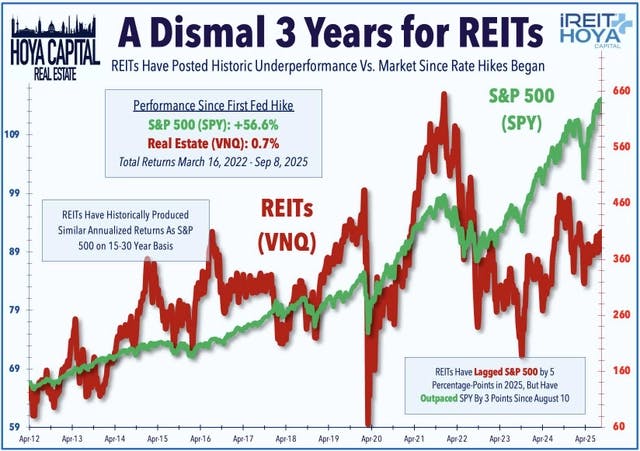
Underperformance from real estate equities in a persistent elevated interest rate environment is not unwarranted, given that the two prior rate hike cycles that exceeded 400 basis points - the late 1980s cycle that sparked the Savings & Loan Crisis and the mid-2000s cycle that sparked the Great Financial Crisis - resulted in significant distress and disruption across the real estate industry. But the cumulative 55-percentage-point performance gap between REITs and the broader equity market in this three-year stretch is nevertheless remarkable, given the historical performance correlations: on a 15, 20, 25, and 30-year basis, REITs and the S&P 500 have delivered annualized total returns that are within about 4 percentage points. By comparison, the rolling relative performance spread (VNQ minus SPY) during the Great Financial Crisis peaked at around 20 percentage points in early 2009, and REITs closed the gap over the subsequent three years and ultimately climbed to fresh record highs by early 2022 - effectively the same time as the full rebound in SPY.
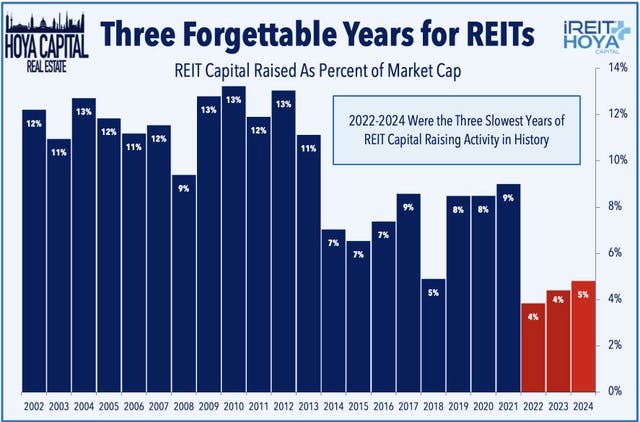
By any measure, it's been a truly forgettable three-year period for real estate equities dating back to the start of the Fed's rate-hiking cycle—a period that's seen historically low levels of "dynamism" across the sector, including the slowest three-year period ever for REIT capital raising activity (as a percent of market cap), the fewest number of REIT IPOs since the late-90s recession, and the only time ever in which the total number of publicly listed REITs declined for three consecutive years. Today, there are 196 REITs in the FTSE Nareit All REITs Index, down from 222 at the start of 2021 and down from the peak of 225 in 2015. After increasing its weight in the S&P 500 in 17 of 20 years from 2000 to 2019, REITs' sector weighting in the major equity benchmark declined for a fourth straight year in 2024 and stands at just 2.2% today. Further, per the BofA Fund Managers Survey, REITs are the single most "unloved" asset class across global markets, with investors underweight REITs in a magnitude not seen since the peak of the GFC in 2009.
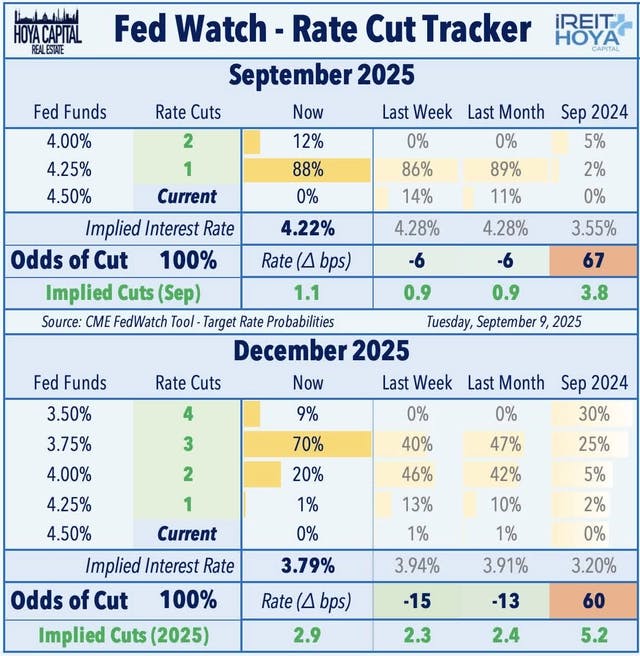
Given the historical correlations between REITs and interest rates - both the 10-Year Treasury Yield and the Fed Funds Rate - we believe the market is overlooking the likelihood - and perhaps inevitability - of a robust real estate rebound if interest rates retreat as implied by current market-implied pricing. Swaps markets now price in a 100% probability of at least one Federal Reserve rate cut in September, including a 12% chance of a "double cut" of 50 basis points. Markets imply a Fed Funds Rate of 3.79% at the end of 2025 (vs. 4.50% now), implying 2.9 Fed interest rate cuts in 2025. Markets imply substantial easing after Fed Chair Powell's term expires next May, with an implied end-of-year 2026 Fed Funds rate of around 2.75%. What goes around comes around: When rates reverse lower, REITs inevitably enjoy an equally powerful tailwind: financing costs decline and directly filter into bottom-line FFO growth, acquisition and development pipelines reopen, and REIT dividend yields regain relative appeal versus Treasuries and corporate bonds.
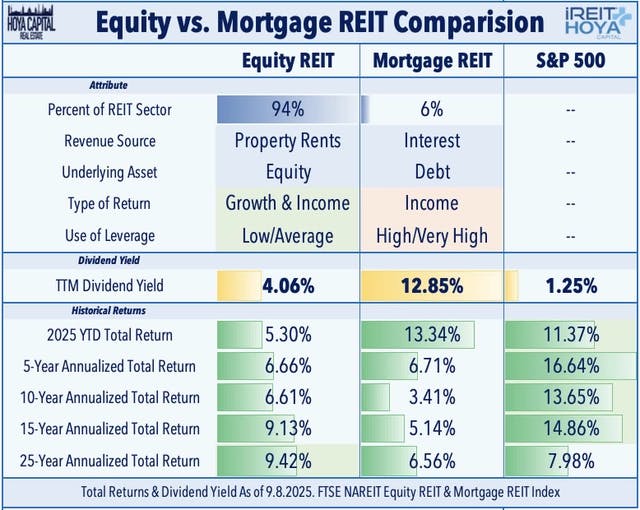
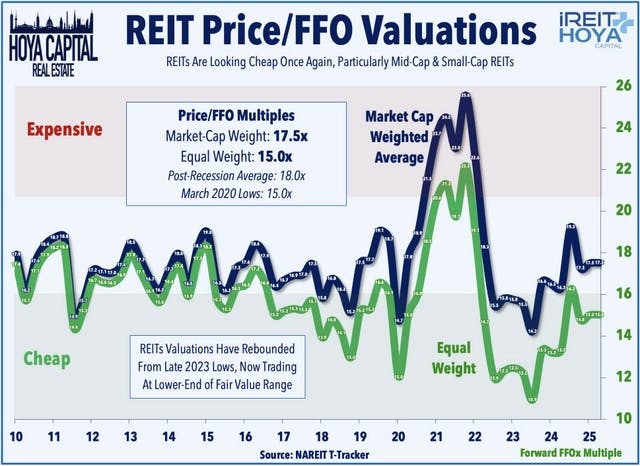
REITs are as "unloved" as they ever have been—but is it justified? A theme we'll emphasize throughout this report, valuations—not necessarily fundamentals—are responsible for the vast majority of the underperformance during this "REIT Dark Age," setting the stage for a sustained REIT rebound in the quarters and years ahead as benchmark interest rates retreat. The extended stretch of REIT underperformance since early 2022—combined with the nearly 20% increase in FFO during this time—pulled REIT valuations to the lowest level since the end of the Great Financial Crisis in late 2023, and while REITs aren't quite as "cheap" now as they were at the bottom, we see substantial upside in the mid- and small-cap REITs - those that have been hit most directly by the "capital starvation" inherent with the Fed's restrictive policy course. On a market-cap-weighted basis, REITs trade at a 17.5x median P/FFO multiple, which is slightly below the post-recession average of 18.0x. On an equal-weight basis, however, REITs trade at a 15.0x P/FFO multiple.
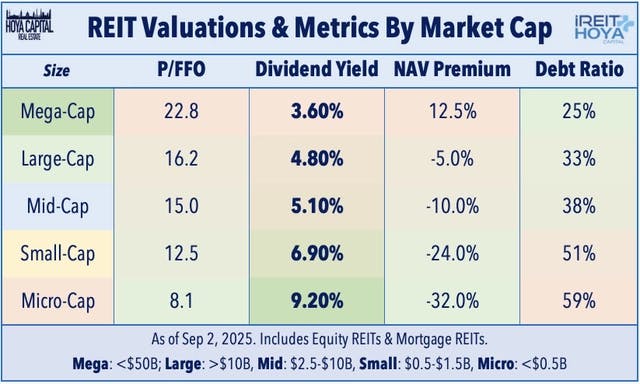
Consistent with the deeper discounts offered by smaller-cap REITs, we note that Equity REITs pay a dividend yield of 4.1% on a market-cap-weighted basis, but this dividend yield climbs to over 6.5% on an equal-weight basis and roughly 8.5% when including mortgage REITs. And while the average REIT now trades at an estimated 10% discount to its Net Asset Value—as implied by current private market valuations—small-cap REITs trade at an estimated 24% discount to NAV, while micro-cap REITs trade with a NAV discount of over 30%. That said, for REITs, being "too cheap" can be a problem - especially in an elevated interest rate environment. Valuations are a reflection of these REITs' cost of capital: highly valued REITs have access to cheap capital, while cheaper REITs must pay more to access capital. While modern equity REITs are more "dynamic" than a conventional bank, these "spreads" between cost of capital and return on capital are still critical. Over most long-term investment horizons, "ultra-cheap" REITs tend to stay cheap via underperformance, and "ultra-expensive" REITs tend to stay expensive via outperformance. We see particularly compelling valuations in the mid-cap "sweet spot" of the REIT universe, where companies are large enough to enjoy scale efficiencies but still small enough to capture outsized growth opportunities, creating the highest upside potential as rates pull back.
Real Estate Recession Becomes Recovery
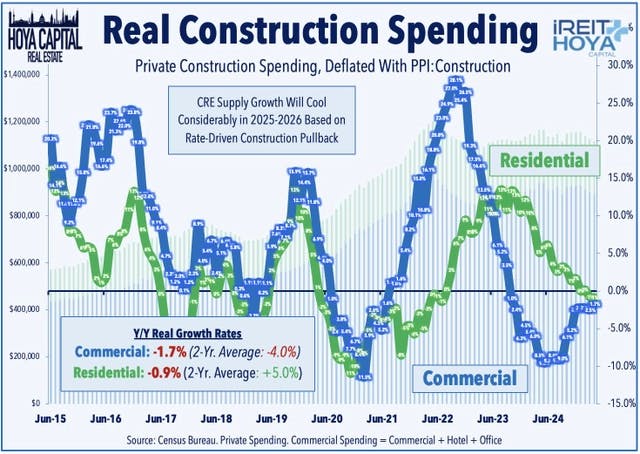
A framework often credited to British economist Fred Harrison, the 4-Phase Real Estate Cycle is comprised of 1) Recovery; 2) Expansion; 3) Hyper supply; and 4) Recession. As we'll discuss in this report, trends over the past several quarters indicate that the real estate cycle has finally begun to transition from the "Recession" phase to the "Recovery" phase in recent months - despite the interest rate fluctuations - with muted supply growth serving as a key "silver lining" to the brutal three-year bear market. Over the past eighteen months, real construction spending on commercial properties (adjusted for the cost inflation) has seen its steepest decline since the Great Financial Crisis, pulling back roughly 5% this year. Real spending on residential properties, meanwhile, dipped more than 12% in 2023 before recovering in 2024 but again turning negative in 2025 as mortgage rates remained stubbornly elevated. Combined, combined supply growth has effectively declined by 5% over the past 24 months, during which time Real Gross Domestic Product - which has a strong correlation with real estate demand - has increased by roughly 8%.
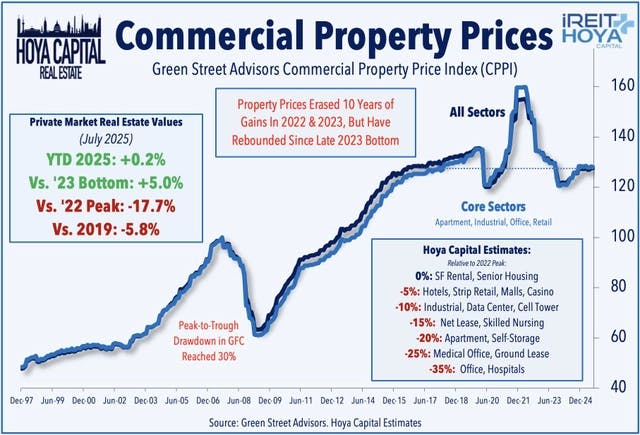
Consistent with the "recovery" phase of the real estate cycle, commercial property values have stabilized in recent quarters following a substantial drawdown during the "recession" phase. Green Street Advisors' data shows that private-market values of commercial real estate properties dipped 22% from the April 2022 peak to the December 2024 bottom and have recovered steadily since then, posting a 5% increase in 2024 and have been marginally positive in 2025. By comparison, the peak-to-trough drawdown in this valuation index during the Great Financial Crisis was 30%. We've noted that the 20-25% drawdown level is a critical "capitulation threshold"—a level that matches the maximum Loan-to-Value ("LTV") ratio accepted by conventional commercial real estate lenders. With real estate valuations still hovering around the 20% drawdown threshold—and steeper within some property sectors, including office—distress will remain elevated in the most highly levered segments of private markets. Defaults tend to peak in the final stage of the "Recession" phase but remain elevated into the early stages of the "Recovery" phase, a period that is generally fertile with acquisition opportunities for entities with access to equity capital.
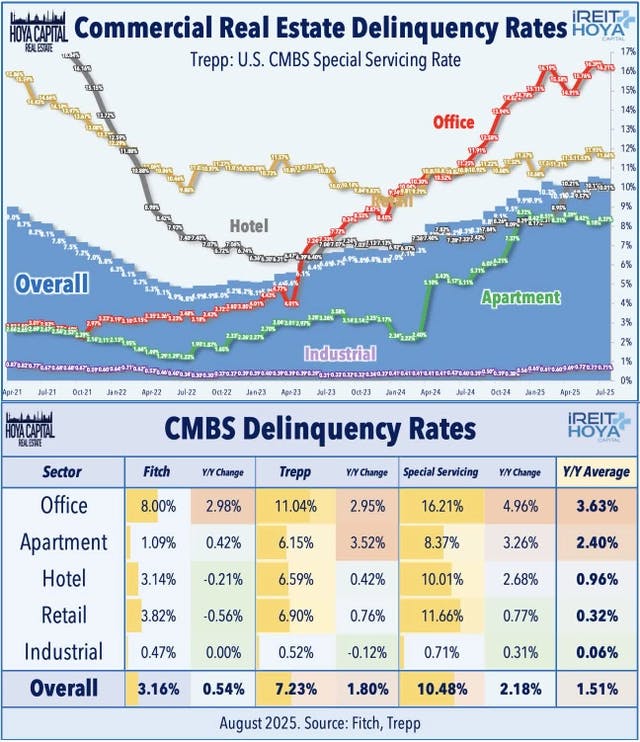
A real estate portfolio is only as good as the balance sheet that finances it. And while public REITs may own the best house in the neighborhood with balance sheets that are the envy of the institutional real estate world, they are certainly not immune to the impacts of the lingering rate-driven distress around them. "Hope" has been the only strategy for many highly levered property owners amid a dearth of buying interest and limited capital availability—"hope" that interest rates recede before their "debt clock" expires. And for an increasing number of borrowers—especially those reliant on high-cost variable-rate debt—the clock hit midnight. Trepp reported this month that the Special Servicing rate for CMBS loans—a forward indicator of potential future loan delinquencies—topped 10% in July for a sixth straight month, while its overall CMBS delinquency rate rose to 7.29% in August - the highest since the pandemic. That said, while delinquency rates are very elevated, actual default CMBS rates remain on the low side, historically speaking, with the lone exception being the office sector. Fitch’s latest data shows that default rates are around 3% - up from lows of around 1.75% in late 2022—but this is actually still below the roughly 3.5% average in the three years preceding the pandemic (2017-2019). Apart from office, the only other segment that has seen a material increase in loan defaults is multifamily—a function of the high variable rate debt utilization rate resulting from its relative ownership skew towards smaller "mom and pop" investors.
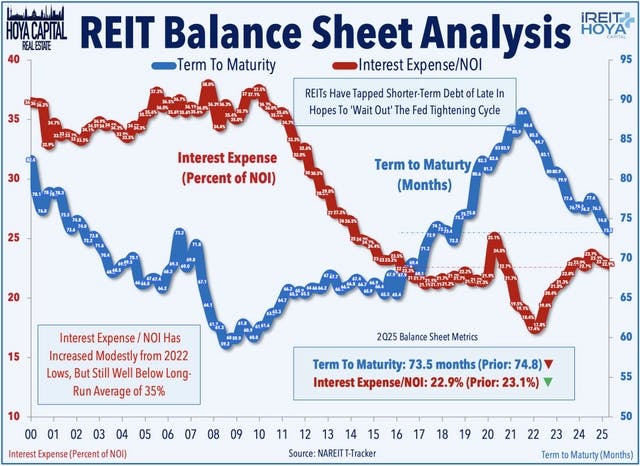
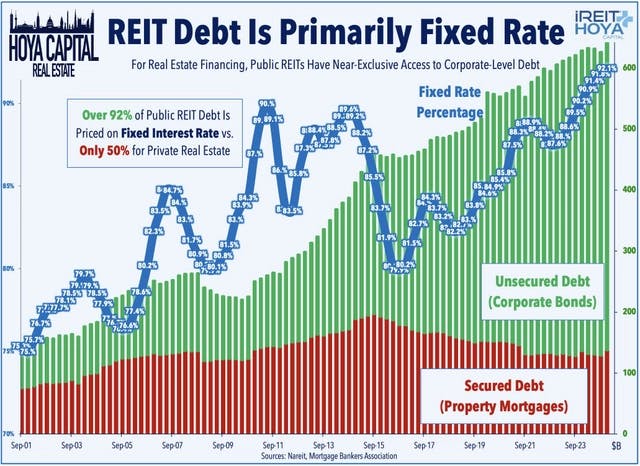
Access to long-term debt is perhaps the most distinct competitive advantage of the public REIT model, but it's an advantage that hardly gave public REITs much of an edge when debt capital was cheap and plentiful in the "zero-rate" economic environment of the 2010s. Compared to private institutions, publicly traded REITs had far greater access to fixed-rate unsecured debt—which is usually in the form of 5-10 year corporate bonds. This allowed REITs to lock in these fixed rates on 90% of their debt while simultaneously pushing their average debt maturity to nearly 7 years, on average, thus avoiding the need to refinance during these highly unfavorable market conditions. Even with the significant pullback in financing activity in recent months, the average term-to-maturity for public REITs is still over 6 years—well above the pre-GFC highs of around 4 years—and significantly above the weighted average term-to-maturity of around 3 years for private real estate assets. Hence, for many of the highly levered players that lacked access to long-term capital, the trends observed in the chart below are magnified by a factor of 2-3x.
Deeper Dive Into REIT Fundamentals
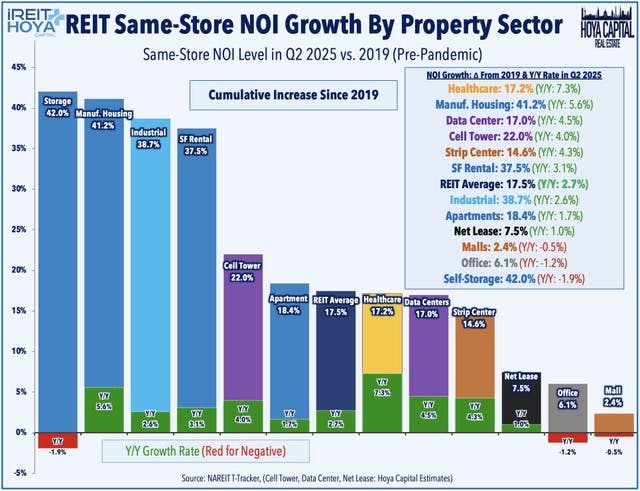
As noted, the pockets of distress are almost entirely debt-driven—and further isolated largely to the office sector—as nearly every property sector reported "same-store" property-level income above pre-pandemic levels. REITs reported that "same-store" property-level operating income ("NOI"), on average, was 17.5% above pre-pandemic levels in the second quarter and up by 2.7% on a year-over-year basis. The residential, industrial, and technology sectors have been the upside standouts during this pandemic and post-pandemic period, with most of these REITs reporting NOI levels that are over 25% above 2019 levels. Retail REITs—which were struggling before the pandemic—have posted some of the more impressive property-level performance in recent quarters, while Senior Housing REITs have also enjoyed a swift NOI rebound since bottoming in early 2023. Underscoring the impact of interest rates and balance sheets relative to property-level fundamentals, even the struggling office sector reported same-store NOI that was 6.1% higher than in 2019.
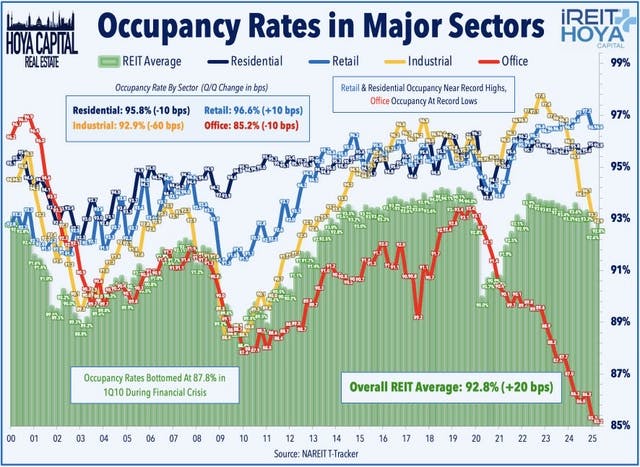
After recording the largest year-over-year decline on record in 2020—which dragged the sector-wide occupancy rate to 89.8%—REIT occupancy rates rebounded since mid-2020 back to around 93%—toward the upper end of its 20-year average of 90-94%. By comparison, occupancy levels dipped as low as 88% during the Financial Crisis and took three years to recover back above 90%. Retail REITs have been the noted upside standout on the occupancy front, as store openings have significantly outpaced store closings over the past three years—a sharp departure from the "retail apocalypse" trends of the 2010s. Residential REITs have continued to report near-record-high occupancy rates in recent quarters—despite record levels of multifamily supply growth. Industrial REITs reported a moderation in occupancy rates to around 93% in Q2 from their record highs of nearly 98% in late 2022. Office REIT occupancy, meanwhile, has seen substantial declines since the start of 2020 and remained 600 basis points below pre-pandemic levels at 85.2% in the second quarter.
REIT company-level metrics have tracked this rebound in property-level performance relatively closely throughout the pandemic, with the exception of the highly levered REITs that have reported sharp FFO declines even as property-level cash flows remain healthy. REIT FFO ("Funds From Operations") fully recovered the sharp declines from early in the pandemic, and in the second quarter, FFO was 20% above its 2019 pre-pandemic level on an absolute basis and roughly 5% above pre-pandemic levels on a per-share basis. On a year-over-year basis, FFO/share was down 2.6% in Q2, however, resulting primarily from a drag from higher interest expense. Dividends per share, meanwhile, are about 4% above pre-pandemic levels and were higher by 1.5% on a year-over-year basis. Roughly 55% of REITs reported year-over-year increases in FFO in the most recent quarter, while 60% of REITs reported year-over-year increases in same-store NOI.
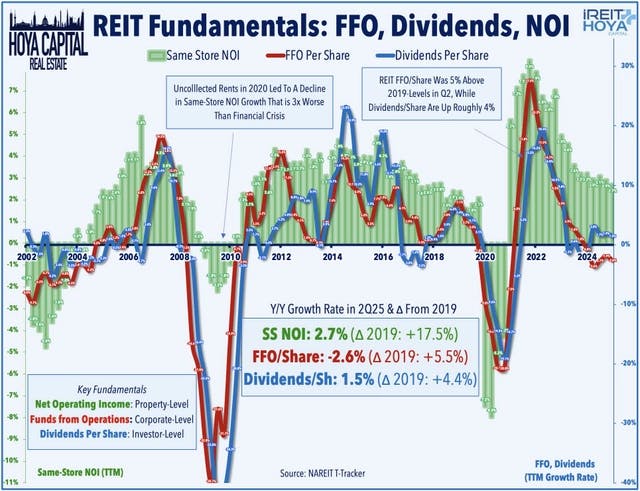
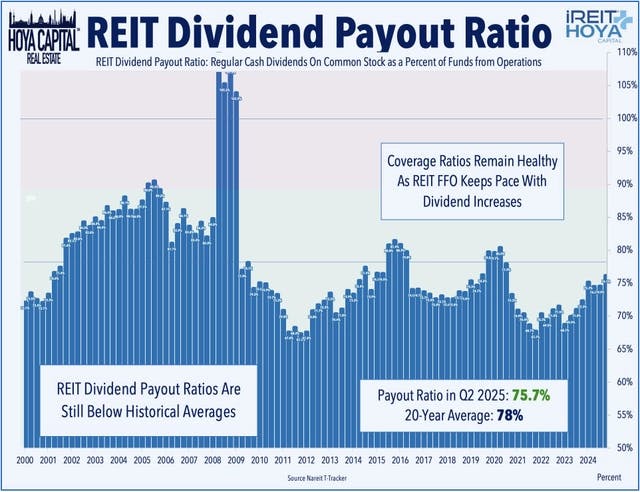
Powered by more than 120 REIT dividend hikes in both 2021 and 2022 and another 80 dividend hikes in 2023 and 2024, dividends per share have finally fully recovered from the wave of pandemic-era dividend cuts in 2020. In 2024, we tracked 85 dividend increases, and 2025 is pacing slightly ahead of 2024 with dividend hikes from 56 REITs thus far. With FFO growth outpacing dividend growth since the start of the pandemic, REIT dividend payout ratios remained at around 76% in the second quarter on a trailing twelve-month basis—below the 20-year average of around 80%. With a relatively healthy dividend payout ratio, the average REIT has built up a buffer to protect current payout levels if macroeconomic conditions take an unfavorable turn, but the sector average does mask some elevated payout ratios across several sectors.
Deeper Dive: REIT Balance Sheets
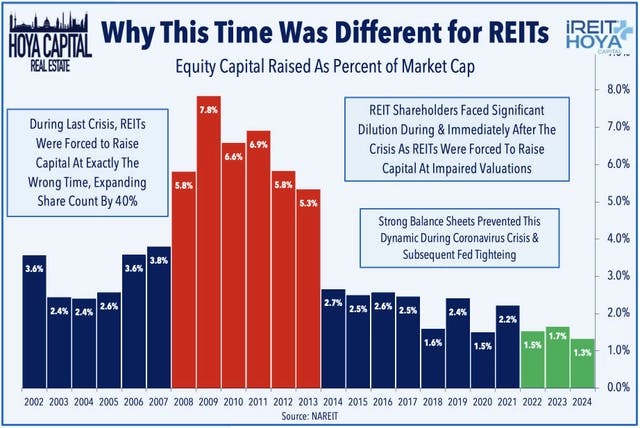
The ability to avoid "forced" capital raising events has been the cornerstone of REIT balance sheet management since the GFC—a time in which many REITs were forced to raise equity through secondary offerings at "firesale" valuations just to keep the lights on, resulting in substantial shareholder dilution, which ultimately led to a "lost decade" for REITs. While REITs entered this tightening period on very solid footing with deeper access to capital, the same can't necessarily be said about many private market players that rely on short-term borrowing or continuous equity inflows to keep the wheels spinning. Much the opposite of their role during the Great Financial Crisis, many well-capitalized REITs are equipped to "play offense" and take advantage of compelling acquisition opportunities if we do indeed see further distress in private markets from higher rates and tighter credit conditions.
With the scars of the Great Financial Crisis still visible, most public REITs were "preparing for winter" for the last decade, often to the frustration of some investors who turned to higher-leveraged and riskier alternatives in recent years. Private market players and non-traded REIT platforms were willing to take on more leverage and to finance operations with shorter-term, variable-rate, and secured debt—a strategy that worked well in a near-zero rate environment but quickly crumbles when financing costs double or triple in a matter of months. NAREIT reported last year that nearly 50% of private real estate debt is priced based on variable rates, compared to under 8% for public REITs. We've observed significant pain inflicted on the handful of public REITs that entered this period with variable rate debt loads in the 20-30% range—still relatively low compared to typical private equity firms—resulting in double-digit percentage point drags on Funds from Operations ("FFO").
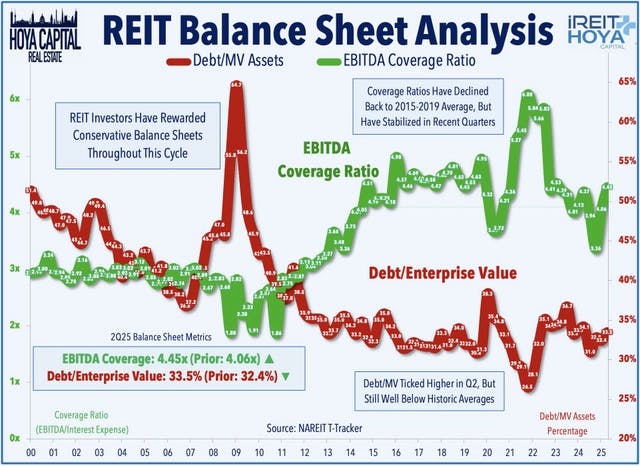
Even as long-term benchmark interest rates doubled and even with market values of REITs lagging the broader equity market by 30-50 percentage points throughout the past several years, REITs balance sheets remain healthy by historical standards, merely giving back the incremental pandemic-era improvement. Debt as a percent of Enterprise Value still accounts for less than 35% of the REITs' capital stack, down from an average of roughly 45% in the pre-recession period—and substantially below the 60-80% Loan-to-Value ratios that are typical in the private commercial real estate space. Interest coverage ratios (calculated by dividing EBITDA over interest expense) have seen a sharper erosion over the past several quarters from their all-time highs in late 2022, however, but still stand at 4.45x, which roughly matches the coverage ratio at the end of 2019 and compares very favorably to the 2.75x average in the three years before the GFC period.
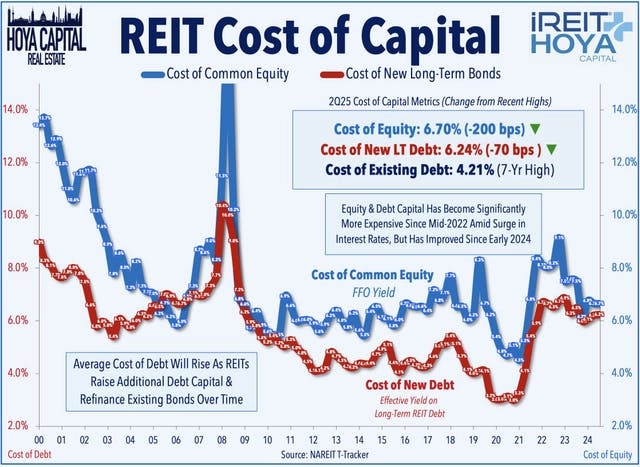
That said, not all REITs are created equal, and the broad-based sector average does mask some of the intensifying issues in several of the more at-risk sectors and among REITs that have been more aggressive in their balance sheet management. A handful of small- and micro-cap REITs—some of which would be considered as having a rather strong balance sheet relative to similar private equity portfolios—have incurred significant charges to "fix" their floating-rate debt exposure, while others have continued to roll the dice by maintaining a sizable chunk of variable-rate debt. The BofA BBB US Corporate Index Effective Yield—a proxy for the incremental cost of real estate debt capital—surged from as low as 2.20% in late 2021 to as high as 6.67% at the October 2023 peak and now sits at 4.49%. On a percentage basis, this represents a nearly 200% increase in interest costs on variable-rate debt. The cost of equity—which we compute based on average FFO yields—is now 6.7% for the average REIT, up from a low of 4.4% in late 2021 but down from a peak of nearly 9% at the "bottom" of the REIT selloff in late 2023.
Like what you're reading?
Stay in the loop — get the latest ETF insights: trends, analysis, and expert picks.
Deeper Dive: REIT Valuations & Growth
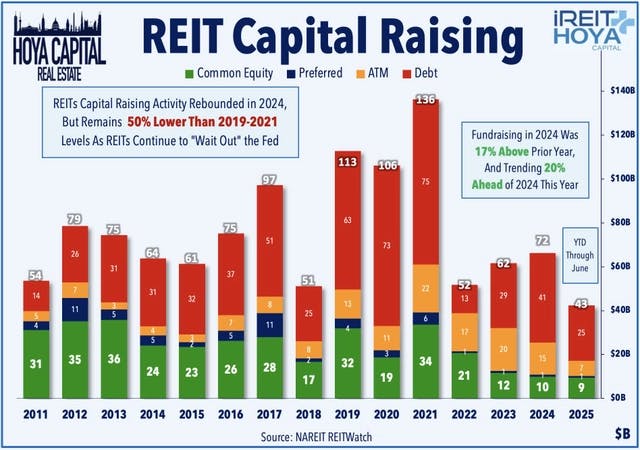
REITs "hunkered down" in recent years as stock price valuations remained low by historical standards and in relation to private market-implied valuations, but activity has started to rebound in recent quarters. On an annual basis, the amount of capital raised through mid-year was up about 50% from a year earlier. REITs raised roughly $43B in capital through equity and debt offerings through June, with the majority of this capital raised coming via long-term debt offerings, which accounted for roughly 65% of the total capital raised thus far in 2025—above the historical average of around 50%. The largest common equity offering of the past three years was Lineage, Inc.'s (LINE) $5.4 IPO in 2024, followed by American Healthcare's (AHR) $773M IPO. By property sector, industrial REITs accounted for the largest share of total capital raised in 2024, followed by data center and healthcare REITs.
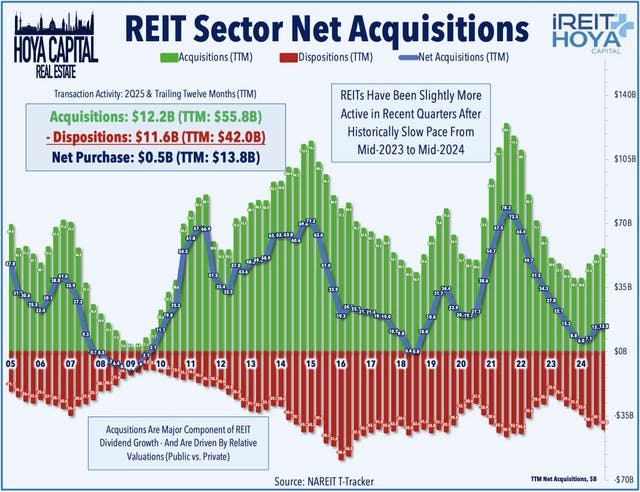
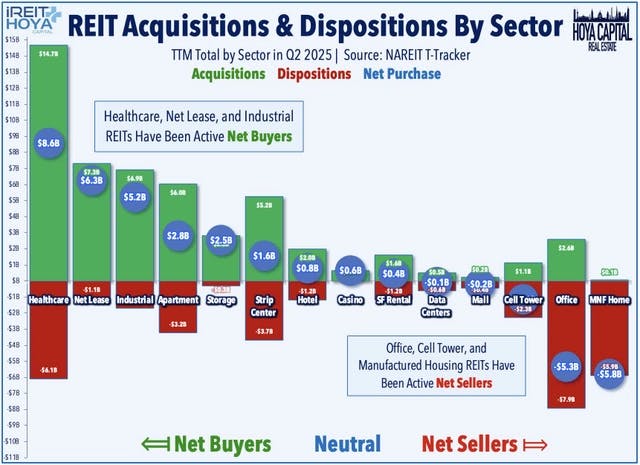
Distress for some is an opportunity for others, and we've begun to see—on a limited scale—public REITs with balance sheet firepower start to take advantage of capitulation from highly levered players—a trend that will gather steam if debt markets remain tight and REIT NAV premiums can hold for at least several quarters. REIT external growth comes in two forms—buying and building. Acquisitions have historically been a key component of FFO/share growth, accounting for more than half of the REIT sector's FFO growth over the past three decades, with the balance coming from "organic" same-store growth and through ground-up development and redevelopment. With a historically large "bid-ask" spread for private real estate assets, REITs were historically quiet on the portfolio-level M&A front in 2024 with gross purchases of only $7B last year—the slowest annual total since late 2018—but REITs have picked up the pace slightly in 2025. REITs reported $12.2B in gross acquisitions in Q2 and $11.6B in dispositions, resulting in a "net buy" of $0.5B.
At the property-sector level, net lease, healthcare, and industrial REITs have been the most active acquirers of private market assets in recent quarters—accounting for more than half of total net purchases across the REIT industry. Most other REIT sectors have been more reluctant to "hit the bid" on slow-to-adjust private market valuations. Office and Cell Tower REITs have been the most significant "net sellers" over the past year. Several of the largest REIT acquisitions in 2024 emanated from Blackstone's (BX) non-traded fund, BREIT, which faced a wave of investor redemption requests in 2023 and 2024, prompting the need to raise capital to meet withdrawals. Since December 2022, BREIT has sold over $10B in assets to public REITs, including a $1B sale of an 11-building apartment portfolio to Equity Residential (EQR) last December and a $1B sale of an industrial portfolio to Rexford (REXR) last March. These deals follow a $5.5B sale of two Las Vegas casinos to VICI Properties (VICI) in 2023, an $800M sale of a Texas resort to Ryman Hospitality (RHP), a $2.2B sale of Simply Self-Storage to Public Storage (PSA), and a $950M partial sale of The Bellagio casino to Realty Income (O).
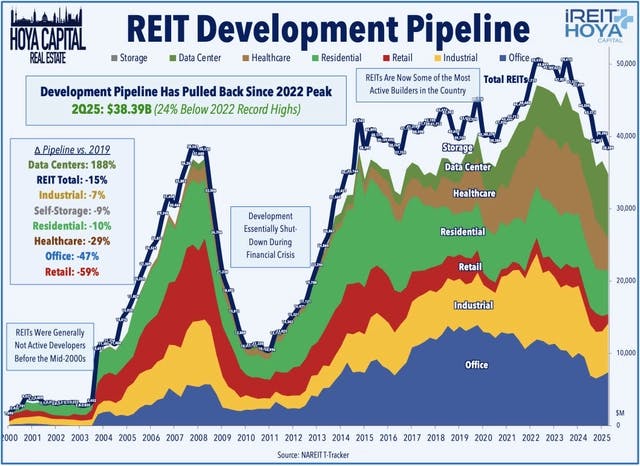
REITs have become some of the most active builders in the country over the past decade, and—despite the slowdown in recent quarters—REITs still have over $40B of active development in the pipeline. Favorably, much of this pipeline is in the final stages of construction, as new groundbreakings have been few and far between over the past few quarters given the unfavorable rate environment. The swelling of the development pipeline to the record highs seen in 2023 was fueled by three property sectors—data centers, industrial, and self-storage—but some of this inflated pipeline is the result of higher construction costs and lingering supply chain delays that prolong the development timeline. Retail REITs, on the other hand, have engaged in minimal development activity over the past several years—which has fueled the recent occupancy increases—while the pipeline in office has also pulled back materially over the last several quarters, as expected.
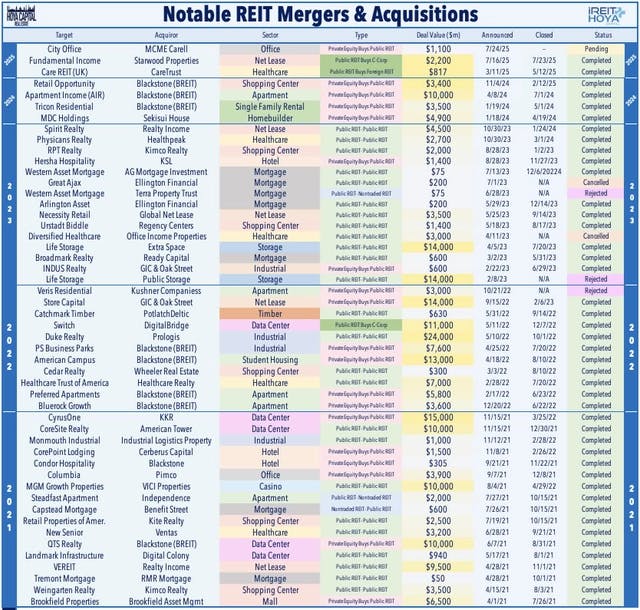
Company-level M&A trends have started to pick up in recent months following a long lull from mid-2024 to mid-2025. In July, City Office REIT (CIO) agreed to be acquired by MCME Carell Holdings in a deal worth $1.1 billion. In August, Braemar Hotels (BHR) announced a plan to sell the company, citing undervaluation and activist pressure. This recent REIT privatization follows a historic wave of such activity from 2020 through 2024 - largely driven by Blackstone and its affiliates, which acquired ten public REITs with a combined enterprise value of over $105B, paying an average premium of 35% relative to these REITs' prior closing price. Outside these Blackstone-involved deals, M&A activity within the REIT sector has been almost nonexistent since late 2023 - a year that was notably active with REIT-to-REIT mergers. The 2023 merger wave was headlined by net lease REIT Realty Income's acquisition of Spirit Realty, healthcare REIT Healthpeak's (DOC) acquisition of medical office REIT Physicians Realty, and Extra Space's (EXR) acquisition of Life Storage. We also saw two smaller-scale consolidations in the strip center space: Regency Centers (REG) acquired small-cap Urstadt Biddle, while Kimco Realty (KIM) acquired mid-cap RPT Realty, along with a handful of mortgage REIT mergers.
Takeaways: Silver Linings After Dark Ages
While REIT stock prices don't yet reflect it, we believe that macroeconomic conditions are evolving in an ideal manner for public REITs to finally exploit their competitive advantage—access to nimble equity capital and long-term fixed-rate debt—which was of little advantage in the "lower forever" environment. And while past periods of tight lending conditions were remembered as those of distress, they can rightfully also be remembered as periods of a significant revolution and rebirth that spanned many of the public REITs that exist today. The S&L Crisis of the late 1980s—which resulted in the failure of nearly a third of community banks and resulted in significantly constrained access to debt capital—spawned the dawn of the 'Modern REIT Era.' A second wave of REIT IPOs followed in the aftermath of 9/11 and again after the Great Financial Crisis as the limited access to (and high cost of) debt capital, combined with a lift in equity market valuations of public REITs, pushed otherwise distressed, highly levered private portfolios into the public equity markets, a theme that we could well see repeated in coming quarters.
Please note that this article reflects the author’s personal views and does not represent the opinions of the publication or its affiliates. It is for informational purposes only and does not constitute investment advice. It is essential to seek guidance from a registered financial professional before making any investment decisions.
Latest ETF News
See all ETF newsRent or Build? The Capital Markets Decision Every New ETF Issuer Must Make


Winners & Losers Of 4Q’25 REIT Earnings Season

When ETF Liquidity Is Only an Illusion

ETF Spreads: The Signal Investors Misread

Can ETFs Make Capital Gains Disappear Forever?




 Advantages of ETFs over Mutual Funds1/6
Lower Costs
In this guide, we'll explore the advantages of ETFs over mutual funds, giving you valuable insights into why ETFs have gained significant popularity among investors like yourself.
Leveraged ETFs: Unlocking the Potential for Amplified Returns1/6
Understanding Leveraged ETFs
Explore leveraged ETFs: potential for amplified returns & risks. 5 ETFs to consider across equities, commodities & fixed income.
What is a Leveraged ETF?1/6
Introducing Leveraged and Inverse ETFs
In this guide, we'll dive into the world of leveraged ETFs, exploring their definition, mechanics, potential risks, and rewards.
Recent educational content
Asset TV
The ETF Show - US-Iran Conflict Sends Oil ETFs Soaring
Lance McGray, Managing Director and Head of ETF Product at Advisors Asset Management joins The ETF Show.

What’sTheFund
What's the Fund | Thrivent Small Cap Value ETF (Ticker: TSCV)
Kyle Detullio, ETF Capital Markets Specialist at Thrivent Asset Management, joins Ethan Hertzfeld on the NYSE trading floor to discuss the Thrivent Small Cap Value ETF (TSCV).


What’sTheFund
What's the Fund | Thrivent Small-Mid Cap Equity ETF (Ticker: TSME)
Kyle Detullio, ETF Capital Markets Specialist at Thrivent Asset Management, joins Ethan Hertzfeld on the NYSE trading floor to discuss the Thrivent Small-Mid Cap Equity ETF (TSME).
What’sTheFund
What's the Fund | Thrivent Mid Cap Value ETF (Ticker: TMVE)
Kyle Detullio, ETF Capital Markets Specialist at Thrivent Asset Management, joins Ethan Hertzfeld on the NYSE trading floor to discuss the Thrivent Mid Cap Value ETF (TMVE).
Browse all educational columns



Have you tried our ETF Compare tool?
Compare ETFs like a pro. Analyze fees, performance, exposure & holdings side-by-side.