Global ETF Survey Is Live! 600+ ETF Professionals Weigh In. See Results →



Spotlight on Market Valuations: Sector Comparisons and ETF Opportunities
Here's an overview of what market valuations look like lately on a sector basis, along with some ETFs you can use to invest in them.


Keep up with what matters in ETFs
Get timely ETF insights, market trends, and top ideas straight to your inbox.
Your newsletter subscriptions with us are subject to ETF Central's Privacy Policy and Terms and Conditions.
When considering the valuation of the market, it's crucial to recognize that the market is not a monolithic entity.
By dissecting the market into its 11 Global Industry Classification Standard (GICS) sectors, which include communication services, consumer discretionary, consumer staples, energy, financials, health care, industrials, information technology, materials, real estate, and utilities, we can observe significant variances in valuation.
As of late, when assessing sectors based on traditional valuation metrics such as price-to-earnings (P/E), price-to-sales (P/S), price-to-book (P/B), and price-to-free-cash-flow (P/FCF) ratios, energy, real estate, and financials emerge as the most undervalued sectors compared to the overall market. Conversely, industrials, healthcare, and information technology are currently perceived as overvalued.
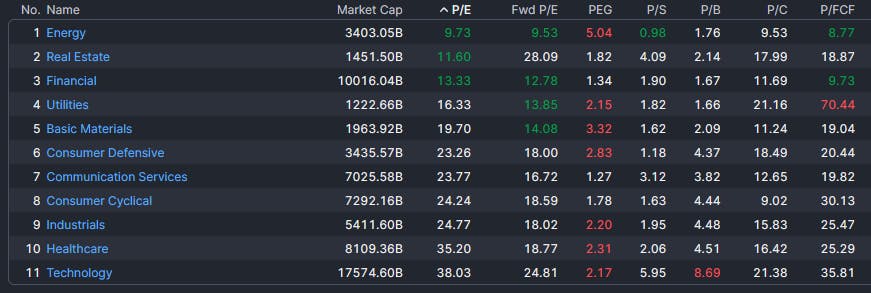
This divergence in sector valuations underscores the importance of a nuanced approach to investing, where opportunities for value can be found by delving into specific sectors rather than making broad market generalizations.
For investors looking to capitalize on these variances, numerous sector ETFs are available, offering a straightforward means to invest in either undervalued sectors poised for growth or to carefully navigate sectors that currently appear overpriced.
Global ETF Survey 2026 is Live!
With 1,790 new products launched by July 2026, choosing is harder than ever. Our Global ETF Survey 2026, built on 620 professional investors and allocators, shows how active, fixed income, options-based and thematic ETFs are reshaping fund selection.
Tech Titans & Healthcare Heroes
The technology sector's valuation has skyrocketed, largely driven by the explosive growth and interest in artificial intelligence (AI), alongside robust earnings reports from industry leaders.
A prime example is Nvidia, a semiconductor giant, which has reported remarkable financial achievements, including record quarterly revenue of $22.1 billion, a 22% increase from the previous quarter and a staggering 265% rise year-over-year.
Its data center revenue alone reached $18.4 billion for the quarter, up 27% from the third quarter and an astonishing 409% from the previous year, culminating in a record full-year revenue of $60.9 billion, marking a 126% increase.
Nvidia's remarkable revenue achievements, driven by its dominance in AI and data center markets, highlight the sector's capacity for rapid expansion and profitability. The technology sector thrives on constant innovation, leading to new products, services, and efficiencies. This continuous evolution creates opportunities for significant revenue growth and thus higher valuations.
The healthcare sector, on the other hand, demonstrates high valuation metrics due to its critical role in society and the non-discretionary nature of its products and services. The demand for healthcare services and products tends to remain stable or even increase, regardless of economic conditions, making companies in this sector less sensitive to economic cycles.
For instance, Novo Nordisk and Eli Lilly have seen significant interest in their weight loss drugs, Ozempic and Wegovy, reflecting the ongoing demand for healthcare solutions that address prevalent health issues. Additionally, Viking Therapeutics' stock surge by 90% following promising Phase 2 testing results for its experimental weight loss drug showcases the potential for innovation and the subsequent investor enthusiasm in the healthcare sector.
The sector's focus on research and development (R&D) leads to breakthroughs that can quickly translate into substantial revenue streams, as medical innovations can command high price points and enjoy patent protection.
Both sectors also benefit from high barriers to entry, including significant R&D expenditures, stringent regulatory requirements, and the need for specialized knowledge. These barriers protect established companies from new competition, allowing them to maintain strong profit margins.
Furthermore, the global reach and scalability of businesses in these sectors contribute to their high valuations. Companies like Microsoft in technology and Abbvie in healthcare have demonstrated the ability to expand their market presence worldwide, leveraging global demand to fuel growth.
How to Invest in Technology and Healthcare Sectors with ETFs
For those looking to bet on continued momentum in these sectors, focusing on the large caps might involve ETFs like the Technology Select Sector SPDR Fund (XLK) and the Health Care Select Sector SPDR Fund (XLV), which track technology and healthcare in the S&P 500, respectively.
For a broader sector view that encompasses more mid and small-cap companies, Vanguard's ETFs such as Vanguard Information Technology ETF (VGT), and Vanguard Health Care ETF (VHT) offer comprehensive coverage.
Energy Challenges & Financial Sector Struggles
On the flip side of the market valuation spectrum, several sectors appear significantly undervalued compared to the overall market. The energy sector, for example, has faced considerable challenges, with prices for WTI Crude, Brent Crude, and Natural Gas all falling sharply from their highs in Fall 2023.
The energy sector is inherently cyclical and highly sensitive to global economic conditions. Prices for commodities such as WTI Crude, Brent Crude, and Natural Gas are directly impacted by geopolitical events, changes in supply and demand dynamics, and broader economic trends, leading to significant price volatility.
This volatility translates into fluctuating revenues and profits for energy companies, making it challenging to maintain consistent growth and leading investors to apply lower valuation multiples when discounting their future growth.
Moreover, the energy sector's capital-intensive nature, requiring substantial investments in exploration, production, and infrastructure, coupled with increasing regulatory pressures and a global shift towards renewable energy, adds to its risk profile. These factors necessitate large ongoing capital expenditures, impacting free cash flows and making the sector more susceptible to economic downturns.
Despite this downturn, oil and gas majors like Exxon Mobil and Chevron have maintained strong margins and continue to generate high levels of free cash flow, indicating a resilience in their operations amidst the price volatility.
The financial sector, including banks and financial institutions, is also characterized by its cyclical nature and direct correlation with economic cycles. It is particularly sensitive to interest rate movements, regulatory changes, and economic health.
Additionally, the financial sector's performance is closely tied to the health of the broader economy, including employment rates, consumer spending, and business investments. As economic conditions deteriorate or uncertainties increase, the sector often faces reduced profitability due to higher loan defaults and tighter margins, further contributing to its historically low valuations.
The sector's valuation is also impacted by the perception of risk, especially credit risk and market risk, which can fluctuate based on economic conditions and regulatory environments.
Currently, the financial sector is still grappling with the aftermath of last year's regional bank crisis, which witnessed the collapse of Silicon Valley Bank, Signature Bank, and Silvergate Bank. The situation escalated when Credit Suisse floundered and was ultimately acquired by UBS. The recent crises have underscored the sector's vulnerability to systemic risks, reducing investor confidence.
Today, the sector remains under pressure, with ongoing concerns about regional banks' exposure to commercial real estate loans, highlighting systemic vulnerabilities. The national vacancy rate stood at 18% in January 2024, pointing to significant challenges for banks with exposure. Many properties are now facing steep discounts to their asset values, further exacerbating the sector's undervaluation.
How to Invest in Energy and Financial Sectors with ETFs
For investors interested in these undervalued sectors, several ETFs offer targeted exposure. For the S&P 500 sectors, the Energy Select Sector SPDR Fund (XLE) and the Financial Select Sector SPDR Fund (XLF) offer exposure.
For a broader perspective that includes a wider range of companies across market capitalizations, Vanguard's ETFs such as Vanguard Energy ETF (VDE) and the Vanguard Financials ETF (VFH) are viable holdings.
Please note this article is for information purposes only and does not in any way constitute investment advice. It is essential that you seek advice from a registered financial professional prior to making any investment decision.
Topics
See all
Mentioned ETFs
Further reading
Latest ETF News
See all ETF newsBeyond Big Tech: The Increasing Specialization of AI ETFs

There's an ETF for That? Humanoid Robotics and Physical AI

How Some ETF Issuers Use Their Own Funds for Cash Management

These Public-Private ETFs Invest in Polymarket and Anduril

There's an ETF for That? Frontier Markets



 Advantages of ETFs over Mutual Funds1/6
Lower Costs
In this guide, we'll explore the advantages of ETFs over mutual funds, giving you valuable insights into why ETFs have gained significant popularity among investors like yourself.
Leveraged ETFs: Unlocking the Potential for Amplified Returns1/6
Understanding Leveraged ETFs
Explore leveraged ETFs: potential for amplified returns & risks. 5 ETFs to consider across equities, commodities & fixed income.
What is a Leveraged ETF?1/6
Introducing Leveraged and Inverse ETFs
In this guide, we'll dive into the world of leveraged ETFs, exploring their definition, mechanics, potential risks, and rewards.
Recent educational content

First Look ETF
First Look ETF: Income, International, and Cash Flow ETFs
In this season 6 episode of First Look ETF, Stephanie Stanton @etfguide examines the latest ETF marketplace trends with NYSE and guests.


ETF Trends
ETF Industry KPIs October 5, 2026
This week’s KPI data overview highlights key metrics and trends shaping the ETF landscape.

ETF Trends
ETF Industry KPIs September 28, 2026
This week’s KPI data overview highlights key metrics and trends shaping the ETF landscape.
ETF Trends
ETF Industry KPIs September 22, 2026
This week’s KPI data overview highlights key metrics and trends shaping the ETF landscape.