Keep tabs on your favorite ETFs with a personalized weekly tracker. Create a Watchlist now →



S&P 500 ETFs: Market-cap or equal weight?
Equal-weight ETFs are getting increased attention. Are they worth it?


Keep up with what matters in ETFs
Get timely ETF insights, market trends, and top ideas straight to your inbox.
Your newsletter subscriptions with us are subject to ETF Central's Privacy Policy and Terms and Conditions.
One of the biggest criticisms of S&P 500 index funds is their high allocation to certain sectors, notably information technology. Currently, the S&P 500 is around 27.7% technology stocks, with the next closest sector being healthcare at 14.49%.
The funny thing was that earlier, between 2011 – 2021, these complaints weren’t as prevalent. Coincidently, during that time big tech (FAANG stocks and the like, which comprise the S&P 500's top holdings) went on an absolute tear. Talk about recency bias. Now that we're in a bear market and many of these mega-cap tech stocks are down from all-time highs, retail investors are looking for other options.
In contrast, a popular type of ETF that has been gaining stronger inflows recently are equal-weight funds. I won't get into a discussion about behavioural finance and the tendency of the retail crowd to chase past performance, but it's worth examining how these funds are constructed, their historical returns/risk, and what type of strategy they're appropriate for.
Get data on 14,000+ ETFs
Access Trackinsight's reliable and comprehensive data with 500M+ points on 14,000+ ETFs.
Index construction methodologies
Modern index funds tend to be constructed in one of two ways:
- Price weighted: Each stock included in the index is weighted proportionately to its stock price. Therefore, a stock with a higher price is weighted more than a low-priced one and has a greater influence on the index's performance. An example of a price weighted index is the Dow Jones Industrial Average.
- Market-cap weighted: Each stock included in the index is weighted proportionately to its market capitalization, which is share price times the number of outstanding shares. Therefore, a stock with a higher market cap is weighted more than one with a lower market cap and has a greater influence on the index's performance. An example of a market-cap weighted index is the S&P 500.
Equal-weighted index ETFs disregard these two methodologies and instead hold all the companies in a particular index at equal weights. Consider the following example:
- A regular market-cap weight S&P 500 ETF would hold Apple (AAPL) at a 7.05% allocation.
- An equal-weight S&P 500 ETF would hold AAPL at a 0.20% allocation, given that there are around 500 stocks in the S&P 500.
Beyond individual stocks, equal-weighted index ETFs also tend to have a more even allocation between different stock market sectors, market capitalizations, and styles (growth, value, blend, etc).
Head-to-head
I've provided a backtest of two S&P 500 ETFs below:
- SPDR S&P 500 ETF (SPY): 0.09 expense ratio.
- Invesco S&P 500 Equal Weight ETF (RSP): 0.20% expense ratio.
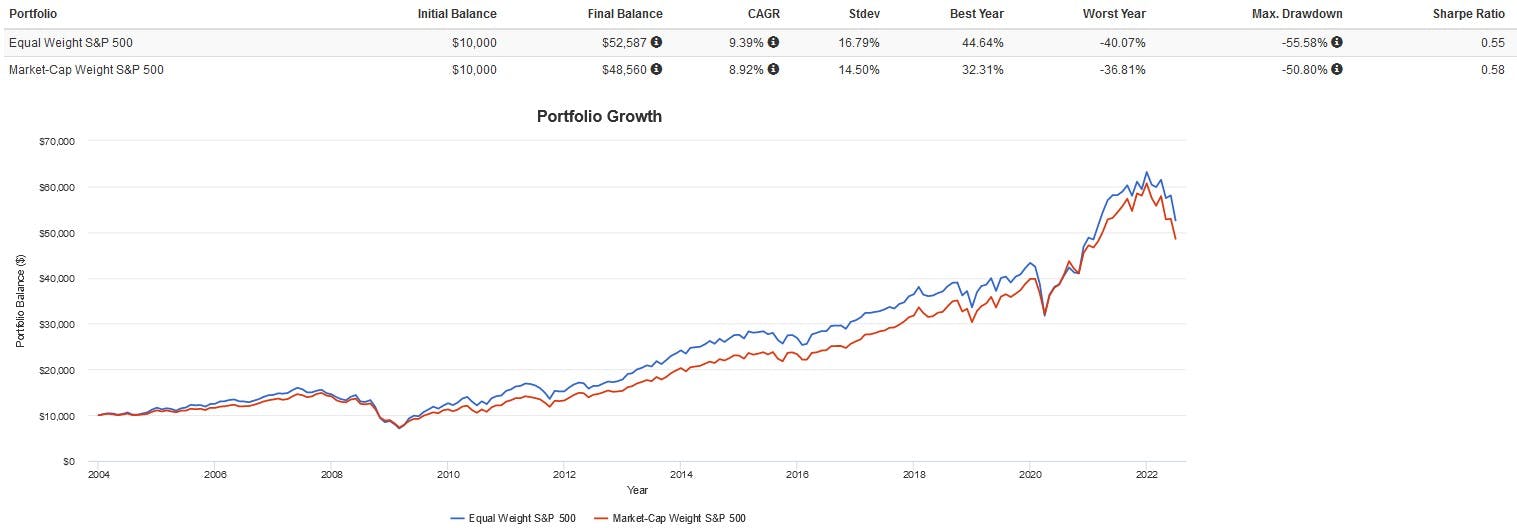
A backtest from May 2003 to present shows RSP outperforming in terms of CAGR, but with higher volatility and drawdowns, with an overall poorer Sharpe ratio.
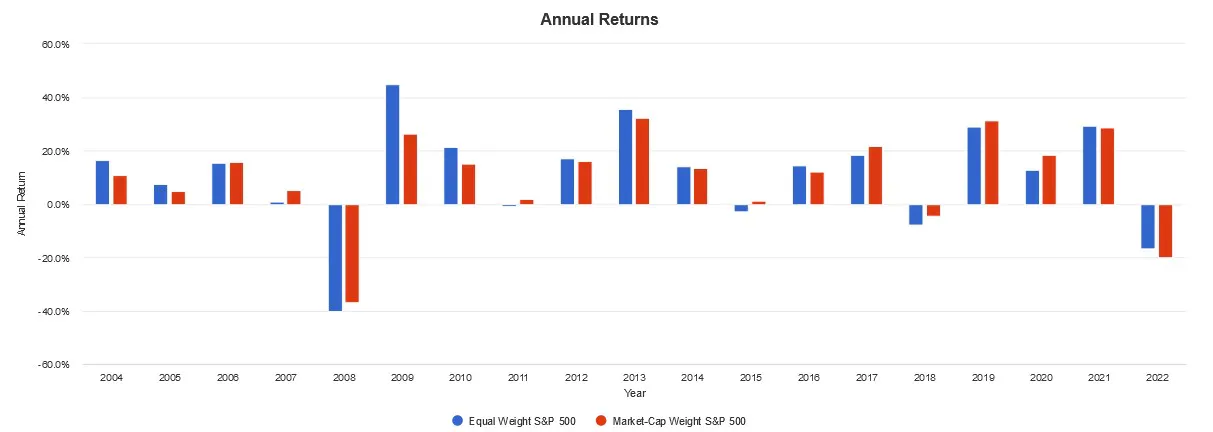
In terms of annual returns, we see notable divergences in 2009, where RSP outperforms (likely due to better mid-cap and defensive sector performance following the 2008 crash), and so far in 2022, thanks to its lower allocation to hard-hit tech stocks.
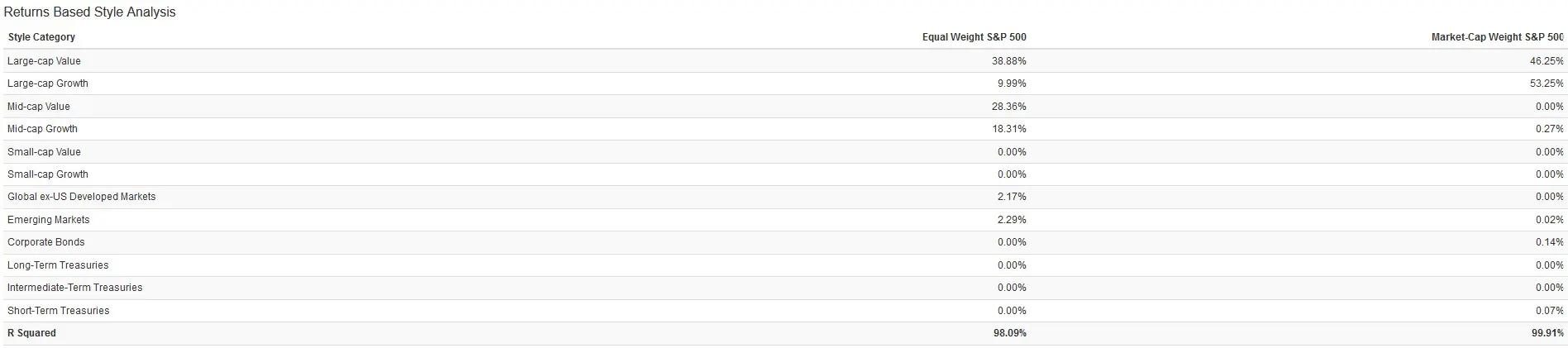
Let's look at exposures now. We see that compared to SPY, RSP has a much higher allocation to both mid-cap value and growth stocks, which can allow investors to capture additional exposure to the size risk factor. This can increase the potential for returns, albeit at higher volatility.
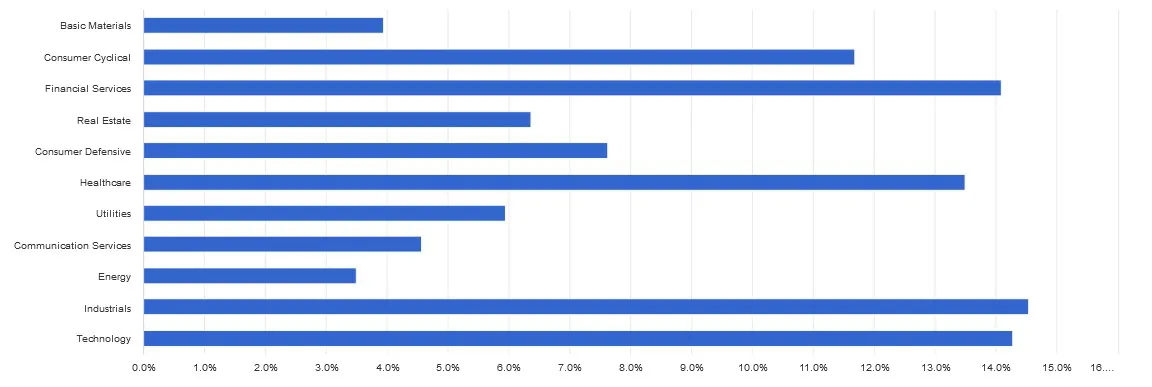
Finally, the sector allocations in RSP are much more balanced compared to SPY. We see a much more even distribution between consumer cyclical, financial services, healthcare, and industrials. Technology no longer dominates the holdings like it did in SPY.
Are equal weight index ETFs worth it?
The answer to that question depends on your thesis on whether or not the markets are efficiently priced. From a passive investor point of view, I want to invest in the market as it is at the moment. This means accepting the market-cap weights of various stocks as they rise and fall. Investors who subscribe to this approach will receive the average of the market's return (net of fees), but nothing more or less.
Investors who think the market is inefficient may want to use an equal-weighting methodology to capture the returns of sectors, market caps, or styles they think are currently undervalued and ready to resurge. Keep in mind that this is an active management approach, regardless of whether or not you use an index ETF. This requires being able to stick to it, especially during years when it underperforms a market-cap weighted fund.
Personally? I like to keep it simple. This means finding the most broadly diversified, lowest cost ETF. Market-cap weighted funds like SPY tend to be much cheaper, have better liquidity (volume, assets under management, bid-ask spread), and lower fund turnover. Still, if you want a more "even" ETF, RSP is a pretty good way of capturing that.
Latest ETF News
See all ETF newsThese Public-Private ETFs Invest in Polymarket and Anduril

There's an ETF for That? Frontier Markets

10-Year Treasury Yield Hits 5%: Which Bond ETFs Offer the Most Direct Exposure?

ETF comparison: NEOS S&P 500 High Income ETF (SPYI) Versus Goldman Sachs S&P 500 Premium Income ETF (GPIX)




 Advantages of ETFs over Mutual Funds1/6
Lower Costs
In this guide, we'll explore the advantages of ETFs over mutual funds, giving you valuable insights into why ETFs have gained significant popularity among investors like yourself.
Leveraged ETFs: Unlocking the Potential for Amplified Returns1/6
Understanding Leveraged ETFs
Explore leveraged ETFs: potential for amplified returns & risks. 5 ETFs to consider across equities, commodities & fixed income.
What is a Leveraged ETF?1/6
Introducing Leveraged and Inverse ETFs
In this guide, we'll dive into the world of leveraged ETFs, exploring their definition, mechanics, potential risks, and rewards.
Recent educational content

ETF Trends
ETF Industry KPIs September 28, 2026
This week’s KPI data overview highlights key metrics and trends shaping the ETF landscape.

ETF Trends
ETF Industry KPIs September 22, 2026
This week’s KPI data overview highlights key metrics and trends shaping the ETF landscape.
First Look ETF
First Look ETF: Income, Corporate Arbitrage, and Growth and Value Investing
First Look ETF September 2026: iCapital, Mast Investments and North Square unpack new ETFs targeting monthly income, merger arbitrage and complementary growth and value exposure.

ETF Trends
ETF Industry KPIs September 14, 2026
This week’s KPI data overview highlights key metrics and trends shaping the ETF landscape.
Browse all educational columns



Build and Analyze Your ETF Portfolio Like a Pro
Create your own ETF portfolio in minutes and instantly see allocations, exposures, performance, and risk. Visualize diversification across asset classes, regions, and sectors. Stress-test ideas, compare benchmarks, and refine your strategy with professional-grade analytics.